

The question the market is actually pricing in GBP/CHF is not whether the Bank of England raises Bank Rate on 5 November. It is whether the Swiss franc still behaves like a haven when the shock hitting Europe raises inflation instead of crushing growth. Six months of data give an answer, and it is no. Through a Middle East conflict that the Bank of England's Megan Greene described in September as having started "more than six months ago", the franc has lost ground to sterling, not gained it. The pair fixed at 1.0977 on Friday 25 September on the European Central Bank's reference rates, 5.66% above the 2026 low of 1.0389 set on 27 February and 0.50% below the 1.1032 high of 15 September. That move ran in the opposite direction to the textbook. The rest of this piece is about why, how long it can last, and what would flip it.
Here is the comparison almost nobody runs on this cross. In April 2025, when US tariffs hit global growth expectations, the same pair fell from 1.1409 on 31 March to 1.0800 on 14 April, a 5.3% slide in two weeks, on the same ECB fixing series. That was the franc doing its old job. In 2026 the shock is an inflationary one, and the arithmetic has turned against the franc. SONIA, the sterling overnight rate, printed 3.7305% on 23 September on the Bank of England database, while SARON, its Swiss counterpart, stood at minus 0.04% on 24 September according to the Swiss National Bank. That is a 377 basis point overnight gap. Subtract the 230 basis point inflation gap (UK CPI 3.1%, Swiss CPI 0.8%, both for August) and sterling still pays roughly 147 basis points a year in real terms to hold against the franc. Our EUR/CHF forecast ran the same sum for the euro and got about 14. Sterling's version is ten times larger, and that is the whole reason GBP/CHF has been the franc cross that trends.
Key facts
- GBP/CHF fixed at 1.0977 on 25 September 2026, up 5.66% from the 1.0389 low of 27 February and up 2.39% on the year — ECB euro reference rates via frankfurter.dev, retrieved 28 September 2026.
- Bank Rate is 3.75%, unchanged since 18 December 2025; the 17 September vote was 6–3 to hold, with three members voting for 4% — Bank of England, Monetary Policy Summary and minutes, 17 September 2026.
- The SNB policy rate is 0%, where it has sat since June 2025, and was left unchanged on 24 September 2026 — SNB press release, 24 September 2026.
- UK CPI inflation was 3.1% in August against 0.8% in Switzerland — ONS, 16 September 2026; Swiss Federal Statistical Office figures via the SNB data portal.
- The five-year gilt par yield rose to 4.88% on 23 September from 4.28% on 30 June, a 60 basis point climb in a quarter — Bank of England yield curve database, retrieved 28 September 2026.
- The franc fell by around 3% on a trade-weighted basis between the June and September SNB assessments — SNB introductory remarks, 24 September 2026.
- Inside the horizon: UK CPI on 21 October, the UK Budget on 28 October, MPC decisions on 5 November and 17 December, and the SNB assessment on 10 December — ONS, HM Treasury, Bank of England and SNB calendars.
Three votes for 4%, and a governor edging toward them
The sterling half of this cross has one number that matters more than any other: the vote count.
At its meeting ending 16 September, the Monetary Policy Committee held Bank Rate at 3.75% by six votes to three. Megan Greene, Catherine L Mann and Huw Pill wanted a quarter-point increase to 4%. The split was identical in July, so the hawkish bloc has not grown. What has changed is the language of the majority. The Committee's summary now says it "judges that the risks to the inflation outlook are tilted to the upside, and more so than at the time of the July Monetary Policy Report."
The governor went further in public than the minutes do. "But the longer this volatility persists, the bigger the impact it will have on inflation, and the more likely it is we will need to raise Bank Rate to ensure that inflation falls back to our 2% target," said Andrew Bailey, Governor of the Bank of England, in the bank's September decision statement. A governor who says a hike is becoming more likely, while voting with the majority to hold, is signalling which way his own vote moves next.
The dissenters' case is explicit about risk management. "Raising Bank Rate is a better risk-management strategy when faced with uncertainty about inflation dynamics and second-round effects," wrote Catherine L Mann, external member of the Monetary Policy Committee at the Bank of England, in the September minutes. She also noted that the Bank's short-term forecast has CPI "reaching somewhat over 4% early next year".
The dovish side of the majority is not dovish in the 2024 sense. Swati Dhingra, an external member who voted with the majority, argued for waiting, but her own reasoning listed that "Bank Rate remains materially higher than in peer European economies". For a GBP/CHF reader that sentence is the carry trade described from inside the MPC. Nobody on the Committee voted to cut.
The bond market has been doing some of the tightening already. The five-year gilt par yield moved from 4.28% on 30 June to 4.88% on 23 September, and the ten-year from 4.74% to 5.29% over the same window, on the Bank of England's own daily yield curve series. For comparison, the SNB's headline Confederation bond yield was 0.649% on 25 September.
Two UK dates arrive before the next MPC decision. The ONS publishes September CPI on 21 October, and the Chancellor confirmed in a letter to the Treasury Select Committee that the Budget will be held on 28 October. A CPI print above 3.1% makes a November hike close to the base case for the hawks; a Budget that spooks the gilt market would test whether higher yields still attract money into sterling or start to repel it. The MPC then meets on 5 November and 17 December.
What Schlegel said about the franc, and what the SNB is not doing
The Swiss half of the pair is quieter, and that is precisely its message. On 24 September the SNB left its policy rate at 0%, kept the 0.25 percentage point discount on sight deposits above the threshold, and repeated that it is "willing to be active in the foreign exchange market as necessary to ensure appropriate monetary conditions." Its conditional inflation forecast assumes the rate stays at 0% across the entire horizon and puts average inflation at 0.7% for 2026, 0.8% for 2027 and 0.8% for 2028.
The most useful paragraph for this cross came in the monetary policy outlook section of the news conference. "Since our last assessment, the Swiss franc has depreciated by around 3% on a trade-weighted basis. This depreciation was in line with the widening of interest rate differentials between the major currency areas and Switzerland," said Martin Schlegel, Chairman of the Governing Board at the Swiss National Bank, in his introductory remarks.
Read that as a central bank telling the market it has no quarrel with a weaker franc. The SNB also said that the depreciation is supporting growth and nudging its medium-term inflation forecast higher, and that inflation "is relatively low by international standards". Nothing in the statement suggests Zurich wants to lean against the move. If the franc started rallying hard, the intervention language is the tool it has already put on the table.
That produces an asymmetry. A weaker franc is welcome; a sharply stronger one is something the SNB has pre-announced it will resist. The policy rate cannot realistically go up while Swiss inflation sits at 0.8%, and a return below zero would need a collapse in inflation that the bank's own forecast does not show. The next assessment is on 10 December, seven days before the final MPC meeting of the year.
The Swiss side, in short, is a fixed point. The pair moves on sterling.
The tape: a year-long range and where 1.0977 sits in it
On the chart, GBP/CHF has spent twelve months building a floor in the 1.038 to 1.040 area and then climbing away from it. The two-year low of 1.0383 came on 14 November 2025, and the 2026 low of 1.0389 on 27 February almost matched it. Since that second test the pair has made a sequence of higher lows, with the rally accelerating after June as UK yields climbed.
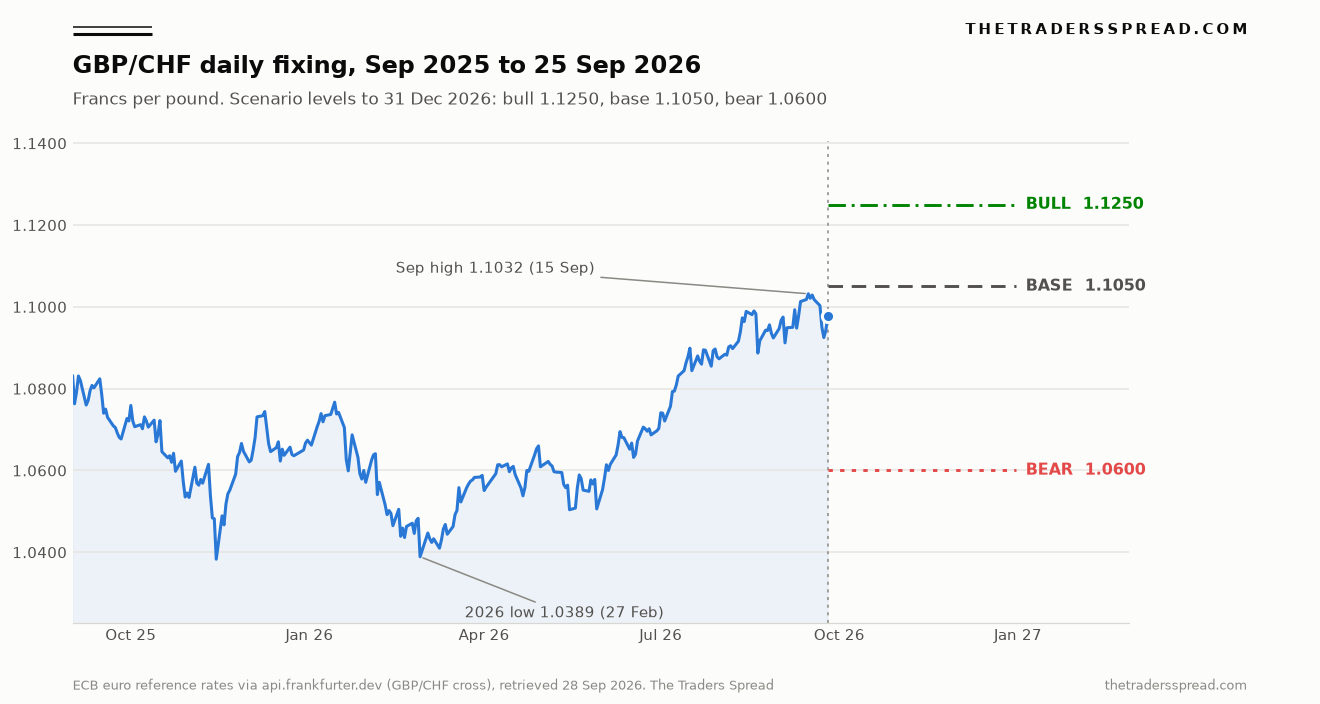
The September high of 1.1032 is the first real test. The fixing has not closed above that level since 17 June 2025, when it printed 1.1033. From the day of the MPC hold the pair eased, from 1.1029 on 17 September to 1.0925 on 23 September, then recovered to 1.0977 after the SNB decision. That dip did not break the rising sequence.
| Window | Anchor date | Anchor fixing | Change to 1.0977 |
|---|---|---|---|
| 1 month | 27 Aug 2026 | 1.0935 | +0.38% |
| 3 months | 30 Jun 2026 | 1.0703 | +2.56% |
| 6 months | 30 Mar 2026 | 1.0584 | +3.71% |
| Year to date | 31 Dec 2025 | 1.0674 | +2.84% |
| 1 year | 30 Sep 2025 | 1.0721 | +2.39% |
| 2 years | 27 Sep 2024 | 1.1303 | −2.88% |
Source for every row: ECB euro reference rates via frankfurter.dev, GBP/CHF cross computed from the EUR legs, retrieved 28 September 2026.
Volatility is low. Annualised realised volatility on the daily fixings was 4.62% over the past year and 3.91% over the past three months, on our calculation from the same series. Over the 68 or so trading days to 31 December, a one standard deviation move is about 2.4%, which frames a band of roughly 1.071 to 1.124 around Friday's fixing. The scenario levels below are set against that band.
Two data notes before anyone reproduces these numbers. The SNB publishes its own GBP/CHF fixing, and on 25 September it showed 1.0968, nine pips under the cross computed from ECB rates, because the two banks fix at different times of day. Spot also trades continuously between fixings: CNBC's quote service showed 1.0991 at 06:59 UTC on Monday 28 September. Every comparison in this article uses the ECB series throughout so that live ticks and fixings are never mixed.
April 2025 is the template for the bear case
The strongest argument against a higher GBP/CHF is the precedent from eighteen months ago, and it deserves a proper hearing.
Between 31 March and 14 April 2025 the pair dropped from 1.1409 to 1.0800. The Bank of England was cutting then, the SNB still had room to cut, and the shock was a demand shock. Money went to the franc because investors feared a recession more than inflation. The reason 2026 looks different is that the energy shock has pushed inflation up everywhere, pulled rate expectations higher and made yield more valuable than safety. The SNB itself noted that key interest rates were raised in both the euro area and the US.
That framing breaks if the energy shock turns into demand destruction. The SNB's own risk paragraph says energy prices "could turn out to be significantly higher than expected", which "would increase inflation further and significantly curb economic growth." If the second half of that sentence starts to dominate, the market will stop pricing BoE hikes and start pricing a UK slowdown. The franc would get its haven bid back and the 147 basis point real carry would look small against a fast move in spot.
There is a UK-specific version of the same risk. Ten-year gilts yielding 5.29% are only supportive for sterling while investors read them as a policy premium. If the 28 October Budget leaves the market reading them as a fiscal risk premium, higher yields and a weaker pound can arrive together, as they did in the autumn of 2022. We are not forecasting that; we are naming the channel through which the carry trade could unwind quickly.
For readers who follow the other sterling crosses, the GBP/USD forecast and the EUR/GBP forecast carry the other side of this argument, and our USD/CHF forecast sets out the franc's dollar leg.
RelatedNZD/CAD Forecast: 0.8320 Bull Case vs 0.7680 Bear Case
The call: 1.1050 base, 1.1250 bull, 1.0600 bear to 31 December 2026
Base case, 1.1050 (+0.67% from 1.0977), probability 50%. The MPC keeps its 6–3 shape in November or moves to a narrow hike by December, the SNB holds at 0% on 10 December with the intervention sentence unchanged, and energy prices stay high without breaking demand. The real carry of about 147 basis points keeps money drifting into sterling, but a test of the 1.1032 September high meets sellers who remember that the pair has not held above it since June 2025. A year-end fixing just above the old high is the most likely outcome.
Bull case, 1.1250 (+2.49%), probability 30%. September CPI prints above 3.1%, the Budget passes without a gilt scare, and the MPC raises Bank Rate to 4% on 5 November or 17 December. The overnight gap widens toward 400 basis points while the SNB, which has just told the market the franc's slide was "in line with" rate differentials, does nothing. The pair clears 1.1032, runs through the June 2025 highs near 1.113, and finishes roughly one standard deviation above Friday's fixing.
Bear case, 1.0600 (−3.43%), probability 20%. Either the energy shock tips into a demand shock, or the Budget turns gilt yields into a risk premium. Rate expectations reverse, the franc's haven role returns, and the pair gives back most of the rally since March, when it traded near 1.0584. We stop short of the 1.0389 low because the SNB's willingness to intervene limits how fast the franc can strengthen.
Probability-weighted, those scenarios put the year-end fixing near 1.1020, about 0.4% above spot. The edge is modest, which is why conviction is two out of five.
What would change my mind: a fixing below 1.0800, about 1.6% under Friday's level and a price the fixing has not seen since 8 July. That would mean the carry arithmetic is no longer steering the pair. A 5–4 or wider vote to hold in November with the hawks losing a member would do the same job from the policy side, as would any SNB statement that softens the intervention language or refers to the franc as too weak.
Frequently asked questions
What is the GBP/CHF forecast for the end of 2026?
Our base case is 1.1050 by 31 December 2026, with a bull case of 1.1250 and a bear case of 1.0600, weighted 50%, 30% and 20%. The anchor is the 25 September fixing of 1.0977, computed from ECB reference rates. The spread between Bank Rate at 3.75% and the SNB rate at 0% is the main driver, and the 5 November and 17 December MPC votes are the events most likely to move it.
Why has the Swiss franc weakened against the pound during a geopolitical crisis?
Because the crisis raised inflation instead of cutting growth expectations. That pushed UK rate expectations and gilt yields higher while the SNB stayed at 0%. The SNB said on 24 September that the franc's roughly 3% trade-weighted fall since June was in line with widening interest rate differentials. In April 2025, when the shock hit growth, the franc rallied and GBP/CHF fell 5.3% in two weeks.
Will the Bank of England raise interest rates in November 2026?
It is a live possibility, not a certainty. Three of nine members voted for 4% in both July and September, and Governor Andrew Bailey said a hike becomes more likely the longer energy volatility persists. September CPI on 21 October and the Budget on 28 October are the two releases that will shape the 5 November vote. The Bank's next decision after that is 17 December.
Is the SNB likely to intervene in the currency market?
The SNB repeats at every assessment that it is willing to intervene as necessary. With the franc weakening and inflation at 0.8%, it has no reason to add francs to the market, and its statement welcomed the supportive effect of the depreciation. Intervention would matter mainly in the bear case, if the franc strengthened sharply. That willingness is why our bear level stops above the 2026 low of 1.0389.
How volatile is GBP/CHF compared with other currency pairs?
By our calculation from ECB fixings, one-year realised volatility is 4.62% annualised and three-month volatility is 3.91%, which is low for a G10 pair. Moves of more than 2% in a quarter are unusual outside shock periods. For comparison with another franc cross that carries more beta, see our CHF/JPY forecast, and the trading glossary explains how carry drives crosses like this one.
Disclaimer
This article is analysis and information, not investment advice, and it does not take account of any individual's circumstances or objectives. Foreign exchange and contracts for difference carry a high risk of loss, and leveraged positions can lose more than the amount deposited. Scenario levels are conditional estimates with stated probabilities, not certainties. Capital is at risk. Fixings are as at 25 September 2026 unless stated otherwise.