

The European Central Bank raised its three key rates by 25 basis points on 10 September, the second increase of 2026, taking the deposit facility rate to 2.50% with effect from 16 September. The Bank of England answered a day later by doing nothing, holding Bank Rate at 3.75% on a 6–3 vote in which three members wanted 4%. Euro-area annual inflation in August was 3.2%. UK CPI in the same month was 3.1%. One central bank has hiked twice this year and has the hotter headline inflation print; the other has not moved since it cut in December and produced a minority report. EUR/GBP is at 0.8587, down 1.56% from its 2 January fix. Sterling has spent 2026 gaining ground against a currency whose carry disadvantage keeps shrinking.
The resolution sits in a number the commentary skipped. The spot policy gap is now 125 basis points, not the 175 it was in December. But the two-year gilt yields 4.7617% and the two-year German Schatz yields 3.2332%, a spread of 152.9 basis points, which is 27.9bp wider than the policy gap that actually exists. Decomposed, the UK two-year sits 101.2bp above Bank Rate while the German two-year sits 73.3bp above the deposit rate. The market is paying sterling for roughly 28 basis points more tightening than it expects from the euro area, from the one of the two central banks that has not tightened at all. The ECB has been delivering. The Bank of England has been dissenting. The curve pays the dissenter.
That is the asymmetry worth watching, and the calendar makes it testable within six weeks.
Key facts
- EUR/GBP traded 0.8587 at 07:22 UTC on 18 September 2026 on CNBC's cross-rate feed, against an ECB reference rate of 0.8583 fixed on 17 September — CNBC and ECB reference rates via Frankfurter, retrieved 18 September 2026.
- The ECB deposit facility rate rose to 2.50% effective 16 September 2026, its second 25bp increase of the year after the move to 2.25% on 17 June — Banque de France policy rates, retrieved 18 September 2026.
- The MPC held Bank Rate at 3.75% by 6–3 on 17 September; Megan Greene, Catherine L Mann and Huw Pill voted for 4% — Bank of England Monetary Policy Summary and Minutes, 17 September 2026.
- Euro-area annual HICP inflation was 3.2% in August 2026, up from 2.9% in July, with energy contributing 1.29 percentage points — Eurostat euro indicators, 17 September 2026. UK CPI was 3.1% — ONS series D7G7, retrieved 18 September 2026.
- The two-year gilt–Schatz spread was 152.9bp and the ten-year spread 175.1bp at 07:28 UTC on 18 September 2026, against a 125bp spot policy gap — CNBC bond quotes.
- Sixty-day realised volatility on EUR/GBP is 2.43% annualised, the lowest of ten liquid crosses measured on the same daily series.
- The MPC voted unanimously to unwind its gilt portfolio to zero at an annual average pace of £46bn to the end of 2034, including £20bn of yearly sales, from £488bn today — BoE Minutes, 17 September 2026.
The 28 basis points sterling has not earned
Currency crosses respond to the forward path of a rate differential, not to where the two policy rates currently sit. A two-year government yield approximates the average expected policy rate over that window plus a term premium, so the difference between two of them is the cleanest available read on what the market thinks a differential will do.
Run that on 18 September and the picture is not the one the headlines implied. Bank Rate at 3.75% against a deposit rate of 2.50% gives a 125bp gap. The two-year spread is 152.9bp. The extra 27.9 basis points is the market's judgement that the Bank of England will out-tighten the ECB over the next two years, in a year when the ECB has raised rates twice and the Bank of England has raised them zero times.
Both curves price tightening, which is what an energy shock common to both blocs should produce. The MPC minutes say so plainly: UK financial conditions had tightened on higher overnight index swap rates and "there had been similar moves in these rates in the United States and in the euro area", co-movement the Committee attributes to "the global nature of the energy supply shock and its implications for inflation". A shock shared by two economies does not, by itself, move the exchange rate between them.
What can move it is delivery. The gap between 101bp and 73bp is a bet on which committee converts rhetoric into a decision first, and the ECB's next meeting is 29 October while the Bank of England's is 5 November. The order matters more than usual this year, because the institution with the earlier meeting is also the one with a demonstrated willingness to move.
This is what separates EUR/GBP from the euro's other crosses. EUR/USD and GBP/USD carry a dollar leg running its own reaction function. Here, two central banks are reading one shock off the same futures curves, and the only genuine variable is which one acts.
One bank moved, the other dissented
The ECB's statement was not hedged. "The Governing Council today decided to raise the three key ECB interest rates by 25 basis points," it opens, and then: "The conflict in the Middle East continues to generate inflation pressures, and inflation is set to remain well above target for an extended period." Staff now see euro-area headline inflation averaging 3.0% in 2026, 2.5% in 2027 and 2.1% in 2028, with the 2027 and 2028 baselines revised up since June. Growth was revised up too, to 0.9% this year and 1.4% next, "mainly reflecting the greater than expected resilience of the euro area economy". The Council closed by saying it "is not pre-committing to a particular rate path", which after a hike reads as an open door rather than a closed one.
The Bank of England's hold was hawkish in tone and empty in effect. Six members — Andrew Bailey, Sarah Breeden, Swati Dhingra, Clare Lombardelli, Dave Ramsden and Alan Taylor — kept Bank Rate at 3.75%, and the minutes record that two of those six rested on slack and restrained cost pass-through rather than on any view that inflation risk had faded. The three who wanted 4% argued the coming inflation peak arrives in early 2027 "just as wage settlements were agreed", and that the slack which normally absorbs second-round effects "appeared to have peaked already given stronger GDP growth and indications of an expansion in employment".
They have a case. Bank staff put UK CPI near 3.75% in the fourth quarter and slightly above 4% in the first quarter of 2027, a higher and later peak than the euro area faces. Services inflation was 3.4% in August, unchanged from July. GDP grew 0.4% in the second quarter and staff now see 0.4% in the third against the 0.1% assumed in July. Unemployment was 4.9% in the three months to July, and underlying private-sector wage growth is judged to be running near 3.5%.
None of which changed a rate.
The Committee did change the balance sheet. It voted unanimously to reduce the gilt stock held for monetary policy purposes to zero through a multi-year plan averaging £46bn a year to the end of 2034, of which £20bn is outright sales. The portfolio is already down from a £895bn peak in February 2022 to £488bn. No other G7 central bank has published a fixed terminal path to zero, and the pace can now only be altered under a deliberately high bar.
Euro-area inflation has overtaken the UK's
This is the fact that reframes the cross, and it arrived the day before the MPC met. Eurostat put euro-area annual inflation at 3.2% in August, up from 2.9% in July and from 2.0% a year earlier. UK CPI was 3.1%. For most of the past three years the comparison ran the other way by a wide margin.
The composition differs in a way that cuts both directions. Euro-area energy prices rose 14.3% year on year in August and contributed 1.29 percentage points of the 3.2% headline, while euro-area core inflation excluding energy, food, alcohol and tobacco was 2.4%, inside the 2.2–2.5 band it has held all year. The euro-area problem is almost entirely imported. The UK's overshoot is smaller but stickier underneath: around 0.7 of the 1.1-point gap to target came from energy, yet services inflation at 3.4% sits well above the euro area's 3.0%.
That argues the Bank of England has the more persistent inflation problem and should therefore be the more hawkish central bank. It is also exactly what the curve has already assumed, and it did not stop the ECB moving first twice. UK households additionally face a scheduled, published increase in energy bills: Ofgem's headline cap for October to December rises to £1,723, higher than the Bank expected in July, and the minutes say it is expected to rise substantially further in the first quarter of 2027. The same wholesale dynamics that set natural gas pricing reach the UK retail cap with roughly two quarters of lag.
Where the pair has traded, and how quietly
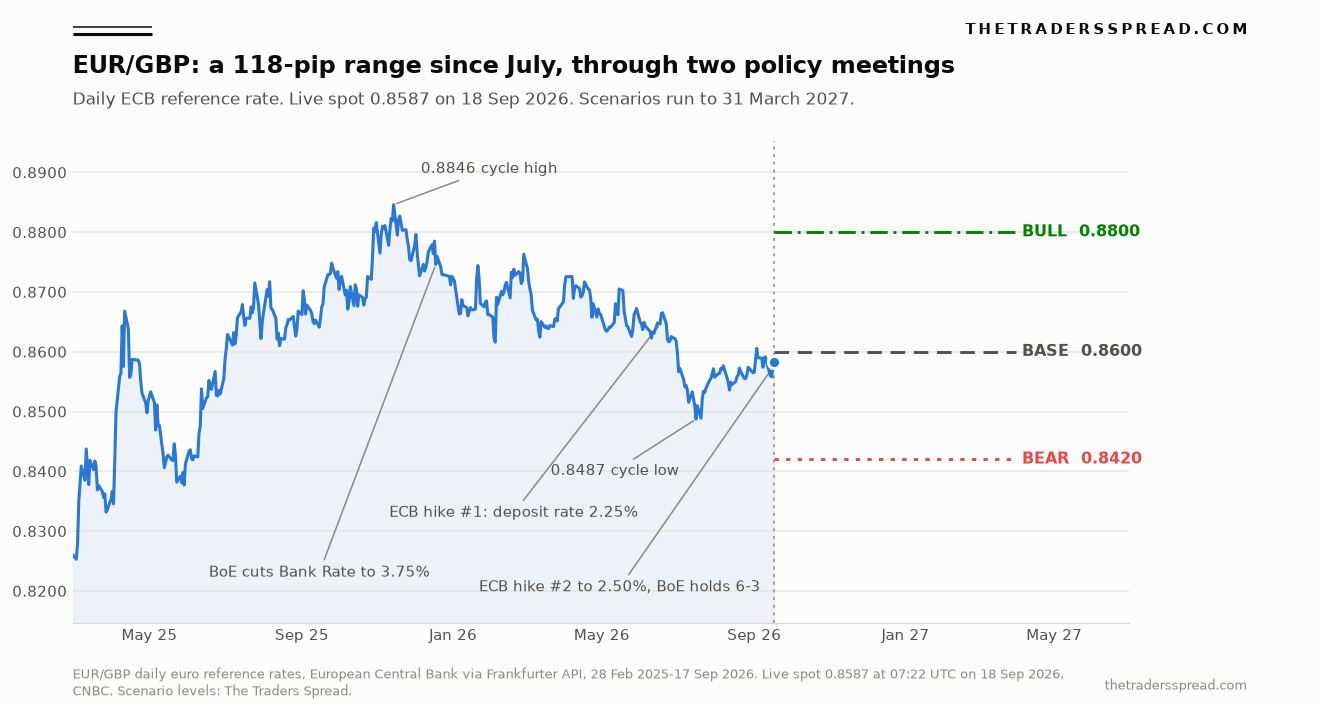
EUR/GBP peaked at 0.8846 on 14 November 2025 and bottomed at 0.84873 on 16 July 2026. Since 1 July the entire range across 57 ECB fixings has been 118 pips. The pair is down 1.56% from its 2 January fix of 0.8719 and down 1.12% on the year. It barely reacted to either policy event: the fix moved from 0.85915 on 10 September, the day the ECB hiked, to 0.85815 the next day, then to 0.8583 on the day the Bank of England held.
The calm is measurable. Annualising the standard deviation of daily log returns on the ECB reference series from 28 February 2025 to 17 September 2026, retrieved 18 September 2026, gives the following.
| Pair | 60-day realised volatility (annualised) | 252-day realised volatility | Rate, 17 Sep 2026 |
|---|---|---|---|
| EUR/GBP | 2.43% | 3.32% | 0.8583 |
| EUR/CHF | 3.05% | 3.27% | 0.9466 |
| EUR/SEK | 3.57% | 5.30% | 11.2715 |
| EUR/USD | 4.13% | 5.38% | 1.1481 |
| USD/CAD | 4.37% | 4.31% | 1.3995 |
| GBP/USD | 4.59% | 6.09% | 1.3376 |
| EUR/NOK | 4.91% | 6.10% | 10.8250 |
| AUD/USD | 5.29% | 7.77% | 0.7114 |
| GBP/JPY | 8.05% | 7.47% | 208.2605 |
| USD/JPY | 8.77% | 8.04% | 155.6920 |
EUR/GBP is the quietest of the ten, and its 60-day reading sits below its own one-year reading, meaning the calm deepened through a period in which one of its two central banks hiked twice and the other grew three dissenters. At 2.43% annualised, a one-standard-deviation move over six and a half months is about 1.8%. That single number disciplines every forecast written about this cross, this one included.
What consensus is getting wrong
The reading after Thursday was that a hawkish MPC gives sterling carry and a hiking bias, so EUR/GBP grinds toward and through the July low. The rate market has already bought that: 101 basis points of UK tightening sit in the two-year gilt. Positioning for Bank of England hikes means paying for something the curve owns.
The second miss is the shape of the six-member majority. Dhingra and Taylor held on timing, not direction. A majority built on a timing disagreement makes November live, which is why the 101bp is defensible rather than excessive. It also means the November meeting is close to a binary, and the ECB gets its answer in first on 29 October.
The third is the long end. At 175.1bp, the ten-year gilt–Bund spread is 22 points wider than the two-year spread, and it widened into the announcement of a permanent gilt supply schedule. The Committee's own estimate is that quantitative tightening explains only 20–30bp of the roughly 200bp rise in UK term premia since February 2022, which is the point: the rest is fiscal and structural. Sterling has been a poor performer when UK long yields rise for term-premium reasons rather than policy ones. The same question sits under the FTSE 100, whose overseas earnings base makes it a partial hedge against exactly this.
RelatedUSD/CNH Forecast: 6.86 Bull Case vs 6.56 Bear Case by Year-End
The call to 31 March 2027
Spot is 0.8587. The base case is that EUR/GBP finishes the first quarter of 2027 between 0.8480 and 0.8660, because the two-year differential has no room to widen much further without a Bank of England delivery it has so far withheld, and no room to compress much without the ECB stopping. I put 45% on that.
The upside case for the pair, at 0.8800, needs the ECB to keep out-delivering: a 29 October move that the Bank of England does not match on 5 November, or a euro-area inflation path that stays above the UK's while UK activity finally yields to mortgage pass-through. It would unwind the 28bp premium the curve currently pays sterling. The pair last traded there on 24 November 2025. That is a 2.48% move, roughly 1.40 standard deviations at current realised volatility, which a random walk would deliver about 8% of the time; I carry the above-0.8660 zone at 32% and the 0.8800 level itself at 12%, because the ECB has the earlier meeting and the better record of using it.
The downside case, at 0.8420, requires the Bank of England to actually hike on 5 November and for that to read as the start of a sequence rather than insurance. It takes the pair through the 16 July low of 0.84873 to a level last seen on 5 June 2025. That is a 1.94% move, about 1.10 standard deviations, roughly 14% on the same arithmetic. I hold the below-0.8480 zone at 23%, below the random-walk reading, because the curve has already paid for most of what a November hike would confirm.
What would change my mind, fastest first: the two-year gilt–Schatz spread breaking decisively outside 140–165bp, which is the mechanical precondition for any trend here; a 29 October ECB hold accompanied by language that closes the door, which would hand the premium back to sterling; a 5 November vote splitting 5–4 in either direction, meaning the Committee has stopped agreeing about the shock rather than its timing; euro-area core inflation breaking out of the 2.2–2.5 band it has held all year; or 60-day realised volatility clearing 4%, which would say the market has found a disagreement the past three months lacked. A Middle East de-escalation compresses both legs at once and is not by itself directional for this pair.
For contrast, EUR/HUF runs on a rate gap that is still moving rather than settled.
FAQ
Why did EUR/GBP barely move after the ECB hike and the Bank of England hold?
Both were priced. The two-year gilt already sits 101bp above Bank Rate and the two-year Schatz 73bp above the deposit rate, so a confirmed ECB move and a confirmed UK vote split added no new information to the forward differential. The ECB reference rate went from 0.85915 on 10 September to 0.8583 on 17 September, a net move of under a pip a day.
What is the current EUR/GBP rate and the ECB deposit rate?
CNBC's cross-rate feed showed EUR/GBP at 0.8587 at 07:22 UTC on 18 September 2026; the ECB's daily euro reference rate was 0.8583 on 17 September. The ECB deposit facility rate has been 2.50% since 16 September 2026, with the main refinancing rate at 2.65% and the marginal lending rate at 2.90%.
When are the next ECB and Bank of England decisions?
The ECB Governing Council decides on 29 October 2026, per the Banque de France policy rates page. The Bank of England's Monetary Policy Committee follows on 5 November 2026, as stated on its own Bank Rate page. The ordering matters: the euro leg gets the first chance to confirm or deny the tightening the curve has priced.
Is euro-area inflation really higher than the UK's?
On the headline measure for August 2026, yes: 3.2% for the euro area against 3.1% for the UK. The composition differs. Euro-area energy prices rose 14.3% year on year and core inflation held at 2.4%, while UK services inflation ran at 3.4%. The euro area has the larger imported shock; the UK has the stickier domestic component.
How volatile is EUR/GBP compared with other major pairs?
Sixty-day realised volatility computed from ECB reference rates to 17 September 2026 was 2.43% annualised, the lowest of ten liquid crosses tested and roughly a quarter of USD/JPY's 8.77%. A one-standard-deviation move over six months at that level is about 1.8%, which is why credible forecast ranges on this cross are narrow relative to almost anything else in currencies.
This article is analysis, not investment advice. It describes price levels, rate differentials and implied probabilities, and it names no position. Currency and CFD trading carries a high risk of loss, including losses greater than the amount deposited on margin accounts. Figures cited were retrieved on 18 September 2026 and market prices change continuously.