

The question the market is actually pricing in EUR/CHF is not whether the Swiss National Bank turns its policy rate negative again on Thursday. It is narrower and far more mechanical: how much of the euro area's inflation problem the Swiss franc has to absorb before the interest rate the euro pays stops covering the bill. On 18 September the pair settled at 0.9462 on the European Central Bank's daily reference fixing, with the SNB's own fix half a pip higher at 0.9467. That is 5.0% above the 0.9008 low struck on 9 March, 1.79% above where 2026 opened, and 1.40% above the level of a year ago. Twelve months of a hiking ECB, a bond spread that has blown out to almost three percentage points and a Swiss policy rate pinned at zero have between them bought the euro less than a rappen and a half.
Here is the arithmetic almost nobody runs on this pair, and it explains the paralysis better than any chart pattern. The ECB's deposit facility rate stands at 2.50% following the increase effective 16 September. The SNB policy rate is 0.00%, and SARON, the rate at which Swiss francs actually change hands overnight, printed minus 0.04% on 17 September. The euro's overnight rate advantage is therefore about 254 basis points a year. Set against it: Swiss consumer prices rose 0.8% in the year to August while euro-area HICP ran at 3.2%, a 240 basis point gap that relative purchasing power parity says the franc claws back in spot over time. Net expected drift, on those two numbers alone, is roughly fourteen basis points a year. Nobody can trade fourteen basis points. It is, though, a very good account of why three-month realised volatility on EUR/CHF is running at 3.12% annualised, among the lowest of any liquid G10 pair.
Key facts
- EUR/CHF closed at 0.9462 on 18 September 2026, up 5.0% from the 0.9008 cycle low of 9 March — daily ECB euro reference rates via frankfurter.dev, retrieved 20 September 2026.
- SNB policy rate 0.00%; SARON −0.04% (17 Sep 2026); Confederation bond yield 0.581% (18 Sep 2026) — Swiss National Bank, current interest rates and exchange rates.
- Sight deposits above the threshold are remunerated at the policy rate minus 0.25 percentage points, and the threshold factor was cut from 15 to 13.5 effective 1 August 2026 — SNB press releases, 18 and 22 June 2026.
- Swiss CPI was +0.8% year on year in August 2026 at 101.5 points (December 2025 = 100), against euro-area HICP of 3.2% — Federal Statistical Office, 3 September 2026.
- SNB foreign currency investments rose from CHF 738.9bn in May 2026 to CHF 802.5bn in July, a jump of 8.6% — SNB data portal balance sheet items, published 31 August 2026.
- The ten-year Bund yielded 3.55% on 18 September 2026 against 2.75% a year earlier — Deutsche Bundesbank daily term structure.
- The SNB's next monetary policy assessment is 24 September 2026 at 09:30 CET, with the Q2 balance of payments, which carries its intervention figure, out two days earlier — SNB time schedule.
The rate stayed at zero. The plumbing did not.
On 18 June the SNB left its policy rate unchanged at 0%. That is the sentence that travelled. Four days later the bank published a second release that almost nobody picked up, and it is the one that changed Swiss money-market conditions.
Swiss banks hold sight deposits at the SNB. Up to a threshold, those balances earn the policy rate. Above it, they earn the policy rate minus a discount, and that discount has been 0.25 percentage points throughout 2026. The threshold itself is not a fixed franc amount. It is a three-year moving average of each bank's minimum reserve requirement multiplied by a factor the SNB sets. On 22 June the SNB cut that factor from 15 to 13.5, effective 1 August, the second factor adjustment of 2026 after one in March.
Shrink the factor and you shrink the bucket of balances that earn zero. Everything displaced above the line earns minus 0.25%. The SNB's own framing is that the change "counteracts the increase in thresholds due to the raising of the minimum reserve requirement as of 1 July 2024, thereby ensuring that the implementation of monetary policy remains effective and supporting an active money market", and that it "has no impact on the current monetary policy stance". Both are defensible. Neither changes the observable result: with the headline policy rate at zero, the marginal Swiss overnight rate has settled below it.
The Governing Board's own minutes support the reading. The summary of the June discussion, published on 16 July, records that "various measures of inflation expectations point to real interest rates in Switzerland currently being negative and below the long-term equilibrium real interest rate", and that excess liquidity has increased over the past year. Switzerland is already running a mildly negative marginal rate. It has simply not had to announce one, which spares the Governing Board the political cost that the 2015 to 2022 experiment carried. For anyone modelling the bear case in EUR/CHF, that matters: the SNB holds a tightening-by-plumbing lever that works in the other direction too, and it can pull it on a Monday without a press conference.
Two forces that cancel
Currency pairs move when one of the forces acting on them gets materially stronger than the other. In EUR/CHF the two dominant forces have grown in near-lockstep, and in opposite directions.
The first is carry, and it has been widening all year. The ECB has raised rates twice in 2026, the second time effective 16 September, taking the deposit facility to 2.50%, with the main refinancing rate at 2.65% and the marginal lending facility at 2.90%. The bond market has gone further than the policy rate: the ten-year Bund yielded 3.55% on 18 September against 3.02% on 18 June and 2.75% a year ago, on Bundesbank's daily term structure. The Confederation's ten-year was 0.581% on the same Friday. That is a spread of 297 basis points on paper that used to be quoted inside 200. Martin Schlegel, Chairman of the SNB Governing Board, described the consequence at the June news conference in the flattest possible terms: "As the interest rate differentials with other countries have widened, the Swiss franc has depreciated somewhat."
"Somewhat" is carrying an enormous amount of weight in that sentence. Three hundred basis points of spread, purchased over roughly a year, produced a 1.40% move in spot.
The second force is the inflation gap, and it is the reason. Swiss consumer prices rose 0.4% in August alone and 0.8% over the year, reaching 101.5 points on the December 2025 base, according to the Federal Statistical Office release of 3 September. Euro-area HICP in the same month was 3.2%. A currency whose purchasing power erodes 240 basis points a year more slowly than its counterparty's does not stay still in nominal terms. The EUR/CHF spot record bears this out with unusual obedience: since the start of 2016 the pair has drifted lower at a compound 1.26% a year, through negative Swiss rates, positive Swiss rates, a pandemic, an energy shock and a banking failure.
Put the two side by side and the fourteen basis points of net drift is what remains. This is also why the pair behaves nothing like EUR/USD, where the carry and inflation vectors have been pointing the same way for most of the year, or like EUR/GBP, where two central banks with similar inflation problems have simply disagreed about the response.
What the price and the spread look like now
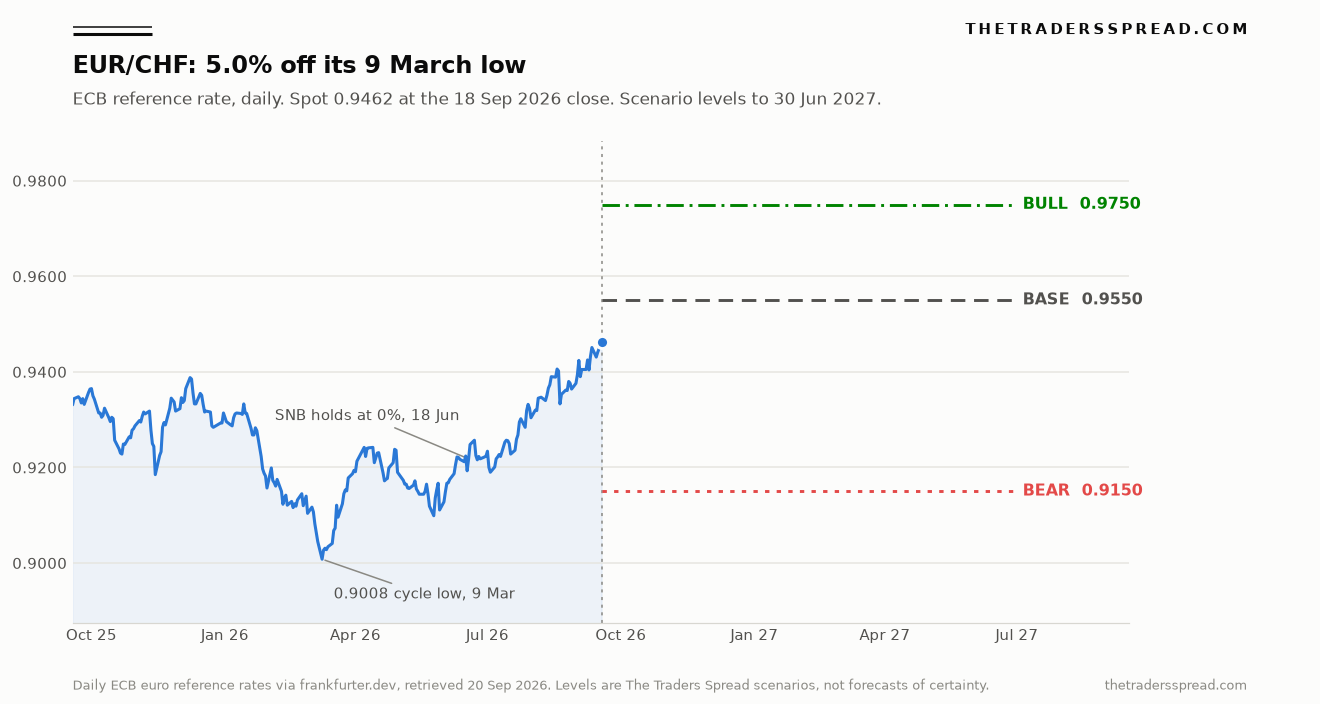
The twelve-month picture divides cleanly into three phases. From late September 2025 to mid-February the pair chopped between 0.9121 and 0.9388 with no direction. From mid-February to 9 March it fell hard, to 0.9008, as the Middle East escalation pulled the safe-haven bid back in. From 9 March it has recovered almost without interruption, and the last four weeks alone have added 0.60% from the 18 August print of 0.9406. The recovery has been steady rather than violent, which is what a carry-driven grind looks like when the valuation anchor pulls the other way.
Here is the relevant comparison, as of Friday's close.
| Measure | Switzerland | Euro area | Gap |
|---|---|---|---|
| Policy rate | 0.00% (SNB policy rate) | 2.50% (ECB deposit facility, effective 16 Sep) | 250bp |
| Overnight market rate | −0.04% (SARON, 17 Sep) | Deposit facility floor | 254bp |
| Ten-year government yield | 0.581% (18 Sep) | 3.55% (Bund, 18 Sep) | 297bp |
| Headline inflation, August | +0.8% (CPI) | +3.2% (HICP) | 240bp |
| Next scheduled decision | 24 September 2026 | 29 October 2026 | — |
Every row in that table has widened in the euro's favour over the past twelve months except the last one. Spot has moved 1.40%. That is the anomaly the rest of this piece is about.
March, and what an intervention floor actually looks like
Schlegel was unusually specific in June about when the SNB changed posture. "We therefore increased our willingness to intervene in the foreign exchange market at the beginning of March," he said, explaining that upward pressure on the franc had intensified with the Middle East escalation and that the franc was being sought as a safe haven. The cycle low in EUR/CHF is dated 9 March 2026. Since that week the pair has closed below 0.9100 exactly once, at 0.9099 on 25 May.
Whether that is a floor or a coincidence depends on a number the SNB has not yet published. The bank's monthly balance sheet, on its data portal, shows foreign currency investments at CHF 738.9bn at the end of May, CHF 786.1bn at the end of June and CHF 802.5bn at the end of July, the most recent month available. That is a rise of CHF 63.6bn, or 8.6%, in two months, and it took total SNB assets from CHF 876.1bn to CHF 930.0bn.
It would be lazy to call all of that intervention, and wrong. Reserves are reported in francs, so a weaker franc inflates them mechanically. Over the same two months EUR/CHF rose 2.12% and USD/CHF rose 3.53%. Applying those to the whole book gives a translation effect somewhere between CHF 16bn and CHF 26bn depending on the currency mix. Bond and equity gains on the portfolio account for more. What is left over, somewhere in the region of CHF 38bn to CHF 48bn before asset-price effects, is the space in which actual franc sales could sit. It is a wide band, and an honest one.
Two details narrow it slightly. Sight deposits of domestic banks fell over the same window, from CHF 429.1bn in May to CHF 420.9bn in July, which is not the signature of unsterilised large-scale purchases. And the precise figure lands imminently: the Swiss balance of payments for the second quarter, which carries the SNB's own intervention disclosure, is scheduled for 09:00 on 22 September, two days before the policy decision. Anyone treating 0.9100 as a defended level is making a bet that will be partly settled by a statistical release on a Tuesday morning.
Where this view breaks
The base case below assumes both that the ECB keeps grinding and that Swiss inflation stays inside the 0% to 2% band the SNB equates with price stability. Four things would break it.
Energy is the first and largest. The June discussion summary records oil futures around USD 80 a barrel and the Governing Board debating scenarios for the reopening of the Strait of Hormuz, with freight companies split on the timetable. A renewed closure pulls the safe-haven bid back into the franc within days, and the March episode showed that when it comes the SNB slows the move rather than stopping it. Petra Tschudin, Member of the Governing Board, put the risk plainly in June: "The upward pressure on the Swiss franc could also increase again." That path leads through 0.9200 and toward the bear level quickly. It is also the path on which the SNB's willingness to intervene is tested rather than described.
Second, the ECB could simply stop. Euro-area HICP at 3.2% is high enough to keep the Governing Council uncomfortable, but a single soft print before 29 October would take the third hike off the table, and with it most of the carry expansion the bull case needs. Third, the SNB could cut to minus 0.25% on Thursday, which markets were not expecting in June and which would widen the differential by a further quarter point in the euro's favour: a bull-case outcome, not a bear-case one. Fourth, and least discussed, Swiss inflation could keep rising. It has gone from 0.1% in February to 0.6% in May to 0.8% in August. Another 60 basis points and the PPP drag on this pair halves.
The call: 0.9550 base, 0.9750 bull, 0.9150 bear to 30 June 2027
Base case, 45% probability: 0.9550 by 30 June 2027, 0.93% above Friday's close. The carry advantage marginally exceeds the inflation drag, the ECB delivers at most one more increase, the SNB holds at zero and manages the franc through the sight-deposit tier rather than the headline rate, and the pair keeps grinding at a realised volatility near 3%. Nine months of drift at that pace is worth under a hundred pips, and that is the honest centre of this distribution.
RelatedEUR/AUD Forecast: 1.68 Bull Case vs 1.54 Bear Case
Bull case, 30% probability: 0.9750, 3.04% above spot and roughly 1.1 standard deviations on current realised volatility. This needs the ECB to hike again on 29 October and signal more, Hormuz to normalise, and euro-area growth to firm enough that the safe-haven bid drains out of the franc. An SNB cut to minus 0.25% on Thursday would add to it. Above 0.9641, the 14 March 2025 print that remains its best level in eighteen months, the pair has no reference points until the low 0.98s.
Bear case, 25% probability: 0.9150, 3.30% below spot. This is the geopolitical path. It requires no change in relative monetary policy at all, only a return of the risk premium that took the pair to 0.9008 in March. The level sits above that low deliberately, because the SNB's demonstrated behaviour in the first quarter argues the descent gets slower below 0.9200, not faster.
What would change my mind: a Q2 intervention figure on 22 September materially above CHF 20bn would tell me the March floor was real and expensive, which raises the base case and compresses the bear. A figure near zero would mean the 5% recovery since March was pure carry and rate differentials, which makes the whole structure far more fragile to an ECB pause. The second number I am watching is the September CPI print in early October. Swiss inflation above 1.0% would start to close the PPP gap that has been the euro's handicap all year.
Frequently asked questions
Why is EUR/CHF so quiet when the rate gap is so wide?
Because the carry and the inflation differential are almost the same size and point in opposite directions. The euro pays about 254 basis points a year more than the franc overnight, while Swiss prices rise about 240 basis points a year more slowly than euro-area prices. The residual drift is tiny, and three-month realised volatility of 3.12% annualised reflects it.
Has the SNB gone back to negative interest rates?
Not at the headline level. The policy rate has been 0.00% all year. But sight deposits above each bank's threshold are remunerated at the policy rate minus 0.25 percentage points, and the SNB cut the threshold factor from 15 to 13.5 effective 1 August 2026, pushing more balances into that tier. SARON printed minus 0.04% on 17 September.
What happens at the SNB meeting on 24 September?
The press release lands at 09:30 CET, followed by the Governing Board news conference at 10:00 and a fresh conditional inflation forecast. The June forecast assumed a 0% policy rate throughout and put average annual inflation at 0.6% for 2026, 0.6% for 2027 and 0.7% for 2028. Any revision upward reduces the case for further easing.
Is the SNB intervening to hold EUR/CHF up?
The SNB says it has an increased willingness to intervene, a posture it adopted at the beginning of March 2026. Its foreign currency investments rose CHF 63.6bn between May and July, though currency translation and asset-price gains explain a large share of that. The actual intervention figure for the second quarter is published with the balance of payments on 22 September.
How does the franc's strength compare against the dollar?
USD/CHF fixed at 0.82565 on 18 September, with the SNB's own fix at 0.8246. The dollar leg has its own driver in the 16 September FOMC increase to 3.75–4.00%, and the two franc crosses have diverged this year. Our separate work on that pair is in the USD/CHF forecast.
Where can I check these Swiss numbers myself?
The SNB publishes its policy rate, SARON and daily fixes on its current interest rates and exchange rates page, and its balance sheet on the data portal. Swiss CPI comes from the Federal Statistical Office. Swiss banks including Swissquote quote the pair through the trading week, and a primer on the mechanics sits in our trading glossary.
Disclaimer
This article is analysis and information, not investment advice, and it does not take account of any individual's circumstances or objectives. Foreign exchange and contracts for difference carry a high risk of loss, and leveraged positions can lose more than the amount deposited. Scenario levels are conditional estimates, not predictions of certainty. Capital is at risk. Prices quoted are as at the close of 18 September 2026 unless stated otherwise.