

At 10:00 on the last working day of August, a four-paragraph notice went up on the Norges Bank website with no chart attached and no press conference behind it. It said that in September 2026 the bank's daily net foreign exchange transactions would amount to a purchase of NOK 176 million. One word had changed from the month before. In August the same notice had said "sales". Behind that single word sits a swing of NOK 650 million a day in the amount of krone hitting the market from Norway's own central bank, and it arrived in the same fortnight that EUR/NOK printed 10.6975, its lowest reading since January 2023. The pair closed the week at 10.8095 on the European Central Bank's 18 September reference fixing. FX spot is shut until Sunday evening, so that fixing is the last honest number on the board, and it describes a krone that has spent nine months getting stronger while the machinery underneath it quietly reversed.
Here is what the monthly notice actually encodes, and why almost nobody trades it. Norway's government collects petroleum tax in krone and petroleum revenue in dollars, and Norges Bank converts whichever side is short. When oil is cheap, krone tax receipts fall below the non-oil budget deficit, so the bank sells foreign currency and buys krone. When oil is expensive, krone receipts overshoot the deficit, the surplus has to be moved into the Government Pension Fund Global, and the bank buys foreign currency instead. Brent went from $102.24 on 4 September to $130.80 on 15 September. That rally, which every screen reads as krone-positive through the terms of trade, is the same rally that turned Norway's central bank into a structural seller of its own currency. The government leg went from minus NOK 350 million a day in August to plus NOK 300 million in September, the first positive month of 2026.
Key facts
- EUR/NOK 10.8095 at the ECB reference fixing on 18 September 2026, down 8.38% from 11.7985 on 2 January and 9.81% from the 11.9858 peak of 17 December 2025 — ECB reference rates via frankfurter.dev, retrieved 19 September 2026
- Norges Bank's September 2026 operation is a net purchase of foreign exchange of NOK 176 million a day: NOK 300 million bought on the government's behalf, NOK 124 million sold to fund the dividend and interest transfer — Norges Bank press release, 31 August 2026
- The government leg by month in 2026, in NOK million per day: −650, −600, −600, −50, −100, −100, −400, −350, then +300 in September — Norges Bank statistics, retrieved 19 September 2026
- Policy rate 4.25%, unchanged on 12 August, against a euro-area deposit facility rate of 2.50% from 16 September: a 175 basis point cushion — Norges Bank, 13 August 2026
- Norwegian CPI re-accelerated to 3.3% in August from 3.0% in July, and CPI-ATE to 3.0% from 2.7% — Statistics Norway, published 10 September 2026
- Brent spot $130.80 on 15 September 2026, against a September average of $109.78 and an August average of $91.08 — US Energy Information Administration daily series, retrieved 19 September 2026
- Monetary Policy Report 3/26 and the next rate decision land together on 24 September 2026; the June path had the policy rate just above 4.5% at end-2026
How a tax receipt becomes a krone trade
The petroleum fund mechanism is one of the few genuinely mechanical flows in developed-market foreign exchange, and it is published a month in advance. Every krone of it is announced, dated and unconditional.
Norway's government receives two streams from the petroleum sector. Oil taxes and the Equinor dividend arrive in krone. Revenue from the State's Direct Financial Interest, the government's own stakes in producing fields, arrives in foreign currency, as does the return on the Government Pension Fund Global. The fiscal rule caps annual spending at the expected real return on the fund, estimated at 3 percent, and everything else is saved abroad. Norges Bank is contracted by the Ministry of Finance to square the difference, and it smooths the resulting transactions evenly across the trading days of each month so that the market can see them coming.
The arithmetic runs the wrong way round from intuition. A higher oil price lifts the krone-denominated tax take faster than it lifts the non-oil deficit, so the krone surplus grows, and that surplus must be converted into foreign currency before it can be transferred into the fund. High oil prices therefore generate central bank krone selling. Low oil prices generate central bank krone buying. The 2026 series shows the turn in detail: NOK 650 million a day of krone buying in January, when Brent averaged in the sixties and seventies, shrinking to NOK 50 million by April, rebuilding to NOK 400 million in July, then flipping outright in September once the oil market moved.
The second leg is smaller and fixed. In December 2025 the Executive Board decided to fund the transfer of dividends and interest for the 2025 financial year by buying krone, NOK 29.4 billion spread evenly over the trading days between March 2026 and February 2027. That works out at NOK 124 million a day, it does not change, and it expires at the end of February. The only part of the operation currently supporting the krone has a fixed end date.
Scale cuts both ways. NOK 176 million is roughly $16 million a day, a rounding error against global krone turnover. What makes it worth pricing is the persistence: the same direction every trading day, pre-announced, setting the sign of the marginal official flow. The petroleum buffer portfolio that houses these transactions held NOK 54.1 billion at the end of the second quarter, after NOK 84.4 billion of purchases from the SDFI and NOK 79.0 billion transferred out to the fund in that quarter alone.
What the 24 September decision has to carry
Five days after this piece publishes, Norges Bank delivers a rate decision and Monetary Policy Report 3/26 at the same moment. It is the first full forecast round since 18 June, and it has to absorb a Brent price 44% above its August average.
The starting point is hawkish and unusual among developed-market central banks. The committee held at 4.25% on 12 August, unanimously, and Governor Ida Wolden Bache was explicit about the direction of risk. "Inflation has slowed and been lower than projected this summer. Slower inflation is welcome news, but inflation is still too high, and it is too early to conclude that the inflation outlook has changed materially. It may thus still become necessary to raise the policy rate," she said at the press conference on 13 August. The June rate path, which remains the operative forecast until Thursday, put the policy rate just above 4.5% at the end of this year.
Then the August inflation print landed on 10 September and moved against the committee's summer read. Headline CPI rose to 3.3% year on year from 3.0% in July. CPI-ATE, the tax-adjusted, energy-excluding measure Norges Bank actually targets its projections against, rose to 3.0% from 2.7%. Restaurants and accommodation ran at 5.5%, insurance and financial services at 7.9%, and services where labour dominates at 3.9%. That is not a disinflation profile; it is a services economy still passing through the wage round.
The Regional Network survey published on 17 September fills in the demand side, and it reads softer. Contacts expect output growth of 0.3% in both the third and fourth quarters. The share reporting full capacity utilisation fell to 28%, and the share reporting difficulty recruiting qualified labour fell to 17%, both below their historical averages. Contacts expect wage growth of 4.5% this year and 4.0% next. Cooling capacity pressure alongside 4% wage growth and re-accelerating core inflation is exactly the configuration that produces a split committee.
One thing that will not change on Thursday is the mandate. The Government adopted a new monetary policy regulation in the Council of State on 18 September, keeping the objective at "annual consumer price inflation of close to 2 percent over time" in the same wording as the regulation it repealed. "The new regulation will not entail any changes to the conduct of monetary policy," Bache said in the accompanying statement. The continuity is the point: nobody gets to argue that the target moved.
Market data: the range that broke
EUR/NOK spent 2023, 2024 and 2025 inside a band that never closed below 10.51, and averaged 11.72 last year. This year it has averaged 11.10 and it printed 10.6975 on 9 September. The last time the ECB fixing was this low was 30 January 2023.
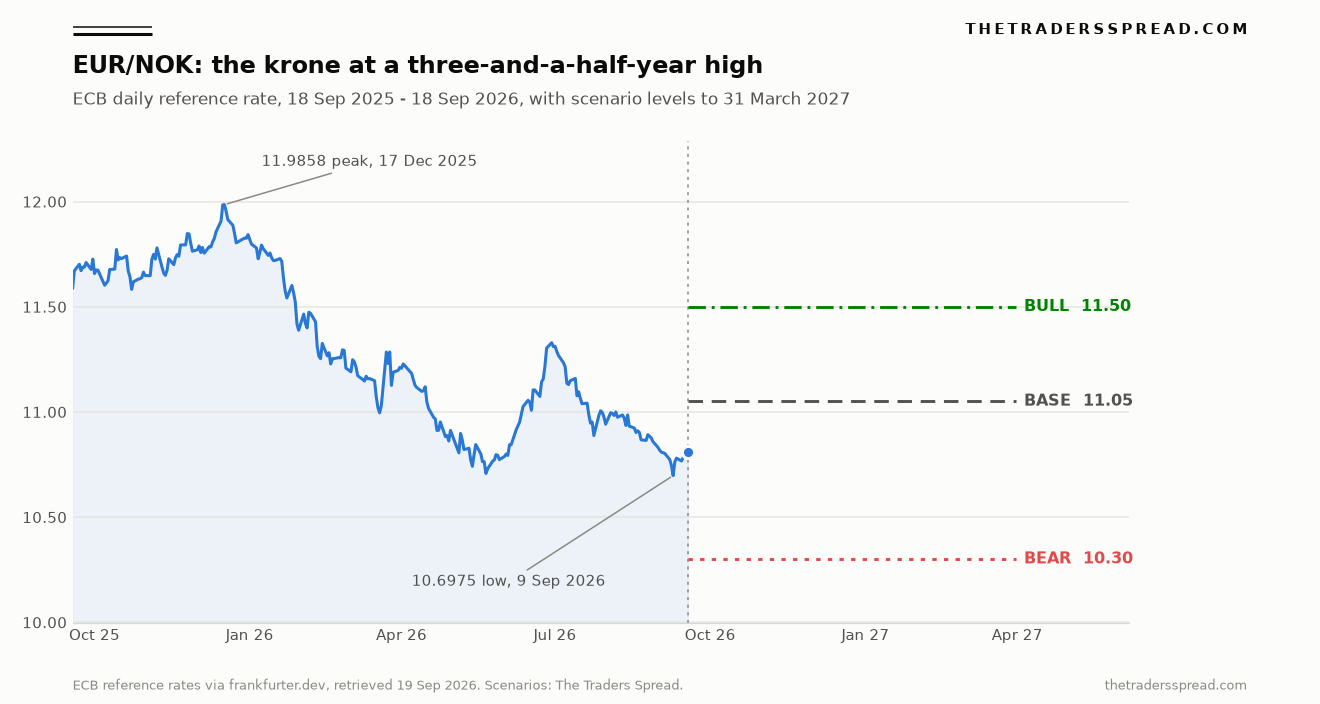
The table below sets each month's official flow against where the pair actually finished that month. The relationship is directionally real and statistically loose, which is the honest description.
| Month 2026 | Government leg, NOK m/day | Direction for NOK | EUR/NOK, month-end fixing |
|---|---|---|---|
| January | −650 | Buying krone | 11.3885 |
| February | −600 | Buying krone | 11.2085 |
| March | −600 | Buying krone | 11.2125 |
| April | −50 | Buying krone | 10.9123 |
| May | −100 | Buying krone | 10.7735 |
| June | −100 | Buying krone | 11.3105 |
| July | −400 | Buying krone | 10.9420 |
| August | −350 | Buying krone | 10.8320 |
| September | +300 | Selling krone | 10.8095 (18th) |
Look at June. The official flow was at its smallest krone-supportive setting of the year and the pair still jumped from 10.7735 to 11.3105 inside a month, then gave most of it back in July. Flow is a tilt, not a steering wheel. The months that matter are the ones where the official tilt lines up with the rate and oil story rather than fighting it, and September 2026 is the first month since the data series began 2026 in which all three point the same way for the euro: official krone selling, an ECB that has just tightened, and a krone already at a three-and-a-half-year extreme.
The euro leg is doing work too. The Governing Council raised the three key rates by 25 basis points on 10 September, taking the deposit facility rate to 2.50% with effect from 16 September, the second increase of 2026. The BIS central bank policy rate series still showed 2.25% through 15 September when retrieved on 19 September, which is what a mid-month effective date does to a daily series. Either way, the spread Norway offers over the euro area has narrowed from 225 basis points at the start of the year to 175 now, and the next ECB meeting is 29 October. Our EUR/USD forecast and EUR/GBP forecast both run off the same tightening euro leg from the other side.
The 2022 precedent, and why it is not a template
This has happened before, on a far larger scale, and the outcome was ugly for the krone.
Through 2022 and 2023 the oil and gas windfall pushed Norges Bank's government-leg purchases of foreign exchange to NOK 4,300 million a day in October 2022 and to NOK 1,900 million in February 2023. Over that stretch EUR/NOK travelled from a low of 9.4923 in 2022 to 12.0045 in 2023 and to 12.1195 in April 2025. Roughly a quarter of the krone's value against the euro went in three years, with the central bank selling krone into the market every single trading day.
Three differences argue against running that tape again. The current operation is 300, not 4,300. Norges Bank's policy rate then was climbing from near zero, whereas today it sits 175 basis points above the euro area's. And 2022 combined the flow with a European gas crisis that made the krone a proxy for a commodity nobody could price; Norway's gas position is still central to Europe, as our natural gas forecast lays out, but the panic premium is gone.
What the precedent does establish is the mechanism's capacity. The flow is not a curiosity that gets arbitraged away. When it scales, it moves the pair, and it scales with the oil price. Brent at $130.80 is not yet in any official Norwegian forecast, because the last one was written on 18 June when the price was $80.33. Our Brent crude prediction put the bull case at $125; spot has already cleared it.
What would have to be wrong
The obvious hole is that the flow is tiny and the market knows about it. Both are true. A pre-announced $16 million a day cannot fight a repricing of Norwegian rates, and the notice went up on 31 August, three days before Brent started its run.
The stronger objection is that the October notice, due on 30 September, could flip straight back. The government leg swung by NOK 650 million in a single month once already this year, from −100 in June to −400 in July. A revised estimate of the non-oil deficit, or an oil price that gives back the September move, would take the purchase back to zero without ceremony.
And the rate story genuinely cuts the other way. If the committee delivers on its June path on Thursday and takes the policy rate to 4.50%, the carry advantage over the euro area widens back to 200 basis points on a currency that already pays the most in the developed world outside the dollar bloc. That is the single cleanest route to the bear case below.
RelatedGBP/CAD Forecast: 1.94 Bull Case vs 1.83 Bear Case
The call
Base case: EUR/NOK grinds back to 11.05 by the end of the first quarter of 2027, 2.2% above the 18 September fixing. The krone has run 9.8% from its December peak on a rate differential that is narrowing from both ends, and it now faces official selling rather than official buying for the first time this year. A retracement to the middle of the 2026 range does not require anything to break. Probability: 45%.
Bull case for the pair: 11.50, 6.4% above the fixing. This needs the petroleum flow to stay positive into the fourth quarter, which means Brent holding above roughly $110, and it needs Norges Bank to hold at 4.25% on 24 September while signalling that the June path has been abandoned. Add the expiry of the NOK 124 million daily dividend-funding purchase at the end of February 2027 and the official bid disappears entirely. Probability: 25%.
Bear case: 10.30, 4.7% below the fixing, which would be the strongest krone against the euro since December 2022. The route is a hike on Thursday plus a September MPR path that adds a second, on the back of CPI-ATE at 3.0% and 4.5% wage growth, while oil stays high enough to keep Norway's terms of trade improving but the fiscal arithmetic sends the flow back to neutral. Probability: 30%.
What would change my mind: the 30 September notice. If the October government leg comes back negative, the flow argument dies that morning and the whole distribution shifts lower. The second trigger is the MPR 3/26 rate path itself. A path that peaks at 4.25% and starts declining in 2027 would remove the carry defence and pull the base case toward 11.30; a path with two more hikes in it would make 10.30 the base rather than the tail.
Frequently asked questions
Why does a higher oil price make Norges Bank sell krone?
Norway's oil taxes and the Equinor dividend arrive in krone, while the budget deficit they finance is set separately. When oil rises, the krone receipts exceed what the budget needs, and the surplus has to be converted into foreign currency before it can be transferred into the Government Pension Fund Global. Norges Bank executes that conversion, which means buying foreign exchange and selling krone.
How large is the September 2026 operation?
A net purchase of foreign exchange worth NOK 176 million per trading day, made up of NOK 300 million bought on the government's behalf and NOK 124 million sold to fund the transfer of dividends and interest. At the 18 September fixing that is roughly $16 million a day. The figure was announced on 31 August and does not change during the month.
What is the carry differential between Norway and the euro area?
Norges Bank's policy rate is 4.25%, effective 14 August 2026. The ECB's deposit facility rate is 2.50% from 16 September 2026. The gap is 175 basis points, down from 225 at the start of the year, because the ECB has raised twice in 2026 while Norges Bank has moved once.
Is the 18 September rate a tradable price?
No. It is the European Central Bank's daily reference fixing, published each afternoon for accounting and reference purposes. FX spot closed for the weekend on Friday and does not reopen until Sunday evening, so any dealable EUR/NOK quote will carry a spread around the fixing rather than match it.
What happens to the flow after February 2027?
The krone-buying leg stops. Norges Bank's Executive Board set the dividend and interest funding at NOK 29.4 billion spread over the trading days from March 2026 to February 2027, so the NOK 124 million daily purchase expires at the end of that window. Whatever the government leg is doing at that point becomes the entire official flow.
When is the next scheduled event for the pair?
Norges Bank publishes its rate decision and Monetary Policy Report 3/26 on 24 September 2026, which includes a new policy rate path. The October foreign exchange transaction notice follows on 30 September. The ECB's next Governing Council meeting is 29 October 2026.
Disclaimer
This article is analysis and information, not investment advice, and nothing in it is a recommendation to take any position. Foreign exchange and contracts for difference carry substantial risk, including the risk of losing more than the amount deposited. Scenario levels and probabilities are the author's estimates and may prove wrong. Anyone acting on this material does so at their own risk and should consider taking independent professional advice.