

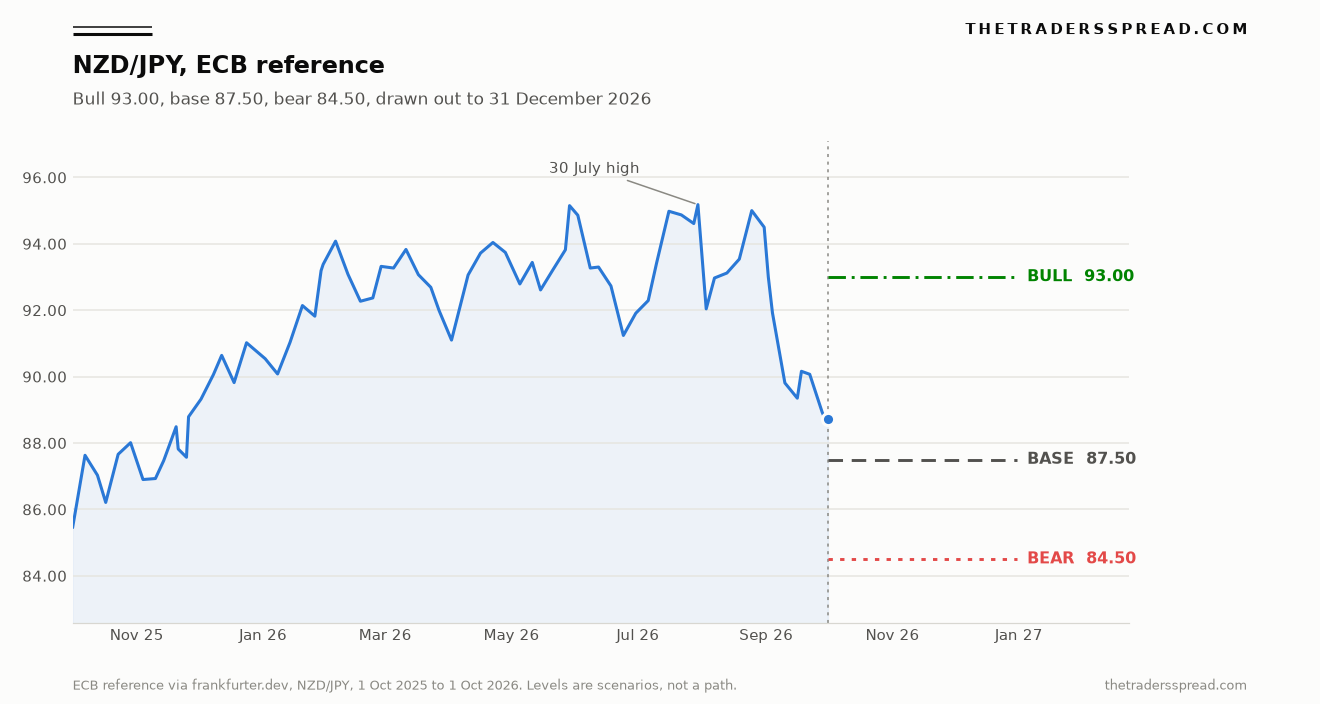
NZD/JPY finished the European Central Bank reference day of 1 October 2026 at 88.71, which is 3.8 percent above the 85.45 reference of 1 October 2025 and 6.8 percent below the 95.18 high of 30 July 2026. Those two results cannot both be comfortable for a book that treats the cross as one trade. A year in profit says the carry worked. A drawdown of 6.8 percent from the high says the risk trade failed. The same price is being asked to confirm both.
It cannot, unless the two legs did opposite work, which is what the dollar rates show. From 1 October 2025 to 1 October 2026 the dollar bought 7.4 percent more yen, from 147.11 to 157.98, while the kiwi fell 3.3 percent against the dollar, from 0.5809 to 0.5615. Multiply those gross changes and the product is the cross, up 3.8 percent. The year's profit was yen weakness. The kiwi subtracted. From 31 August to 1 October the arithmetic flips. The cross fell 6.1 percent, from 94.50 to 88.71. A 5.1 percent drop in the kiwi, from 0.5916 to 0.5615, did most of it. A 1.1 percent rise in the yen, with dollar-yen moving from 159.73 to 157.98, did the rest. The year was a yen story. The last six weeks were a kiwi story.
That switch is the forecast.
Figures below are ECB reference rates from frankfurter.dev, retrieved on 2 October 2026, not a dealing screen and not this site's price tile. The anchor is 1 October 2026. One-decimal percentages are rounded ratios. Paths run to 31 December 2026. They are scenarios, not an instruction.
- NZD/JPY 88.71 on 1 October 2026, versus 85.45 a year earlier and a high of 95.18 on 30 July. NZD/USD 0.5615, USD/JPY 157.98. The kiwi is the weakest ECB reference since 0.5606 on 25 November 2025. The series low since 1 October 2025 is 0.5603 on 21 November 2025.
- Official Cash Rate 2.75 percent from 2 September 2026, after 2.50 percent from 8 July and 2.25 percent from 26 November 2025. Bank of Japan call rate around 1.25 percent from 24 September, voted 7 to 2 on 18 September, after around 1.0 percent from 17 June. Gap: 1.50 percentage points, down from 1.75.
- Tokyo Ku-area, September preliminary, released 2 October: all items less fresh food up 2.7 percent on the year, from 1.8 percent in August. Excluding fresh food and energy, up 3.0 percent. Energy still down 1.9 percent. National August core, released 18 September, up 1.7 percent. September national CPI is scheduled for 23 October.
A year in profit, then a six-week reversal
NZD/JPY is NZD/USD times USD/JPY, up to a hundredth where frankfurter rounds the direct cross and the two legs apart. On 1 October the legs were 0.5615 and 157.98, and the product is 88.71, which is also the direct cross with the kiwi as the base. A forecast that will not say which leg is doing the work is a label, not a forecast.
June already ran the pattern. On 29 May the cross was 95.15, with the kiwi at 0.5974 and dollar-yen at 159.27. By 30 June it was 91.91. The kiwi had fallen 5.3 percent, to 0.5659, while dollar-yen rose 2.0 percent, to 162.44. A weaker yen should have lifted the cross. The kiwi's fall won, and NZD/JPY dropped 3.4 percent.
September did not need a softer yen, and it did not get one. From 31 August both legs moved against the cross. The yen firmed a little. The kiwi fell a lot. A hedge that treated late-August NZD/JPY as a leftover yen-weakness position was holding the kiwi.
The 2 September reference pins that to a calendar. The Monetary Policy Committee raised the cash rate to 2.75 percent that day. The ECB cross was 93.00, the kiwi 0.5828, dollar-yen 159.60. By 1 October the cross was 4.6 percent lower and the kiwi 3.7 percent lower against the dollar. A hike day was not a floor. It was a local high that did not survive the month.
Month-end references. The cross is the direct NZD/JPY series. The dollar rates are the USD base series. Both are ECB references via frankfurter.dev, so the last column times the third can differ from the cross by a hundredth.
| ECB date | NZD/JPY | NZD/USD | USD/JPY |
|---|---|---|---|
| 31 Oct 2025 | 88.14 | 0.5716 | 154.18 |
| 30 Jan 2026 | 93.38 | 0.6062 | 154.03 |
| 29 May 2026 | 95.15 | 0.5974 | 159.27 |
| 30 Jun 2026 | 91.91 | 0.5659 | 162.44 |
| 31 Aug 2026 | 94.50 | 0.5916 | 159.73 |
| 30 Sep 2026 | 88.63 | 0.5645 | 157.00 |
| 1 Oct 2026 | 88.71 | 0.5615 | 157.98 |
Read across. January's 93.38 came with a kiwi at 0.6062 and dollar-yen at 154.03. May's 95.15 had both legs helping. June fell while the yen was still weakening. September fell once the yen stopped helping. The level 93 has already traded under more than one mix of legs. That is the bull case. The July high is not.
What 150 basis points do not cover
The rate differential still favours the kiwi. Wellington's cash rate is 2.75 percent. Tokyo's overnight target is around 1.25 percent. The gap of 1.50 percentage points is the raw material of a carry trade: fund in yen, hold the kiwi, and hope spot does not fall by more than the interest pays.
It has not paid for the move on the tape. Simple interest on 1.50 points over the 90 days to 31 December is about 0.37 point. The drawdown from 30 July to 1 October was 6.8 percent. The gap was 1.25 points after 17 June, 1.75 points after the 2 September cash-rate rise, and 1.50 again from 24 September. The latest narrowing came from Japan.
On 2 September the committee chaired by Anna Breman lifted the cash rate to 2.75 percent by consensus. The summary record says the committee judged that step "appropriate to sustainably return inflation to the 2 percent target mid-point while avoiding unnecessary instability in output, employment, interest rates and the exchange rate." On the central outlook the cash rate may need to rise further, and the path is not pre-determined. The record puts June-quarter inflation at 4.1 percent, largely fuel tied to the Middle East conflict, and at 2.9 percent excluding vehicle fuels. In July the committee had said headline inflation was expected to have peaked at 3.9 percent in that quarter. Spare capacity, September's record says, remains, especially in the labour market. No unemployment rate is stated in that summary, so none is added here.
The exchange-rate lines in the two records are not the ECB kiwi. In July, MPC member Karen Silk added that a depreciation could, if sustained, add to imported inflation. The 2 September record speaks of higher wholesale rates passing into mortgages and business loans "and a small appreciation in the exchange rate", partly on expectations of further cash-rate rises. Whatever basket that sentence describes, NZD/USD on the ECB reference went from 0.5828 on 2 September to 0.5615 on 1 October. The dollar leg inside NZD/JPY weakened after the hike.
Tokyo has said it is not finished. The 18 September statement, with Governor Kazuo Ueda in the chair, says the Bank "will continue to raise the policy interest rate and adjust the degree of monetary accommodation, in response to developments in economic activity and prices as well as financial conditions." The vote was 7 to 2: Ueda, Ryozo Himino, Shinichi Uchida, Hajime Takata, Naoki Tamura, Junko Koeda and Kazuyuki Masu for; Toichiro Asada and Ayano Sato against. The 1.25 percent call rate, a matching deposit rate and a 1.5 percent basic loan rate took effect on 24 September.
Ueda said it in his own voice that afternoon. In the Japanese transcript of the 18 September press conference, published on 24 September, he said, in this desk's translation: "I think we will continue to raise the policy interest rate and adjust the degree of monetary accommodation in response to developments in economic activity, prices and financial conditions." He also treated yen weakness as a price risk. Costs passed between firms may show up later in consumer prices.
The dissent blocks a straight line to another hike before December. The statement records Asada's reason: with CPI excluding fresh food "below 2 percent recently, it could not necessarily be said that the economic situation was strong", so he wanted the guideline kept. Sato's recorded view was that activity and prices had not accelerated enough. The national print dated that day fits Asada's phrase: August core up 1.7 percent, all items up 1.9 percent, ex-fresh-food-and-energy up 1.9 percent. Takata had wanted 1.25 percent on 31 July, when the board held at 1.0. In September he joined the majority. The centre moved, not unanimously, with national core still under 2 percent.
Tokyo's 2.7 percent, item by item
Two weeks later the Tokyo Ku-area preliminary for September arrived, dated 2 October. All items, and all items less fresh food, were up 2.7 percent on the year. August's core rate had been 1.8 percent. Excluding fresh food and energy, September was 3.0 percent, from 2.0. Seasonally adjusted, core rose 0.9 percent on the month. The 2.7 percent core rate is the highest since November 2025, when the same measure was 2.8 percent. October 2025 was also 2.8. From December's 2.3 through August, every print was lower.
Stop at 2.7 and the yen story writes itself. The bureau's difference column does not cooperate. The headline widened by 0.8 point, from 1.9 percent in August to 2.7. The bureau attributes 0.29 point of that widening to nursery-school fees and 0.24 point to water charges. Hotel charges added 0.12 point. Energy added 0.01. The energy group was down 1.9 percent on the year, after 2.0 percent down in August. Electricity was down 2.6 percent, city gas 0.5 percent, gasoline 2.6 percent. This was not petrol coming back.
Nursery fees are still a drag on the level. The item is recorded at minus 100 percent on the year, contributing minus 0.21 point to the September headline. The change in that contribution widened the year-on-year rate by 0.29 point, which means the drag got lighter, not that a new fee appeared. Water and sewerage charges were up 29.5 percent on the year, and the water-charge line the bureau singles out was up 65.6 percent, contributing 0.24 point. Administered prices in one city can be real and still fail to show up at the same size in the national basket.
You cannot shrug the print off by stripping fuel. Water charges and nursery fees sit outside the energy exclusion, and that index still jumped from 2.0 to 3.0 percent. A board can look through administered prices, or it can treat the print as permission after saying underlying inflation is nearing 2 percent. Both readings fit one PDF. The national September CPI, the test of whether Tokyo travelled, is on the bureau calendar for 23 October. Until then 2.7 percent is a leading indicator with a known mix, not a national fact.
Other yen crosses on this desk are a different trade. AUD/JPY shares the yen and does not share the Reserve Bank of New Zealand. CHF/JPY shares the yen with another base currency. The kiwi's regional cross, AUD/NZD, is where a New Zealand move shows up without the yen in the denominator. None of those is a shadow target for 88.71.
93.00, 87.50 and 84.50
The bull case is 93.00, the ECB reference on the 2 September hike, next to January and February month-ends at 93.38 and 93.32. It is not 95.18. With dollar-yen held at 157.98, 93.00 needs the kiwi near 0.5887, above 2 September's 0.5828 and below 31 August's 0.5916. That is a partial repair, not a new dollar high. The other route, holding the kiwi at 0.5615, would need dollar-yen near 165.6, past the 163.91 high of 28 July. The bull case is the kiwi repair, not a weaker yen.
The base case, and the target on this piece, is 87.50, under the 88.71 anchor. On 21 November 2025 the kiwi printed 0.5603, the low since 1 October 2025, and direct NZD/JPY was 87.82 with dollar-yen at 156.74. Today's kiwi is a hair stronger and the yen a hair weaker, which is how the cross sits at 88.71. A base of 87.50 says that November mix gives a little more: dollar-yen toward 155.83, which is 87.50 divided by 0.5615, without a break of the 85.45 low from 1 October 2025.
RelatedUSD/DKK Forecast: 6.85 Bull Case vs 6.40 Bear Case
The bear case is 84.50, about one yen under 85.45, the lowest direct cross in the year, set on 1 October 2025 when dollar-yen was 147.11 and the kiwi was still 0.5809. Breaking 85.45 is an event, not a drift. Hold the latest kiwi at 0.5615 and 84.50 implies dollar-yen near 150.49: firmer than 157.98, not a return to 147. The yen leg supplied the year's entire gain. The bear case is that leg giving part of it back while the kiwi stays at the lows.
Desk weights, not an options price: 25 percent on 93.00, 45 percent on 87.50, 30 percent on 84.50. The centre of those weights is about 88.0, under 88.71, so the bias is bear and conviction is 3 of 5. Not 4, because nursery fees and water charges are a poor base for a yen squeeze and two board members refused the last hike with national core at 1.7 percent. Not 2, because the board said it will keep raising the policy rate if the outlook holds, and the gap has already narrowed from 1.75 points to 1.50, from Tokyo.
What would move the weights. A 23 October national core rate still near August's 1.7 percent, rather than near Tokyo's 2.7, would push weight toward 93.00. So would an ECB kiwi reference through 0.5887, the rate that produces 93 if dollar-yen stays at 157.98. A direct NZD/JPY reference above 93.00 invalidates the downside lean. A print under 85.45 brings 84.50 forward. The Wellington record does not lock the next cash-rate move, and the Tokyo statement does not name a month, so neither date is filled in here.
The book on the other side of 87.50 holds the cross for the 1.50 point gap, into a kiwi already at its weakest dollar references of the year. It can collect a quarter of carry, about 0.37 point, and still lose if the yen firms by more than that. The opposing book reads 2.7 percent as a national reacceleration and reads "continue to raise" as a date. It can be right about the next Bank of Japan step and still early: nursery fees and water charges did the widening, and Asada dissented against a core rate below 2 percent. The base case needs no drama. It needs the kiwi near a low it has printed, and a firmer yen that does not break 85.45.
Questions the level actually answers
Is 88.71 a live NZD/JPY price?
No. It is the ECB reference for 1 October 2026 from frankfurter.dev, with the kiwi as the base, and it matches that day's dollar legs, NZD/USD 0.5615 and USD/JPY 157.98. A dealing price on 2 October can differ. The bull and bear cases are measured from the reference. Shift the anchor and they can land on the wrong side of spot.
Why is the bull case 93.00 and not the July high?
95.18 on 30 July needed a kiwi near 0.584 and dollar-yen near 163. The bull case is a return to the 2 September reference of 93.00. With dollar-yen unchanged at 157.98, that level needs the kiwi near 0.5887. That repairs part of September. It does not call for a weaker yen than July, and it is not a new high.
Does Tokyo's CPI mean another Bank of Japan rise before December?
The 18 September statement says the Bank will keep raising the policy rate if activity, prices and financial conditions warrant it. It does not date the next step. Tokyo core at 2.7 percent is the highest since November 2025, and the bureau ties most of the latest widening to nursery fees and water charges, not to energy, which was still falling. National September figures are due on 23 October.
What knocks out the downside lean?
A direct NZD/JPY ECB reference above 93.00. That is the invalidation. A kiwi reference through 0.5887, with dollar-yen stable, would put 93 in reach. So would a 23 October national core rate still near August's 1.7 percent. Those are observations that would make 87.50 the wrong centre. They are not a prompt to transact.
Does the 1.50 point gap force the cross up?
No. The gap is about 0.37 point of simple interest over the 90 days to 31 December. The cross fell 6.8 percent from 30 July to 1 October while a gap of that order was in place. Interest does not refund a spot move several times larger. It is compensation for holding the cross, and in this window it did not cover the hold.
How can the kiwi be at its lows while the cross is not?
The weakest NZD/USD reference of 2026 is 0.5615 on 1 October, the weakest since 0.5606 on 25 November 2025. The cross low since 1 October 2025 is 85.45, set when dollar-yen was 147.11. On 21 November 2025, with the kiwi at 0.5603, NZD/JPY was 87.82 because the yen was already near 157. The cushion is the yen. 84.50 is that cushion thinning toward about 150.50 while the kiwi stays at these lows.
This is analysis, not a recommendation. It is not a solicitation to transact in NZD/JPY or any other instrument. Capital is at risk. The rate can trade through 93.00, 87.50 and 84.50 without pausing, and the ECB reference is not a dealing price. The weights are this desk's judgement on 2 October 2026. They are not an options-market probability, and they will be wrong if the legs refuse the split above.