

I pulled every ECB reference fix for EUR/JPY back to September 2025 this morning, sorted the daily moves since March, and the biggest up-day on the list stopped me. It was not a euro story. It was Friday 18 September, the day the Bank of Japan raised its policy rate to 1.25%, and the cross rose 1.23% on the fix, from 178.75 to 180.94. A central bank tightening and its currency falling is not new to anyone who sat through June, when the BoJ hiked and the yen went nowhere. What is new is how often it has now happened, and how little the policy arithmetic has actually changed underneath it. At 06:53 UTC on Monday, the CNBC quote feed had EUR/JPY at 180.22, inside a session range of 179.84 to 180.34. This forecast runs to 31 December 2026, and it is built on three primary sources: the two central banks' own decision records and the Japanese Finance Ministry's intervention ledger.
Here is the part the headline reaction misses. The ECB and the BoJ have now hiked within eight days of each other twice this year, on 11 and 16 June and then on 10 and 18 September, so the nominal policy gap is exactly where it was in June: 125 basis points once the BoJ move takes effect on 24 September. Adjust for August inflation and the real-rate gap has closed to roughly zero, with the euro area at minus 0.70 points and Japan at minus 0.65. Carry alone cannot explain a 180 handle any more. Tokyo's cheque book, which has written ¥27.1 trillion of yen purchases this year, explains the ceiling.
Key facts
- EUR/JPY 180.22 at 06:53 UTC, 21 Sep 2026; ECB reference fix 180.94 on 18 Sep, up 1.23% on the day — CNBC quote feed and ECB fix via Frankfurter, 21 Sep 2026
- BoJ raised the overnight call rate target to around 1.25% from around 1.0%, by a 7–2 vote, effective 24 Sep — Bank of Japan statement, 18 Sep 2026
- ECB deposit facility rate 2.50% from 16 Sep (decided 10 Sep), after 2.25% from 17 Jun — Deutsche Bundesbank time series, retrieved 21 Sep 2026
- Japan spent ¥15,399.3 billion on intervention between 30 Jul and 26 Aug, after ¥11,734.9 billion in April to June — Ministry of Finance, 28 Aug 2026
- Japan August CPI 1.9% year on year, 1.7% excluding fresh food — Statistics Bureau of Japan, 18 Sep 2026
- Euro-area August HICP 3.2% year on year — Eurostat, updated 17 Sep 2026
- EUR/JPY is down 1.71% year to date on the fix (184.09 on 31 Dec 2025) but up 4.11% on 12 months (173.79 on 19 Sep 2025) — ECB reference rates, 18 Sep 2026
Where the pair has actually been since December
The chart below plots every ECB reference fix from 1 December 2025 to 18 September 2026. The fix is taken at 14:15 Central European Time, which matters here: Friday's print came roughly ten hours after the BoJ announcement, so it captures the whole Tokyo and London reaction.
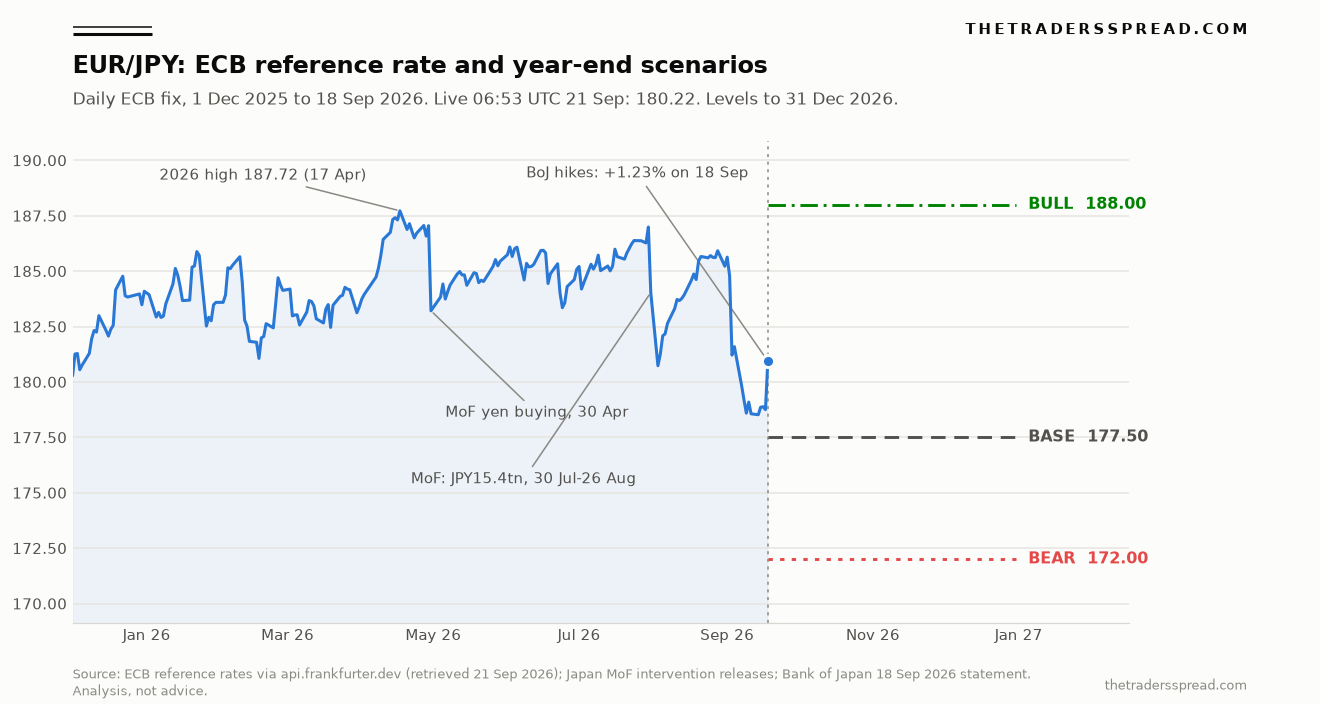
Three things stand out. The 2026 high on the fix was 187.72 on 17 April. The low was 178.52 on 14 September, only four sessions before the hike. And the spot rate now sits below every moving average I can build from the fixes: the 50-day mean is 183.55, the 100-day 184.25 and the 200-day 184.12. That is a pair which has spent most of the year pinned in the 182 to 187 band and has only just fallen out of it.
Volatility has been rising as it fell. Annualised from daily log returns, one-month realised volatility is 9.1%, against 7.9% over three months and 7.0% over six. When I rank the daily moves since 1 March, the four largest declines are 30 April (minus 2.05%), 3 September (minus 1.93%), 3 August (minus 1.79%) and 31 July (minus 1.58%). The largest gain is Friday. The asymmetry tells you who has been doing the pushing.
| Measure | Euro area | Japan |
|---|---|---|
| Policy rate | ECB deposit rate 2.50% (from 16 Sep) | BoJ call-rate target 1.25% (from 24 Sep) |
| Latest move | +25bp, decided 10 Sep | +25bp, decided 18 Sep, 7–2 vote |
| Previous move | +25bp to 2.25%, decided 11 Jun | Raised to 1.0%, decided 16 Jun, 7–1 vote |
| August headline inflation | 3.2% (HICP) | 1.9% (CPI) |
| Real policy rate, headline basis | minus 0.70 points | minus 0.65 points |
| 10-year government yield | Bund 3.48% (06:53 UTC, 21 Sep) | JGB 2.985% (Friday 18 Sep close) |
| Next decision | 29 Oct | 29–30 Oct, with Outlook Report |
Sources: Deutsche Bundesbank, Bank of Japan, Eurostat, Statistics Bureau of Japan, CNBC quote feed for yields. Real rate is the policy rate minus August headline inflation.
Why a matched pair of hikes left the yen weaker
The mechanism is uncomfortable for anyone who trades EUR/JPY as a pure rate-differential cross. The ECB went first on 10 September. The BoJ followed eight days later. On the policy-rate spread alone, nothing changed; from 24 September it will read 2.50% against 1.25%, the same 125 basis points that separated 2.25% and 1.0% after the June moves.
So the market traded the vote instead. Two of nine board members, Toichiro Asada and Ayano Sato, dissented. Asada argued that with core CPI below 2% recently, the economy could not necessarily be called strong. Sato argued that economic and price developments had not substantially accelerated. Two dissents on a 25 basis point move tell a market that the next step will not come quickly, and a slow path is what a carry position wants to hear.
Ryozo Himino, Deputy Governor at the Bank of Japan, had already described this pattern after June. "Following the policy interest rate hike by the Bank in June, I often heard comments arguing that the rate hike did not help rectify the weak yen," he said in a speech in Saitama on 27 August. His answer was that monetary policy does not target exchange rates. The September fix suggests the market has taken him at his word.
A board member who voted for the hike was even more explicit. "Foreign exchange policy falls under the jurisdiction of the government, and the Bank does not set its policy interest rate to respond directly to changes in foreign exchange rates," Kazuyuki Masu, Member of the Policy Board at the Bank of Japan, said in Fukui on 10 September. Read alongside the dissents, that line tells the market that yen weakness alone will not hurry the BoJ.
The ¥27 trillion ceiling
If the BoJ will not defend the yen, the Ministry of Finance has. Its intervention ledger records dollar sales and yen purchases of ¥6,278.7 billion on 30 April, ¥780.2 billion on 4 May and ¥4,675.9 billion on 6 May. The monthly release for 30 July to 26 August adds ¥15,399.3 billion, with daily detail due only in the quarterly report. The window from 29 June to 29 July shows zero. Together that is ¥27.13 trillion in 2026 to date.
Line those dates up against the EUR/JPY table and the pattern is plain. The 30 April fix fell 2.05%, the largest daily decline of the year. The 31 July and 3 August fixes fell a combined 3.35% as the second campaign began. Measured through the same ECB fixes, implied USD/JPY stood at 159.79 on 29 April and 162.94 on 30 July.
| Date | EUR/JPY fix | Daily change | What the primary record shows |
|---|---|---|---|
| 30 Apr 2026 | 183.21 | minus 2.05% | MoF yen purchases of ¥6,278.7bn |
| 31 Jul 2026 | 184.03 | minus 1.58% | Inside MoF's ¥15,399.3bn window; BoJ held rates that day |
| 3 Aug 2026 | 180.73 | minus 1.79% | Inside the same window |
| 3 Sep 2026 | 181.21 | minus 1.93% | Not yet covered by any MoF release |
| 18 Sep 2026 | 180.94 | plus 1.23% | BoJ hike to 1.25%, two dissents |
The 3 September drop is the one I cannot attribute. Implied USD/JPY was 160.16 on 1 September, close to the levels that preceded both confirmed campaigns, and it fell to 156.01 by the 3 September fix. The Finance Ministry's next monthly figure, covering the period from 27 August, is due around the end of this month. Until it arrives, anyone calling that move an intervention is guessing, and I am not going to.
For EUR/JPY the practical point is simple. The cross cannot rally far without USD/JPY rallying too, unless EUR/USD does the lifting on its own, and USD/JPY at 157.04 this morning is only about 2% below the zone where Tokyo has acted twice. That is why I treat 188 as the bull case, not the base. For the dollar side of this, our USD/JPY forecast set out the levels in August, and the EUR/USD forecast covers the euro leg. The glossary entry on central bank intervention explains the mechanics.
What the real-rate consensus has not caught up with
For most of this cycle the yen story has rested on one sentence: Japan has the lowest real interest rate in the developed world. Hajime Takata, Member of the Policy Board at the Bank of Japan, repeated a version of it on 2 September, and he flagged why it matters for currencies. "Given that some participants in foreign exchange markets have recently paid attention to not only nominal but also real interest rate differentials, it is necessary to monitor price developments transmitted through exchange rates," he said in Sapporo.
Against the euro, that sentence no longer holds on August data. Euro-area inflation printed 3.2%, so a 2.50% deposit rate is minus 0.70 points in real terms. Japan's headline CPI was 1.9%; against a 1.25% policy rate that is minus 0.65, and on the core measure excluding fresh food (1.7%) it is minus 0.45. By either reading, once the new rate takes effect on 24 September, the real policy rate in Japan will be marginally higher than in the euro area.
That does not mean EUR/JPY must fall. Real-rate models are slow and the 10-year spread still favours the euro, with the Bund at 3.48% against 2.985% on the JGB. It does mean the pair's premium over its own 12-month starting point, 4.11% higher than the 173.79 fix of 19 September 2025, rests more on positioning and on Tokyo's tolerance than on a yield advantage that is still widening. It is not widening. It has been flat since June.
Masu gave the other half of the argument. The BoJ's estimate of the nominal neutral rate spans 1.1% to 2.5%, and he said: "To complete the normalization of monetary policy in Japan, I am convinced that the Bank needs to raise the policy interest rate further, so that it falls solidly within the estimated range of the neutral interest rate." At 1.25%, the BoJ is barely inside the bottom of that range.
October's double-header, and the second-order trade
The calendar compresses the next test into two days. The ECB meets on 29 October. The BoJ meets on 29 and 30 October and publishes its Outlook Report on the 30th, according to its published schedule. Before that, the Summary of Opinions from the September meeting lands on 28 September, which will show how many of the board's anonymous opinions lean towards another move in December (17 and 18 December is the last meeting of the year).
Consider the second-order effect for anyone running yen crosses. If the ECB pauses in October with euro inflation back near 3% and the BoJ signals December, the nominal spread narrows for the first time this year. That is the scenario where EUR/JPY loses its carry support rather than just its momentum. The GBP/JPY forecast published on 9 September faces the same sensitivity, and the Nikkei 225 forecast covers what a firmer yen does to Japanese exporters. The carry trade entry in our glossary covers why a flat spread can still unwind fast.
RelatedCAD/JPY Forecast: 115.30 Bull Case vs 107.50 Bear Case
The call: EUR/JPY to 31 December 2026
From the live 180.22, my base case is 177.50 by year end, 1.51% lower. I give it 55%. It assumes the BoJ Summary of Opinions and the October Outlook Report keep a December hike alive, the ECB does not add to its two 2026 moves in October, and the Finance Ministry's presence near 160 on USD/JPY keeps rallies short. In that world EUR/JPY spends the quarter trading between the 14 September low of 178.52 and 182, and drifts lower as the nominal spread narrows.
| Scenario | Level | From 180.22 | Probability | What has to happen |
|---|---|---|---|---|
| Bull | 188.00 | +4.32% | 20% | BoJ signals a long pause, ECB hikes again on 29 Oct, no new intervention |
| Base | 177.50 | minus 1.51% | 55% | December BoJ hike stays priced, ECB holds, USD/JPY capped below 160 |
| Bear | 172.00 | minus 4.56% | 25% | BoJ hikes in October, a third intervention campaign, or both |
The bull case, 188.00, is 4.32% above spot and just above the 2026 high of 187.72. It needs the dissents to spread, a third ECB hike and a quiet Tokyo; 20%. The bear case, 172.00, is 4.56% below spot and under the 172.47 fix of 1 October 2025, the 12-month low. It needs the BoJ to move again in October, or a third intervention campaign that catches USD/JPY and EUR/USD falling together. I put it at 25%, higher than the bull case, because three of the four largest daily declines since March fell on a confirmed intervention day or inside a reported intervention window, and the ministry has never acted to weaken the yen this year.
What would change my mind: a September Summary of Opinions in which more than two members argue against further hikes, or a daily close back above 185.50 (2.93% above spot), which would put the pair above the 31 August fix of 185.22 and mark the September break as noise. A zero in the end-September MoF release, paired with USD/JPY holding above 160, would also move probability from the bear case to the bull case.
Frequently asked questions
Why did EUR/JPY rise when the Bank of Japan raised rates?
Because the hike was fully matched. The ECB had raised its deposit rate eight days earlier, leaving the policy gap at 125 basis points. Two board members, Toichiro Asada and Ayano Sato, voted against the move, which markets read as a sign that further hikes will be slow. The ECB fix rose 1.23% to 180.94 on 18 September.
What is the EUR/JPY forecast for the end of 2026?
Our base case is 177.50 by 31 December 2026, with a 55% weight. The bull case is 188.00 at 20% and the bear case is 172.00 at 25%, all measured from the 180.22 live quote at 06:53 UTC on 21 September. This is scenario analysis, not a recommendation, and the levels will be revisited after the 29–30 October meetings.
How much has Japan spent on yen intervention in 2026?
The Ministry of Finance reports ¥11,734.9 billion across April to June, on 30 April, 4 May and 6 May, and ¥15,399.3 billion between 30 July and 26 August. That is ¥27.13 trillion this year. The next monthly figure, covering the period from 27 August, has not been published yet and is due around the end of September.
Is the euro-yen interest rate gap widening or narrowing?
Neither, in nominal terms. It has been 125 basis points since the June hikes and will be again once the BoJ's 1.25% rate takes effect on 24 September. In real terms, using August inflation of 3.2% in the euro area and 1.9% in Japan, the gap has closed to roughly zero.
What dates matter most for EUR/JPY this quarter?
28 September brings the BoJ Summary of Opinions from the September meeting. The end of September brings the next Finance Ministry intervention figure. On 29 October the ECB decides, and the BoJ decides on 30 October with its Outlook Report. The BoJ's final 2026 meeting is on 17 and 18 December.
Disclaimer
This article is analysis and opinion for information only. It is not investment advice or a recommendation to trade any instrument. Leveraged foreign-exchange and CFD trading carries a high risk of losing money rapidly, and you can lose more than your initial capital in some account types. Past price behaviour and central bank patterns do not guarantee future results. Figures were retrieved on 21 September 2026 and may have changed since.