

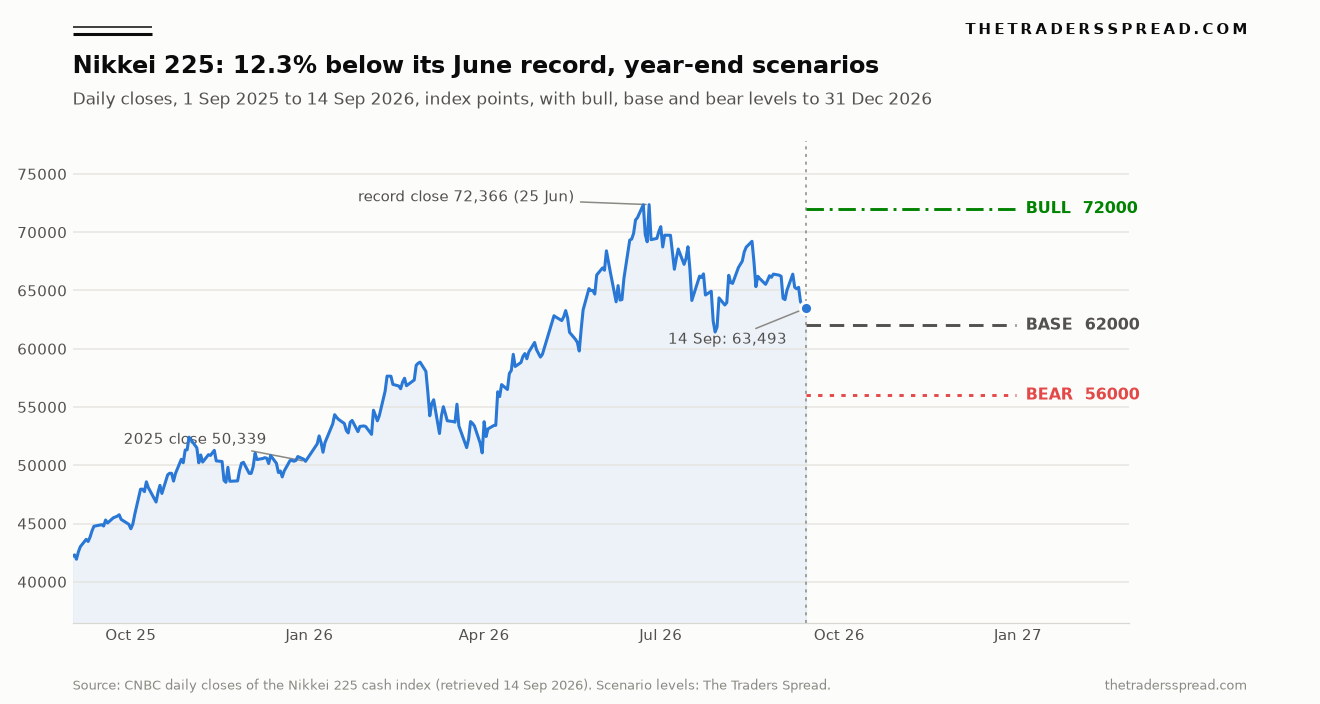
What is the market actually pricing after the Nikkei 225's slide from its June record: a verdict on Japan, or a verdict on a handful of AI stocks? Monday's session in Tokyo gave a clean answer. The Nikkei 225 closed at 63,492.99 on 14 September, down 518.35 points or 0.81%, according to CNBC's delayed index data. The TOPIX, which covers the whole Prime market and weights companies by free-float value, closed 0.74% higher at 4,058.21. One benchmark fell while the broader one rose, so the selling was concentrated, not national. The Nikkei now sits 12.3% below its record close of 72,366.34 from 25 June. TOPIX is just 3.3% under its own record of 4,197.20, set on 14 August. For anyone trading a Japan 225 CFD into the fourth quarter, that gap is the trade: it closes either by the Nikkei catching up or by TOPIX catching down.
The number we have not seen published elsewhere is how lopsided Monday was. We used the share counts held by Nomura Asset Management's NEXT FUNDS Nikkei 225 ETF (code 1321) on 31 August, which track the index's price weights. On that basis, SoftBank Group's 10.72% fall to ¥5,839 removed about 561 index points by itself, more than the whole index lost. Advantest, Kioxia and Tokyo Electron took off another 288 points between them. The remaining 221 constituents, Fast Retailing among them, added roughly 330 back. On 31 August, seven chip, component and AI-investment names (Advantest, Tokyo Electron, SoftBank Group, TDK, Ibiden, Kioxia and Fujikura) made up 34.8% of that ETF. A price-weighted index built that way behaves like a concentrated AI position with a Japanese flag on it.
Key facts
- Nikkei 225 closed at 63,492.99, down 0.81%, while TOPIX rose 0.74% to 4,058.21 — CNBC delayed index data, Tokyo close, 14 Sep 2026
- Record close 72,366.34 on 25 Jun 2026; the index is 12.3% below it but still up 26.1% from the 2025 close of 50,339.48 — CNBC daily closes, retrieved 14 Sep 2026
- Advantest 12.2%, Fast Retailing 8.8%, Tokyo Electron 8.5% and SoftBank Group 6.3% of net assets in the largest Nikkei 225 tracker — Nomura Asset Management, NEXT FUNDS 1321 holdings, 31 Aug 2026
- Bank of Japan policy rate around 1.0% since 17 Jun; the July hold was an 8–1 vote with one member proposing 1.25%; next meeting 17–18 Sep — Bank of Japan statements, 16 Jun and 31 Jul 2026
- Fed funds target range 3.50% to 3.75%, with three July dissents for a hike; Polymarket prices a 25bp hike on 16 Sep at 78.5% — Federal Reserve, 29 Jul 2026; Polymarket, 07:19 UTC 14 Sep 2026
- Japan's Ministry of Finance spent ¥15,399.3bn on currency intervention between 30 Jul and 26 Aug — Ministry of Finance, 28 Aug 2026
- Foreign investors net bought ¥728.8bn of TSE Prime shares in the week to 4 Sep, after net selling in three of the previous four weeks — Japan Exchange Group, investor-type statistics, Sep 2026 week 1
How one stock outweighed the whole index on Monday
The Nikkei 225 is price-weighted. Each constituent counts according to its share price multiplied by an adjustment factor that Nikkei Inc. sets, not according to its market value. TOPIX weights by free-float market capitalisation. A 10% drop in an expensive, heavily factored stock such as SoftBank Group therefore moves the Nikkei far more than it moves TOPIX, where SoftBank is one large company among the whole Prime market.
Our attribution converts each stock's yen move into index points using three inputs: the ETF's share count, its net asset value (about ¥17.6 trillion, implied by Advantest's 12.2% weight and its ¥2.15 trillion holding), and the index level of 66,311.93 on 31 August. Nikkei Inc.'s own weight file returned an access error from our systems on 14 September, so treat these as close estimates rather than the publisher's official figures. Prices are CNBC's delayed Tokyo closes.
| Stock | Weight in ETF 1321 (31 Aug) | Close 14 Sep (¥) | Day change | Est. index points |
|---|---|---|---|---|
| SoftBank Group | 6.3% | 5,839 | −10.72% | −561 |
| Advantest | 12.2% | 31,080 | −2.02% | −154 |
| Kioxia Holdings | 1.8% | 50,590 | −6.37% | −80 |
| Tokyo Electron | 8.5% | 50,930 | −1.03% | −53 |
| Fast Retailing | 8.8% | 66,760 | +0.42% | +22 |
| Other 220 constituents | 62.5% (incl. cash) | n/a | n/a | +308 |
| Nikkei 225 | 100% | 63,492.99 | −0.81% | −518 |
So what changed over the weekend? Anthropic's chief executive published an essay titled "We Must Pace the Frontier". "We must slow the pace at which we improve the capabilities of AI models," wrote Dario Amodei, Chief Executive Officer at Anthropic, in the September 2026 essay. He added that the industry "should also consider pacing based on limiting the ingredients that go into frontier models, such as training compute". For a market that has priced years of rising AI capital expenditure into chip testers, memory makers and the investors that fund AI labs, a leading lab's own chief executive asking for slower capability gains is an uncomfortable read.
Monday was the first Asian session after the essay circulated, and the names most exposed to AI spending took the worst of it. Besides SoftBank and Kioxia, South Korea's KOSPI fell 3.26% to 6,684.37, while Taiwan's weighted index lost 0.70% and TSMC 1.24% (CNBC, delayed, 14 September).
We cannot prove the essay caused all of it. Oil was also firmer, with the November Brent contract trading 2.8% higher at $107.54 early in London after settling at $104.61 on Friday, and hotter US inflation data (below) had lifted hike bets. But the pattern fits an AI-spending scare better than an oil scare. An oil shock hits importers and consumers across the market, which would have dragged TOPIX lower too. Instead, TOPIX rose and Fast Retailing gained.
Two central banks in three days: the Fed on Wednesday, the BOJ on Friday
The fourth-quarter path for the Nikkei 225 runs through one week. The Federal Open Market Committee meets on 15–16 September, a meeting that carries a Summary of Economic Projections. The Bank of Japan's Policy Board meets on 17–18 September. Tokyo's cash market will digest the Fed on Thursday morning and the BOJ on Friday, while index futures and the CFDs priced off them react first.
The Fed held its target range at 3.50% to 3.75% on 29 July by a 9–3 vote. All three dissenters (Beth M. Hammack, Neel Kashkari and Lorie K. Logan) wanted a quarter-point hike, and the statement said inflation "remains elevated relative to the Committee's 2 percent goal, in part reflecting supply shocks". August's consumer prices added to that case. Bureau of Labor Statistics index data show headline CPI up 0.4% on the month and 3.4% on the year, with core up 0.3% on the month and 2.4% on the year. On Polymarket, the "25 bps increase" leg traded at 78.5% and "No change" at 20.5% at 07:19 UTC on Monday. Links to Polymarket are affiliate links, from which The Traders Spread may earn a commission at no cost to you. Our prediction-markets desk tracked how those odds moved in its September Fed decision piece.
The BOJ side is the less settled one. The Bank raised its policy rate to around 1.0% at its June meeting, effective 17 June, by a 7–1 vote. On 31 July it held, but Takata Hajime dissented and proposed 1.25%. He then went further in Sapporo on 2 September: "2026 represents the start of a new phase, in which rate hikes will not be carried out at a fixed pace but will instead be conducted in a nimble manner," said Hajime Takata, Policy Board Member at the Bank of Japan.
Currency and bond markets heard him. The dollar-yen rate fell from 160.16 on 1 September to 154.04 on 11 September on ECB reference rates, a 3.8% yen gain, and traded at 154.25 at 07:13 UTC on Monday. Japan's 10-year government bond yield closed at 3.006% on 2 September in Ministry of Finance data, the first close at or above 3% since 6 September 1996. It was 2.987% on 11 September. Tokyo has also been in the market directly: the Ministry of Finance reported ¥15,399.3bn of intervention between 30 July and 26 August, after zero in the previous month. Our USD/JPY forecast and the USD/JPY hub cover the currency leg in detail.
Why does this matter for an equity index? A stronger yen cuts the yen value of overseas earnings, and the Nikkei's heaviest names (Advantest, Tokyo Electron, Fast Retailing) earn a large share abroad. A Fed hike alone would widen the rate gap and push the other way. Both central banks tightening in the same week leaves the yen's direction genuinely open, and that is the main reason our base case is a range rather than a trend.
The chart: the NT ratio has already given back most of the AI premium
The cleanest way to see the concentration is the NT ratio: the Nikkei 225 divided by TOPIX. When it rises, the price-weighted index is outrunning the broad market, which in 2026 has meant the AI names are leading. The table uses CNBC daily closes for both indices.
| Date | Nikkei 225 | TOPIX | NT ratio |
|---|---|---|---|
| 12 Sep 2025 | 44,768.12 | 3,160.49 | 14.16 |
| 30 Dec 2025 | 50,339.48 | 3,408.97 | 14.77 |
| 31 Mar 2026 | 51,063.72 | 3,497.86 | 14.60 |
| 25 Jun 2026 (Nikkei record) | 72,366.34 | 4,016.47 | 18.02 |
| 14 Aug 2026 (TOPIX record) | 68,713.80 | 4,197.20 | 16.37 |
| 31 Aug 2026 | 66,311.93 | 4,156.29 | 15.95 |
| 14 Sep 2026 | 63,492.99 | 4,058.21 | 15.65 |
Between the end of March and 25 June the ratio jumped from 14.60 to 18.02. In one quarter the Nikkei outran TOPIX by about 23%. Since that peak it has given back 2.37 of the 3.42 points it gained, roughly 69% of the move, while TOPIX went on to a record in August.
That reframes the forecast. The Nikkei is still up 41.8% on a year ago and 26.1% since the end of 2025, against 28.4% and 19.0% for TOPIX. Most of the air has come out of the AI premium already. What remains is a question of where the ratio settles: around today's 15.6, or back at the 14.6 to 14.8 band that held through the first quarter.
Other desks show how different this looks from other benchmarks. Our S&P 500 forecast and DAX forecast deal with cap-weighted indices, where a single stock cannot outweigh the whole index's daily move the way SoftBank did on Monday.
Who bought the dip, and who kept selling
Japan Exchange Group's weekly investor-type statistics cover the whole TSE Prime market rather than the Nikkei alone. They still show who was on the other side of the late-summer slide. Foreign investors, who accounted for 68.8% of brokerage trading value in the latest week, were net sellers in four of the five weeks before September:
- 27–31 July: net sold ¥490.3bn
- 3–7 August: net sold ¥376.3bn
- 10–14 August: net bought ¥210.9bn
- 17–21 August: net sold ¥414.1bn
- 24–28 August: net sold ¥174.7bn
- 31 August–4 September: net bought ¥728.8bn
That last week is the interesting one. The Nikkei fell 1.9% across it, from 66,311.93 to 65,020.94, yet overseas money bought the most it had in any of the six weeks. Domestic institutions supplied the stock: trust banks net sold ¥442.7bn, investment trusts ¥298.1bn and individuals ¥54.6bn. Business companies, the category that captures corporate buybacks, net bought ¥266.4bn.
One week is not a trend. The data for the week to 11 September, which included the Nikkei's 1.9% drop on Friday, had not been published at the time of writing. If that release shows foreigners buying again into weakness, the case for the NT ratio stabilising gets stronger.
What the bears are missing
The downside case leans on AI sentiment and a stronger yen. The Bank of Japan's own hawk supplies the best rebuttal. In the same Sapporo speech, Takata noted that "the improvement in firms' financial results for the April-June quarter of 2026 has exceeded expectations", and he described stock prices "renewing historical highs around the world in 2026, including in Japan". A central banker arguing for faster hikes because the economy is strong is not describing a recession.
Monday's breadth argues the same way. Fast Retailing, the Nikkei's second-largest weight, rose. TOPIX rose. The broad market has absorbed a 3.8% yen rally and a 3% bond yield without breaking, and it sits only 3.3% off its record.
There is also a practical point for CFD traders. CME's December Nikkei futures traded at 63,315 at 07:05 UTC, against the 63,492.99 cash close and a Friday settlement of 64,590 (CNBC, delayed). Many brokers price their Japan 225 CFD from futures rather than the cash index, so the quote on your screen can differ from the level quoted in Tokyo, and it keeps moving through the US session when the Fed speaks. Check your broker's contract specification for the reference market and the dividend adjustment before comparing your fill with the cash close.
The call: a range with a bearish lean into year-end
Our scenarios multiply an NT ratio by a TOPIX level, because that separates the AI-concentration question from the Japan question. All levels run to 31 December 2026 and are measured from the 63,492.99 close on 14 September.
RelatedEUR/NZD Bull Case at 2.06 Sits Above a 1.89 Bear Case
Base case, 50%: 62,000 (−2.4%). The BOJ hikes in September or October, USD/JPY stays below 158, and AI-linked names stay under pressure while domestic stocks hold. An NT ratio near 15.0 on a TOPIX of about 4,130 gives 61,950.
Bull case, 20%: 72,000 (+13.4%). The AI-spending scare fades, SoftBank and the chip testers recover, and foreign buying continues. That needs an NT ratio back at 17.0, between its end-May (16.76) and end-June (17.54) readings, on a TOPIX of 4,235, just above the August record. It would put the Nikkei within 0.5% of its record close.
Bear case, 30%: 56,000 (−11.8%). Both central banks tighten, USD/JPY breaks below 150, and the NT ratio drops to 14.5, just under its first-quarter range of 14.6 to 14.9, on a TOPIX that gives back about 5% to 3,860.
The probability-weighted level is about 62,200, a mild bearish lean. Conviction is 2 out of 5, because the outcome hinges on two central bank decisions due in the same week. Invalidation for the lean is a daily close above 67,000 (+5.5%), which would put the index above every close since 1 September.
What would change my mind? Three things, in order of weight. A BOJ hold on 18 September with a statement that pushes USD/JPY back above 158. JPX data showing foreign net buying for three consecutive weeks. And SoftBank Group reclaiming Friday's ¥6,540 close, which would tell us Monday's AI scare was a one-session event. Any two of those and the bull case becomes the base case.
FAQ
Why did the Nikkei 225 fall on 14 September while TOPIX rose?
Because the Nikkei is price-weighted and dominated by a few expensive AI-linked stocks. SoftBank Group fell 10.72% and, by our estimate from ETF share counts, removed about 561 points, more than the index's 518-point decline. TOPIX weights by market value across the whole Prime market, so it rose 0.74% as domestic names gained.
What is the Nikkei 225 forecast for the end of 2026?
Our base case is 62,000 by 31 December (50% probability), with a bull case of 72,000 (20%) and a bear case of 56,000 (30%), all measured from the 63,492.99 close on 14 September. The lean is mildly bearish at conviction 2 of 5, invalidated by a daily close above 67,000.
When does the Bank of Japan decide in September 2026?
The Policy Board meets on 17 and 18 September, according to the Bank of Japan's published schedule. The policy rate has been around 1.0% since 17 June. At the July meeting one board member, Takata Hajime, voted for 1.25%. The Fed announces its own decision two days earlier, on 16 September.
Is a Japan 225 CFD the same price as the Nikkei 225 index?
Not exactly. Many brokers derive their Japan 225 CFD price from index futures, which trade outside Tokyo hours and include a dividend and interest adjustment. On 14 September the CME December contract traded at 63,315 while the cash index closed at 63,492.99. Your broker's contract specification names the reference market.
How much of the Nikkei 225 is Advantest?
Advantest made up 12.2% of Nomura's NEXT FUNDS Nikkei 225 ETF on 31 August, the largest single holding, ahead of Fast Retailing at 8.8%, Tokyo Electron at 8.5% and SoftBank Group at 6.3%. Because the ETF tracks the index, those shares closely approximate the index weights on that date.
Disclaimer
This article is analysis and commentary, not investment advice or a recommendation to trade any instrument. Index CFDs are leveraged products and carry a high risk of losing money rapidly; your capital is at risk. Scenario levels and probabilities are the author's estimates and can be wrong. Prices quoted are delayed and may differ from the level available to you.