

The Dow Jones Industrial Average closed at 52,093.11 on 15 September, down 328.09 points or 0.63% on the day, and 4.84% below the 54,744.33 it reached on 5 August (CNBC quote service, 15 September 2026). Two facts about that closing number cannot both sit comfortably. Nvidia is worth $5.11 trillion and accounts for 2.42% of the Dow. Goldman Sachs is worth $284.4 billion, roughly one-eighteenth as much, and accounts for 11.14% (Nasdaq market data, 15 September 2026).
That gap is not an accident or a rounding artefact. It is the design. The Dow ranks its members by share price rather than by company size, so a stock trading at $976.67 carries four and a half times the index influence of a stock trading at $212.17, whatever the two businesses are actually worth. Almost every piece written about the Dow mentions price weighting in a subordinate clause and then moves on to talk about sentiment. The clause is the story.
Here is the arithmetic, done rather than asserted. Add the 15 September closing prices of all thirty constituents and the total comes to $8,764.57. Divide that by the Dow Divisor, published as 0.16824816528350 in Barron's Market Lab and unchanged since the 29 June reconstitution, and the answer is 52,093.11: the published close, to the cent. That reconstruction is also the check on everything below, because a wrong divisor or a wrong constituent list would not land on the right number. One division is the entire index. It also fixes the exchange rate between dollars and points at 5.943601 points per $1 of share-price movement, identically for Nike and for Goldman Sachs, which is why a Dow headline is usually a story about eight or nine share prices wearing the costume of thirty companies.
Key facts
- The Dow closed at 52,093.11 on 15 September, with an intraday range of 51,875.65 to 52,336.61 and volume of 376.8 million shares — CNBC quote service, 15 September 2026.
- Year to date the index is up 8.38% from its 2025 close of 48,063.29 — S&P Dow Jones Indices yearly performance data, 31 December 2025.
- Goldman Sachs alone is 11.14% of the index and Caterpillar 8.94%. The top five names together are 34.36%, the bottom fifteen 28.49% — calculated from constituent closes, 15 September 2026.
- Nike, at $36.22, is now 0.41% of the Dow, lighter than the "one-half of one percentage point" S&P Dow Jones Indices cited when it removed Verizon — S&P Dow Jones Indices press release, 23 June 2026.
- Since the 29 June reconstitution the index has moved a net 89.6 points, against 6,129.5 points of gross constituent movement — calculated from constituent closes, 29 June to 15 September 2026.
- The federal funds target range has stood at 3.50% to 3.75% since at least March, held on 29 July by a 9–3 vote in which all three dissenters wanted it raised — Federal Reserve, 29 July 2026.
- Structural levels: the record 54,744.33 of 5 August 2026 and the 45,057.28 low of 30 March 2026 — CNBC quote service, 15 September 2026.
- The Dow Divisor stands at 0.16824816528350, fixing every $1 of constituent share-price movement at 5.943601 index points — Barron's Market Lab, divisors at the 11 September 2026 close.
Eight share prices in a thirty-company coat
Run the weights out and the concentration is severe. Goldman Sachs takes 11.14% of the index at $976.67. Caterpillar takes 8.94% at $783.54. Microsoft is third at 5.67%, then a cluster of four names sitting within six cents of each other: Travelers at 4.31%, UnitedHealth, Amgen and Visa all at 4.29%. JPMorgan follows at 4.02%, Alphabet at 3.94%, Apple at 3.78%. Ten companies account for 54.67% of the whole thing. The remaining twenty share the rest.
Turn that into the number a trader actually needs. A 1% move in Goldman Sachs is worth 58.05 Dow points. A 1% move in Nvidia is worth 12.61. Same market, same day, same percentage, four and a half times the effect.
The effect runs in the other direction too, and this is where the design starts to look uncomfortable. Nike now represents 0.41% of the Dow. When S&P Dow Jones Indices announced on 23 June that Alphabet would replace Verizon, the committee explained the removal in exactly these terms: "Verizon represents only one-half of one percentage point of the DJIA due to its lower share price. The Dow Jones Industrial Average is a price weighted index, and thus persistently lower-priced stocks have an immaterial impact on the index." Nike is now lighter than the stock that was dropped for being too light. It joined the index in 2013 and has fallen 43.15% this year.
Nvidia, meanwhile, replaced Intel in November 2024 and has spent the intervening two years becoming the most valuable listed company in the United States, at $5.11 trillion against Apple's $4.84 trillion and Alphabet's $4.22 trillion (Nasdaq market data, 15 September 2026), without gaining any meaningful say over the index it sits in.
The chart, and who actually moved it
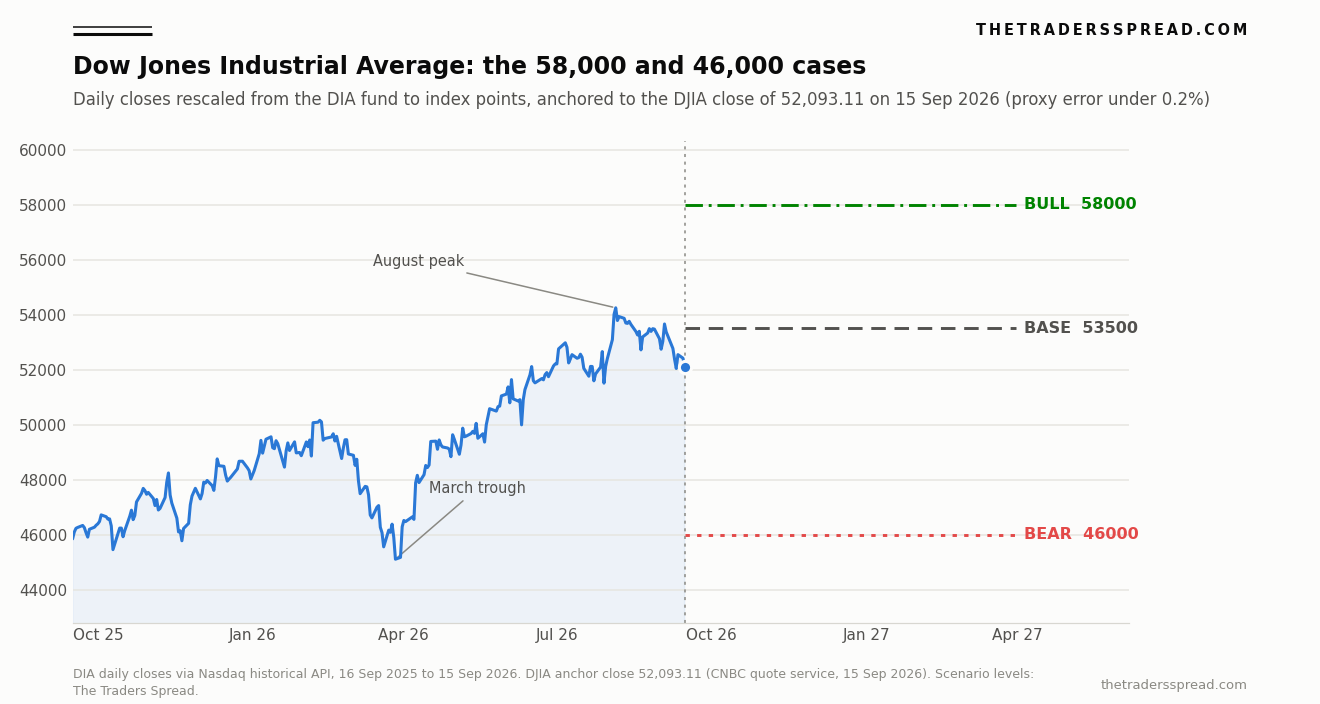
The series above is drawn from the SPDR Dow Jones Industrial Average ETF Trust, rescaled to index points and anchored to the 15 September close, because the tradeable fund is the cleanest daily series available without a terminal. The rescaling is honest but not perfect, and the size of its imperfection is itself instructive: measured on the fund, the Dow is up 8.46% this year, while the index itself is up 8.38%. Eight basis points of drift in eight and a half months. Anyone quoting a fund price as an index level is making a small error every day, and the error is not always small.
The shape is easy to read. A grind from roughly 46,000 last autumn to just over 50,000 by February, a violent March that took the index to 45,057.28 on the thirtieth, then five months of near-uninterrupted recovery to the 5 August record, and six weeks of quiet erosion since.
What the shape hides is more interesting. Take the window since the 29 June reconstitution, when the current constituent list and the current divisor both came into force, so the arithmetic is exact rather than approximate. Over that stretch the index has fallen 89.6 points, from 52,182.74 to 52,093.11, a move of 0.17%. Underneath, individual constituents added 3,019.9 points and subtracted 3,109.6 points. Six thousand points of gross movement produced ninety points of net result.
| Constituent | 29 Jun close | 15 Sep close | Change | Dow points | Weight now |
|---|---|---|---|---|---|
| Microsoft | $368.57 | $497.12 | +34.88% | +764.0 | 5.67% |
| Salesforce | $157.93 | $255.65 | +61.88% | +580.8 | 2.92% |
| Apple | $281.74 | $331.34 | +17.60% | +294.8 | 3.78% |
| Chevron | $168.47 | $217.77 | +29.26% | +293.0 | 2.48% |
| Travelers | $331.88 | $377.97 | +13.89% | +273.9 | 4.31% |
| Goldman Sachs | $1,020.21 | $976.67 | -4.27% | -258.8 | 11.14% |
| UnitedHealth | $419.82 | $375.93 | -10.45% | -260.9 | 4.29% |
| Home Depot | $350.81 | $305.48 | -12.92% | -269.4 | 3.49% |
| Caterpillar | $1,033.19 | $783.54 | -24.16% | -1,483.8 | 8.94% |
Source: constituent closes via Nasdaq historical data and CNBC, 29 June and 15 September 2026. Dow points calculated at the published divisor of 0.16824816528350.
Caterpillar is the single fact that matters in that table. One stock took 1,483.8 points out of the Dow in eleven weeks, which is 2.8% of the entire index, and the index finished the period almost exactly where it started because Microsoft and Salesforce between them put 1,344.8 points back. A cap-weighted investor barely felt Caterpillar. A Dow-tracking investor felt very little else.
The awkward part is that Caterpillar's business did not deteriorate. Reporting second-quarter results on 4 August, the company recorded $20.5 billion of sales and revenues, up 24% year on year, with an operating margin of 20.9% and adjusted profit per share of $8.17 against $4.72 a year earlier. "This is the first time in company history that we have generated over $20 billion in sales and revenues in a single quarter," said Joe Creed, Chairman and CEO of Caterpillar, in the earnings release filed with the SEC. "Strong order rates and a growing backlog reflect broadening momentum across all three of our primary segments." The stock is down 24.16% since the end of June regardless, having run up more than 80% in the first half. The Dow's second-largest weight is a valuation argument, not an earnings one.
A Fed that is arguing about hiking
The monetary backdrop has quietly inverted this year, and the voting record is the cleanest evidence. On 18 March the FOMC held the target range at 3.50% to 3.75% with a single dissent: Stephen Miran, who wanted a quarter-point cut. On 29 July the committee held the same range by 9–3, and all three dissenters (Beth Hammack, Neel Kashkari and Lorie Logan) wanted a quarter-point increase. In nineteen weeks the internal argument moved from one person asking for easier policy to three asking for tighter.
Kevin Warsh, who chaired that July meeting as his second as Chairman of the Federal Reserve, was explicit about the priority. "There is no soft inflation target; there is no soft implicit target," he told reporters, adding that five-plus years of inflation above target "cannot be cured in nine weeks" (press conference transcript, 29 July 2026). He also noted that market pricing had "tightened financial conditions in this intermeeting period," and treated that as helpful rather than threatening.
He was asked directly what he would do about the September meeting. Ann Saphir of Reuters framed the question around the fact that "markets are seeing a near 100 percent chance of a rate hike, as they see now." Warsh's answer was that the committee would not be constrained by market prices but would treat them as "a very good source of information — not a determinative source."
That meeting concludes at 18:00 UTC on 16 September, shortly before this piece was published, and it carries a fresh set of projections. Nothing that follows assumes its outcome.
Two more follow it: 27–28 October and 8–9 December. A Dow at 52,093 has therefore priced a tightening cycle that has not formally restarted, into an index whose largest weights are two financials, an insurer, a healthcare payer and a construction-equipment maker. Higher policy rates are not uniformly bad for that mix. Goldman Sachs and JPMorgan together are 15.16% of the index and do not suffer from a steeper curve the way a long-duration software name does. That is the underappreciated reason the Dow's composition could matter more in the fourth quarter than it has in years.
What the year-to-date gap is really saying
Compare the three American benchmarks on identical terms, using their tracking funds so the methodology is the same for all three. From the 31 December 2025 close to 15 September 2026, the Dow proxy is up 8.46%, the S&P 500 proxy up 11.07%, and the Nasdaq 100 proxy up 14.69% (Nasdaq historical data, 15 September 2026). The Dow has lagged the broad market by 2.6 percentage points and the growth index by 6.2.
The standard reading is that this is a technology story and the Dow simply owns less technology. The standard reading is incomplete.
Run the constituents individually and the Dow's laggards are not a sector. Honeywell is down 47.86% for the year, but that number is contaminated by the Honeywell Aerospace spin-off completed on 29 June and does not represent a loss of shareholder value. Strip it out and the genuine year-to-date damage sits in Nike at -43.15%, McDonald's at -17.29%, IBM at -16.15%, American Express at -12.30% and Home Depot at -11.22%. Consumer names and legacy enterprise technology, not an absence of artificial intelligence exposure. Meanwhile Cisco is up 42.89%, Chevron 42.88%, Caterpillar 36.77% and Merck 36.60%. The Dow's year has been a rotation inside the index, not a failure to own the right sector.
The comparison with our S&P 500 forecast and Nasdaq 100 forecast is worth holding in mind here, because the three indices are now expressing three different bets on the same economy. Similar questions sit under our DAX forecast and our Nikkei 225 forecast, and the Nikkei is the sharper parallel: it is price-weighted too, so it shares the Dow's structural quirk exactly.
Volatility, for its part, is not pricing alarm. The VIX closed at 17.20 on 15 September against a 52-week range of 13.38 to 35.30 (CNBC, 15 September 2026). Options markets are treating the current drift as ordinary.
RelatedEUR/PLN Price Prediction: 4.58 Bull Case vs 4.22 Bear
The call
Base case, and the most probable path at roughly 50%: the Dow spends the fourth quarter and the first part of 2027 working between 50,000 and 55,000, with 53,500 as the central estimate. That range is bounded below by the June consolidation zone near 50,000 and above by the August record. The reasoning is that a Fed which has stopped cutting and is arguing about hiking removes the multiple-expansion route, while the earnings base underneath the index remains intact, Caterpillar's record quarter being the clearest example. Index-level progress then depends on earnings growth alone, which is slower and rangier than what the market delivered between April and August.
Bull case, around 27%: 58,000, or 11.34% above the current close and 5.9% above the record. This requires the inflation data to co-operate enough that the three hawkish dissents stay dissents, and it requires Caterpillar to stabilise. Because of the price weighting, Caterpillar recovering to its June level would add roughly 1,480 points by itself. Add a continuation of the financial-sector strength that Goldman Sachs and JPMorgan represent at 15.16% of the index, and 58,000 does not need a broad melt-up. It needs four or five share prices.
Bear case, around 23%: 46,000, or 11.7% below the current close, sitting just above the 45,057.28 March low. The route there is a genuine restart of the tightening cycle across the October and December meetings, which would compress valuations at the same time as the consumer-facing constituents already falling this year keep falling. In that scenario the Dow's concentration works against it, and the March low becomes the obvious test.
What would change this view: a close above 54,744.33 on expanding volume would retire the bear case and shift the base range upward. A weekly close below 49,900 would do the reverse and put the March low in play. And a 15% move in either Goldman Sachs or Caterpillar would be worth about 870 and 700 points respectively, so single-stock news in those two names deserves more attention from Dow traders than the macro calendar does on most days.
Frequently asked questions
Why does the Dow move differently from the S&P 500 on the same day?
Because the two indices weight companies on different variables. The S&P 500 weights by float-adjusted market capitalisation, so the largest companies dominate. The Dow weights by share price, so Goldman Sachs at $976.67 outweighs Nvidia at $212.17 by more than four to one despite being a fraction of its size. On any day when high-priced and large-capitalisation stocks move in opposite directions, the two indices will diverge.
What is the Dow Divisor and why is it so small?
The divisor converts the sum of the thirty share prices into the published index level. It currently stands at 0.16824816528350 and has been adjusted downward over decades to neutralise stock splits, spin-offs and constituent changes, none of which should move the index by themselves. Because it is below one, the index level is far larger than the price sum: $8,764.57 becomes 52,093.11.
Is the Dow still a useful indicator if only a few stocks matter?
It is useful as long as you know what you are reading. The Dow measures the combined share-price behaviour of thirty large American companies, weighted in a way that has no economic rationale beyond history. It correlates closely with broader indices over long periods but can diverge sharply over weeks, as the 2.6-point year-to-date gap with the S&P 500 proxy shows.
Why does the price quoted on tracking funds differ from the index level?
Exchange-traded funds that follow the Dow hold the underlying shares and accrue dividends between distribution dates, so their price drifts against a pure price index. The gap is small but persistent: the fund shows an 8.46% year-to-date gain against the index's 8.38%. For position sizing on an index CFD, the index level is the number that settles.
What happens to the Dow if a constituent is replaced?
The divisor is recalculated before the open on the effective date so the index level does not jump. That happened on 29 June 2026, when Alphabet replaced Verizon and Honeywell completed its aerospace spin-off on the same day. The index carried on uninterrupted, but every constituent's weight changed, which is why the concentration figures in this piece are dated rather than permanent.
Which single stock matters most to the Dow right now?
Goldman Sachs, at 11.14% of the index. A 1% move in the stock is worth 58.05 Dow points. Caterpillar is second at 8.94% and 46.57 points per 1%, and has been by far the more volatile of the two, having cost the index 1,483.8 points since the end of June.
This article is analysis, not investment advice. The levels and probabilities above are the author's assessment of the evidence available on 16 September 2026 and may be wrong. Index CFDs are leveraged instruments and capital is at risk. Nothing here constitutes a recommendation to buy or sell any instrument.