

The claim that the Swedish krona has already handed back its 2025 rally against the dollar, the story retold whenever USD/SEK prints higher, is not what the fixings show. On 29 September 2026 the European Central Bank's reference rate was 9.9701 kronor per dollar. That is the latest fixing on the tape: a request for 30 September still resolves to the 29th, and it is the highest print in the year since 9.4089 on 29 September 2025, a rise of 6.0 per cent. It is also 9.9 per cent below the 11.067 fixing of 2 January 2025. A twelve-month high and a krona that is still firmer against the dollar than it was at the start of 2025 are both true. Folding the first into proof that the second is over is how this cross gets misread.
The Federal Reserve's target range is 3.75 to 4 per cent after a unanimous quarter-point rise on 16 September. The median participant still has the funds rate at 4.1 at the end of 2026 and at 4.1 again at the end of 2027. The Riksbank's policy rate is 1.75 per cent, unchanged for a year, and its quarterly path reaches only 2.24 per cent in the second quarter of 2027. Line those figures up and something close to 1.9 percentage points of rate gap is still there a year and a half from now. Hawkish against its own June forecast, the Riksbank is still the funding side of USD/SEK. In this note the bull case is a higher dollar rate, which means a weaker krona. The bear case is the opposite. The chart uses that map: green above the latest dot, red below it.
From the 30 January 2026 low of 8.8267, the fixing has risen 13.0 per cent. That rally is real. It has not climbed back to where 2025 began.
The numbers, with the dates attached
- USD/SEK 9.9701 on 29 September 2026, ECB via Frankfurter. Up 6.0 per cent from 9.4089 a year earlier, up 13.0 per cent from 8.8267 on 30 January 2026, and 9.9 per cent below 11.067 on 2 January 2025.
- Riksbank policy rate 1.75 per cent from 30 September 2026. Quarterly averages: 1.85 in the fourth quarter of 2026, 2.07 and 2.24 in the first two quarters of 2027. June had 1.82, 1.89 and 1.93.
- Fed funds 3.75 to 4 per cent from 17 September, a 12 to 0 vote. Median projection 4.1 at the end of 2026 and of 2027, from 3.8 and 3.6 in June.
- August CPIF 0.7 per cent, or 2.2 per cent once temporary fiscal measures are excluded. US PCE up 3.7 per cent and core PCE up 3.3 per cent in the year to July. The August US report is due 30 September at 8:30 a.m. Eastern, after this note.
- USD/NOK 9.576 on 29 September, down 3.9 per cent from 9.9612 a year earlier. The Norwegian krone strengthened against the dollar in a year the Swedish krona weakened.
A twelve-month high that is still a partial give-back
The path into 9.9701 is a give-back of part of a much larger move, and the calendar of that move matters more than the round number 10.
The high in the series pulled here was 11.2821 on 13 January 2025, with the 2 January 2025 fixing at 11.067. The Riksbank's September report records that during 2025 the krona appreciated by around 16 per cent against the dollar and around 6 per cent against the euro. On the fixings the dollar rate fell to 9.2576 by 16 September 2025, and the low print after that was 8.8267 on 30 January 2026. The climb back is the 2026 story: 9.7363 on 30 June, 9.5809 on 31 August, 9.9701 on 29 September. The second-quarter average of those fixings was 9.36, which is where the bear case later in this note sits.
September did a lot of the recent work. From the last August fixing to the 29 September print is 4.1 per cent. From the 24 September decision-day fixing of 9.9098 the further rise is 0.6 per cent. Small, and in the wrong direction for anyone who heard a hawkish Riksbank and assumed the krona would be marked up the same afternoon.
The bank's own account of the currency, in the September Monetary Policy Report, is blunter than the forecast headline. Since the June monetary policy meeting the krona had weakened by almost 4 per cent in trade-weighted terms, and by just above 2 per cent since the August meeting. The report then says the weakening over the past year "has instead occurred in an environment of growing expectations of tighter monetary policy abroad." The 2025 appreciation, it adds, coincided with easier financial conditions and a high appetite for risk, "which usually benefits the krona." The forecast of renewed strength sits on the far side of that sentence. It is a projection. It was not a bid on 24 September, and it was not a bid on the 29th.
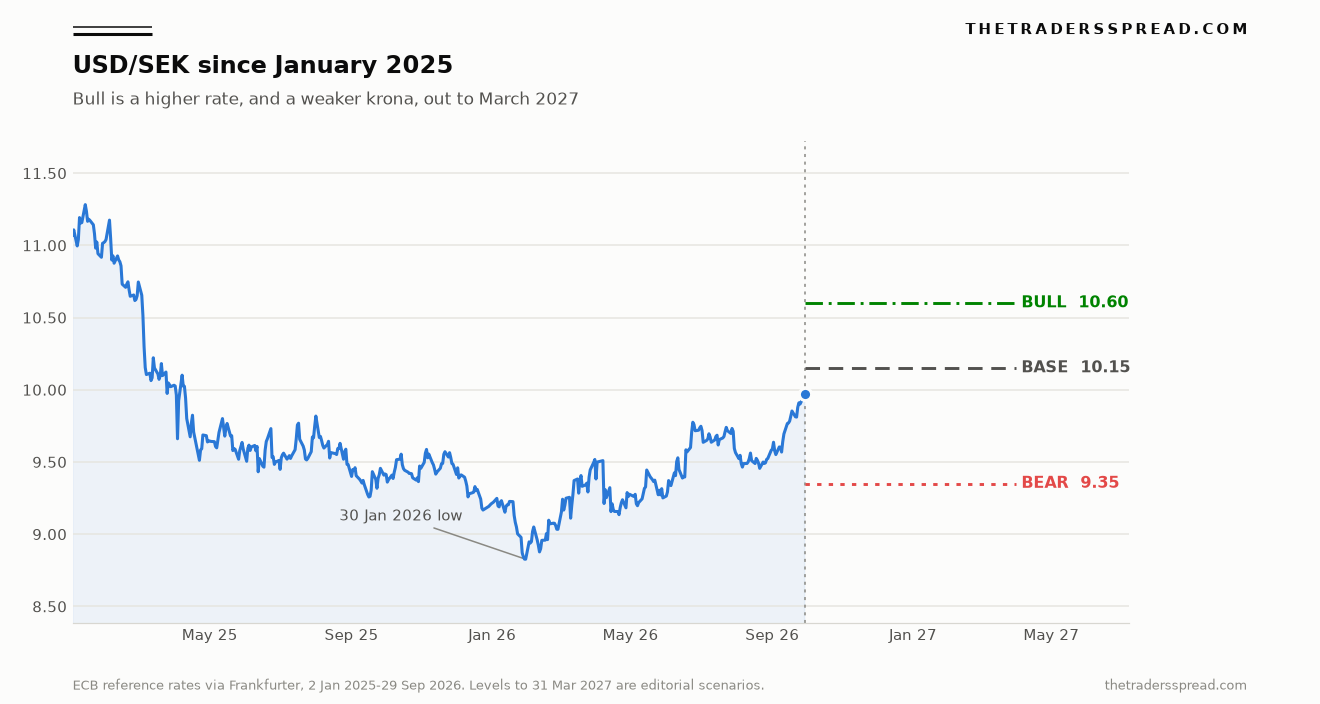
Read the chart from the left. The drop through 2025 is the rally in the krona the current twelve-month high has not erased. The rise through 2026 is the partial give-back. To the right of the dotted line, BULL at 10.60 is still under the January 2025 region near 11.1, and BEAR at 9.35 sits near the second-quarter average, well above the January 2026 low.
0.7 per cent is the wrong inflation number
Headline Swedish inflation looks like a reason for the Riksbank to sit still forever. It is not the number the Executive Board is using.
In August, CPIF inflation was 0.7 per cent and CPIF excluding energy was 0.5 per cent, in line with the June forecast. The report is plain about why the headline is that low: temporary fiscal measures, tax cuts on food and fuel among them, are holding measured inflation down. Exclude those measures and August CPIF was 2.2 per cent, with CPIF excluding energy at 1.6 per cent. The inflation target is 2 per cent. Service prices were still firmer than the Bank had expected. The same chapter says inflationary pressures, taken across a wide set of indicators, are higher than normal, and that a weaker krona raises firms' import costs.
A weaker krona raises import costs, which is one reason the Board expects inflation to rise, which is why the rate path was marked up. The report still says the krona should strengthen again over the forecast period. Spending that future bid today, against a Fed whose median dot does not ease in 2027, is the mistake.
The decision notified on 24 September, taken by Governor Erik Thedéen together with First Deputy Governor Aino Bunge and Deputy Governors Per Jansson, Anna Seim and Göran Hjelm, holds the policy rate at 1.75 per cent from 30 September and states the condition for what comes next. "If the outlook for inflation and economic activity remains unchanged, the Riksbank expects to begin raising the policy rate this year." The same text says a larger and more persistent inflation rise would mean a faster pace than the current forecast. The next monetary policy meeting is on 3 November, with the decision published on 4 November.
Little of that hiking talk sits inside 2026. The fourth-quarter average is 1.85 per cent, against 1.75 today and 1.82 in the June projection. A revision of three hundredths is the footprint of a single late quarter-point: a rate of 2.00 for the final month of the quarter, and 1.75 for the other two, averages near 1.83. The surprise is 2027. The second-quarter average went from 1.93 to 2.24, the third-quarter average from 1.97 to 2.38, and the annual policy-rate forecast for 2027 from 1.9 to 2.3 per cent. GDP for 2026 was revised from 2.2 to 2.8 per cent, with unemployment still at 8.6 per cent this year. Sweden is being forecast as an economy that can take higher rates. It is not being forecast as one that closes the gap with the Fed inside this horizon.
What Washington published, and what it did not
On 16 September the Federal Open Market Committee raised the target range by a quarter of a percentage point, to 3.75 to 4 per cent, 12 to 0. Interest on reserve balances went to 3.90 per cent, effective 17 September. July's meeting had held at 3.50 to 3.75 per cent, and Beth M. Hammack, Neel Kashkari and Lorie K. Logan had preferred a quarter-point rise then. September's rise drew no dissent.
Kevin Warsh, Chairman of the Federal Reserve, put the reason in the press conference the same afternoon. "The plain fact is that inflation is too high and has been for too long." He also gave a nowcast, not an official print, of the month the Bureau of Economic Analysis is publishing today: based on CPI and PPI, "the 12-month change in total PCE prices likely was around 3.6 percent in August. Core PCE and CPI prices are running at about 3.2 and 2.4 percent, respectively." The last official figures, for July, were a 3.7 per cent rise in the PCE price index and a 3.3 per cent rise excluding food and energy, in the 26 August BEA release. Real consumer spending that month was essentially flat.
This note is scheduled before that August release. The BEA calendar puts Personal Income and Outlays for August at 8:30 a.m. Eastern on 30 September, 12:30 UTC, and publication here is 11:30 UTC. Warsh's roughly 3.2 per cent core figure is a 16 September reading of CPI and PPI, not the official print. The Committee's median projection for core PCE, fourth quarter on fourth quarter, is 3.4 per cent for 2026. Headline PCE in the same table is 3.7 per cent for 2026 and 2.3 per cent for 2027.
Eighteen participants filed dots. For the end of 2026, two sit on a midpoint of 3.875 per cent, the midpoint of the range just set. Twelve sit at 4.125. Four sit at 4.375. The median, reported as 4.1, is one further quarter-point from here, not two and not zero. For the end of 2027 the median is still 4.1. In June that end-2027 median was 3.6. Half a percentage point on the dollar side, against a Swedish 2027 path that was revised by less.
The gap today, midpoint of the Fed range minus 1.75, is 2.125 percentage points. Set 4.1 at the end of 2027 against the Riksbank's second-quarter 2027 average of 2.24 and 1.86 points are still on the page. The FOMC schedule next lists 27 to 28 October, then 8 to 9 December, and only December brings new projections. Pricing of the September meeting before the vote is a separate record, in the September Fed contract note. Those odds are not reused here. The open question is whether the extra quarter-point in the 2026 median survives today's PCE print.
Norway did not take this path
A weaker krona is easy to file under "Scandinavia" and move on. The other krone refuses the filing.
On 29 September 2025 the ECB reference was 9.9612 Norwegian kroner per dollar. On 29 September 2026 it was 9.576. That is a 3.9 per cent decline in USD/NOK: the Norwegian krone strengthened against the dollar. Over the same dates USD/SEK rose 6.0 per cent. The gap between those two dollar moves is just under 10 percentage points. Against the euro the Swedish krona also lost ground, but less than against the dollar. EUR/SEK went from 11.03 on 29 September 2025 to 11.321 on 29 September 2026, a rise of 2.6 per cent. The dollar leg is the larger one. It is not the only one.
KIX, the Riksbank's basket against the dollar, the euro, sterling and the Norwegian krone, has weakened almost 4 per cent since the June meeting. A lower index means a stronger krona, so that is a genuine trade-weighted loss, not a dollar-only chart trick, and it is still not a Nordic one. The EUR/NOK forecast on this desk is a different central bank. The year-end cases for USD/CNH do not point the same way as a higher USD/SEK either. This is a krona call.
RelatedGBP/NZD Forecast: 2.42 Bull Case vs 2.24 Bear Case
| Published setting | Now | Path used in this note |
|---|---|---|
| Fed funds | 3.75 to 4 per cent, from 17 September 2026 | Median 4.1 at end-2026 and end-2027 |
| Riksbank policy rate | 1.75 per cent, from 30 September 2026 | 1.85 in Q4 2026, 2.24 in Q2 2027, quarterly averages |
| USD/SEK, ECB reference | 9.9701 on 29 September 2026 | Base 10.15, bull 10.60, bear 9.35, to 31 March 2027 |
| CPIF, August 2026 | 0.7 per cent headline, 2.2 excluding temporary fiscal measures | Riksbank sees the weak krona among the reasons inflation rises from here |
Base 10.15, bull 10.60, bear 9.35
The base case is 10.15 by 31 March 2027, 1.8 per cent above the 29 September fixing. About 1.9 percentage points still separate a 4.1 funds-rate median from a 2.24 Swedish average in mid-2027. Half the editorial weight sits here.
The bull case, and the target on the higher-USD/SEK view, is 10.60, about 6.3 per cent above the fixing and still below 11.067 from 2 January 2025. It needs August PCE to keep the median dot's extra quarter-point alive at the 27 October or 8 December meeting, and a Riksbank that does not bring the 2027 path forward on 4 November. Three in ten. Too far from spot to be the central case.
The bear case is 9.35, about 6.2 per cent below the fixing and in line with the 9.36 second-quarter average. It is also the invalidation. It needs the Fed inside 3.75 to 4 per cent through March, a minority of the dots, and a Riksbank that narrows the gap without a fresh inflation scare from the weak krona. Two in ten. These are editorial weights, not option prices, and not an instruction. Conviction on the higher-USD/SEK view is 3 out of 5: the gap points up, and a twelve-month high plus a PCE print one hour after publication argues against treating 10.60 as the likely path.
Weight moves toward 10.60 if core PCE lands well above Warsh's roughly 3.2 per cent nowcast and the Riksbank is still on hold on 4 November. It moves toward 9.35 if core PCE breaks below that nowcast, if the 28 October Fed statement no longer matches twelve dots at 4.125, or if Swedish inflation ex fiscal measures jumps far enough above August's 2.2 per cent that the Board pulls the 2027 path forward. A fixing back through 9.35 retires the higher-USD/SEK view on price alone.
Questions that actually come up on this cross
Does a higher USD/SEK mean a stronger krona?
No. USD/SEK is kronor per dollar. A rise means the dollar buys more kronor, so the krona is weaker. The bull case at 10.60 is a weaker krona. The bear case at 9.35 is a stronger one. The labels on the chart follow the rate, not a view about Swedish growth, and the base case at 10.15 is also above the 9.9701 fixing.
Why did the krona not strengthen on the 24 September decision?
The fourth-quarter average rose only from 1.82 to 1.85 per cent. The Fed had already set a 3.75 to 4 per cent range on 16 September, with a 4.1 median at year-end. From 9.9098 on decision day to 9.9701 on 29 September, the dollar rate rose. A forecast of a stronger krona over the projection was not a reason, on those days, to mark USD/SEK down.
Does CPIF at 0.7 per cent cap USD/SEK?
Not by itself. Once temporary fiscal measures are removed, the Riksbank puts August CPIF at 2.2 per cent, close to the 2 per cent target, and says pressures are higher than normal. It also lists the weaker krona among the reasons inflation is expected to pick up. The 0.7 per cent headline is a poor guide to the 24 September reaction function.
Where do 10.60 and 9.35 come from?
10.60 is about 6.3 per cent above the 29 September fixing and still below the 11.067 reference of 2 January 2025, so it extends the give-back without completing it. 9.35 is about 6.2 per cent below the fixing and matches the second-quarter 2026 average of 9.36. The base, 10.15, is 1.8 per cent above spot. All three sit inside the range the pair has already traded since January 2025.
What arrives next that can break this?
Today, after publication: the August personal income and outlays release, 8:30 a.m. Eastern on 30 September. Then the Fed on 27 to 28 October, the Riksbank decision on 4 November, and the Fed projections on 8 to 9 December. The level that retires the higher-USD/SEK case without waiting for those meetings is a move back through 9.35.
Disclaimer: This article is market analysis for information only and is not investment advice or a recommendation to transact in any currency or derivative. Scenario levels and the weights attached to them are the author's estimates and may prove wrong. Trading foreign exchange and CFDs on margin carries a high level of risk, and you can lose more than your initial capital. Fixings are ECB reference rates via Frankfurter as retrieved on 30 September 2026, latest fixing date 29 September 2026, unless a source and a date in the text say otherwise.