

Having traded the DAX through the 2022 gas panic and then through the easing cycle that took the European Central Bank's deposit rate from 3.00% down to 2.00% across 2025, I have learned to read a single session for its shape rather than its size. On 9 September the index closed at 25,576.45, down 431.18 points, or 1.66%. Deutsche Börse's own quote page for ISIN DE0008469008 put the day's high at 25,909.66 and the low at 25,512.39, so the tape spent the whole session travelling in one direction. It was the first daily move larger than 1.5% in 34 sessions. What held my attention was not the magnitude but the composition. Of the 26 index members I priced off Börse Frankfurt that evening, 24 finished lower, and the heaviest losses sat nowhere near the banks or the classic exporters.
They sat in Rheinmetall, down 3.75%, MTU Aero Engines, down 3.18%, Siemens, down 2.97%, and Heidelberg Materials, down 2.84%. Those four are the purest listed expressions of one idea: German government spending. Two are defence primes, one supplies the concrete and cement that any infrastructure programme consumes, and Siemens straddles both. So on the session before an ECB decision, the market was not repricing German earnings. It was repricing the German fiscal promise. That distinction matters more than it sounds, because the ECB itself has been explicit about which of the two is holding the economy up. In the 23 July monetary policy statement, Christine Lagarde, President of the European Central Bank, told the press conference that manufacturing "has continued to hold up, supported by firms building up stocks to guard against supply chain risks, as well as by higher defence spending." Strip the spending out of that sentence and there is not much left.
Key facts
- DAX closed at 25,576.45 on 9 September 2026, down 431.18 points or 1.66% — Deutsche Börse / boerse-frankfurt.de quote for ISIN DE0008469008, XETR, retrieved 10 September 2026
- That leaves the index 3.74% below its record closing high of 26,569.99, set on 28 August 2026, and up 4.23% year to date from the 2 January close of 24,539.34 — Xetra daily closes, retrieved 10 September 2026
- German industrial production fell 1.1% month on month in July 2026 and 1.6% year on year; excluding energy and construction it was down 2.2% on the month — Destatis release 316, 7 September 2026
- German consumer price inflation was 2.9% in August 2026, with energy prices up 10.5% year on year after 8.3% in July and 3.4% in June — Destatis release 311, 31 August 2026
- The ECB deposit facility rate has been 2.25% since 17 June 2026, when it was raised from 2.00%; the main refinancing rate is 2.40% — ECB Data Portal series FM.D.U2.EUR.4F.KR.DFR.LEV, retrieved 10 September 2026
- The euro area AAA-rated 10-year spot yield was 3.378% on 8 September 2026, against 2.975% on 2 January — ECB euro area yield curve, retrieved 10 September 2026
- German exports to the United States reached €14.4bn in July 2026, up 28.3% year on year, while exports to China fell 9.5% on the month to €5.6bn — Destatis release 318, 8 September 2026
What the tape did on 9 September
Breadth was the story. I pulled closing changes for 26 of the 40 index members directly from Börse Frankfurt on the morning of 10 September, before the Xetra open, so each figure is that stock's 9 September session change against its previous close. Twenty-four were red. Only two were green, and the two were SAP, up 0.64% at €180.18, and RWE, up 1.69% at €60.18. A utility and an enterprise software house are not a rotation. They are what is left standing when everything cyclical and everything policy-linked is sold at once.
| DAX member | Close, 9 Sep 2026 | Session change | What it represents |
|---|---|---|---|
| Rheinmetall | €1,010.20 | -3.75% | Defence prime |
| MTU Aero Engines | €344.00 | -3.18% | Military and civil propulsion |
| Siemens | €264.70 | -2.97% | Industrial capex and infrastructure |
| Heidelberg Materials | €157.50 | -2.84% | Cement, aggregates, public works |
| Infineon | €56.93 | -2.57% | Auto and industrial semiconductors |
| Deutsche Börse | €272.90 | -2.28% | Exchange and post-trade fees |
| Airbus | €196.54 | -2.24% | Aerospace |
| SAP | €180.18 | +0.64% | Enterprise software |
| RWE | €60.18 | +1.69% | Power generation |
Source: Deutsche Börse / boerse-frankfurt.de single-quote data for each ISIN, retrieved 10 September 2026 before the Xetra open. Sample of 26 of 40 index members.
Put that day in context and it looks less alarming and more like a reminder. Across 176 trading sessions in 2026 the index has produced 21 daily moves larger than 1.5%; 9 September was the eighth-worst down day of the year, and the worst since 23 July. Ninety-day realised volatility, computed from daily log returns and annualised by the square root of 252, sits at 14.1%. Thirty-day realised volatility is 10.3%. The market had been unusually still, and then it was not.
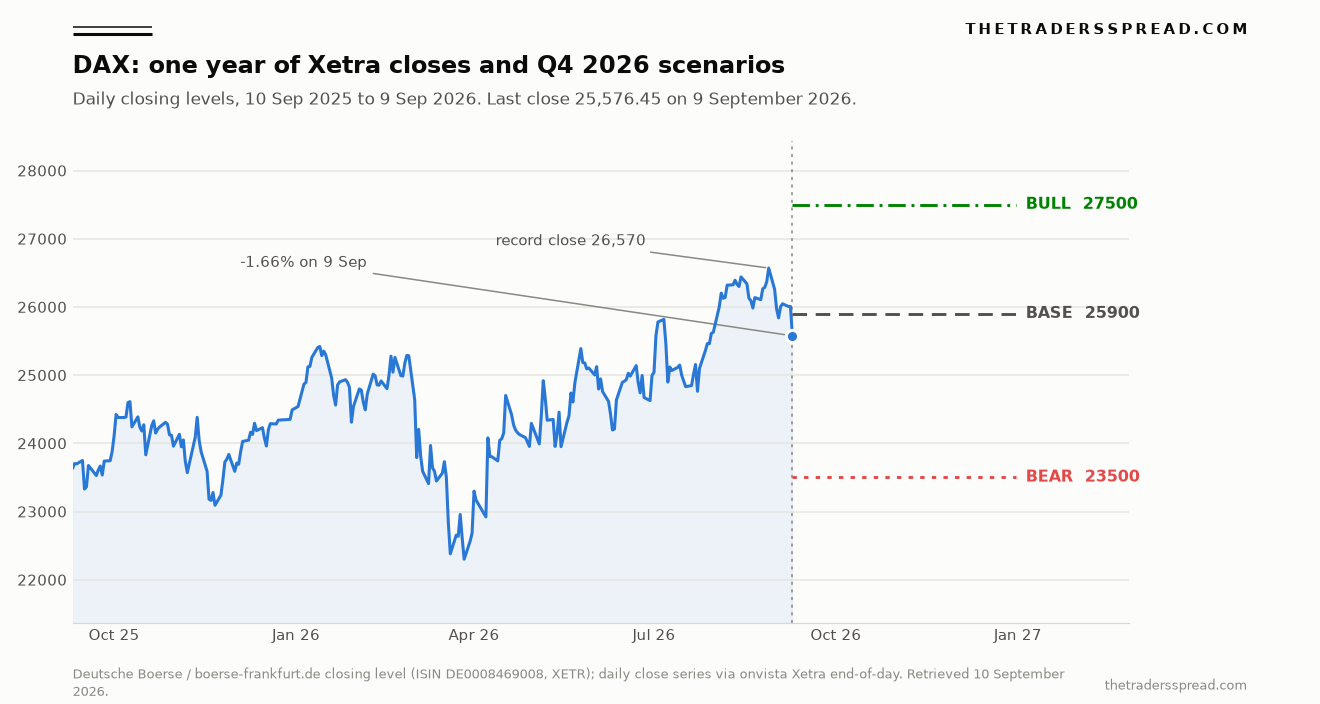
The one-year picture is a market that fell 12.3% between 13 January and 27 March, then climbed 19.1% off that 22,300.75 trough to the August record, and has since given back a little under four points of that. Deutsche Börse's own performance summary puts the index up 8.22% over twelve months and 40.02% over twenty-four. The two-year number is the one worth sitting with. Very little of it was delivered by German industrial output.
Now look at the economy underneath
German industrial production fell 1.1% in July 2026 against June, and 1.6% against July 2025. Strip out energy and construction and the decline was 2.2% on the month and 3.3% on the year. Capital goods production, the segment that maps most directly onto the industrial names in the index, fell 3.4% in a single month.
Destatis attributes much of the July drop to a multi-week shutdown in the automotive industry, where output fell 9.2%, and that is a fair caveat: shutdowns reverse. But the year-on-year figure does not reverse, and the three-month comparison, which is the series the statisticians themselves prefer, showed growth of only 0.4%.
Trade tells a stranger story. July exports came in at €138.2bn, down 0.8% on the month but up 6.1% on the year, with imports down 5.7% at €116.9bn. The surplus widened to €21.3bn from €15.4bn in June. Inside that number, exports to the United States jumped 19.1% on the month to €14.4bn and were 28.3% higher than a year earlier, while exports to China dropped 9.5% to €5.6bn and shipments to the United Kingdom fell 7.2%.
Germany is running a trade book that is increasingly a single-customer book. That is a source of earnings in a good quarter and a source of concentrated policy risk in a bad one, and it is one reason the euro's own path matters so much to this index. The EUR/USD forecast we published on this desk frames the same tension from the currency side. At the ECB reference rate of 1.1652 on 9 September, a stronger euro is a direct translation haircut on those American revenues.
Frankfurt's discount rate is going the wrong way
Here is the part of the setup I think is genuinely underpriced. Equity valuations are a function of two things, expected cash flows and the rate you discount them at, and in Germany both are moving against the index at the same time.
The ECB raised its deposit facility rate to 2.25% with effect from 17 June 2026, the first increase after the 2024 to 2025 easing sequence, and left it there on 23 July. The main refinancing rate is 2.40%. Neither is restrictive by the standards of 2023. What matters is the direction and the reason. Lagarde's July statement described risks to the inflation outlook as being "to the upside" and warned that the energy shock "is likely to keep inflation well above target into the first half of 2027."
German data since then has confirmed the warning rather than softened it. Consumer price inflation ran at 2.9% in August. Core inflation held at 2.4%. Energy prices, the component that transmits fastest into industrial margins, accelerated from 3.4% year on year in June to 8.3% in July and 10.5% in August. That is not a base effect unwinding. That is a live cost shock, and it is the same shock that pushed crude back above $90 after strikes on Iran resumed.
The bond market has already responded. The euro area AAA-rated 10-year spot yield stood at 3.378% on 8 September, against 2.975% on 2 January and a February low of 2.727%. Forty basis points of additional discount rate across a year in which the index gained 4.23% means the entire equity gain has been achieved while the denominator worked against it. Central bankers were in Berlin for an external Governing Council meeting as this was happening. Speaking at the Bode-Museum on the evening of 9 September, Joachim Nagel, President of the Deutsche Bundesbank, argued that "Europe is large on paper. It must become large in practice." He was talking about the single market and artificial intelligence. He was also, whether he intended it or not, describing the gap between what this index is priced for and what the continent currently delivers.
The fiscal bid is a flow, not an earnings stream
The bull case for German equities in 2026 has been fiscal, and it has worked. Defence procurement and infrastructure spending have re-rated an entire cohort of industrial names, which is why Rheinmetall trades above €1,000 and why a cement business is a momentum stock.
My objection is not that the spending is fake. It is that a government spending programme is a flow with a political duration attached to it, and equity multiples are being set as though it were a permanent margin structure. Germany's general government deficit reached €71.3bn in the first half of 2026 alone, according to Destatis, which is precisely the kind of number that generates a domestic argument about the pace of disbursement rather than about the direction of policy.
Sentiment surveys, to be fair, are pointing the other way and they have been right more often than I have this year. The ifo Business Climate Index rose to 88.8 points in August from 86.7 in July, with the current situation component at 88.5 and expectations at 89.1. Clemens Fuest, President of the ifo Institute, summarised it as follows: "Despite another rise in energy prices, the German economy is recovering." The ZEW Indicator of Economic Sentiment reached plus 34.2 points on 18 August.
An index level of 88.8, though, is still a long way below the 100 mark that separates optimism from resignation on that series. What the surveys are describing is a recovery from a low base, arriving alongside a rising policy rate and a re-accelerating energy bill. Hold both facts at once and you get a market that can grind higher without ever becoming cheap.
Where this argument falls apart
I want to be honest about the ways I could be wrong, because a forecast that only lists supporting evidence is marketing.
First, the export number. A 28.3% year-on-year jump in shipments to the United States is not a rounding error, and if that persists through the autumn then German earnings revisions turn positive regardless of what domestic production does. Second, new orders in manufacturing rose 2.5% in July, which usually leads production by a quarter or two. Third, the automotive shutdown that cost 9.2% of that sector's July output mechanically reverses in August and September.
Fourth, and most important, the ECB may simply be finished. Today's Governing Council decision in Berlin lands after this piece is filed. If the statement drops the upside-risk language and the projections show inflation back at target in 2027, the discount-rate argument I have just made collapses within a fortnight, and every scenario in the table below shifts higher. The euro's behaviour will tell you first, which is why the safe-haven bid inside USD/CHF and the rate spread running through EUR/HUF are worth watching alongside the index itself. Our DAX market page tracks the level as it moves.
The call: 27,500 bull, 23,500 bear, and what changes my mind
Ninety-day realised volatility of 14.1% over the 77 trading sessions to 31 December implies a one standard deviation range of roughly 1,990 index points around spot, or about 7.8%. Every probability below comes from that distribution, applied to daily log returns with no drift assumption layered on top.
RelatedUSD/SGD Forecast: 1.3200 Bull Case vs 1.2500 Bear Case
Base case, 25,900 by 31 December 2026, with a 24,500 to 26,500 band carrying 39% of the distribution. The index chops sideways to slightly higher as fiscal disbursement continues, energy inflation caps the multiple, and neither the economy nor the ECB forces a decision.
Bull case, 27,500, roughly 7.5% above spot. A close at or above that level carries an 18% terminal probability, and the level is touched at some point in the quarter with 35% probability. The wider bull region, a close above 26,500, carries 32%. This requires the ECB to signal it is done, the automotive rebound to show up in the August and September production prints, and the American export channel to hold.
Bear case, 23,500, roughly 8.1% below spot. A close at or below it carries a 14% terminal probability, with a 28% chance of being touched. The wider bear region, a close below 24,500, carries 29%. The route there is a further ECB hike into an economy that is already contracting in real terms, or a credible domestic challenge to the pace of the spending programme, which would hit the same four stocks that led the 9 September decline.
What would change my mind, in order: an August production print that recovers the automotive loss in full; German energy CPI decelerating below 6% year on year; the euro area 10-year AAA yield closing back below 3.10%. Any two of those and I move the base case toward the top of the band. A close below 24,500 on rising volume would tell me the fiscal re-rating is being unwound rather than trimmed, and at that point the bear scenario stops being a tail.
FAQ
What is the DAX and what does a DAX CFD track?
The DAX is Deutsche Börse's benchmark index of the 40 largest and most liquid companies listed on the Frankfurt Stock Exchange, calculated from Xetra prices under ISIN DE0008469008. It is a performance index, meaning dividends are reinvested in the calculation. A DAX CFD is a contract whose value follows that index level, usually quoted around the Xetra cash session and the futures market outside it, so the price you see on a broker platform may differ from the official closing level of 25,576.45 on 9 September 2026.
Why did the DAX fall 1.66% on 9 September 2026?
The decline was broad, with 24 of the 26 members I sampled finishing lower, and it was led by defence and capital-goods names rather than by banks or consumer stocks. It followed two weak Destatis releases, production down 1.1% on 7 September and exports down 0.8% on 8 September, and it landed on the session before an ECB Governing Council decision. I have not found a single confirmed catalyst at a primary source, and I am not going to invent one.
Is the DAX expensive at 25,576?
That depends entirely on whether you treat German fiscal spending as a permanent earnings stream or as a multi-year flow. The index has gained 40.02% over two years and 4.23% in 2026 to date, while real industrial output has fallen 1.6% year on year and the euro area 10-year AAA discount rate has risen roughly 40 basis points since January. Those three facts are hard to reconcile without assuming the spending programme runs for a long time.
How do the bull and bear probabilities work?
They are derived from realised volatility, not from options pricing. I take 90 days of daily log returns on Xetra closing levels, take the standard deviation, annualise by multiplying by the square root of 252, and scale to the 77 trading days remaining to 31 December 2026. That produces the terminal probabilities. Touch probabilities use the reflection principle, which doubles the terminal probability of breaching a level, capped at one.
What is the single most important date for the DAX this quarter?
Each ECB Governing Council decision, starting with the one in Berlin on 10 September 2026. German inflation is running at 2.9% with energy up 10.5% year on year, the deposit rate has already been raised once this cycle, and the July statement flagged upside inflation risks. Whether the Council extends that language or retires it decides which half of my distribution the index spends the fourth quarter in.
Disclaimer
This article is analysis and information, not investment advice, and nothing in it is a recommendation to take a position in the DAX, in any index CFD or in any listed security. Levels, probabilities and scenarios are estimates derived from public data and stated assumptions, and they can be wrong. CFDs and leveraged index products carry a high risk of rapid loss; your capital is at risk. Prices and figures were retrieved on 10 September 2026 and will change.