

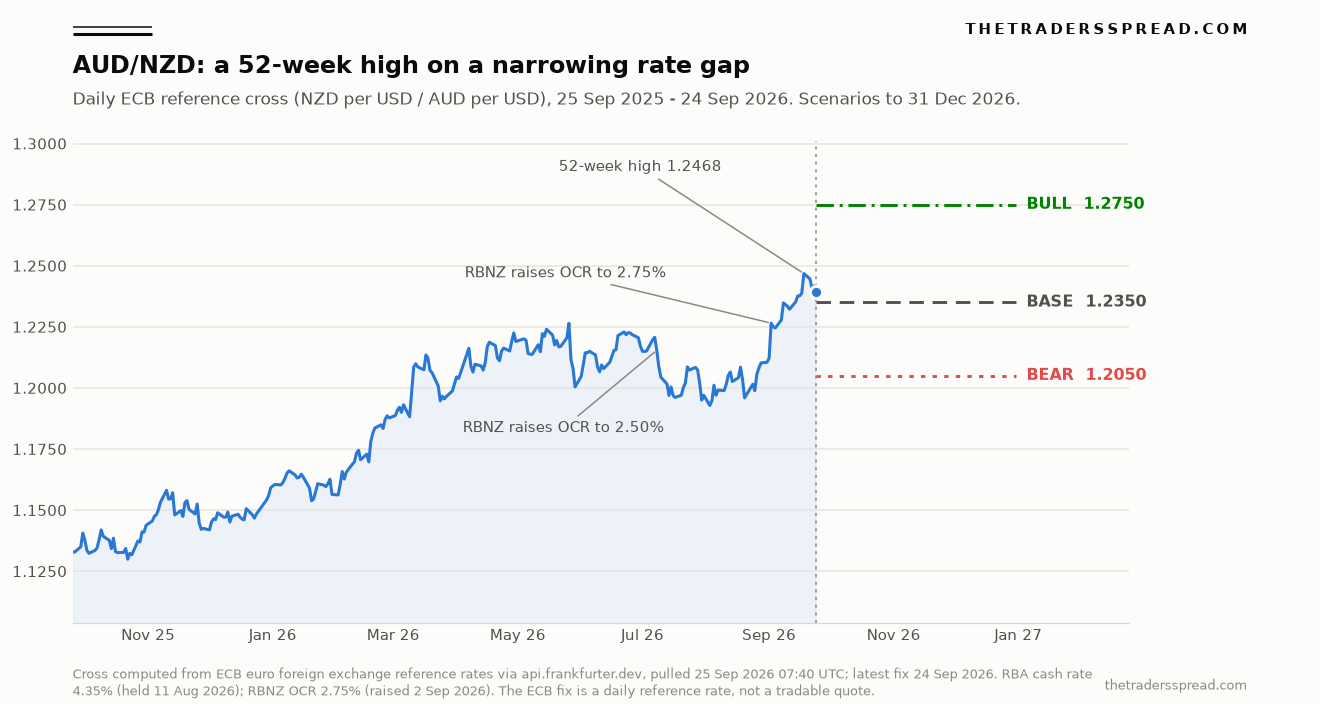
On the morning of 18 September 2026, in a committee room in Canberra, Reserve Bank of Australia Governor Michele Bullock told the House of Representatives Standing Committee on Economics that Australian inflation was "too high" and that the risks around it had begun to move the wrong way. Later that same day the European Central Bank published its daily reference rates, and the cross derived from them, AUD/NZD, printed 1.2468. That was the highest fix in a year. The pair has spent the twelve months since September 2025 grinding from 1.1329 to 1.2393, a gain of 9.40 per cent, and almost every explanation offered for that climb has rested on one number: the gap between Australian and New Zealand policy rates.
The trouble with that explanation is that the gap peaked nearly five months ago. On 6 May 2026 the RBA raised its cash rate target to 4.35 per cent while the Reserve Bank of New Zealand still sat at an Official Cash Rate of 2.25 per cent, a spread of 209 basis points. AUD/NZD fixed at 1.2141 that day. The RBNZ has since raised twice, to 2.50 per cent on 8 July and to 2.75 per cent on 2 September, closing the spread to 159 basis points. Over the same stretch the cross rose another 2.08 per cent. The carry advantage shrank by a quarter and the currency it was supposed to be funding went up anyway.
- AUD/NZD at 1.2393 on the ECB reference fix of 24 September 2026 — computed as NZD per USD 1.7638 divided by AUD per USD 1.4232, ECB rates via api.frankfurter.dev, pulled 25 September 2026 07:40 UTC
- 52-week high 1.2468 on 18 September 2026; 52-week low 1.1299 on 22 October 2025 — the fix sits at 93.6% of that range
- RBA cash rate target 4.35%, unchanged since 6 May 2026, held unanimously on 11 August — RBA Statement by the Monetary Policy Board, 11 August 2026
- RBNZ Official Cash Rate 2.75% after a 25bp increase decided by consensus — RBNZ summary record of meeting, 2 September 2026
- Policy spread 159bp today against a 2026 peak of 209bp on 6 May — RBA cash rate table and RBNZ past-decisions page, both read 25 September 2026
- New Zealand annual CPI 4.1% in the June 2026 quarter against Australian CPI of 3.5% in the year to July 2026 — Stats NZ and the ABS
- Australian unemployment rose 0.2ppt to 4.6% in August 2026, published on 24 September, five days before the RBA next decides — ABS Labour Force, Australia
Two banks, one oil shock, opposite starting points
Both central banks are fighting the same fire. The Middle East conflict pushed oil and refined products sharply higher through 2026, and both describe the pass-through in almost identical language. What differs is where each started and how much of the shock each chose to look through.
Australia entered the episode with a domestically generated inflation problem. The RBA's statement of 11 August 2026 is explicit that inflation "picked up materially in the second half of 2025" and that "some of the increase reflected greater capacity pressures" — that is, an economy running hot before a barrel of oil moved. The Board responded with three increases in the first half of 2026, taking the cash rate target from 3.60 per cent to 4.35 per cent across 4 February, 18 March and 6 May, according to the RBA's own cash rate table. It has held at that level through June and August.
New Zealand entered from the other side. The RBNZ cut to an OCR of 2.25 per cent on 26 November 2025 and stayed there through February, April and May 2026, a genuinely stimulative setting for an economy that had shrunk on an annual basis for most of 2025. Its inflation problem arrived later and from outside. The Committee's summary record for 2 September puts annual CPI at 4.1 per cent in the June quarter, "largely driven by higher fuel and related prices", and then adds the number that matters: "Excluding vehicle fuels, annual CPI inflation decreased to 2.9 percent in the June quarter."
So one bank is tightening against a core problem it has already had for a year, and the other is removing stimulus against a shock it expects to drop out of the annual comparison. The first bank is nearly done. The second has barely started. The RBNZ said as much: "Conditional on the central economic outlook, members judged that the OCR may need to increase further."
What the carry story is ignoring
Take the nominal spread at face value and Australia pays 160 basis points more than New Zealand. Deflate each policy rate by its own headline inflation and the ranking inverts in magnitude: Australia's real cash rate is roughly plus 0.85 percentage points against CPI of 3.5 per cent in the year to July 2026, while New Zealand's real OCR is minus 1.35 points against 4.1 per cent. On that measure the gap is not 160 basis points but 220, and the bull case looks stronger than the nominal spread suggests.
Now deflate by each country's own attempt to strip out the volatile items. The ABS put Australian trimmed mean inflation at 3.6 per cent in the year to July 2026, which leaves a real cash rate of plus 0.75 points. Stats NZ measured CPI excluding food, the household energy subgroup and vehicle fuels at 2.5 per cent for the June quarter, which leaves a real OCR of plus 0.25 points. The gap collapses to 50 basis points.
Three defensible answers to the same question, ranging from 50 to 220 basis points, and the difference between them is a choice about whether the oil shock counts as inflation. A trimmed mean is not the same object as a fixed-exclusion index, so the 50 basis point figure is an approximation. But it is the approximation both central banks are running policy off, and it is not the one priced into a cross trading at 93.6 per cent of its 52-week range.
| Measure | Australia | New Zealand | Gap |
|---|---|---|---|
| Policy rate | 4.35% (cash rate, since 6 May 2026) | 2.75% (OCR, since 2 Sep 2026) | 160bp |
| Last move | +25bp, 6 May 2026 | +25bp, 2 Sep 2026 | — |
| Headline CPI | 3.5% (year to Jul 2026) | 4.1% (Jun 2026 quarter) | −0.6pp |
| Ex-volatile measure | 3.6% trimmed mean | 2.5% ex food, energy, fuel | +1.1pp |
| Unemployment | 4.6% (Aug 2026) | 5.6% (Jun 2026 quarter) | −1.0pp |
| Latest GDP | demand growth easing, per RBA | +0.2% q/q, +1.7% y/y (Jun 2026 qtr) | — |
| Next decision | 29 September 2026 | after the September quarter data | — |
Sources for the table: RBA cash rate table, RBNZ past monetary policy decisions, ABS Consumer Price Index, Australia, Stats NZ consumers price index, ABS Labour Force, Australia and Stats NZ labour market statistics, all read 25 September 2026.
Five days that decide the Australian leg
The RBA Monetary Policy Board meets on 28 and 29 September 2026, with the decision due on the Tuesday. That date comes from the Bank's published board meeting schedule, and the statistical release calendar confirms the Monetary Policy Changes table is slated for after 2.30pm on 29 September.
Bullock previewed the meeting herself. "The Monetary Policy Board will meet in just over a week's time," she told the committee on 18 September. "A key question is whether the tightening in monetary policy to date will be sufficient to bring inflation back to target in a reasonable time."
She was blunter about the direction of surprise. "Developments since then suggest that although growth in the Australian economy is slowing, some of these upside risks to inflation appear to be materialising," said Michele Bullock, Governor of the Reserve Bank of Australia, in her opening statement to the House of Representatives Standing Committee on Economics on 18 September 2026. She put the unemployment rate at 4.5 per cent that morning and described the labour market as "close to, but a little tighter than, full employment".
Six days later the ABS published August labour force data showing the unemployment rate had risen 0.2 percentage points to 4.6 per cent, seasonally adjusted. That release landed on the morning of 24 September, the day of the ECB fix quoted throughout this piece, and the cross slipped 0.19 per cent from 1.2417 to 1.2393. One print and one fix prove nothing. They do mean the last labour reading the Board sees before Tuesday is softer than the one its Governor described in Canberra.
The calendar adds a second complication. The ABS lists August CPI for 30 September 2026, the day after the Board decides. The cash rate will be set without the freshest inflation print, from July's 3.5 per cent headline and 3.6 per cent trimmed mean.
And the Board is not of one mind about the mechanism that would justify going further. Speaking in Melbourne on 22 September, three days after Bullock's testimony, Iain Ross AO, Monetary Policy Board member at the Reserve Bank of Australia, took direct aim at the wage-spiral argument: "The overall thesis is that there is no evidence of the emergence of a wage-price spiral in the present circumstances and recent data suggest such an outcome is unlikely." He added that "recent data provide further reassurance: there is little evidence that a self-sustaining wage-price spiral has emerged following the latest inflationary episode." Ross was careful to note he speaks for himself and not the Board. That he chose to say it publicly nine days before a live meeting is the point.
The New Zealand leg is a fuel story wearing an inflation mask
Everything that makes New Zealand look weak on paper is real. Unemployment reached 5.6 per cent in the June 2026 quarter, up from 5.4, with underutilisation at 13.8 per cent, per Stats NZ. Wage inflation on the labour cost index ran at 2.0 per cent. June quarter GDP, released 17 September, rose 0.2 per cent against 0.9 in March, and real gross national disposable income fell 0.4 per cent.
That print landed roughly a day before the fix that made the 52-week high. A soft New Zealand growth number on one side of the clock and hawkish Australian testimony on the other describes what the 18 September fix contained, though an ECB reference rate is a daily snapshot and cannot be decomposed into causes.
Look at the composition rather than the level, though, and New Zealand reads differently. Tradeables inflation ran at 4.9 per cent annually in the June quarter against non-tradeables at 3.4 per cent, an unusual inversion for an economy whose inflation problem is normally domestic. The imported half of that is precisely what fuel prices do, and it is what the RBNZ means when it forecasts inflation back inside the band by mid-2027 as the fuel base effect washes out. The same oil shock running through crude and through refined product prices is doing more visible work in the New Zealand index than in the Australian one.
The RBNZ also recorded something in September that bears directly on this cross. Domestic financial conditions have tightened, the Committee noted, with higher wholesale rates producing "a small appreciation in the exchange rate, partly reflecting expectations of future OCR increases". The Committee was describing a currency the market had already begun repricing upward. Sixteen days later AUD/NZD made its 52-week high in the opposite direction.
Four of the six Committee members — Hayley Gourley, Karen Silk, Prasanna Gai and chairperson Anna Breman — recorded upside risks to inflation relative to the central projection. Only Paul Conway and Carl Hansen saw those risks as balanced. A committee that skews hawkish four to two, on a rate 160 basis points below its neighbour's, is not obviously the weaker of the two currencies on a six-month view.
What would have to break
The bear case for this cross does not require a New Zealand boom. It requires the RBA to stop, which is roughly what its own August statement described: "the Board decided to leave the cash rate target unchanged while it assesses how the economy is evolving." A hold on 29 September, followed by an August CPI print on 30 September that continues July's descent from 3.8 to 3.5 per cent, would leave the Australian leg with nothing new to price while the RBNZ still has stated intent to deliver.
The bull case needs the opposite. It needs the Board to act on Bullock's "upside risks appear to be materialising" and hike on Tuesday, and it needs the RBNZ's fuel base effect to arrive on schedule so that New Zealand headline inflation falls back toward the band without further tightening. That combination reopens the spread toward 185 basis points and puts the 18 September high behind the market rather than in front of it.
Both legs have their own dollar stories running underneath, which is why a cross behaves differently from either component. Our standing views on those sit in the AUD/USD forecast and the NZD/USD forecast, and the Australian dollar's behaviour against a third high-carry funding leg is covered in the AUD/JPY forecast.
RelatedUSD/THB Forecast: 34.80 Bull Case vs 32.40 Bear Case
The call
Base case, 45 per cent: AUD/NZD spends the fourth quarter between 1.2050 and 1.2500 and finishes near 1.2350, 0.35 per cent below the 24 September fix. This is the outcome where the RBA holds on Tuesday without closing the door, the RBNZ keeps its gradual language, and a 160 basis point spread with neither side moving decisively produces a range rather than a trend.
Bear case, 33 per cent: a move to 1.2050, 2.77 per cent below the fix and back inside the August 2026 band of 1.1928 to 1.2105. This needs the RBA on hold on 29 September, the 30 September CPI confirming the July direction of travel, and the RBNZ delivering on "the OCR may need to increase further" before year-end. That is the full retracement of the September breakout, and it is where the 50 basis point real-rate reading points.
Bull case, 22 per cent: a move to 1.2750, 2.88 per cent above the fix and comfortably clear of the 1.2468 high. This requires an RBA increase on Tuesday and a New Zealand disinflation path that lets the RBNZ stop at 2.75 per cent. Both levels sit close to one standard deviation from the fix on the pair's 60-day realised volatility of 5.31 per cent annualised over a 98-day horizon, so neither is an extreme.
What would change my mind: a clean close above 1.2500 on the ECB fix would say the market is pricing an RBA increase and an RBNZ pause together, retiring the narrowing-spread argument the bear case rests on. An RBNZ move to 3.00 per cent before December with the RBA still at 4.35 would cut the spread to 135 basis points and make 1.2050 the base rather than the bear. A resolution of the Middle East conflict cuts both ways, but it removes proportionally more from the New Zealand index, where tradeables are doing the work.
FAQ
What is AUD/NZD trading at right now?
The most recent European Central Bank daily reference fix available at the time of writing was 24 September 2026, which put AUD/NZD at 1.2393, derived from NZD 1.7638 and AUD 1.4232 per US dollar. The 25 September set publishes at approximately 14:15 UTC. The ECB rate is a daily reference published once per business day and is not a tradable quote; intraday dealing prices will differ.
Why does the interest rate gap matter for AUD/NZD?
A cross between two commodity currencies with similar risk profiles trades on the relative policy path rather than global risk appetite, because the common factors largely cancel. Australia pays 4.35 per cent against New Zealand's 2.75 per cent, and the direction of that 160 basis point spread over the next two quarters is the largest identifiable driver of the cross.
Did the RBA raise rates in September 2026?
Not as at the date of this article. The last RBA decision published was 11 August 2026, which left the cash rate target unchanged at 4.35 per cent by unanimous vote. The Monetary Policy Board meets on 28 and 29 September 2026 with the decision due on the Tuesday, per the Bank's published schedule. Nothing here assumes an outcome.
What did the RBNZ actually decide on 2 September 2026?
The Monetary Policy Committee decided by consensus to raise the Official Cash Rate by 25 basis points to 2.75 per cent, its second increase of 2026 after the move to 2.50 per cent on 8 July. The summary record states that members judged the OCR "may need to increase further", conditional on the central economic outlook, and that the future path is not pre-determined.
Why is New Zealand's inflation higher than Australia's if its rate is lower?
Because the two indices are picking up different things. New Zealand's 4.1 per cent annual CPI in the June quarter is fuel-heavy, with tradeables at 4.9 per cent and the measure excluding food, household energy and vehicle fuels at 2.5 per cent. Australia's 3.5 per cent headline sits alongside a 3.6 per cent trimmed mean, which points to inflation generated at home rather than imported.
How were the bull and bear levels chosen?
Both are set approximately one standard deviation from the 24 September fix, using the pair's realised volatility of 5.31 per cent annualised over the trailing 60 ECB fixes and a horizon of 98 days to 31 December 2026. The bull level of 1.2750 also sits above the 52-week high of 1.2468, and the bear level of 1.2050 sits inside the August 2026 trading band.
Disclaimer
This article is analysis, not investment advice. Levels, probabilities and scenarios reflect the author's reading of primary sources as at 25 September 2026 and may be wrong. Foreign exchange and CFD trading carries a high risk of loss, including loss in excess of deposits. Past price behaviour is not a guide to future results.