

I have kept the Austin robotaxi service-area map open in a pinned tab since the middle of last year, and for the better part of ten months checking it was a waste of a click. Tesla (TSLA) left the boundary exactly where it had been. Hours changed, the fleet crept, the software shipped, and the outline of the geofence stayed frozen. On 31 August 2026 it finally moved, widening about 9% from roughly 264 square miles to roughly 288, pushing north along the US-183 corridor toward Pflugerville, according to Teslarati's reporting that day. On the same day, Texas regulators logged the first purpose-built Cybercabs on the state's automated-vehicle register. The stock closed at $367.95, up 5.51% from $348.75, on 60,931,996 shares against 32,009,732 the session before, per stockanalysis.com daily data pulled on 1 September 2026.
Most of the coverage framed 31 August as anticipation: traders positioning three days ahead of Tesla's 3 September Cybercab event in Austin. Anticipation is a forecast, and forecasts are cheap. Two checkable facts nobody led with make it a dated record instead. First, the Cybercab count on the Texas Motor Carrier Credentialing System did not simply appear at 45. It appeared at seven, under Tesla Robotaxi, LLC, with VINs starting 5YJA, and was revised upward to 45 the same day, a 38-vehicle amendment inside a single trading session. Second, the geofence had been static for ten months before that morning. Two dormant variables moved in the same session. That is the part worth writing down.
And the tape agreed it was Tesla-specific. On 31 August the SPDR S&P 500 ETF closed down 0.30% and the Dow-tracking SPDR DIA fell 0.65%, while the Nasdaq-100 QQQ managed +0.05% (stockanalysis.com, 31 August 2026). A 5.51% single-session gain against a flat-to-lower index is idiosyncratic risk expressing itself, not beta.
Key facts
- TSLA closed $367.95 on 31 August 2026, +5.51% from $348.75, its largest one-session gain since 6 July 2026 — stockanalysis.com daily OHLC, pulled 1 September 2026.
- Volume 60,931,996 shares, 1.90x the prior session and 1.54x the trailing 50-session average of about 39.5 million — same source.
- Texas logged seven Cybercabs, revised to 45 the same day, under Tesla Robotaxi, LLC in TxMCCS; the authorised Texas robotaxi total stood at 276 vehicles (269 Model Ys plus the seven) at the first count — Teslarati, 31 August 2026.
- Austin's driverless service area widened from ~264 to ~288 square miles, about 9%, its first expansion in roughly ten months — Teslarati, 31 August 2026.
- Unsupervised vehicles across Austin, Dallas and Houston reached nearly 200, up roughly 7x in about three weeks, per the crowdsourced Robotaxi Tracker cited by Teslarati on 31 August 2026.
- August 2026 as a month: $311.21 to $367.95, +18.23%. The stock still sits 26.2% below its 52-week intraday high of $498.83 set on 22 December 2025.
- Valuation on that close: market capitalisation $1.45 trillion, trailing P/E 381.83, forward P/E 193.29, trailing twelve-month revenue $103.62bn — stockanalysis.com, 1 September 2026.
Seven, then 45, in a single day
The mechanism here is duller than the price action, and knowing it changes how you read the number. Texas Senate Bill 2807 took effect in late May 2026 and created a self-certification route for commercial Level 4 operations. An operator files through the Texas Motor Carrier Credentialing System, attests to SAE Level 4 capability, carries insurance, and maintains an active vehicle list that the public can query through the TxDMV Motor Carrier and Automated Motor Vehicle Operator Lookup. Tesla completed that process months ago for the Model Y robotaxis already carrying paying passengers in Austin, Dallas and Houston.
What appeared on 31 August was an addition to an existing authorisation, not a new licence.
That distinction matters for anyone pricing the event. The filing is a legal prerequisite for commercial operation of the two-seat, steering-wheel-free vehicle on Texas roads. It is not evidence that a single member of the public has ridden in one. The VIN prefix is the tell that these are the real thing rather than reclassified test mules: 5YJA on the Cybercabs, distinct from the 7SAYG prefix carried by the Model Y robotaxis that make up the rest of the state fleet. Community trackers scraping the same public database recorded the new entries the same morning, and the count on the Cybercab line climbed from seven to 45 within hours, per Teslarati's update.
Tesla has had a friendly regulator in Texas for some time. In June the Cybercab was shown at the Texas Department of Transportation's Texas Innovation Invitational, where the agency's own executive director sat in one and wrote up the experience.
"Observing this vehicle firsthand, from its design and butterfly doors to the cargo trunk configuration, provides a tangible example of how quickly our transportation system is evolving… No steering wheel, no accelerator, no brake. Only a single touchscreen monitor."
— Marc Williams, Executive Director, Texas Department of Transportation, 17 June 2026 (via Teslarati)
A state transport chief posting an admiring note about a vehicle he regulates is not a rubber stamp, and it is not nothing either. It tells you the political friction that has slowed autonomy programmes in California and Arizona is largely absent in the jurisdiction where Tesla builds the car, houses its headquarters, and runs its largest driverless fleet.
The map had not moved since late 2025
Tesla launched public robotaxi operations in Austin in mid-2025 inside a zone of roughly 20 square miles. Through the back half of 2025 and into early 2026 the boundary was enlarged repeatedly until it covered most of the metropolitan area, and then it stopped. Roughly ten months passed with the same outline while the company collected miles and iterated on the Full Self-Driving stack.
The 31 August redraw adds about 24 square miles. It reaches north of the Domain, takes in Mesa Park, and follows US-183 toward Pflugerville, bringing higher-income residential and commercial districts inside the operating zone for the first time. Riders can now book unsupervised trips starting or ending there, provided the whole route stays inside the digital boundary.
Nine per cent is not a dramatic number. What it signals is a change of posture after a long hold, and the geography chosen is not random: the northern corridor is where Tesla's existing service infrastructure sits, which makes vehicle staging cheaper.
The safety record is the argument Tesla has used to justify the slow pace.
The robotaxi programme "had logged more than 380,000 unsupervised miles with zero notable incidents."
— Ashok Elluswamy, Vice President of AI Software, Tesla, on the company's Q2 2026 earnings call (reported by Teslarati, 31 August 2026)
Critics have read the same caution the other way round: a fleet that appeared stuck near two dozen unsupervised vehicles for months looked like evidence the ambition had outrun the deployment. That reading got harder on 31 August, when the Robotaxi Tracker count of vehicles running without a safety monitor across Austin, Dallas and Houston reached nearly 200, roughly seven times where it sat three weeks earlier.
Reading the session: 1.9x volume, and the index went the other way
The intraday shape is worth having in front of you. TSLA opened at $347.21, essentially unchanged from the prior close, made its low of $347.15 early, ran to $368.92, and closed at $367.95 — within 97 cents of the high. A session that opens flat, trends all day and closes on its high is a different animal from a gap-up that fades, and it is consistent with sustained institutional accumulation rather than a headline pop.
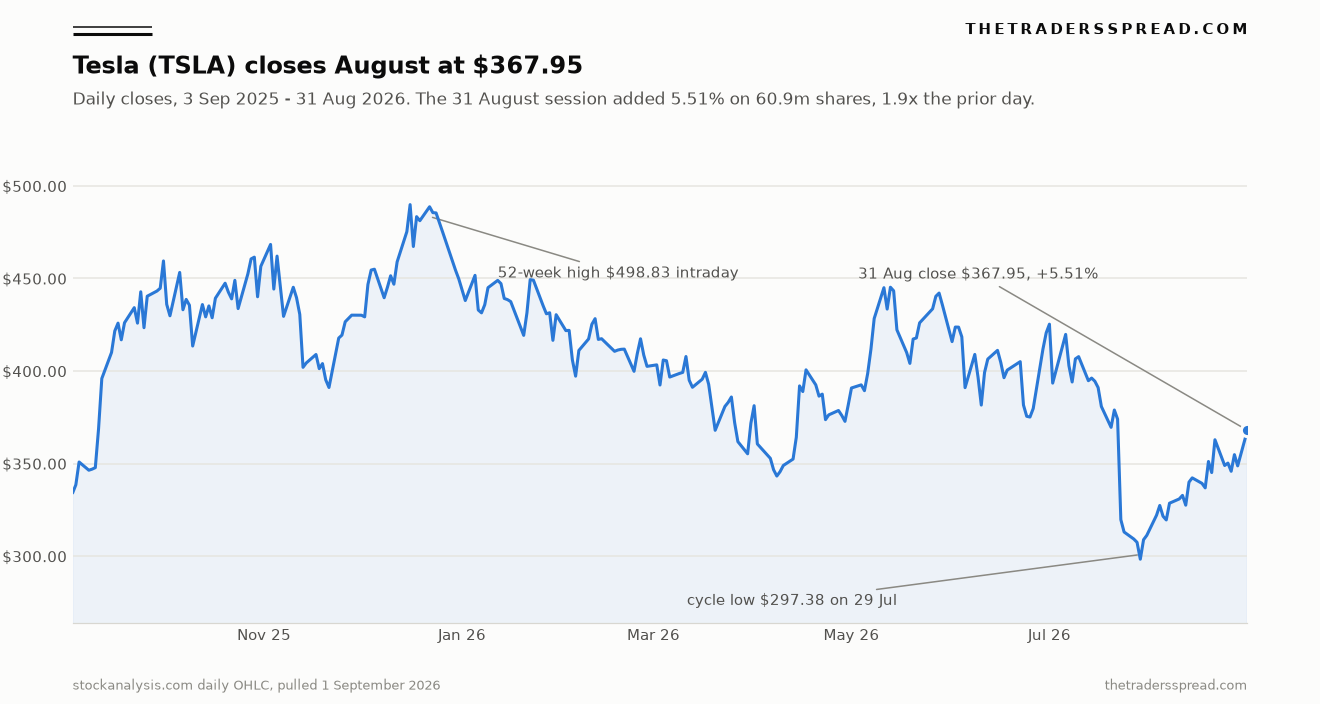
Context from the chart cuts both ways. August was Tesla's strongest month in a while, +18.23% from the $311.21 close on 31 July. The rally started from a floor: $297.38 on 29 July was the lowest print of the trailing year. Even after a 23.7% recovery off that low, the stock finishes August 26.2% under the $498.83 intraday high it set on 22 December 2025. Nothing about 31 August repaired the twelve-month picture.
| 31 August 2026 close | Change | Level |
|---|---|---|
| Tesla (TSLA) | +5.51% | $367.95 |
| Invesco QQQ (Nasdaq 100) | +0.05% | $716.76 |
| SPDR S&P 500 (SPY) | −0.30% | $767.05 |
| SPDR Dow Jones (DIA) | −0.65% | $531.57 |
Source: stockanalysis.com quote data, 31 August 2026 close, pulled 1 September 2026.
Run the arithmetic on the move and it gets uncomfortable. With 3.95 billion shares outstanding, a $19.20 gain adds roughly $75.8 billion of market value in one session. Divide that by 45 registered Cybercabs and each vehicle on the Texas register is notionally worth about $1.7 billion of Monday's repricing. That is not a valuation claim. It is a way of showing how much of Tesla's price is an option on something that has barely started.
Compare it with how the desk has watched other single-session repricings behave. When Nvidia jumped 9.3% on a $108 billion guidance number, the move was anchored to a figure that lands in a future income statement. When MicroStrategy fell 7.3% with its bitcoin stack sitting 3% above cost, the move was anchored to a mark-to-market. Tesla's 31 August has no comparable anchor in a filing. It has a vehicle count on a state database.
So who is on the other side of this?
Someone sold 60.9 million shares into that rally, and the pre-market tape on 1 September suggests they were not obviously wrong. TSLA was quoted at $363.99, down 1.08%, at 04:26 EDT on 1 September (stockanalysis.com). Roughly a fifth of Monday's gain came back before the cash open, two days ahead of the event the rally was supposedly discounting.
The bear case does not need to dispute a single fact above. It only needs the filings.
Tesla's Form 10-Q for the quarter ended 30 June 2026 reports total revenues of $28.236bn for the quarter against $22.496bn a year earlier, and $50.623bn for the first half against $41.831bn. Deferred revenue tied to connectivity, FSD (Supervised) features and over-the-air updates stood at $4.05bn at 30 June, up from $3.87bn at 31 December 2025. Those are real, growing numbers. None of them is robotaxi revenue at scale. The same filing lists the operational milestones attached to the 2025 CEO award, and milestone four is "1 million Robotaxis in commercial operation."
Forty-five registered Cybercabs is 0.0045% of that milestone.
Set that against a trailing P/E of 381.83 and a forward P/E of 193.29 on trailing net income of $3.81bn, and the shape of the disagreement is clear. Bulls are paying for the derivative of the fleet count. Bears are paying attention to the level. Both can be looking at the same 45.
There is also a quieter signal in the pricing decisions. On 25 August Tesla raised US Cybertruck prices by $5,000 on two of three trims, taking the base all-wheel-drive from $69,990 to $74,990 and the Premium AWD from $79,990 to $84,990, with the Cyberbeast unchanged at $99,990, per Teslarati. A company raising prices into questioned demand is making a statement about order books. Whether the order books support it is a first-quarter question: Tesla delivered 358,023 vehicles in Q1 2026, a 14% sequential decline and a miss against consensus of roughly 365,000 to 370,000.
RelatedCrown Castle (CCI) Rises 15.6% on SpaceX's $8bn Spectrum Buy
What this changes
The registry entry converts an argument into a countable series. Until 31 August, anyone forecasting Cybercab deployment was arguing from Tesla's statements and factory footage. From now on, TxMCCS publishes a number that anyone can refresh, and the second-order consequence is that the debate moves from narrative to cadence. The question stops being whether Cybercabs exist and becomes how fast the line grows: 45 to 200 in a month is a different company from 45 to 60.
Watch four things.
The 3 September event in Austin is the immediate one, and the informative part will not be the reveal. It will be whether any of the 45 registered units carry paying passengers, and how quickly, because registration and revenue service are separated by an operational gap Tesla has historically taken months to close. Second, the geofence cadence: after ten static months, whether the next expansion lands in weeks or another three quarters tells you far more about FSD readiness than any single map. Third, the unsupervised fleet count as Cybercabs mix into it, since Elluswamy's 380,000-mile safety record was compiled on Model Ys with a different sensor package and a different cabin. Fourth, the Q3 print on 21 October 2026, where the interesting line will be whether robotaxi economics appear anywhere in the segment disclosure or remain folded into automotive services.
For the twelve-month picture, the level that matters is not on the upside. The $297.38 low of 29 July is 19.2% below Monday's close, and it was set only twenty-three sessions earlier. A stock that can travel that distance in a month on no earnings event is telling you the price is being set by expectations about 2028, not by cash flows in 2026. That cuts in both directions, and it is why the pre-market fade on 1 September is more informative than the 31 August close. You can follow the live quote and the running series on our Tesla (TSLA) market hub, alongside the rest of the desk's tracked instruments.
FAQ
How many Cybercabs are actually registered in Texas?
Forty-five, as of 31 August 2026. The Texas Motor Carrier Credentialing System first showed seven 2026 Tesla Cybercabs filed under Tesla Robotaxi, LLC with VINs beginning 5YJA, and the entry was revised upward to 45 the same day. At the seven-unit count, Tesla's total authorised Texas robotaxi fleet stood at 276 vehicles, the balance being 269 Model Ys.
Does registration mean Cybercabs are carrying passengers?
No. Under Texas Senate Bill 2807, which took effect in late May 2026, an operator self-certifies SAE Level 4 capability, carries insurance and files an active vehicle list. That filing is the legal prerequisite for commercial operation, not proof of it. Tesla has historically run months of internal testing between a regulatory step and public rides.
Why did TSLA rise 5.51% when the broad market fell?
Because the catalyst was company-specific. On the same 31 August session the SPDR S&P 500 ETF fell 0.30% and the Dow-tracking DIA fell 0.65%, while QQQ was flat at +0.05%. A move of that size against a lower tape is idiosyncratic rather than market-driven, and volume of 60.9 million shares, 1.9x the prior session, is consistent with that.
How large is Tesla's Austin robotaxi service area now?
About 288 square miles, up roughly 9% from about 264. The addition of roughly 24 square miles extends the zone north of the Domain, into Mesa Park, and along the US-183 corridor toward Pflugerville. It is the first expansion in approximately ten months; the service launched in mid-2025 covering around 20 square miles.
Where does Tesla's valuation sit after the move?
At the 31 August close of $367.95, market capitalisation was $1.45 trillion on 3.95 billion shares, with a trailing P/E of 381.83 and a forward P/E of 193.29 against trailing twelve-month revenue of $103.62bn and net income of $3.81bn. The stock remained 26.2% below its 52-week intraday high of $498.83 from 22 December 2025.
When is the next scheduled catalyst?
The Cybercab launch event at Tesla's Austin campus on 3 September 2026, which is invite-only and livestreamed. After that, third-quarter results are scheduled for 21 October 2026, per stockanalysis.com. The Q3 filing is the first opportunity to see whether robotaxi operations are disclosed separately or stay inside the automotive segment.
Featured image: Tesla Cybercab, San Francisco, June 2026. Photo by 9yz via Wikimedia Commons, licensed CC BY 4.0.

Disclaimer
This article is analysis and information only. It is not investment advice, a recommendation, or an offer to buy or sell any security. Prices and figures were verified against the sources named above on 1 September 2026 and change continuously. Trading and investing carry risk, including the loss of capital. Readers should carry out their own research and consider their circumstances before acting on anything published here.