

API2 coal, the benchmark for thermal coal delivered cost, insurance and freight into Amsterdam, Rotterdam and Antwerp, still shows $104.75 a tonne in the regularMarketPrice field on Yahoo Finance's futures symbol MTF=F. That field came back at 06:57 UTC on 7 October 2026. The same response stamps the quote at 09:12 UTC on 6 February 2025. The daily close on that February date was $106.35, not $104.75, and the history has no daily bar after a $96.00 close on 26 December 2025. Yahoo's short name begins "Coal (API2) CIF ARA (ARGUS-McCl" and the exchange label is NY Mercantile. This is a Yahoo futures print of API2 coal. It is not an official Argus settlement, and it is not the cash price ICE Futures Europe uses to settle its Rotterdam coal contract. Anyone treating the figure as this morning's European cargo price is using the wrong object.
Those Yahoo figures already disagree with each other, and they disagree with the assessed market. The International Energy Agency, drawing on Argus data in its Coal Mid-Year Update, said ARA CIF coal increased to around $130 a tonne in the first half of 2026 and rose further after early March. Coal Hub's note of 5 October 2026 put November API2 at $142.90, up $6.20 on the week. A file whose last daily close is $96, dated December 2025, is not that rally. Averaging $96, $104.75 and $142.90 would invent a price nobody printed.
Key facts
- Yahoo MTF=F quote field: $104.75, timestamp 6 February 2025 at 09:12 UTC, retrieved 7 October 2026 at 06:57 UTC. Source: Yahoo Finance chart endpoint.
- Daily close on that timestamp's date: $106.35, on 6 February 2025. Last daily close: $96.00 on 26 December 2025. Calendar-2025 range on the same pull: $114.50 on 2 January to $89.25 on 14 October. Source: Yahoo Finance, 7 October 2026.
- One-year request, range of 1y and a daily interval: 57 closes, from $91.25 on 7 October 2025 to $96.00 on 26 December 2025, with a high of $99.50 on 2 December 2025. No 2026 session. Source: Yahoo Finance, 7 October 2026.
- IEA: ARA CIF increased to around $130 a tonne in the first half of 2026, with prices higher again after early March. Source: IEA Coal Mid-Year Update 2026, prices, report of 10 September 2026, Argus-based.
- IEA: EU coal consumption fell 6% in 2025. Demand in 2026 is expected at 276 million tonnes, still a decline, milder than the agency had expected before gas prices jumped. Source: IEA demand section, same report.
- Coal Hub: November API2 at $142.90 a tonne, up $6.20 on the week. Source: Coal Hub, 5 October 2026. A published lede, not an Argus terminal settlement.
- ICE Rotterdam coal futures, symbol ATW: 1,000 metric tonnes, cash-settled on the API 2 index in the Argus/McCloskey Coal Price Index Report. Source: ICE product page, read 7 October 2026. That page does not display today's settlement.
What the ticker is actually pricing
ICE Futures Europe lists API2 Rotterdam coal futures under the symbol ATW. The contract is financially settled. The payout tracks the API 2 index published in the Argus/McCloskey Coal Price Index Report, for coal delivered into the Amsterdam-Rotterdam region and Antwerp. Each lot is 1,000 metric tonnes. The quote is in dollars and cents per tonne, and the minimum price move is 5 cents. Trading stops on the last Friday of the delivery month, or the prior business day if that Friday is a holiday. The page we opened describes that machinery. It does not hand over a live settlement, so this piece does not borrow one and then pretend it came from Yahoo.
MTF=F is a different screen that happens to wear a similar name. The feed says NY Mercantile, not ICE Futures Europe. The short name is chopped at "ARGUS-McCl", which tells you the listing was built to point at the Argus/McCloskey assessment and does not prove the number in the field is that assessment. A label is not a settlement print. On 7 October 2026 the label was also stale: the quote time sits in February 2025, and it does not even match the daily close Yahoo stored for that same date.
Rotterdam's dry-bulk docks do not price one commodity. Iron ore moves across the same water and is a separate benchmark. It does not settle API2, and API2 does not settle it. Mixing the two because they share a berth is how a coal story turns into a different article.
Four numbers, and a chart that stops
Calendar 2025 on this feed was a grind lower, not a base for a rally. The first daily close of the year was also the high, $114.50 on 2 January. From there the path was uneven: February's close on the quote-field date was $106.35, spring dipped into the mid-$90s, summer bounced, and the low printed at $89.25 on 14 October. December went out at $96.00 on the 26th. Then the daily file stops. A request covering January 2024 through 7 October 2026 returned 500 closes and not one of them in 2026.
A one-year request is even thinner. Asked for a year of daily bars on the morning of 7 October 2026, Yahoo returned 57 closes, all of them between 7 October 2025 and 26 December 2025. That window opens at $91.25, tops out at $99.50 on 2 December 2025, and ends at the same $96.00. There is no 2026 candle to update against Coal Hub's November reading.
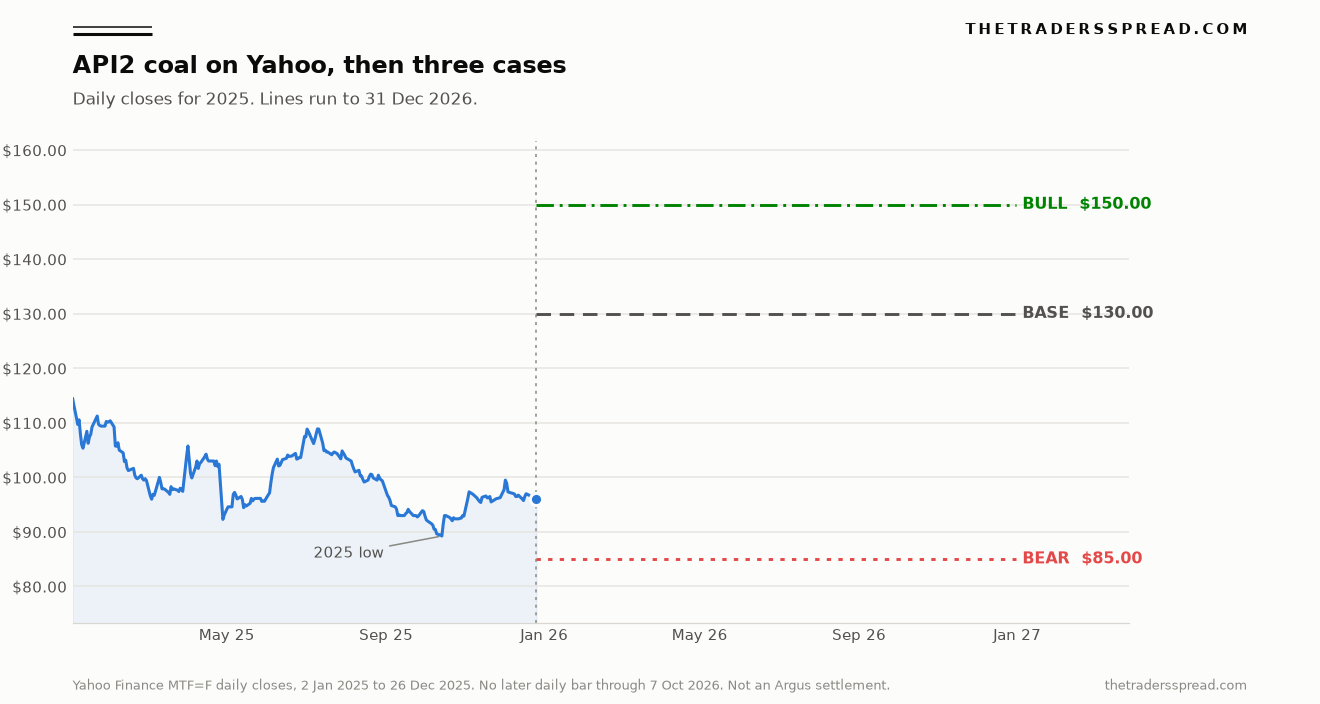
Lines to the right of the last bar are our cases for an API2 CIF ARA mark on 31 December 2026. They start at the final Yahoo close because that is where the series ends, and they run to the year-end date so they have length. Bull at $150 and base at $130 sit above the $104.75 quote field. Bear at $85 sits under that field, under the $96 last close, and under the $89.25 low of 14 October 2025. The labels are names. Nothing in the picture is an order.
| Level | What it is | Date | |
|---|---|---|---|
| Yahoo last daily close | $96.00 | MTF=F daily close | 26 December 2025 |
| Yahoo quote field | $104.75 | regularMarketPrice, stamped 6 February 2025 | Retrieved 7 October 2026 |
| Close on the stamp's date | $106.35 | MTF=F daily close that day | 6 February 2025 |
| IEA, ARA CIF | around $130 | Argus-based first-half reading | IEA, September 2026 |
| Coal Hub, November API2 | $142.90 | Hub lede, up $6.20 on the week | 5 October 2026 |
Do not average the column. The first three rows are one Yahoo response, and they do not agree with each other. The last two rows are other published readings of the European benchmark the ICE contract is built to track. The distance from $96 to $142.90 is the subject of the forecast. It is not a bid-offer.
Europe is burning less, and the bid can still jump
The IEA's September update did not describe a European coal boom. Consumption in the EU fell 6% in 2025, in electricity and in industry, after a brief first-quarter lift when wind and hydro were weak. For 2026 the agency expects 276 million tonnes of demand. That is still a structural decline. The fall is milder than the one it had sketched before gas prices jumped. Germany and Poland are the countries it names, because spare coal capacity is still sitting there when gas-fired generation becomes expensive. A cold spell can add a few weeks of burn on top. None of that converts a December 2025 close of $96 into a description of this year's assessed market.
Fatih Birol, executive director of the IEA, put the mechanism in ordinary language at the ONS conference in Stavanger on 25 August 2026. Countries that do not export energy, he said, are looking harder at what they can produce at home. "Renewables will be a big winner in my view, nuclear comeback is strengthened but they also look at other energy sources, including coal which will also get a boost from this issue," he told the conference, as reported by Latika M Bourke in The Nightly. The boost he described is a response to the shock that began on 28 February. It is not a promise that an API2 mark holds a winter spike through New Year's Eve.
One power-market consequence cut the other way this month, and it belongs in a single sentence rather than a second article. Coal Hub reported on 5 October that German electricity prices plunged from €226.18 per megawatt-hour to €153.40, and that coal-plant spreads fell to just over €26 per megawatt-hour from €97.93 the week before. A unit that was deeply in the money can be much less so seven days later, even while the coal quotation itself is firm.
Shipping through the Strait of Hormuz is its own market. Our September note on Hormuz transit odds framed the chokepoint separately from any coal swap, and those odds are not re-quoted here as a live price.
Atlantic supply added a scratch of its own. The IEA said Colombia's Cerrejón mine, a supplier of thermal coal into Europe, declared force majeure on 1 June 2026 after rail blockades, which tightened prompt cargoes into northwest Europe. That is a logistics hit on a specific mine, not a change in the size of Europe's coal fleet. It helps explain how an assessed CIF ARA price could firm into the summer while the annual demand number was still pointed down. It does not name the 31 December print.
A boost is not a new coal age
Keisuke Sadamori, the IEA's director of energy markets and security, was looking the other way in January 2025. Commenting on the agency's Coal 2024 report, he said the models showed "global demand for coal plateauing through 2027 even as electricity consumption rises sharply," with weather, especially in China, able to shove the near-term path around. Global Mining Review carried the comment on 7 January 2025. The September 2026 update revised the near-term total: global demand is now forecast to rise 1.2% this year, to 8.94 billion tonnes, because of the Middle East shock and a strong El Niño. The plateau line is 20 months old. Using it as this month's forecast would be false. Using it as the view that got revised is the point. Europe's slice of the revision is a slower decline, not a growth market.
Tonmit Talukdar, analyst for coal research at Rystad Energy, drew a similar line from the Asian side. "What we are seeing is not a coal comeback but a reality check for APAC's energy transition," he said, in comments World Coal published on 11 June 2026. Coal steps in when gas spikes, supply tightens, or a mothballed plant restarts, and he described the response as more contained than in 2022, when the loss of Russian gas produced a much sharper surge. The same article said no major producer had moved to sanction large new mines or to extend mine lives in a meaningful way. If the firms that would have to spend the capital are not building for a new age, a winter API2 spike has a shorter life than the headline.
Contained is not the same thing as cheap.
In 2022, thermal coal spiked above $400 a tonne across several major benchmarks. The 2026 move, in the IEA's telling, was smaller, because European coal supply itself was not cut off. Coal was pulled along by gas and power, and the forward curve implied a more moderate path through 2027 than oil and gas. Reconnect to the assessed market, then stop climbing. The screen most people can refresh is the wrong vintage for that job.
Base, bull and bear into 31 December
Base case, $130 a tonne on 31 December 2026. Bull case, $150. Bear case, $85. Base and bull sit above the Yahoo quote field of $104.75. The bear sits below it and below the last daily close of $96. A live series would be marked off that $104.75 field, knowing the timestamp is 6 February 2025 and that day's close was $106.35. Conviction is 2 out of 5. A chart with no 2026 bar cannot carry a louder number.
This base case is the settlement index, not the frozen file. The IEA's first-half ARA CIF reading was around $130, on a curve it called moderate through 2027. Coal Hub's November API2 figure of $142.90 on 5 October sits above that. A fade toward $130 by year-end fits a shock that was not priced as permanent, and EU demand that is still falling, only more slowly. $130 is that first-half level if the benchmark reconnects and then stops. It is not an Argus print for 31 December.
RelatedLumber Price Prediction: $640 Bull Case vs $470 Bear
Getting to the bull case at $150 takes early-October firmness plus a winter premium: a cold December in Germany or Poland, another Atlantic break after the June force majeure at Cerrejón, and gas tight enough that spare coal units keep running. That is Birol's boost, and a mild December makes $150 the miss.
At $85 the Yahoo file wins. That bear case sits under the 14 October 2025 low of $89.25. You land there if the assessed rally unwinds, gas comes back, and this listing never gaps up. A sourced print under $85 into December invalidates the catch-up. An Argus or ICE page in the $80s would too. We do not have that page.
A new daily bar on MTF=F, or an Argus page between $110 and $145, would retire the stale file before year-end. A reopened gas route, with European coal imports falling again, pushes the base toward $85 rather than $150. So does nuclear output that actually returns. Uranium is that fuel's contract. None of these levels is an instruction to enter, add to, or exit a swap.
Questions readers actually ask
What is API2 coal?
API2 is the Argus/McCloskey index for thermal coal delivered CIF ARA, meaning into Amsterdam, Rotterdam and Antwerp. ICE's Rotterdam coal future, symbol ATW, cash-settles against that index. Each lot is 1,000 metric tonnes, quoted in dollars per tonne, with a 5-cent minimum move. Yahoo's MTF=F uses a truncated version of the same name on a NY Mercantile label. The similar name does not make the Yahoo field the ICE settlement.
Is $104.75 today's Argus price?
No. It is the regularMarketPrice in Yahoo's MTF=F response, retrieved at 06:57 UTC on 7 October 2026. The timestamp on the field is 6 February 2025, and the daily close that day was $106.35. The last daily close in the file is $96.00 on 26 December 2025. We did not open an Argus terminal, so none of those figures is relabelled here as an official settlement.
Why does the chart stop in 2025?
Because the Yahoo daily history stops. A request from January 2024 through 7 October 2026 returned 500 closes, and none of them fell in 2026. The one-year request returned 57 closes, all between 7 October and 26 December 2025. The scenario lines are our cases, drawn out to 31 December 2026 so they can be seen. They are not trades that printed.
Why is the base case above the Yahoo price?
It is a year-end level for the benchmark the ICE contract settles against, not a claim that the stale Yahoo field ticks up by a dollar. The IEA's Argus-based ARA CIF reading was already around $130 in the first half of 2026. We use $130 after a fade from Coal Hub's $142.90 November reading. If the Yahoo file is the better description, the base case is wrong.
What would make $85 the right case?
A return of gas that knocks coal units back out of the stack, power spreads that stay as tight as the drop Coal Hub described in Germany in early October, and a live print under the 2025 low of $89.25. We mark $85 as the line that kills the catch-up idea. World Coal's June account of Rystad's work, that large new mines were not being sanctioned, fits a fade better than a new multi-year uptrend.
Does any of this say to trade the swap?
No. It is a scenario for a price on 31 December 2026, built from a Yahoo file that has not updated in 2026 and from assessments we have cited with dates. Futures and swaps lose money, including from a level that looks obvious on a chart. Nothing here tells a reader to enter, add to, or leave a position. Capital is at risk either way.
Disclaimer
This is analysis, not a recommendation. The Yahoo series used here is stale, the assessed prices come from third parties with their own methods, and the gap between those sources is wide. Levels can be missed by a long way. Capital is at risk.