

Rhodium sat on a Kitco screen at 2:52 a.m. New York time on 9 October 2026 with a bid of $8,250 a troy ounce and an ask of $9,250. A rhodium price forecast that treats $8,250 as the whole market misses the ask by a thousand dollars. Kitco Metals Inc. in Montreal called $8,250 the current price, unchanged on the day. The page named the unit, a troy ounce, and the currency, US dollars. It did not say sponge or ingot.
The other print does not close the gap. Trading Economics calls XRH:COM a contract for difference tracking the benchmark. It was $9,000 on 9 October, flat, inside the Kitco spread: 24.14% above the $7,250 print of 10 October 2025, and 8.40% below the $9,825 print of 10 September 2026. TD Commodity Strategy, on 25 September, still has this year in deficit and next year in surplus. Quote, path and balance are three different stories.
- Kitco bid $8,250, ask $9,250, midpoint $8,750 per troy ounce, unchanged on the day, with the page stamped 2:52 a.m. EDT on 9 October 2026 (Kitco Metals Inc., Montreal).
- Trading Economics XRH:COM benchmark $9,000 on 9 October 2026, a CFD print sitting between that bid and that ask (Trading Economics, 9 October 2026).
- Benchmark down 8.40% from $9,825 on 10 September 2026, and up 24.14% from $7,250 on 10 October 2025 (Trading Economics daily series, pulled 9 October 2026).
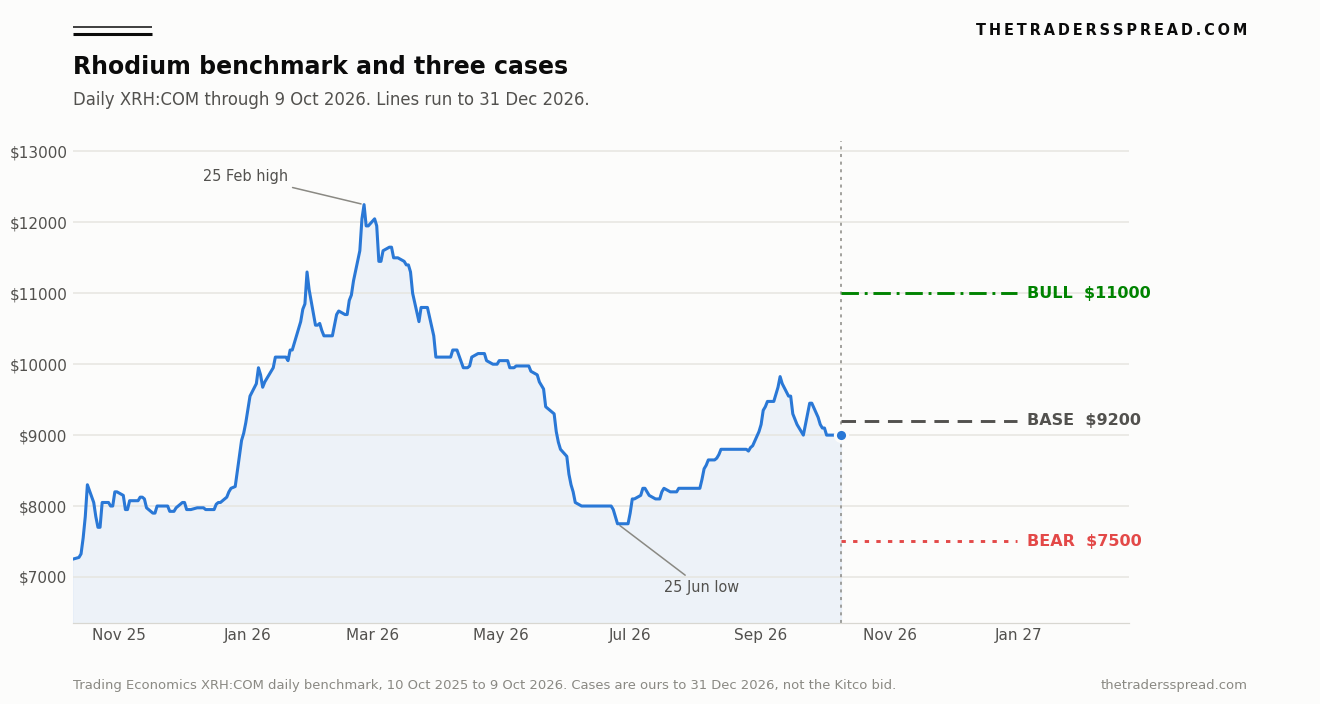
- 2026 daily high $12,250 on 25 February and daily low $7,750 on 25 June, so the October print is 26.5% under the high (same daily series).
- TD looks for a deficit of about 50,000 ounces in 2026 and a surplus of 20,000 ounces in 2027, the first surplus since 2022 (Mining.com, citing TD Commodity Strategy, 25 September 2026).
- South Africa supplies about 85% of primary rhodium, and five of its mines account for roughly half of world output (same TD note, 25 September 2026).
- Above-ground stocks are expected to fall to a little more than three months of demand, and refining the metal takes more than three months (same note, 25 September 2026).
A bid, an ask, and no futures curve
Rhodium has no exchange contract. Kitco says the metal trades dealer to dealer, and the figure on its page is a bid per troy ounce, refreshed through the day. On the morning of 9 October the bid had not moved. The quote record underneath the page carries an originalTime of 18:00 UTC on 8 October, while the page itself stamps the display at 2:52 a.m. EDT on the 9th. Change on the day: zero. A still screen at that hour is not a London auction and it is not a COMEX settlement. It is a dealer pair.
The pair is the fact that matters. From the $8,750 midpoint, the $1,000 gap is 11.4% of the price. The benchmark's entire drop since 10 September was $825. The spread on the Kitco screen is wider than that month's move. Anyone who publishes a forecast to the nearest ten dollars is pretending the market is tighter than the market makers are willing to be.
We use the Kitco bid and ask as the live spot, because they are a bid and an ask from a named dealer, with a clock time, in dollars per troy ounce. We use the Trading Economics series as the path, because it is a daily file we could actually download, running from 10 October 2025 through 9 October 2026, and because its latest reading of $9,000 matches the figure on the firm's own page. Where the two disagree, both numbers stay in the piece. The scenarios below have to clear the ask on the way up and break the bid on the way down. A case that lives between $8,250 and $9,250 is not a new price. It is today's market.
The round trip that ended near New Year
The daily benchmark did not drift here. It started this chart window at $7,250 on 10 October 2025, printed $9,175 on 31 December 2025, spiked to $12,250 on 25 February 2026, and gave it back. The low of the year was $7,750 on 25 June. By 10 September it had recovered to $9,825. By 9 October it was $9,000 again, about 1.9% under the last print of 2025.
On 18 May, with the benchmark at $9,850, Metals Focus told the market it expected rhodium to rise 62% over 2026. Jackson Chen's Mining.com report that day quoted Wilma Swarts, PGMs director at Metals Focus: "Aside from the Covid pandemic, when we saw sporadic breakouts in these metals, the entire complex has effectively shifted higher." She added that battery-car growth had so far been less dramatic than expected. Five months later the benchmark is not higher than it was on New Year's Eve. The breakout she described was real in February. It has not survived into October.
From the February high to 9 October the benchmark fell 26.5%. A smooth year-end number that ignores a path like that is a spreadsheet habit, not a description of this metal.
| Reading | USD per troy ounce | When | What it is |
|---|---|---|---|
| Kitco bid | 8,250 | 9 Oct 2026, 2:52 a.m. EDT | Dealer bid, called the current price |
| Kitco ask | 9,250 | Same stamp | Dealer ask |
| Kitco midpoint | 8,750 | Same stamp | Mid of that bid and ask |
| Benchmark | 9,000 | 9 Oct 2026 | XRH:COM daily print |
| Year-ago benchmark | 7,250 | 10 Oct 2025 | Daily print, plus 24.14% since |
| 2026 high | 12,250 | 25 Feb 2026 | Daily high in the chart window |
| 2026 low | 7,750 | 25 Jun 2026 | Daily low so far in 2026 |
| Bull case | 11,000 | 31 Dec 2026 | This forecast |
| Base case | 9,200 | 31 Dec 2026 | This forecast |
| Bear case | 7,500 | 31 Dec 2026 | This forecast |
Trading Economics' own macro model, on the same rhodium page, puts the benchmark at $9,269.18 by the end of this quarter and at $9,803.43 in twelve months. The quarter-end figure sits $69 from our base. We will come back to why that closeness is not a compliment to either number.
Supply that does not answer its own price
Primary rhodium is not a mine plan. Kitco's own note on the metal says essentially all of it arrives as a by-product of platinum and nickel mining, with South Africa the dominant source. TD's September account is sharper. South Africa supplies about 85% of primary output. Five mines in that country account for roughly half of global supply. Russia and Zimbabwe, plus smaller South African pits, make up most of the rest. Rhodium is about a quarter of mined platinum-group revenue, so the decision to dig is taken on the rest of the basket.
That is why a rhodium rally does not open a rhodium mine. It waits on the platinum case, and on the nickel mines that carry the other by-product stream we looked at in the September nickel forecast. If those metals pay, rhodium comes along. If they do not, rhodium stays scarce for reasons that have nothing to do with its own quote.
The photograph at the top of this piece is one of those plants, not a bar of metal. Ryanj93's April 2016 aerial on Wikimedia Commons shows the Two Rivers platinum mine in South Africa. The file description identifies shared ownership between African Rainbow Minerals and Impala Platinum. Silos, a conveyor and green-roofed sheds sit in bushveld hills. Rhodium is not why that complex was built. It is what the complex throws off.

Time makes the by-product problem worse. TD says material takes more than three months to move from mine output to refined metal, against a little over a month for platinum and palladium. Above-ground inventories, on the same note, are headed toward a little more than three months of demand. A disruption and the buffer are about the same length. There is no slack year sitting in a warehouse.
The bank thinks the balance could have tipped sooner. It says shaft collapses at South Africa's Amandelbult mine in 2025 delayed the turn, and that 2026 is still a deficit of about 50,000 ounces after four deficit years. The first surplus it sketches is 20,000 ounces in 2027, the first since 2022. A surplus that small, against a stockpile measured in months, is a change of sign on a thin book. It is not a flood.
Producers have seen what a thin book does on the way down. In the 2023 results call reported by Mining.com, Impala Platinum chief executive Nico Muller said the record prices of 2021 were not the surprise. The speed was: "It was the speed at which it happened that surprised us, not necessarily the fact that record highs we experienced from 2021 have not been maintained." Trading Economics puts that peak at $29,800 in March 2021. On the weekly XRH:COM file, outside the chart above, the later washout printed $4,000 in the week of 3 July 2023. Muller was talking about a fall of that order. The same market structure is still the one on the screen this morning.
Demand is an exhaust pipe, and 2027 is the turn TD marks
Most of the metal goes into three-way catalytic converters, where it breaks down nitrogen oxides. Kitco lists smaller uses in glass, chemical catalysts and the plating on white-gold jewelry. None of those is large enough to replace the car. When internal-combustion volumes flatten, rhodium demand flattens with them.
TD's demand case is the bearish half of an otherwise tight year. Autocatalyst demand has stopped growing as electric vehicles take a larger share of sales. The bank expects further pressure as combustion-engine volumes slip. It also says slower-than-hoped electric adoption should limit the damage in the near term, and that cars staying on the road longer delay the return of old, heavily loaded converters into scrap. Secondary supply still rises, because those older cars do eventually get scrapped, and a high price pulls more metal out of the wrecking yard. Recovery is imperfect, and some retirement markets lack the plant to process it.
Substitution is the other escape hatch, and it is slow. Palladium is the usual stand-in. TD estimates the switch takes 18 to 24 months and needs five to eight times as much palladium as the rhodium it replaces. That is not a week-to-week lever. It is a model-year decision, and the substitute has its own stops. A September walkout at a Montana palladium mine was enough, on its own, to dominate that metal's week. Swapping one scarce autocatalyst for another does not delete the supply risk. It moves it.
Money has come back, in a small way. TD says rhodium exchange-traded funds took in metal for the first time in more than a decade. Holdings remain well below the early 2010s. The note gives no ounce figure, so none is repeated here. A little investment demand has returned, not a wall of it.
Put the bank's price path next to the calendar, not on top of it. From about $9,000, TD projects $7,600 in 2027 and $6,500 in 2028. Jamasmie's 25 September piece is explicit that the bearish stretch comes with a caveat: stocks near three months of demand, a long refining cycle, and a handful of mines, so a supply break can still spike the price inside a market that is loosening. Their lower numbers are next year and the year after. Our horizon is 31 December 2026, while they still have this year in deficit.
Rhodium price forecast to 31 December 2026
Base case, $9,200. Bull case, $11,000. Bear case, $7,500. The horizon is 31 December 2026, twelve weeks out. Bias is neutral. Conviction is 2 out of 5. Neutral means the central case never has to leave the band dealers were already quoting on 9 October.
$9,200 is above the $8,250 bid, below the $9,250 ask, and $200 over the $9,000 benchmark. Trading Economics' model puts the quarter-end at $9,269.18. That $69 gap is about one-fourteenth of the spread, not a real disagreement. Their twelve-month figure of $9,803 is a milder path than 2026 already walked.
RelatedHeating Oil Price Prediction: $5.05 Bull Case vs $3.55 Bear
The bull case has to clear the ask, not merely print a higher benchmark. On the daily series, 26 January was $10,600 and 27 January was $10,775. $11,000 is a return to that area, not a rerun of the $12,250 print on 25 February. Getting there before year-end takes a supply break: one of the five mines TD says make up about half of world output, or a refinery, offline while stocks cover about three months. February showed the book can travel. It does not stay.
The bear case is $250 under the 25 June low of $7,750 and through the Kitco bid. It is the December level at which next year's surplus would be treated as this year's fact. TD's 2027 figure is $7,600, and we did not paste that onto 2026. The test is whether the June low breaks. $7,500 says it has. It still sits far above the July 2023 weekly trough of $4,000 and far above TD's $6,500 sketch for 2028.
What changes the view is concrete. A named South African outage, of the sort TD credits with delaying the surplus at Amandelbult, would retire the $9,200 base and make $11,000 the live case. Faster scrap, or autocatalyst orders cut for the next model year, would pull the base toward $7,500. A Kitco bid through $7,500, or an ask through $11,000, ends the map. Until then this is a deficit year that already had its spike, with the surplus parked in 2027.
Questions on the quote and the cases
What is the rhodium price on 9 October 2026?
There are two honest answers, and they are not the same number. Kitco Metals showed a bid of $8,250 and an ask of $9,250 per troy ounce at 2:52 a.m. EDT, and called the bid the current price. Trading Economics' XRH:COM benchmark was $9,000, flat on the day. The midpoint of the Kitco pair is $8,750. A forecast that quotes only one of those is leaving out the market.
Why is there no rhodium futures price?
The metal does not have an exchange-traded futures contract. Kitco describes the trade as dealer to dealer, in small size, which is why the bid and the ask can sit $1,000 apart and why the quote can jump between updates. The daily path in the chart is a contract-for-difference benchmark from Trading Economics, not a settlement on a futures exchange. It is a history of a reference price.
What would push the price to the $11,000 bull case?
A supply break while the 2026 deficit is still in place. TD's September note still has 2026 in deficit by about 50,000 ounces, with stocks near three months of demand and about half of world output in five South African mines. An outage at one of those mines, or at a refinery, can reprice the book toward the late-January area around $10,600 to $10,775 before year-end. $11,000 is that area, not the February high of $12,250.
What would push it to the $7,500 bear case?
The market starting to trade 2027's surplus in 2026. TD looks for a 20,000-ounce surplus next year, the first since 2022, as autocatalyst demand flattens and mine plus scrap supply rises. If that story is pulled forward, a break of the 25 June low at $7,750 is the line that matters. $7,500 is just through that low. It is not TD's $6,500 figure for 2028, and it is not the 2023 washout.
Is rhodium still mostly an autocatalyst metal?
Yes. Kitco and TD both put catalytic converters, and the nitrogen-oxide job inside them, as the main use. Glass, chemical catalysts and jewelry plating are real and smaller. Electric vehicles reduce the addressable fleet only as fast as combustion cars actually leave the mix. TD says that shift has been slower than hoped, which caps the near-term damage, and that replacing rhodium with palladium takes 18 to 24 months.
How does this differ from the 2021 spike?
Trading Economics puts the all-time high at $29,800 in March 2021. The weekly benchmark later troughed at $4,000 in the week of 3 July 2023. Nico Muller, speaking as Impala's chief executive in 2023, said the speed of that fall was the shock, not the idea that records fade. Nothing in the 9 October 2026 quote, a bid of $8,250, resembles $29,800. The thin-book problem he was describing has not gone away.
This is analysis, not a recommendation. Rhodium trades in a dealer market that can gap between updates, and the bid and the ask on 9 October were already $1,000 apart. Capital is at risk.