

On 9 October the 1# antimony ingot quotation in Lengshuijiang was 105,000 yuan a tonne, the same figure Shanghai Metals Market had printed on 11 September. Spot boards in China were shut from 1 October through 7 October for the National Day holiday. They reopened on the 8th. The 1# line did not move, and it did not move again on the 9th. Zero-grade ingot was quoted at 107,000 yuan. Antimony trioxide at 99.5 percent was quoted at 87,500 yuan. Sulphide concentrate of 55 percent antimony or better was quoted at 85,000 yuan a tonne of contained metal. The climb from 95,000 yuan on 17 August to 105,000 yuan on 11 September, a rise of 10.5 percent, was already finished before the holiday. After that, the board waited. SMM wrote it up on the morning of 10 October.
The stall is a bad place to pretend there is one antimony price. On the same day, SMM's sheet for 1# ingot under GB/T 1599-2014, in warehouse in China, translated that 105,000 yuan into $13,823.32 a tonne with value-added tax taken out and $15,620.35 a tonne with the tax left in. Its Europe assessment for 99.65 percent metal averaged $19,050 a tonne, inside $18,800 to $19,300, and was unchanged. Its United States assessment for 99.65 percent metal averaged $12.85 a pound, inside $11.80 to $13.90, also unchanged. At 2,204.62 pounds to the tonne, the American average is about $28,329 a tonne. That is roughly 1.8 times the Chinese VAT-inclusive dollar price, and just over double the ex-VAT figure. Europe sat about 22 percent above the Chinese VAT-inclusive translation. A single "spot" is a choice of cargo, tax and coast.
Key facts
- 1# antimony ingot, China, in warehouse: 105,000 yuan a tonne on 9 October 2026, unchanged on the day, and unchanged from 11 September. SMM, product page updated 11:30 GMT+8, and the 10 October weekly review.
- SMM's own dollar translation of that quotation: $13,823.32 a tonne excluding 13 percent VAT, $15,620.35 including it. Same page, same timestamp.
- Europe, 99.65 percent antimony: $18,800 to $19,300 a tonne, average $19,050, change zero, 9 October 2026. SMM minor-metals board, retrieved 10 October 2026.
- United States, 99.65 percent antimony: $11.80 to $13.90 a pound, average $12.85, change zero, 9 October 2026. Same board.
- From 17 August to 11 September the 1# average rose from 95,000 to 105,000 yuan, plus 10.5 percent. Concentrate at 85,000 yuan a tonne of metal was up 2.4 percent from late August. SMM weekly review, 10 October 2026.
- SMM's assessed Chinese antimony ingot output fell about 2 percent in September from August, a second monthly decline. SMM, 8 October 2026, repeated in the 10 October review. SMM estimates first-grade sodium pyroantimonate output fell about 25 percent in September.
- The ECB reference rate on 9 October 2026 was 6.6921 yuan per dollar. Applied to 105,000 yuan, that is about $15,690 a tonne, under half a percent away from SMM's VAT-inclusive figure of $15,620.35. Frankfurter, ECB reference, retrieved 10 October 2026.
Three boards, one Thursday
Antimony does not settle on an exchange the way tin does, or the way copper does. There is no LME antimony contract and no SHFE antimony contract to mark. The number a trader can actually defend is a dealer assessment, and on 9 October those assessments did not agree with each other.
The Chinese domestic quotation is a round yuan figure. SMM then publishes two dollar readings of it, one inside VAT and one outside, on its own exchange rate rather than the ECB reference. The gap between $15,620.35 and the $15,690 implied by 6.6921 yuan per dollar is an FX convention. It is small enough to ignore when the question is whether China and the United States are in the same market. They are not. $12.85 a pound is about $28,329 a tonne, or 2.05 times the Chinese ex-VAT dollar price and 1.81 times the VAT-inclusive one. Europe at $19,050 a tonne is about $8.64 a pound, the middle cargo.
Grades are close and not identical. Chinese 1# on the product page is 99.70 percent minimum. The Europe and US lines are 99.65 percent. Trioxide is a different product. SMM's 99.5 percent trioxide FOB assessment averaged $22,450 a tonne on 9 October, inside $22,200 to $22,700, unchanged, while domestic Chinese trioxide was 87,500 yuan. Mixing those rows is how a forecast ends up on the wrong side of the cargo it claims to describe.
| Assessment, 9 Oct 2026 | Price | Day change |
|---|---|---|
| China 1# ingot, yuan | 105,000 yuan/t | 0 |
| China 1# ingot, USD ex-VAT | $13,823.32/t | 0 |
| China 1# ingot, USD inc-VAT | $15,620.35/t | 0 |
| Europe 99.65% metal | $19,050/t average | 0 |
| US 99.65% metal | $12.85/lb average | 0 |
| Trioxide 99.5% FOB | $22,450/t average | 0 |
Sources: SMM 1# product page and SMM minor-metals board, both timestamped 9 October 2026 and read on 10 October. The US tonne figure is this desk's conversion at 2,204.62 pounds per tonne.
What the Montana smelter was actually selling
The regional gap shows up in a processor's realised price. On United States Antimony's second-quarter call, whose transcript the company filed with the SEC on 17 August 2026, interim chief financial officer Shawn Winkler said antimony revenue was $5.9 million in the quarter against $9.6 million a year earlier. Pounds sold rose about 26 percent, to 428,425. Average selling prices fell about 52 percent, from $28.32 a pound to $13.70.
While our pounds sold increased approximately 26% year-over-year to 428,425 pounds, average selling prices declined approximately 52% from $28.32 per pound to $13.70 per pound, reflecting broader antimony market price conditions.
Shawn Winkler, interim CFO, United States Antimony, on the second-quarter call filed 17 August 2026. Company revenue overall was about $7.9 million in the quarter, against $10.5 million in the second quarter of 2025, and up from $6.8 million in the first quarter of 2026. Six-month revenue was $14.7 million against $17.5 million. Volume did not save the antimony line. The price did the damage.
Gary C. Evans, the chairman and chief executive, was asked on the same call where he thought the price would sit for the rest of 2026. He did not offer a range with a decimal. He offered a neighbourhood, and a confession that the neighbourhood is set elsewhere.
I believe that we're probably, for the remainder of 2026, in this $10 per pound range. Now, you got to remember, that's double what this company historically had gotten, but it's obviously down from $30 a pound. ... I wish I could say that it's going to go back to $20, but I just don't know. The price is undoubtedly manipulated by China.
That was mid-August. Seven weeks later the US dealer average was $12.85, inside a $11.80 to $13.90 band, not $10 and not $30. The company's own second-quarter selling price, $13.70, sits inside the October band. Evans was describing a US price that had already done most of its falling, and that has since gone sideways rather than back to the $28 his CFO cited for the prior-year quarter. He also cut full-year revenue guidance, on that call, to $60 million to $75 million, and he said the cut was the price, not delivery times.
Damian Coleman said on that call the firm was executing a $245 million sole-source contract with the Defense Logistics Agency, with about $57.3 million of orders awarded. Aaron Tenesch said a Bolivian line was aimed at about 150 tons a month. Joe Bardswich described about 800 tons of ore grading about 10 percent antimony, dug near Thompson Falls in late 2025. Those are August statements, and none of the tonnages is large enough to set a Chinese 1# quotation.
Why 105,000 stopped moving
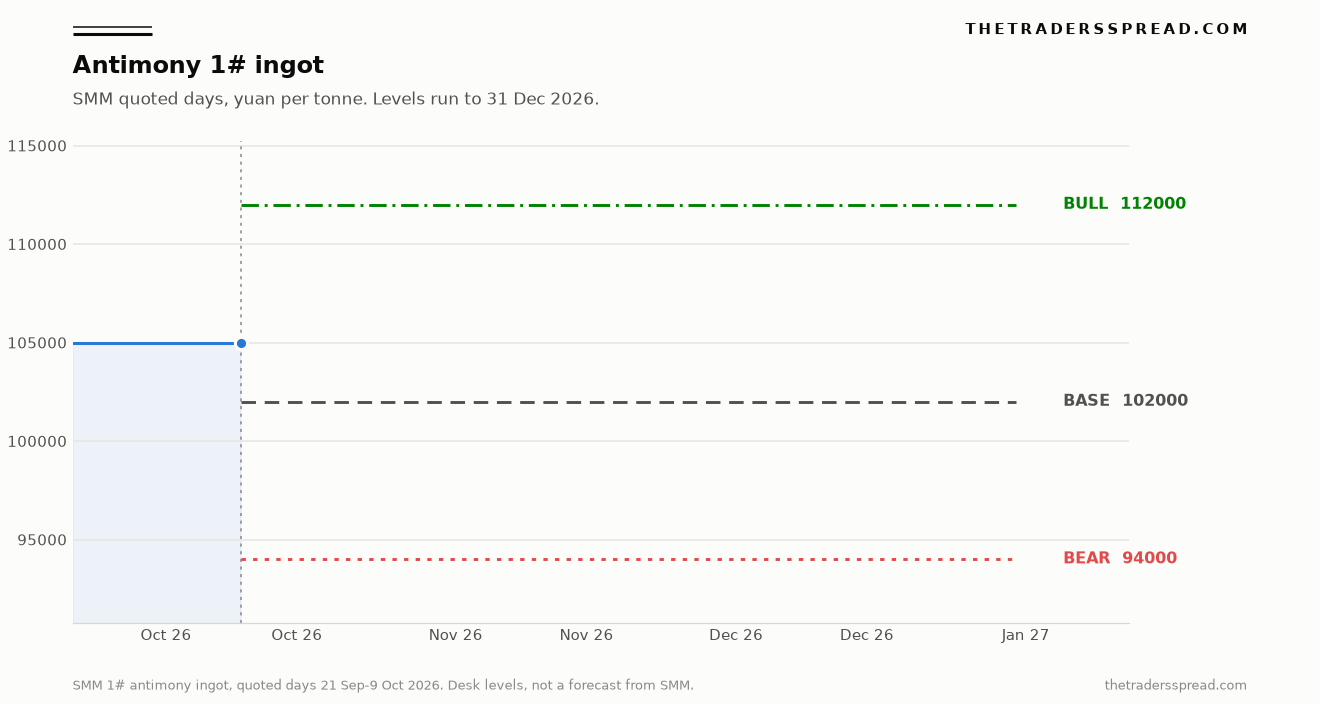
SMM's 10 October review covers the quoted days around the holiday: 28 to 30 September, then 8 and 9 October. Across that stretch, and on the daily sheet back to 21 September, 1# ingot is a horizontal line at 105,000 yuan. The review says the price has been there for four consecutive weeks, after the climb that began at 95,000 yuan on 17 August.
Supply did not loosen. Assessed national ingot output in September, counting ingot, converted crude antimony and cathode, fell about 2 percent from August. SMM called it a second straight monthly drop, and it tied the drop to a sharp fall in August imports of antimony ore. The review does not publish the import tonne figure, so this article will not invent one. What it does publish is the concentrate price: 85,000 yuan a tonne of contained metal, up 2.4 percent from late August. Smelters, on SMM's account, are holding thin raw-material stocks. Output cannot be switched on because a buyer appeared after the holiday.
Demand did not take the other side of that tightness. SMM described late September as a round of stocking by photovoltaic-glass makers, flame-retardant plants and polyester-catalyst users, and then a stop. Its estimate for first-grade sodium pyroantimonate, the salt the glass line uses, is a drop of about 25 percent in September from August. On 8 and 9 October, inquiries came back and transactions did not. SMM's phrase for the deals that did print is small rigid-demand orders. Buyers wanted a lower number. Sellers did not offer one. The 100,000 yuan handle, which the market crossed in September, is still being digested.
Both sides of that description can be true at once. Ore is tight enough that concentrate rose while ingot was flat. Downstream orders are soft enough that ingot could not rise either. A market with a cost floor and no marginal buyer prints the same number every day. That is what 21 September to 9 October looks like. It is also why a forecast that needs a trend in the last three weeks will not find one. The trend is the August-to-September rally. The live information is that the rally paused at 105,000 and stayed there through a holiday and two reopenings.
SMM's near-term line in that review is that prices most likely keep consolidating on a weak note. Room for the centre to fall is limited, it says, because supply is rigid and metal outside China stays tighter. A push higher needs restocking that looks small. Export controls continued on a regular footing. The review does not date any change in them, and this article will not invent one.
Where 112,000 and 94,000 come from
The horizon is 31 December 2026. That is twelve weeks from the 9 October quotation, not a view on 2027 and not a claim about what Evans called manipulation. The levels are scenarios around one series: the Chinese 1# yuan quotation. They are not targets for the US pound price and not targets for European warehouse metal. Those can move without the Lengshuijiang board moving, and the last year is evidence that they do.
The bull case is 112,000 yuan a tonne. From 105,000 that is about 6.7 percent, smaller than the 10.5 percent leg from 17 August to 11 September. It is the tentative lift SMM allows if restocking arrives, or if the overseas premium starts to pull Chinese offers instead of only sitting beside them. It would not, by itself, put US metal back at $28 a pound.
The base case is 102,000 yuan. That is 3,000 yuan under the live quotation, about 2.9 percent, a drift inside a band the market has refused to leave. Concentrate at 85,000 yuan of contained metal is why the drift is shallow. A smelter paying that has a reason to hold 105,000, and a buyer who will not pay it has a reason to wait. 102,000 is the landing zone this desk treats as most likely by year-end.
The bear case is 94,000 yuan. That is 1,000 yuan under the 17 August print of 95,000, and about 10.5 percent under the 9 October quotation. It is the September rally given back, with a small overshoot, if buyers above 100,000 do not return. SMM does not treat that as the centre, because supply is tight. It is still the clean disconfirmation. A print at 94,000 would mean the review's "limited downside" line was wrong.
Weights, as desk judgement and not as a market-implied probability: 55 percent on the base at 102,000 yuan, 25 percent on the bear at 94,000, 20 percent on the bull at 112,000. The skew is mild and downward because the last information is a failed attempt, by nobody, to pay more, while the floor argument rests on concentrate and on a premium that has already failed to lift the Chinese quote. There is no options market in which to check those weights. Nickel at least has a contract and a position report. Antimony has a weekly review.
RelatedAPI2 Coal Prediction: $150 Bull Case vs $85 Bear Case
The call, and what would retire it
Bias on the Chinese 1# quotation into 31 December is mildly lower, not a collapse and not a squeeze. Entry, for the record of the scenario, is the live quotation of 105,000 yuan. The level this desk treats as the central landing zone is 102,000. The idea is wrong if 1# is quoted at 112,000 or above before the year ends, which is why 112,000 is the invalidation as well as the bull case. A print at 94,000 would not invalidate a soft call. It would mean the soft call was not soft enough.
Conviction is low. Two, on a scale that tops out at five. The pause itself is well evidenced: nine quoted days at one number, plus a written review. The next twelve weeks are not. Both the bull and the bear need a change that has not happened: restocking, or a real break of 100,000. The October US band, $11.80 to $13.90, has sat still in the spirit of Evans's August remark without matching his round $10. Chinese 1# can stay at 105,000 while that band does nothing. That pairing is the base case.
What would change the weighting is a print, not a hunch. A 1# quotation off 105,000 on a normal SMM session. An October ingot-output figure that reverses the two-month decline, or extends it. A concentrate price back through the late-August level, which would say the cost floor had cracked. A US or European assessment that gaps instead of printing zero. Those are the reads that would make 102,000 the wrong centre. They are not a prompt to trade.
One more limit. The 17 August low of 95,000 yuan and the 11 September high-water mark of 105,000 are published endpoints. The path between them, on SMM's seven-week chart, was a staircase, and this article does not pretend to have the unlabelled daily steps. The chart above uses only the days the 10 October materials mark at 105,000: 21, 22, 23, 24, 28, 29 and 30 September, then 8 and 9 October. A flat line is the honest picture of that window. It is not a history of the year.
Questions the quotation leaves open
What is the antimony price on 10 October 2026?
There was no Chinese spot quotation on 10 October. SMM notes that the day was a Saturday. The last 1# print is 105,000 yuan a tonne on 9 October, with SMM's dollar readings at $13,823.32 ex-VAT and $15,620.35 including VAT. Europe's 99.65 percent average that day was $19,050 a tonne. The US 99.65 percent average was $12.85 a pound. Those are assessments, not a single screen price.
Why is US antimony so far above the Chinese quotation?
On 9 October the US average of $12.85 a pound was about $28,329 a tonne, against $15,620.35 for Chinese 1# with VAT included. SMM's weekly review says export controls on antimony-related items stayed in force and that metal outside China has stayed tighter than domestic metal. The premium is a policy and availability gap, not a freight calculation. It did not close while the Chinese board was flat.
Does antimony have a futures contract to anchor a forecast?
Not on the venues that set copper, nickel or tin. The working prices are dealer assessments: yuan quotations inside China, and separate US and European ranges in dollars. That is why this scenario is tied to the 1# yuan line and why a US pound forecast would be a different article. The conversion between them moves with VAT and with the rate SMM chooses.
What would justify 112,000 yuan by year-end?
A real return of downstream buying after the holiday pause. SMM says photovoltaic glass, flame retardants and polyester catalysts stocked up in late September and then stopped, and it estimates sodium pyroantimonate output fell about 25 percent in September. If those users come back in size, a lift of about 6.7 percent from 105,000 is the bull case. It is smaller than the rally just completed.
What would 94,000 yuan mean?
It would mean the market had given back the entire move from 95,000 yuan on 17 August, and 1,000 yuan more. That is the bear case, not the base. It needs buyers to keep rejecting anything above 100,000 and it needs the concentrate floor to stop mattering. SMM's review treats that downside as limited. A print at 94,000 would retire that sentence.
This is analysis of published assessments and a company filing, not advice and not a solicitation to trade antimony, ingot, trioxide or any security. The 112,000, 102,000 and 94,000 yuan figures are scenarios around the Chinese 1# quotation. They are not instructions, and they are not forecasts issued by SMM or by United States Antimony. Dealer prices differ by grade, tax and location. Capital put to work on a view like this can be lost.