

Lithium carbonate is not rallying because the world suddenly wants more lithium. It is rallying because one county environmental bureau in Jiangxi province has not signed one document. The most-active contract on the Guangzhou Futures Exchange closed at 161,000 yuan a tonne on 31 August 2026, up 18.2% from the 136,260 yuan cycle low struck on 31 July, and the entire move traces back to a single administrative file at CATL's Jianxiawo mine that has now been pending for more than a year.
That is a smaller story than the price action suggests, and a much smaller story than Western lithium equities are pricing. Over the same 30 days, the Global X Lithium & Battery Tech ETF gained 14.0% and Albemarle gained 20.6%, against 8.3% for the Chinese carbonate contract that actually sets the global reference price. The equity complex has moved between 1.6 and 2.5 times the underlying. And the futures curve itself disagrees with all of them: on 31 August the December 2026 contract settled at 161,140 yuan while May 2027 settled at 157,580, a 2.2% discount. Guangzhou is pricing this as a winter problem. New York is pricing it as a regime change.
Key facts
- The GFEX most-active lithium carbonate contract closed at 161,000 yuan a tonne on 31 August 2026, up 18.2% from the 31 July low of 136,260 – Guangzhou Futures Exchange daily quotations, 31 August 2026.
- The contract is still 21.5% below the 205,040 yuan two-year high set on 12 May 2026 – Guangzhou Futures Exchange daily quotations, 12 May 2026.
- CATL's Jianxiawo mine in Yichun, Jiangxi has been suspended since August 2025; in early August the Yifeng County Ecology and Environment Bureau said no ore transportation or crushing was taking place – Shanghai Securities News, reported by Reuters, 7 August 2026.
- The project's mineral designation was reclassified from ceramic clay containing lithium to lithium ore, forcing a fresh environmental impact assessment that went to public consultation on 27 July 2026 – Reuters, 7 August 2026.
- Benchmark Mineral Intelligence estimates a prolonged shutdown puts roughly 60,000 tonnes of lithium carbonate equivalent at risk, about 4% of global supply – Benchmark Mineral Intelligence, 14 August 2026.
- Albemarle rose 20.6% in the 30 days to 28 August against 8.3% for the Chinese carbonate contract over the identical window – stockanalysis.com and GFEX, 28 August 2026.
- China applies a 2% consumption tax on lithium battery products from 1 September 2026, doubling to 4% a year later – reported 22 July 2026.
A permit problem, not a mine problem
The mechanism matters here, because most coverage compresses it into the phrase "mine closure" and loses the part that determines when it ends.
Jianxiawo, in the city of Yichun in Jiangxi province, stopped producing in August 2025 when its mining licence expired. That was the original event, and it set off the rally that carried lithium carbonate above 200,000 yuan a tonne by May. CATL then worked through the reinstatement process and obtained a safety production permit on 29 June 2026, which most of the market read as the last meaningful gate.
It was not. The project's mineral designation had been changed from ceramic clay containing lithium to lithium ore, and that reclassification is not cosmetic. Under Chinese environmental law a change of mineral category obliges the operator to prepare a new environmental impact assessment report for the reclassified activity, which then goes to public consultation and county-level approval. CATL published that new report for consultation on 27 July 2026.
On 7 August, with the market speculating about an imminent restart, the Yifeng County Ecology and Environment Bureau put the position on the record through Shanghai Securities News: the mine remained pending environmental approval, was also undergoing maintenance, and no ore transportation or crushing was taking place. The bureau said CATL had been asked to complete the environmental impact assessment approval procedures as soon as possible. Three weeks later, on 27 August, the assessment was still awaiting approval.
So the constraint on roughly 4% of world lithium supply is a county-level document review with no published deadline. That is a different risk profile from a geological problem or a plant failure. It can clear in a week. It can also sit for another quarter, and nobody outside Yifeng County can model which. Traders who have watched single-asset supply shocks in uranium will recognise the shape: the commodity reprices off a permitting calendar rather than a cost curve.
The scale is real even if the mechanism is bureaucratic. Benchmark Mineral Intelligence puts about 60,000 tonnes of lithium carbonate equivalent at risk in Jiangxi from a prolonged shutdown, and warns that a sustained delay combined with wider provincial disruption could erase the roughly 78,000 tonne global surplus it forecasts for 2026 outright. Demand is not helping the bears. "We continue to see resilient demand fundamentals across our core markets, including energy storage, electric vehicles, and semiconductors," said Kent Masters, chief executive at Albemarle, in the company's second-quarter results statement on 5 August 2026, alongside a 61% rise in realised lithium prices and an 11% rise in volumes.
Who is repositioning, and where
The response has split cleanly along a geographic line, and that split is the tradeable observation.
Inside China, the exchange itself is the main actor. GFEX opened its lithium carbonate contract to overseas participants in July 2026 and has said it plans to launch a lithium hydroxide contract, part of an explicit policy push to make Guangzhou rather than Western assessment agencies the reference point for global lithium pricing. Open interest across the lithium carbonate complex stood at 723,142 lots on 31 August, against 715,568 lots on 28 August, on exchange figures. The exchange has previously capped new positions and raised trading fees to damp volatility in this contract, which tells you how much speculative flow the Jianxiawo file attracts.
Outside China, the response has been an equity re-rating rather than a physical one. Albemarle, the world's largest lithium producer, rose from $113.88 on 29 July to $137.36 on 28 August. SQM rose from $67.55 to $78.63 over the same window. Lithium Americas rose from $2.71 to $3.07. None of those companies produce a tonne of material in Jiangxi, and none of them will supply the Chinese cathode plants that Jianxiawo's absence leaves short in the next two quarters.
Producers elsewhere are moving on supply rather than on price. Mineral Resources is restarting Bald Hill, Core Lithium is bringing Finniss back online, and the Mt Marion joint venture has approved a A$490 million expansion – all decisions taken while the metal was falling, and all adding tonnes into 2027. Restarts of this kind are the reason BMI, the Fitch Solutions unit, expects the market to stay in surplus through the end of the decade even while raising its near-term price forecast.
Government buyers have joined too. The US Defense Logistics Agency solicited fixed-price offers in July for about 16,000 tonnes of battery-grade lithium carbonate over five years, worth as much as $300 million, with all processing and testing required to take place inside the continental United States. Spread over five years that is a few days of global consumption, but it puts Washington in the market as a buyer for the first time in the battery era – the same state-as-participant pattern now visible across copper and other critical minerals.
Africa is the other supply-side variable, and it is a hard one. Zimbabwe, which accounted for roughly 10% of the world's mined lithium last year, will ban lithium concentrate exports from 1 January and has rejected industry requests to delay. "We are still sticking with January 1," mines minister Polite Kambamura told Bloomberg reporters. "They have to run with this."
The number the equities are not looking at
Put the two data series side by side over an identical window and the divergence is precise rather than impressionistic.
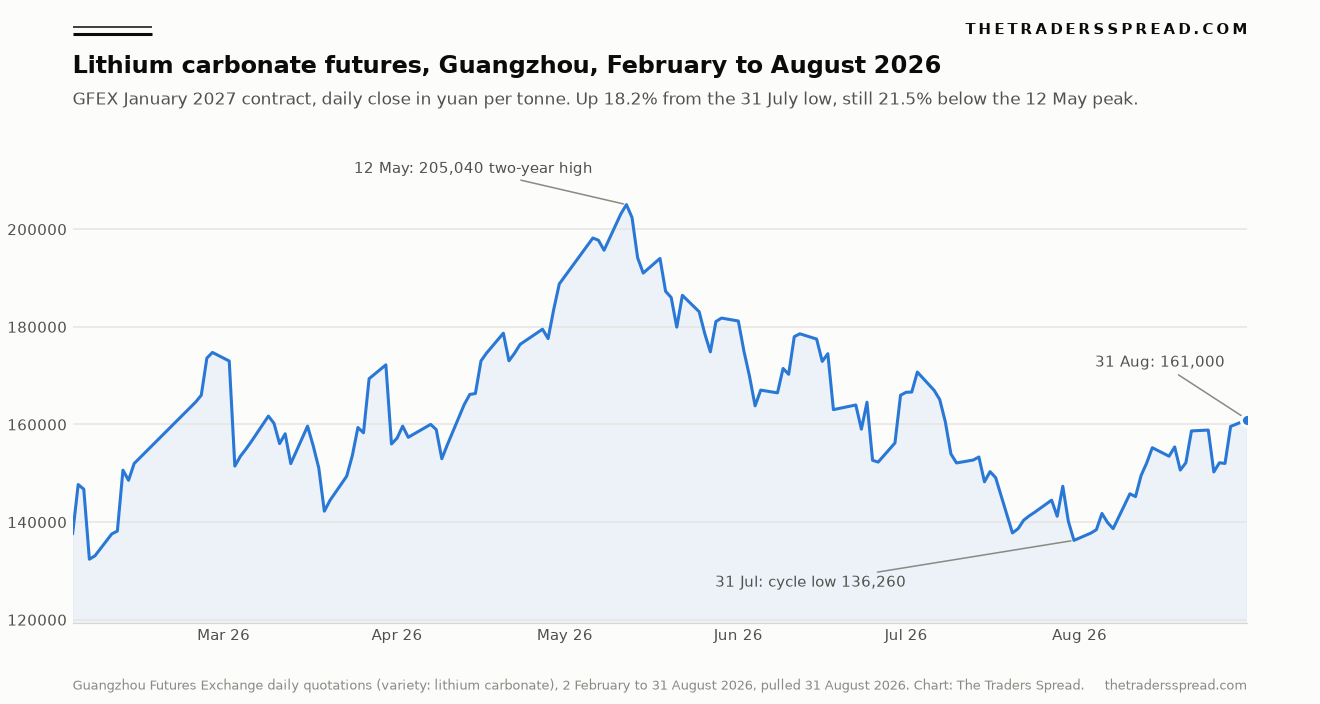
The table below uses closing prices for the 30 days to 28 August 2026, the last session on which both the Chinese futures market and the US equity market were open. Carbonate is the GFEX January 2027 contract; equity prices are from stockanalysis.com.
| Instrument | 29 July 2026 | 28 August 2026 | 30-day change |
|---|---|---|---|
| GFEX lithium carbonate, Jan 2027 (CNY/t) | 147,340 | 159,600 | +8.3% |
| Global X Lithium & Battery Tech ETF (LIT) | $66.74 | $76.07 | +14.0% |
| Albemarle (ALB) | $113.88 | $137.36 | +20.6% |
| SQM (SQM) | $67.55 | $78.63 | +16.4% |
| Lithium Americas (LAC) | $2.71 | $3.07 | +13.3% |
Equities are geared to the metal, so some amplification is normal and expected. What is not normal is the direction of the gearing relative to the forward curve. Here is the GFEX settlement structure on 31 August 2026, taken from the exchange's own daily quotations:
| Delivery month | Close (CNY/t) | Open interest (lots) |
|---|---|---|
| September 2026 | 159,000 | 17,498 |
| November 2026 | 159,720 | 159,801 |
| December 2026 | 161,140 | 33,282 |
| January 2027 | 161,000 | 403,032 |
| March 2027 | 157,620 | 2,662 |
| May 2027 | 157,580 | 60,221 |
The curve is humped. It rises into December and January, then rolls off. May 2027 trades 3,560 yuan, or 2.2%, below the December 2026 peak, and the May contract is not a thin one – it carries 60,221 lots of open interest, the third-largest position in the complex. The physical market, in other words, is paying up for tonnes it needs this winter and marking down tonnes it expects to be plentiful by the middle of next year.
That is a coherent view. It is consistent with Australian restarts landing through 2027, with BMI's forecast of 13.2% global production growth this year, and with Jianxiawo eventually clearing its paperwork. It is harder to square with a 20.6% one-month re-rating of a producer whose earnings are levered to prices two and three years out.
BMI made the same point from a different direction on 27 August, raising its 2026 average forecast for Chinese lithium carbonate to $20,100 a tonne while noting that Chinese spot carbonate has averaged $22,941 so far this year. Its own upgrade therefore implies a decline through the rest of 2026, with quarterly averages of $17,200 and $16,800 pencilled in for the third and fourth quarters. The firm said it continues "to view current price levels as already extending beyond what underlying fundamentals alone would justify." The same asymmetry – a spot squeeze the curve refuses to extrapolate – showed up in silver earlier this month.
One caution on the equity leg: lithium equities overshoot in both directions, and the July data proves it. In the month to 22 July, while carbonate was falling to a five-month low, Liontown Resources lost 36% in Sydney, PLS fell 26% and Ganfeng Lithium 36% in Hong Kong. August's outperformance is the mirror image of that collapse, not a new information set.
Regulation is the supply curve now
The structural point behind all of this is that lithium supply in 2026 is being set by permitting authorities rather than by price.
Yichun's Bureau of Natural Resources has run a rolling licence clean-up since September 2025. It revoked six mining permits on 27 November 2025 and then published a notice proposing to cancel a further 27. Most had already expired, some more than a decade earlier, and most were registered for ceramic clay or limestone rather than lithium; analysts at Galaxy Futures noted at the time that none covered operating mines. The market still bid the carbonate contract up 7.61% on the day the notice was reported. The lesson traders drew, correctly, was that Yichun's paperwork moves the global lithium price.
Jianxiawo is the same story with a live asset attached. The county Ecology and Environment Bureau, not the Ministry of Ecology and Environment in Beijing, holds the file. That decentralisation cuts both ways: it means approval can arrive without national-level signalling, and it means there is no press office anywhere that can tell the market when.
Beyond China, the regulatory theme is identical. Zimbabwe's Ministry of Mines will remove roughly a tenth of world mined supply from the concentrate export market on 1 January. "A notable portion of global concentrate supply could be trapped in Zimbabwe," Cameron Hughes, an analyst at CRU Group, told Bloomberg News, comparing the measure to the Democratic Republic of Congo's cobalt export ban. Indonesia has imposed controls on nickel and coal. The US Defense Logistics Agency is stockpiling. Each of these is a policy decision, and none of them responds to a price signal in the way a mine or a smelter does.
RelatedAntimony Price Prediction: 112,000 Yuan Bull vs 94,000 Bear
The consequence for anyone modelling lithium is that the historic relationship between price and supply response has weakened. Higher prices normally pull idled capacity back within two or three quarters. In Jiangxi they currently pull nothing at all, because the binding constraint is not economics. That is why the front of the GFEX curve can sit 18% above its July low while the back end falls: the market believes the restraint is administrative and therefore temporary, but it cannot say when. Traders who follow macro-driven metals will find the sequencing unfamiliar, because there is no data release that resolves it.
What this changes
The first thing it changes is what the carbonate price is measuring. At 161,000 yuan a tonne, the GFEX contract is no longer a clean read on battery demand: it is a compound of demand, Australian restart timing and a binary permitting event with no resolution date. Anyone using lithium as a proxy for electric vehicle or storage momentum is reading a signal with a large administrative component embedded in it.
The second is the equity-versus-metal spread. Western lithium equities have run well ahead of both the spot contract and the forward curve over the past 30 days. If Jianxiawo's environmental impact assessment is approved, the resolution hits the front of the GFEX curve first and hardest, and the equity complex that re-rated on the shortage narrative would be repricing a story that no longer exists. If approval drags into the fourth quarter, the December and January contracts have room to extend and the spread closes from the other side. Both paths are live; the curve currently assigns more weight to the first.
Third, the calendar now matters more than the tape. Four dates stand out. 1 September 2026: China's 2% consumption tax on lithium battery products takes effect, doubling to 4% a year later, and Goldman Sachs has flagged that anticipation of the tax may have pulled demand forward into August – which would make September and October Chinese battery output data softer than the raw trend implies. 1 January 2027: Zimbabwe's concentrate export ban begins. Through the fourth quarter: Bald Hill, Finniss and the Mt Marion expansion feed tonnes into a market BMI already expects to be in surplus. And at any moment without notice: the Yifeng County environmental approval.
Fourth, the sodium question sits underneath all of it. CATL's Naxtra sodium-ion cell already matches lithium iron phosphate on energy density, and CATL expects up to 20,000 vehicles to carry its sodium batteries this year. Those volumes are trivial against a market measured in hundreds of thousands of tonnes. The signal is not the volume; it is that the world's largest consumer of lithium is engineering a substitute, and it is the same company whose idled mine is setting the price.
Frequently asked questions
Why is lithium carbonate rising when analysts still forecast a surplus?
Because the surplus is a full-year average and the shortage is immediate. BMI forecasts global lithium production growth of 13.2% in 2026 and expects the market to remain in surplus through the end of the decade, but Benchmark Mineral Intelligence estimates that a prolonged Jianxiawo shutdown puts about 60,000 tonnes of lithium carbonate equivalent at risk, enough to consume most of the roughly 78,000 tonne cushion it projects for this year. The GFEX curve reflects exactly that split: firm into January 2027, softer by May.
What is the Jianxiawo mine and why does it matter so much?
Jianxiawo is a lepidolite lithium mine in Yichun, Jiangxi province, owned by CATL, the world's largest battery manufacturer. Estimates of its share of global supply run from about 3% to about 4%. It has been suspended since August 2025, when its mining licence expired, and its restart is held up by an environmental impact assessment triggered by the deposit's reclassification from ceramic clay to lithium ore.
How does the GFEX lithium carbonate contract relate to physical lithium prices?
The Guangzhou Futures Exchange contract, launched in 2023, has become the most liquid transparent price signal for battery-grade lithium carbonate, with 723,142 lots of open interest across delivery months on 31 August 2026. It is quoted in yuan per tonne for delivery in China. The exchange opened it to overseas traders in July 2026 and plans a lithium hydroxide contract, part of a deliberate policy of moving global lithium price discovery onshore.
Why did Western lithium equities outperform the metal in August?
Producer equities are geared to price because their costs are largely fixed, so a percentage move in lithium translates into a larger percentage move in earnings. Albemarle's second-quarter net income was $480 million against $22.9 million a year earlier on a 61% rise in realised prices. That gearing works in reverse too: over the month to 22 July, with carbonate at a five-month low, Ganfeng Lithium and Liontown Resources each lost 36%.
What would end the current squeeze?
Approval of Jianxiawo's environmental impact assessment by the Yifeng County Ecology and Environment Bureau is the single largest resolving event, and it carries no published timetable. Beyond that, the Australian restarts at Bald Hill and Finniss, the Mt Marion expansion and the pace of Chinese battery output after the 1 September consumption tax all feed into the 2027 balance that the back of the GFEX curve is already discounting.
Disclaimer
This article is analysis and information, not investment advice. It does not recommend any position, instrument or course of action. Prices cited are historical and were accurate at the date stated. Trading futures, equities and exchange-traded products carries risk, and capital is at risk.