

Cobalt is the metal in the question the market is actually pricing. Is the cobalt price forecast from here a repair of the 2026 plateau, or a recognition that $38,445 a tonne is closer to the new range than $55,000 was? PricePedia, in an article published on 6 October 2026 by Luca Sazzini, put the London Metal Exchange spot at $38,445 a tonne and the December 2027 future at $40,760. The curve is in contango, and only just. The gap is about 6%. A curve that flat is not a vote to restore the stretch the same article describes from January through August, when LME cobalt held above $55,500 a tonne, before a fall of more than 30%. The screen is pricing a pause, not a march back to January.
The answer here is a partial recovery, not a full repair. A base of $44,000 by 31 December 2027 sits above the 6 October spot and above that December 2027 future. It sits below the entire 21 September Consensus Economics range PricePedia reprints, $48,500 to $59,500 a tonne. The bull case at $52,000 needs the Congolese export quota to be cut, not merely left on the table. The bear case at $32,000 gives back the quota premium toward the 2025 annual average, and a print there ends the recovery idea.
Two metal references, eight days apart, do not describe the same move. Blending them would invent a spot. On 30 September 2026 Benchmark Mineral Intelligence said European cobalt metal had eased about 11% in the third quarter and had held above $25 a pound through August. Hydroxide, CIF Asia, was down 31% to $17.25 a pound, $38,030 a tonne on Benchmark's conversion. On 6 October the LME spot was $38,445, a few hundred dollars from that hydroxide print and more than 30% under the plateau. Hydroxide stays off the chart. The two metal comments still disagree about the end of September. This page uses the dated LME figure and does not average it with anything else.
Key facts
- LME cobalt spot $38,445 a tonne, and the December 2027 future $40,760, a contango of about 6%. Source: PricePedia, 6 October 2026.
- January through August 2026 held above $55,500 a tonne, then the price fell more than 30% to below $38,500. Source: PricePedia, 6 October 2026.
- LME cash mean $25.05 a pound in January 2026, about $55,230 a tonne, and $9.68 a pound in February 2025, about $21,340. Source: USGS Mineral Industry Surveys, those months.
- Estimated 2025 annual LME cash average $15 a pound, about $33,070 a tonne. The 2024 annual cash average was $11.84 a pound, about $26,100. Source: USGS Mineral Commodity Summaries, February 2026.
- DRC export quota of 96,600 tonnes a year for 2026 and 2027, of which 87,000 is the base and 9,600 is strategic. Source: IEA policy record, updated 28 May 2026, and USGS, February 2026.
- Cobalt hydroxide CIF Asia $17.25 a pound, down 31% over the third quarter, equal to $38,030 a tonne on Benchmark's conversion. Not an LME print. Source: Benchmark, 30 September 2026.
- LME cobalt stocks 99 tonnes at end-June 2026. Source: USGS Cobalt in June 2026, data through 5 August 2026.
The print that counts
LME cobalt is a physical contract, quoted in dollars per tonne. PricePedia treats it as the main global financial benchmark, and so does this forecast. The anchor is the spot in that 6 October article, $38,445 a tonne. It is not a cash-settlement file from lme.com. The exchange still puts historical prices behind a login. The newest LME metal figure that could be opened and dated on this pass is PricePedia's.
Anything else stays off the anchor.
An undated cash board showed a settlement near $38,800 beside a last trade near $56,000, with no session date. Both are dropped. A retail page at $39,245, a 15 September line still stuck at $40,675, and a Chinese domestic figure that was not re-opened are dropped too. August averages that would not reload are not today's spot.
USGS is the history. Its cash mean is the buyer-seller average, published in dollars per pound and rounded to the nearest cent. January 2026, the last month with that box, was $25.05 a pound, about $55,230 at 2,204.62 pounds per tonne. PricePedia's "above $55,500" for January through August sits just over that mean. From February the workbooks drop the price. The chart runs the monthly means through January, then one point at the 6 October spot. The join is a connector, not a daily path.
How a quota built a plateau, and how shipments cracked it
In the USGS Mineral Commodity Summaries, February 2026, Congo (Kinshasa) was about 73% of world mined cobalt in 2025 and Indonesia 14%. Output was about 230,000 tonnes in the DRC and 44,000 in Indonesia, of 310,000 worldwide. DRC cobalt comes with copper. Indonesia's comes from nickel laterites. LME nickel cash was $15,645 a tonne on 7 October 2026, per Westmetall. That is a different market, and it does not set this forecast.
In February 2025 the DRC banned exports. The cash mean was $9.68 a pound, about $21,340 a tonne. March was $13.98. April, May, July, August and September sat between $14.81 and $15.04. June's file did not open, so June is skipped. In October the ban became a quota and the mean jumped to $19.19 a pound, about $42,310. December was $23.31. January 2026 was $25.05. February to December more than doubled, which is PricePedia's account of 2025.
The IEA record of ARECOMS Decision No. 004/2025, updated 28 May 2026, sets 18,125 tonnes for the rest of 2025 and 96,600 a year for 2026 and 2027. Of the annual figure, 87,000 is the base, 7,250 a month, and 9,600 is strategic. USGS describes the same switch. The cap binds exports, not mining. Next to 230,000 tonnes of estimated 2025 DRC mine output, 96,600 tonnes of exports is tight on paper and loose if the metal that leaves is what sets the price.
What left is the crack. Benchmark wrote on 30 September that DRC hydroxide imports into China exceeded 10,000 tonnes in June, against roughly 2,000 tonnes in May. George Ingall, senior price analyst for rare earths and battery minerals at Benchmark, put the quarter in one sentence: "Q3 2026 has seen a broad decline in prices across the cobalt supply chain as rising DRC-origin supply succeeded the weak downstream buying that defined Q2."
Exchange stocks do not explain it. The USGS June 2026 survey, data through 5 August, shows 99 tonnes in LME warehouses at end-June, against 123 tonnes at end-December 2025. That shed is a rounding error next to an 87,000-tonne export quota. The buffer is hydroxide, not registered metal, which is why the price can fall while the warehouse stays nearly empty.
Cobalt price forecast: the curve against the surveys
The chart plots the USGS cash mean, converted to dollars per tonne, from January 2025 through January 2026, and then the 6 October 2026 spot. Bull, base and bear run to 31 December 2027. The labels are names. The renderer adds the figures.
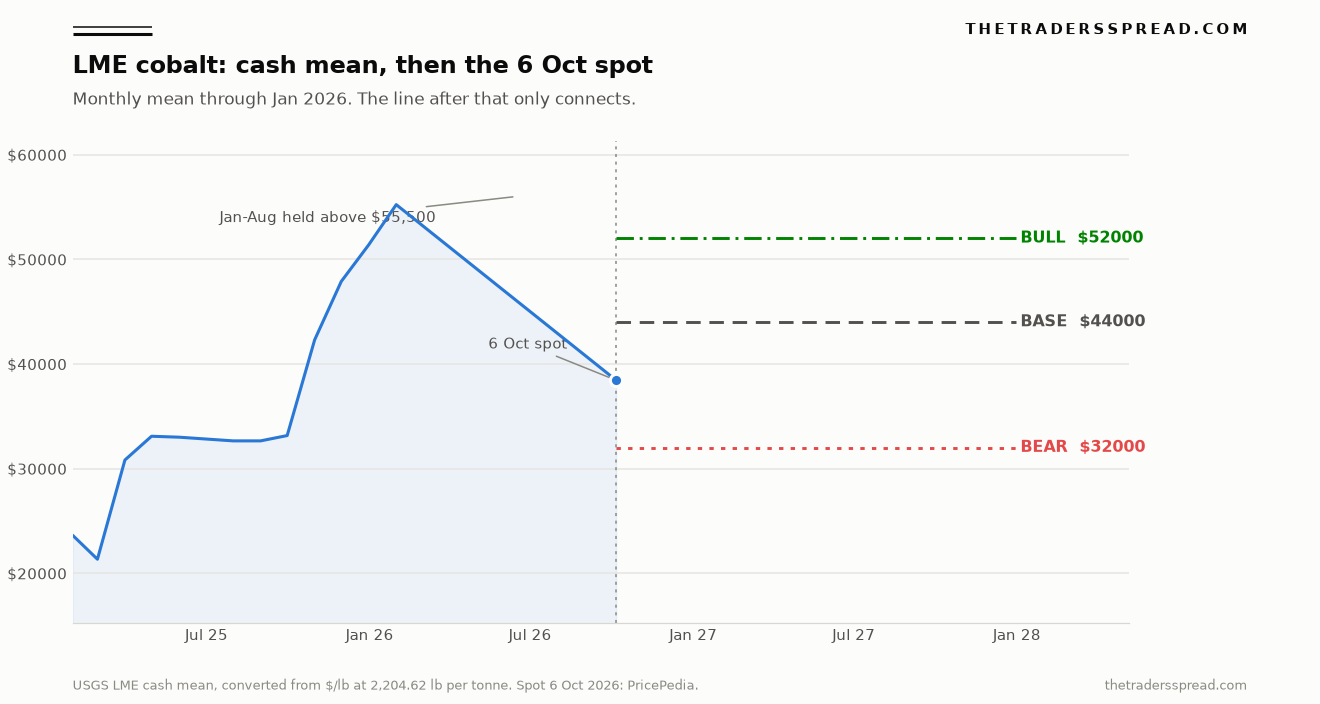
Read the gap before the slope. January through August above $55,500 are not plotted points. The USGS price box stops in January, and no daily LME file was open. The note on the chart marks that zone. The line into 6 October only puts the live print on the graphic. PricePedia calls the break a move "over the past month" as of 6 October. Benchmark, on 30 September, still had European metal about 11% lower on the quarter and above $25 a pound, about $55,100, through August. The sharp LME move fits early autumn.
| Reference | What it is | Figure | Date |
|---|---|---|---|
| PricePedia | LME spot, the anchor | $38,445/t | 6 Oct 2026 |
| PricePedia | LME December 2027 future | $40,760/t | 6 Oct 2026 |
| USGS | LME cash mean, January | $25.05/lb, about $55,230/t | Jan 2026 |
| USGS | LME cash, 2025 annual estimate | $15/lb, about $33,070/t | Feb 2026 summary |
| Benchmark | Hydroxide, CIF Asia, not LME | $17.25/lb, $38,030/t | 30 Sep 2026 |
| Consensus Economics, via PricePedia | December 2027 survey range | $48,500 to $59,500/t | Survey 21 Sep 2026 |
| This forecast | Base, bull, bear | $44,000 / $52,000 / $32,000 | 8 Oct 2026 |
Consensus Economics, in the 21 September round PricePedia cites, had December 2027 at $22 to $27 a pound, average $24.1. PricePedia converts the range to $48,500 to $59,500 a tonne. At 2,204.62 pounds per tonne, $24.1 is about $53,130, next to their own December 2027 scenario near $53,000. Every name in that survey sat above the 6 October spot, which was more than $10,000 under the floor. The survey is dated 21 September, before the LME move was finished. It is a stale centre, not a level the curve has to meet.
PricePedia also prints annual averages around $52,000 for 2026 and $51,000 for 2027. Those are a model, not a spot and not a December price. Eight months above $55,500 lift a 2026 average even if the last quarter stays in the high $30,000s. The forward claim is about $53,000 in December 2027. That is close to this page's bull case. It is not the base.
The December 2027 future at $40,760 is only about $2,300 above the spot. Over fifteen months that is a mild contango. It pays for time and storage. It does not, by itself, mean the market expects a higher spot. PricePedia says as much. What the flat curve does say is that nobody is paying up for the survey. Financing is not free when yields are high. The desk has already set out what a 5.31% US 10-year yield does to prices. That note is rate arithmetic, not a cobalt input.
The bracket follows the same rule as the API2 coal prediction and the lumber forecast. The bull has to clear the live print. The bear has to sit under it. $52,000 is above $38,445. $32,000 is below it. The base, $44,000, is also above the spot, which is why the bias is for a higher price, with conviction only at 3 out of 5. The destination is the part the evidence does not settle.
Kinshasa still has the pen
Patrick Mpoyi Luabeya, chairman of ARECOMS, told Fastmarkets on 11 August 2026, in comments published the next day, that the quotas were set to preserve balance. "In light of recent market developments and the decline in cobalt prices, ARECOMS does not, at this stage, intend to modify the quota volumes allocated for the coming months," he said. He left the door open: "If the imbalance between supply and demand were to persist or deteriorate, a reduction in export quotas may be considered in order to help restore market balance."
Mid-August still had European metal above $25 a pound, and LME cobalt, on PricePedia's account, still above $55,500. The decline in that interview lines up with hydroxide. Fastmarkets assessed hydroxide that day at $22.00 to $23.00 a pound, CIF China, down from $26.00 to $26.25 in late April. The LME print of $38,445 came later. The cut he described had not been used.
Fastmarkets also said the late-June clawback of unused quota removed about 15,000 to 20,000 tonnes of annual allowance, as market participants estimated it. That is an estimate, not an ARECOMS release. Unused rights were already pulled, and the autumn metal price still fell. That is not what a binding shortage looks like.
USGS says cobalt in batteries was being designed down, and that iron-and-phosphorus chemistries held a significant share in China. No October share was re-pulled, so none is added. Indonesia's 14% of mined supply comes off nickel operations that do not need a high cobalt price to keep running.
The call through December 2027
Base case: $44,000 a tonne by 31 December 2027, about 14% above the $38,445 spot and about $3,200 above the December 2027 future. It is about $4,500 under the consensus floor. The path retraces part of the autumn break and does not revisit the January mean near $55,230. The quota stays. Hydroxide keeps moving, so the shortage above $55,500 does not return, but 96,600 tonnes of exports against 230,000 tonnes of recent DRC mine output is still enough to block a full unwind to February 2025. Conviction is 3. The anchor is two days old and is not an exchange settlement file.
RelatedSoybean Oil Price Prediction: 74c Bull vs 64c Bear
Bull case: $52,000, if ARECOMS actually cuts the 87,000-tonne base, or if Chinese hydroxide arrivals fall from June's pace above 10,000 tonnes toward May's roughly 2,000. That would put the survey range back in play. $52,000 sits inside it, near PricePedia's December 2027 scenario of about $53,000, and it is not their 2026 annual-average model. An average can look like $52,000 because the first eight months were high.
Bear case: $32,000, which is also the invalidation. It is under the live print and just under the 2025 annual cash average of about $33,070. It is not the lowest plausible tick. February 2025 was about $21,340 and the 2024 annual average about $26,100. If the cap does not bind, the contract has already traded there. $32,000 is where this recovery idea is wrong.
A published quota cut, or imports back at the May pace, would lift the base toward the bull. Prints under $32,000, or exports running through the cap with no reply, would retire it. A cash settlement still near the January mean would mean the anchor was the wrong print. None of those was on the screen. Until one is, $38,445 on 6 October stands, the bull is above it, and the bear is below it.
Questions the forecast has to answer
What is the cobalt price forecast into 2027?
The base case is $44,000 a tonne on the LME by 31 December 2027, against a spot of $38,445 on 6 October 2026. The bull case is $52,000 if the DRC cuts exports. The bear case is $32,000 if the quota premium fades toward the 2025 annual average. The December 2027 future was $40,760 that same day, closer to the base than the surveys are. These are levels for a thin contract, not an instruction.
Why did the cobalt price fall after August 2026?
PricePedia says LME cobalt held above $55,500 a tonne from January through August, then fell more than 30% to $38,445 by 6 October. Benchmark, on 30 September, tied the quarter to rising DRC supply, including Chinese hydroxide imports above 10,000 tonnes in June against about 2,000 in May. European metal had eased only about 11% in that note. A week later the LME spot was down with hydroxide. End-June stocks of 99 tonnes are too small to be the cause.
Is the cobalt hydroxide price the LME price?
No. Hydroxide CIF Asia was $17.25 a pound, $38,030 a tonne, on 30 September in Benchmark's assessment. That is feedstock, not the LME metal contract. On 6 October the two landed a few hundred dollars apart. Through August they did not. Benchmark had European metal above $25 a pound, about $55,100 a tonne, while hydroxide had already fallen. Averaging them is not a forecast of either market.
What cobalt price would invalidate this view?
A move under $32,000 a tonne would invalidate the base case of a partial recovery. That level is just below the USGS estimate of the 2025 annual LME cash average, about $33,070 a tonne. It is not a floor. The February 2025 cash mean was $9.68 a pound, about $21,340. A real cut to the 87,000-tonne base quota, or Chinese imports back near the May pace, would make $52,000 more plausible than $44,000.
Does the DRC export quota still hold cobalt up?
The quota is still the policy. For 2026 and 2027 it is 96,600 tonnes a year, 87,000 for producers and 9,600 as a strategic slice. Luabeya told Fastmarkets on 11 August that he did not, at that stage, plan to change the volumes, while leaving a cut open if the surplus worsened. The LME break described on 6 October came after that interview. A quota discussed and not reduced has not held the January plateau.
Will cobalt return to $55,000 a tonne?
Not in the base case. PricePedia's scenario uses an annual average around $52,000 for 2026 and about $53,000 by December 2027. An average can look high because January through August were high, even if the year ends much lower. The December 2027 future, at $40,760, is not priced for a return to $55,000. The $52,000 bull case is the path where Kinshasa cuts exports. It is a scenario, not the central case.
Disclaimer
This is analysis, not a recommendation. Capital is at risk. Cobalt on the LME is a thin contract, the anchor is a published spot rather than a settlement file from the exchange, and the scenarios can be wrong. Nothing here is an instruction to trade.