

Is December soybean oil pricing a shortage of fuel feedstock, or is it simply sitting on the average the US Department of Agriculture already published? It is sitting on the average. In WASDE-675, dated 11 September 2026, the World Agricultural Outlook Board left the US season-average price for crude soybean oil at Decatur unchanged at 70 cents a pound. At 07:06 UTC on 5 October 2026 the December 2026 contract on the Chicago Board of Trade last traded at 69.42 cents a pound, on the Yahoo Finance feed for ZLZ26.CBT. That print is less than a cent under the official average, five days into the oil marketing year. The open question is whether this contract can still be near 70 cents when Chinese crushers return on 8 October and the next balance sheet is released at noon Eastern time on 9 October.
The same September report did not treat the rest of the crush this way. It raised the season-average soybean price by 60 cents, to $12.00 a bushel, and soybean meal by $30, to $340 a short ton, and copied every US soybean-oil line forward from August. A record bean crop and a higher meal price sit next to an oil market USDA declined to reprice. Soybeans have already had their own note on this desk. The line the Board refused to edit is the one that matters here.
Key facts
- December 2026 CBOT soybean oil, Yahoo symbol ZLZ26.CBT, quoted in US cents per pound, last traded at 69.42 cents at 07:06 UTC on 5 October 2026. The session had ranged from 68.77 to 69.45. The 2 October daily close was 68.62 cents. Source: Yahoo Finance, pulled 5 October 2026.
- USDA left the 2026/27 season-average price for crude soybean oil at Decatur unchanged at 70 cents a pound. The 2025/26 estimate is 64.00 cents. The 2024/25 average was 47.59 cents. Source: WASDE-675, 11 September 2026.
- Biofuel use of soybean oil is projected at 17,800 million pounds, 53.8% of domestic disappearance and 20.3% above the 14,800 million pounds estimated for 2025/26. Food, feed and other industrial use is 15,305 million pounds. Source: WASDE-675, 11 September 2026.
- Ending stocks are 1,877 million pounds against total use of 33,505 million pounds, a stocks-to-use ratio of 5.6%. Neither stocks nor use changed from the August projection. Source: WASDE-675, 11 September 2026.
- US soybean oil exports are projected at 400 million pounds, down from 2,472 million pounds in 2024/25, an 83.8% drop. In the world table that is 0.18 million metric tons, against 6.65 million for Argentina. Source: WASDE-675, 11 September 2026.
- NOPA members crushed 205.456 million bushels in August, down 5.2% from July and 8.2% above August 2025. Member oil stocks fell to 1.201 billion pounds, down 11.7% on the month. Source: Commoditiescontrol, reporting NOPA, 16 September 2026.
- China's National Day holiday runs from 1 to 7 October 2026, and work resumes on 8 October. The October WASDE is scheduled for 9 October at 12:00 Eastern time. Sources: State Council General Office notice, 4 November 2025; USDA release calendar.
One report, three prices
WASDE-675 is dated 11 September 2026. After lifting the soybean farm price and the meal price, the Board wrote that the soybean oil price was unchanged at 70 cents a pound. Footnote 2 says that number is not a futures settlement. It is a simple average of crude soybean oil at Decatur across the marketing year, and for oil that year starts on 1 October. On 5 October the oil year is five days old. December has opened it on top of the average printed for all twelve months.
Beans on the same page did move. Production for 2026/27 is 4,535 million bushels, up 16 million from August, on a yield of 52.8 bushels an acre. Exports are 1,685 million bushels, up 25 million. The narrative rounds that export line to 1.69 billion. Crush is unchanged at 2,780 million bushels. Ending stocks are 310 million, down 10 million. The farm price went from $11.40 to $12.00. Meal imports went from 875,000 short tons to 900,000, and the meal price from $310 a short ton to $340. Oil did none of this.
| WASDE-675, September against August | Soybeans | Soybean meal | Soybean oil |
|---|---|---|---|
| Season-average price | $12.00 a bushel, up $0.60 | $340 a short ton, up $30 | 70 cents a pound, unchanged |
| The line that changed | Exports 1,685 million bushels, up 25 million | Imports 900,000 short tons, up 25,000 | Biofuel use 17,800 million pounds, unchanged |
| Ending stocks | 310 million bushels, down 10 million | 450,000 short tons, unchanged | 1,877 million pounds, unchanged |
Source: USDA WASDE-675, released 11 September 2026. Oil and meal marketing years start on 1 October. The soybean year starts on 1 September.
Every September oil line matches August. Stocks-to-use is 5.6%, and biofuel is 53.8% of domestic use. Exports fall from 2,472 million pounds in 2024/25 to 400 million, 0.18 million metric tons in the world table, against 6.65 million for Argentina. Seventy cents is 9.4% above the 64-cent estimate for 2025/26 and 47% above the 47.59-cent average for 2024/25. The record crush is already inside that 70. December oil near 69 cents is the average.
Where the December contract has already been
The chart uses December 2026 itself, Yahoo symbol ZLZ26.CBT, short name Soybean Oil Futures, Dec-2026. The currency code is USX, so 69.42 means cents a pound, not dollars. CME Group's quote page blocked this host. The tape is Yahoo's. The 70-cent and 64-cent levels come from the WASDE PDF.
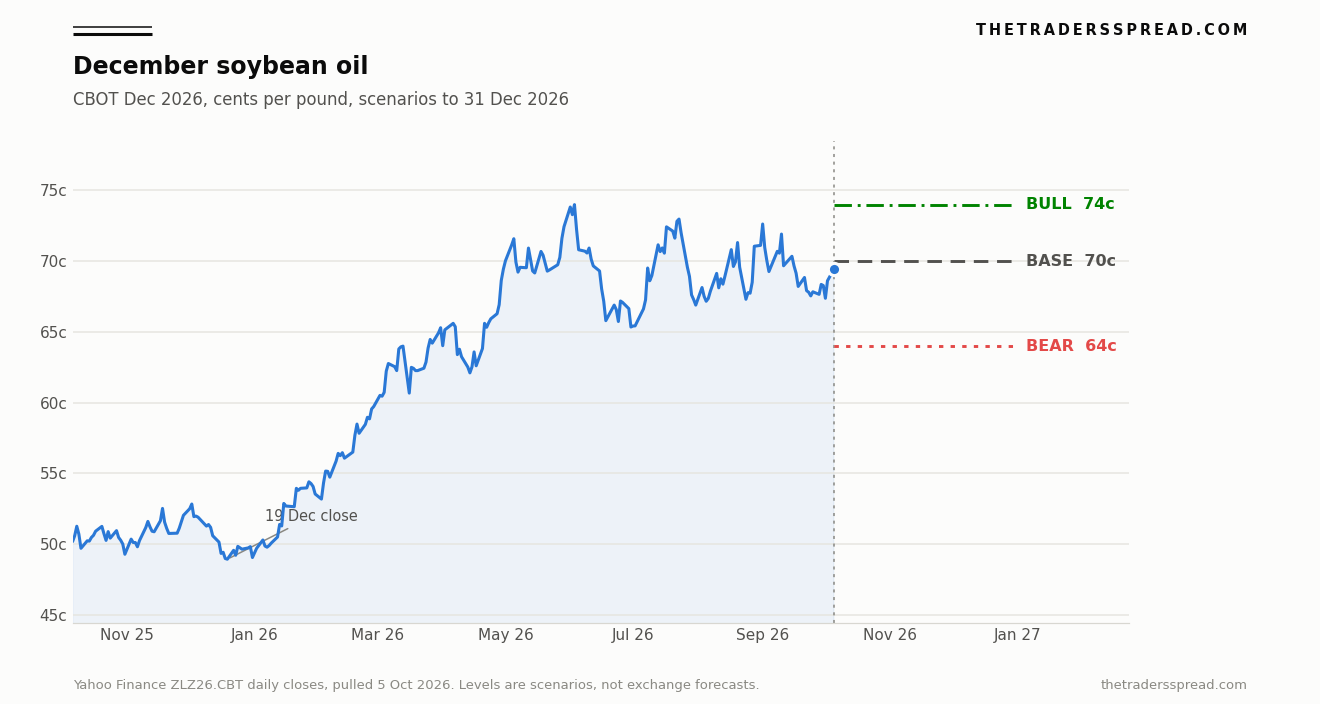
Three closes set the scenarios. On 19 December 2025 the contract closed at 48.94 cents, session low 48.53, the low of this file. On 3 June 2026 it closed at 74.00 cents and traded to 74.55, the high. On 2 October it closed at 68.62. The 5 October daily bar opened at 68.95. At 07:06 UTC the one-minute feed last showed 69.42, inside 68.77 to 69.45, with about 5,900 contracts. That is an early-session price, not a settlement.
Bull on the chart is 74 cents, the 3 June close. Base is 70 cents, the Decatur average. Bear is 64 cents, the 2025/26 average, and it is below the print. From 69.42, 74 is about 6.6% higher and 64 is about 7.8% lower. The lines run to 31 December because that is the horizon of this note. CBOT soybean oil stops trading in the middle of the delivery month.
August crush slowed, and the tank still fell
The crush report the trade waits for covers National Oilseed Processors Association members, not every US plant. Commoditiescontrol, writing in Mumbai on 16 September 2026, reported August. Members crushed 205.456 million bushels, 11.191 million, or 5.2%, below July's 216.647 million, and the smallest month since September 2025. The figure was 2.9% under the average guess of 211.553 million, and still a record for August, 8.2% above the 189.810 million bushels crushed in August 2025. That slowdown reads as maintenance.
Stocks did not fit a simple shutdown story. Member oil stocks ended August at 1.201 billion pounds, down 159 million, or 11.7%, from 1.360 billion at the end of July. Lowest month-end stock since November 2024, and 56 million pounds under the average guess. Shut plants produce less oil. The miss versus the guess is the sharper fact.
These series are not the same unit of observation. USDA's 1,877 million pounds is a projection for September 2027. NOPA's 1.201 billion is a member snapshot, not a Census total. They share a direction. Through late summer, oil left the member tanks faster than the crush replaced it. Extra beans, on the annual sheet, leave as beans or sit in the carryout. They become oil only if crush rises, and crush was already at the 2,780 million bushel pace USDA is willing to print.
The holiday shuts a bean buyer
China's State Council set the 2026 holiday calendar in a General Office notice dated 4 November 2025. National Day runs from Thursday 1 October to Wednesday 7 October, seven days, with a makeup work day on 10 October. Mid-Autumn was a separate break, 25 to 27 September. Crushers and the Dalian vegetable-oil trade are shut this week and back on 8 October, the day before the October WASDE.
That week is not a US soybean-oil export story. Projected US oil exports of 400 million pounds, 0.18 million metric tons, are a residual. China's soybean-oil production in the September world table is 21.56 million metric tons. Oil imports were cut from 0.30 million tons to 0.20 million, and ending stocks from 0.97 million tons to 0.75 million. China makes most of its soybean oil by crushing imported beans. The shut buyer is a bean buyer.
Palm oil, the rival export oil, has its own recent history on this desk. Argentine soybean oil, at 6.65 million tons of projected exports, is the large seaborne competitor. A holiday effect on December CBOT oil would run through Chinese bean buying and Asian vegetable-oil price discovery, then a restart on 8 October into the next day's WASDE. From a daily open at 68.95 cents the contract traded 68.77 to 69.45. The test is the three sessions after the holiday, not this one.
Fuel is the swing line
Biofuel is 17.8 billion pounds of the US oil sheet. Food, feed and other industrial use is 15.3 billion. Exports are 0.4 billion. The WASDE footnote defines that fuel line as soybean oil used for biofuels as reported by the Energy Information Administration. The 2026/27 figure of 17,800 million pounds is 20.3% above the 14,800 million estimated for 2025/26. Spread evenly, it is about 1.48 billion pounds a month. That split illustrates the year. It is not a monthly EIA print.
In May, before this projection was on the page, Alan Weber set a lower bar. Weber, an agricultural economist consulting for Clean Fuels Alliance America, said: "We need to be well over a billion pounds of soybean oil used each month to support growing biofuel production." The line is from an Iowa Soybean Association article by Kriss Nelson, 14 May 2026. The September sheet clears that bar if the year unfolds as USDA has it. Kurt Kovarik, vice president of federal affairs at Clean Fuels, put the constraint somewhere else in the same piece. "The determining factor most likely limiting production and use of biomass-based diesel is production capacity," he said. "The availability of qualifying feedstocks is not a hard limit."
If the plants can run, 70 cents is what USDA thinks that home is worth. The other version is that the mandate and the plants come apart. On 25 August 2026 Farms.com reported an American Soybean Association warning that small-refinery exemptions for the 2025 compliance year could exceed 1.8 billion RIN credits, nearly double the level EPA had assumed, and could remove roughly 500 million gallons of biomass-based diesel demand. This desk did not pull the original release, so the figure stays a reported claim. It is the plainest policy path from 70 cents toward 64.
Ed Usset, professor emeritus and grain marketing economist at the University of Minnesota's Center for Farm Financial Management, spoke on 21 September. Farm and Ranch Guide published the conversation on 28 September 2026. "We've got energy prices up, and energy prices as much as anything are driving the bean and the corn market because of ethanol and renewable diesel. These are the highest prices we've seen in three years," he said. On oil he was flatter. "We've been that high before, in the mid-60s to 70 cents for a while, but it's the meal that is the big surprise." He called the crushing market fantastic. Meal was the price the Board marked up. Oil was left alone.
Diesel is the energy contract this desk has already framed on its own. Soybean oil does not have to follow it tick for tick. Fuel demand can be large and the oil price can still sit still, because the crush supplies oil as fast as the fuel plants take it. A firm energy market is a reason the 70-cent average exists. It is not, alone, a reason December oil trades 74 cents.
The call
The base case is 70 cents a pound into the life of the December contract, the Decatur average USDA has already published. The live price is 69.42 cents. Nothing in the September oil sheet, and nothing in Monday's range of 68.77 to 69.45, requires a new number. The view is neutral and conviction is ordinary. China returns on 8 October and the balance sheet is rewritten on 9 October.
RelatedCaustic soda futures fell 3.89% to 1,632 yuan a tonne
The bull case is 74 cents, the close on 3 June 2026. It needs the October report to cut oil supply or raise the biofuel line enough that 70 cents stops looking right, or a post-holiday run that pulls the contract back to a high it has already paid. A trade through 74.55 cents, the 3 June high, would be a stronger claim than the one drawn here. From 69.42 cents, 74 is about 6.6%.
The bear case is 64 cents, the 2025/26 Decatur average, and it sits under the market. Getting there takes a miss on the fuel line: exemptions that bite, a crush that refills member tanks once maintenance ends, or an October WASDE that cuts the 70-cent price September left alone. A drift back to the 1 October close of 67.38 cents would be a soft week, not this case. Sixty-four cents is about 7.8% under 69.42, and it is where a 70-cent oil year has failed.
A cut to the Decatur price on 9 October retires the base case that day. A later crush report with oil stocks rebuilding toward the summer totals would do it more slowly, and a close under the early-October lows would be the price saying it first. Export sales that show US oil moving in size, or a close back through 74 cents, would make 74 the new base and 70 a floor. Until one of those prints, the working description is the one the Board already wrote. Seventy cents, unchanged.
Questions
Which soybean oil price is this?
December 2026 soybean oil on the Chicago Board of Trade, Yahoo symbol ZLZ26.CBT, quoted in US cents per pound. It is not the soybean future and not a posted crusher cash price, though the 70-cent USDA figure is a Decatur cash average. The last used here is 69.42 cents at 07:06 UTC on 5 October 2026, with the session still open.
Why is the bull case 74 cents rather than a new high?
On 3 June 2026 this contract closed at 74.00 cents and traded as high as 74.55. A bull case of 74 cents returns to that close. It sits above the 69.42 cent print, and it does not require a price the contract has not already traded this year. A break of 74.55 cents would be a larger claim than the title makes.
Why is the bear case 64 cents?
WASDE-675 estimates the 2025/26 Decatur average at 64.00 cents. That is last year's official average, below the 5 October print, and it is not the contract low. The lowest close in the chart file was 48.94 cents on 19 December 2025. Sixty-four cents gives back the 2026/27 premium rather than revisiting that winter trough.
Does the China holiday hit US soybean oil exports?
Not in any size USDA is projecting. US soybean oil exports for 2026/27 are 400 million pounds, about 0.18 million metric tons, against 6.65 million tons from Argentina. China produces 21.56 million tons and the September sheet has it importing 0.20 million. The holiday shuts bean buying. The US oil balance is a domestic fuel balance.
Is 70 cents a forecast of the December settlement?
No. In the WASDE table, 70 cents is a simple average of crude Decatur soybean oil across the marketing year that starts on 1 October. A December future can trade on that average in week one without anyone promising the contract expires there. The base case is that it holds near the average. A scenario, not a guarantee.
What would knock this view over?
An October WASDE that cuts the Decatur oil price would do it on 9 October. So would a post-maintenance crush report that refills tanks while the contract slides toward 64 cents. A close back through 74 cents, or US oil exports that stop looking like a 400 million pound residual, would push the base case up. Until then the description is the one USDA left unchanged.
This is analysis, not a recommendation. Soybean oil futures can move on a single WASDE line, a crush report or a policy headline, and capital is at risk. The 74, 70 and 64 cent levels are scenarios for the December contract. They are not instructions to buy or sell.