

EU carbon, for anyone importing steel, aluminium, cement, fertiliser, electricity or hydrogen into the Union, is not the futures price on an exchange screen. Treating those two figures as one number is how a CBAM bill gets mis-stated. The EU carbon price that attaches to goods which entered during the third quarter of 2026 is a certificate price the European Commission put on its own page on Monday 5 October: €82.32 per tonne of CO2-equivalent. Beside it sit €75.36 for the first quarter, published on 7 April, and €75.28 for the second, published on 6 July. The third-quarter print is €7.04 above the second-quarter print. Divide 7.04 by 75.28 and the rise is 9.4% once that ratio is rounded to one decimal place. The page is the Commission's price of CBAM certificates. It is the only official euro figure for this instrument. No broker screen produced it, and it is not a forecast of the quarter still underway.
Read the three prints together and the year stops looking like a grind. From the first quarter to the second, the EU carbon price used at the border fell by €0.08, about 0.1%. The whole of the 2026 increase arrived in one quarter, and it describes imports in July, August and September, not the market on the Monday the figure was released. Commission Implementing Regulation (EU) 2025/2548 builds each quarterly price as a volume-weighted average of EU ETS auction clearing prices, calculated in the first calendar week after the quarter ends and rounded to the nearest cent. The Commission price page, read again on 11 October 2026, adds a third clock: certificates are purchased on the common central platform only from February 2027. Import quarter, publication week and payment date are three different clocks.
Key facts
- The Q3 2026 CBAM certificate price is €82.32 per tonne of CO2-equivalent, published on 5 October 2026 — European Commission, Price of CBAM certificates, retrieved 11 October 2026
- The Q2 2026 price was €75.28, published on 6 July 2026, so the quarter-on-quarter rise is €7.04, or 9.4% — same Commission table, retrieved 11 October 2026
- The Q1 2026 price was €75.36, published on 7 April 2026, which is €0.08, about 0.1%, above Q2, and Q3 is 9.2% above Q1 — same Commission table, retrieved 11 October 2026
- Each 2026 quarterly price is the volume-weighted average of auction clearing prices, rounded to the nearest cent, and it applies to the quarter the goods were imported — Commission Implementing Regulation (EU) 2025/2548, Articles 1(4), 1(5) and 1(6), Official Journal, 22 December 2025
- From 1 January 2027 the Commission replaces the four quarterly averages with a weekly average — Regulation (EU) 2025/2548, Article 5(1), and the Commission price page, retrieved 11 October 2026
- The Q4 2026 row is listed for publication on 4 January 2027, and the price cell was still blank — European Commission price table, retrieved 11 October 2026
- CBAM's definitive regime, from 1 January 2026, covers cement, iron and steel, aluminium, fertilisers, electricity and hydrogen — European Commission CBAM page, retrieved 11 October 2026
A weighted average, not a closing print
The methodology sits in the Official Journal, not in a market comment. Regulation (EU) 2025/2548 of 10 December 2025 was published in the L series on 22 December 2025 and applies from 1 January 2026. It was signed at Brussels for the Commission by its president, Ursula von der Leyen. Article 1 tells the Commission, for each quarter of 2026, to calculate the quarterly average of auction clearing prices. The clearing price is what successful bidders pay for each allowance when the bidding window closes, the definition the regulation takes from Delegated Regulation (EU) 2023/2830.
Volumes are why a simple mean is rejected.
Recital 3 says auction sizes differ, so each clearing price is weighted by the volume sold in that auction. A large primary sale moves the certificate price more than a thin one. Cancelled auctions drop out. Recital 2 also leaves out auctions of allowances for buildings, road transport and additional sectors. What goes in is the common auction platform, including Union funds and third-country auctioneers, plus Member State opt-out platforms. Article 1(3) is the operative line. An outside reader cannot rebuild €82.32 from that description, because the price page does not post the auction tape or the weights. The average is verifiable as a published result. Its ingredients are not.
The calculation falls in the first calendar week of the following quarter. The price is in euro, rounded to the nearest cent, and it locks onto the certificates that correspond to embedded emissions in goods imported during that quarter. Later auctions do not revise it. Q3 goods keep €82.32 even if an October clearing price prints somewhere else. Article 4(1) puts the figure on the Commission's website on the first Commission working day of the week after the calculation week. The table records Monday 5 October 2026 next to Q3.
Article 4(2) adds a registry duty: as from the third quarter of 2026, the quarterly prices applicable in 2026 are to be made available to authorised CBAM declarants in the CBAM registry. The 5 October print is the first publication inside that window. Q1 and Q2 were already on the public table. The new fact is the registry obligation, not the invention of the series. Q4's row is already drawn, dated 4 January 2027, with the price empty. From 1 January 2027, Article 5 replaces the four quarterly averages with a weekly average, still volume-weighted and still to the nearest cent. 2026 is the only year this instrument arrives as four numbers.
Three quarters, one move
The chart plots the only history this series has. Each point sits on the last day of the quarter the price covers: 31 March at €75.36, 30 June at €75.28, 30 September at €82.32. The lines between them join three observations. They are not a daily path, and they are not an EUA futures curve. The dotted vertical marks 30 September. Blank space to its right is axis margin so the final point is not cut off. It is not a forecast. Q4 has no number yet.
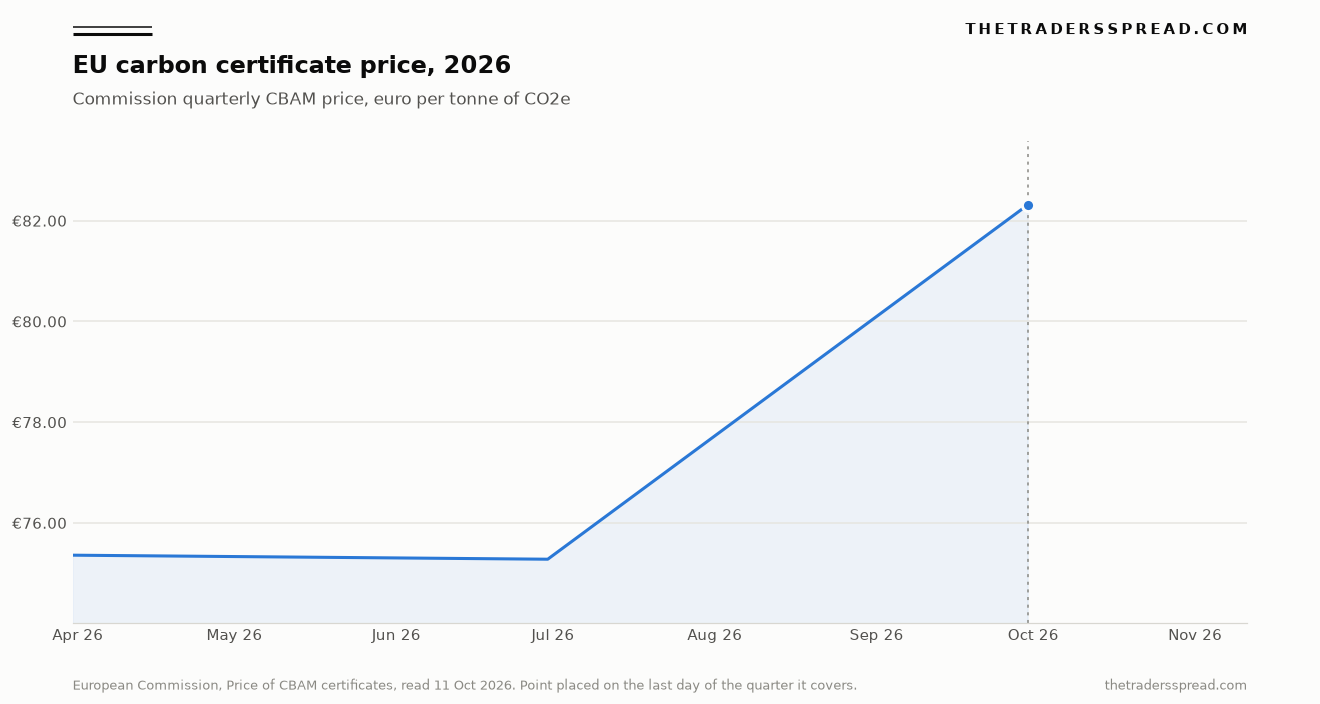
The Q1-to-Q2 dip is €0.08. On a scale that also has to fit a jump of €7.04, that dip is a small kink. It stays in the table because €0.08 still counts. From the Q2 low to the Q3 print the rise is €7.04. Against Q1, Q3 is €6.96 higher, 9.2% when 6.96 is divided by 75.36 and rounded to one decimal place. Q3 is the high of the three published prints. Q2 is the low. The path is a dip, then a jump, not a row of higher highs.
| Quarter | Imports it covers | Published | Price (€ per t CO2e) | Change from the prior print |
|---|---|---|---|---|
| Q1 2026 | January to March | 7 April 2026 | 75.36 | First print of the definitive regime |
| Q2 2026 | April to June | 6 July 2026 | 75.28 | Down €0.08, about 0.1% |
| Q3 2026 | July to September | 5 October 2026 | 82.32 | Up €7.04, 9.4% |
| Q4 2026 | October to December | 4 January 2027, listed | Not published | Price cell blank on 11 October 2026 |
All four rows are the Commission price table as retrieved on 11 October 2026. The percentages are this desk's arithmetic on those euros, not a second official statistic. 9.4% is 7.04 divided by 75.28. 0.1% is 0.08 divided by 75.36. A line that says "nearly 10%" is in the neighbourhood and is less exact than the division.
The page does not explain the jump. There is no split into July, August and September auctions, and no list of volumes. European gas is the story traders will reach for, because gas still sets the power price in many hours and power stations sit inside the EU ETS. This desk follows that market through TTF gas. Reaching for gas is not measuring it against this certificate. The Commission has not published the tape behind €82.32.
Coal is the other fuel in that merit order. API2 coal is a different price, and it does not appear in the certificate formula. A cause for the €7.04 needs the weights, from the Commission or from the auction platforms' own reports with the working shown. This article does not pretend to have that file.
Six sectors, one price, different tonne counts
Since 1 January 2026, CBAM has been in its definitive regime. The Commission's CBAM page, retrieved with the price table, lists the goods: cement, iron and steel, aluminium, fertilisers, electricity and hydrogen. The €82.32 figure does not care which customs code the shipment carries. The certificate price is common. The number of certificates is not.
Regulation (EU) 2023/956, Article 7, read on EUR-Lex on 11 October 2026, keeps the tonne count apart from the euro price. Embedded emissions in goods other than electricity come from actual emissions. Where actual emissions cannot be adequately determined, and for indirect emissions, they come from default values. For goods in Annex II, only direct emissions are calculated. This piece does not restate Annex II, and it does not invent an electricity formula. Article 7 treats electricity apart from other goods. What survives that caution: a default value is an emissions intensity, tonnes of CO2e per tonne of product, not a euro price. Multiplying an intensity by €82.32 is a second calculation. The 5 October page published the price, not that product.
Two importers of the same nominal good can face different certificate counts at the identical €82.32. One has verified plant data. The other is on a default. The price print does not rank them.
Aluminium is on the sector list, and the metal's price is a different market from the certificate. Coverage of aluminium on this desk is not a read-through to €82.32, and the certificate is not a read-through to the metal. Iron and steel are on the list too. Iron ore feeds that steel. It is not the CBAM good the certificate attaches to.
The legal obligor is the authorised CBAM declarant. The Commission price page, citing Article 20 of Regulation (EU) 2023/956, states that all CBAM certificates will be purchased on the common central platform from February 2027. The 5 October figure is a liability for third-quarter imports. It is not a ticket that cleared on 5 October. The cash date and the publication date are not the same day.
The futures screen is a different series
A futures contract on EU allowances is a secondary-market price. It updates through the session. It is not weighted by primary-auction volume. It is not rounded once a quarter by the Commission. It does not attach, by itself, to a customs declaration for embedded emissions.
Recital 9 of Regulation (EU) 2025/2548 asks for one clear price indication, published only by the Commission, free of charge, on its website. There is no second official print. A book marked to a futures close is a different object from the figure an importer uses for Q3 embedded emissions. The two can diverge inside a quarter without either correcting the other. The certificate averages auctions across the quarter, then freezes. A futures close on 30 September is the last day of the quarter that certificate describes. A close on 5 October is a later moment, the day the average was published. Using one to restate the other swaps the series. The Commission's page does not invite the swap.
From 2027 the average becomes weekly under Article 5. The lag shrinks from a quarter to a week. It does not become a futures settlement. The weekly figure is still an auction average, published on the first Commission working day of the following week and placed in the registry on the first day that price applies. Four fixes for 2026 is the design Q3 importers are under.
No live futures price appears here. No auction file was required to read €82.32, and none is reproduced. Leaving the screen blank is deliberate. An unverified second number would rebuild the mix-up the opening sentence is there to stop. When a platform file is in hand, with volumes and clearing prices for July through September, the weighted average can be checked against the Commission's cent. Until then the official figure stands on the Commission page, and the screen stands somewhere else.
What this changes
Importers of Q3 goods now have a fixed euro amount per tonne of embedded CO2-equivalent. For goods that entered from 1 July to 30 September 2026, the certificate price is €82.32. Later auctions do not revise it. A cost booked at the Q2 rate of €75.28 on those shipments was €7.04 per tonne light, 9.4% of the Q2 price. That is an accounting gap on a finished quarter. It says nothing about where the next auction clears.
Q4 is still open. The table lists 4 January 2027, a Monday, and leaves the price blank. Goods entering from 1 October to 31 December do not yet have a certificate price. The Q3 jump does not require Q4 to print higher. This series has already fallen once, by €0.08, between the first quarter and the second. One rise is not a run of rises. A declaration cannot fill that blank with the Q3 number.
RelatedCobalt Price Forecast: $52,000 Bull vs $32,000 Bear
Cash sits later than the liability. The Commission page places purchase on the common central platform in February 2027. A figure known on 5 October 2026 and a payment dated 2027 are different lines in any treasury view. A model that spends the euros on publication day uses a date the page does not give.
The tonne count is still the larger unknown for many declarants. €82.32 does nothing without an emissions figure, whether verified actuals or a default intensity. Two suppliers of one good can face two bills at the same certificate price. The 5 October page did not rank those suppliers, and it did not print product-level default values beside the euro. Price and intensity remain separate documents.
A Commission correction, a restated auction, or a tape showing the €7.04 in a handful of sales would change the reading. None of that is on the price page on 11 October 2026. The official EU carbon price for Q3 CBAM certificates is €82.32, 9.4% above €75.28, and it does not price goods crossing the border this month.
FAQ
What is the EU carbon price for CBAM in the third quarter of 2026?
The Commission set the Q3 2026 CBAM certificate price at €82.32 per tonne of CO2-equivalent and published it on 5 October 2026. That is the EU carbon price for goods imported in July, August and September 2026. It is €7.04, or 9.4%, above the Q2 price of €75.28. It is not a futures settlement, and it does not cover imports arriving from 1 October. On 11 October 2026 the Q4 cell on the same table was still blank.
How is the CBAM carbon price calculated in 2026?
For each quarter of 2026 the Commission takes EU ETS auction clearing prices, weights each by the volume sold, and rounds to the nearest cent. Cancelled auctions are left out. The calculation sits in the first calendar week after the quarter ends. The result applies to embedded emissions in goods imported during that quarter, under Regulation (EU) 2025/2548, Articles 1(4) to 1(6). From 2027 the average becomes weekly rather than quarterly.
Is the CBAM certificate price the same as an EUA futures price?
No. A futures price is a secondary-market contract that updates through the session. The certificate price is a volume-weighted average of primary auction clearing prices across a finished quarter, published once by the Commission. Regulation (EU) 2025/2548 treats that single figure as the CBAM certificate price. The two can diverge without either correcting the other. This article quotes no live futures price.
Which imports does the Q3 2026 certificate price cover?
It covers CBAM goods imported into the Union during July, August and September 2026. In the definitive regime, which began on 1 January 2026, those goods fall in cement, iron and steel, aluminium, fertilisers, electricity and hydrogen. The euro price is the same across the list. The certificate count depends on embedded emissions, from verified actuals or, where those cannot be adequately determined, from default values. A default is an emissions intensity, not a euro price.
When is the next CBAM carbon price published?
The Commission table lists the Q4 2026 price for publication on 4 January 2027 and leaves the amount blank. That price will cover imports from October through December 2026, and it will again be a quarterly average. Beginning in 2027 the Commission moves to weekly prices, published on its website on the first Commission working day of the following calendar week. The Q3 figure does not update while importers wait for that January date.
When are 2026 CBAM certificates paid for?
The price is already fixed for the first three quarters of 2026. The Commission price page says certificates are purchased on the common central platform from February 2027, citing Article 20 of Regulation (EU) 2023/956. Knowing €82.32 on 5 October is not the same event as paying it. The print is the liability per tonne of embedded CO2e for Q3 goods. The platform date is a separate treasury fact.
Disclaimer
This is analysis, not advice. It does not tell you to transact in allowances, certificates or any commodity. Carbon markets and the goods they attach to can move against you, and capital is at risk. Figures come from the European Commission pages and the Official Journal texts cited above, as read on 11 October 2026, and from arithmetic on those figures. The publisher can correct them. The chart connects three quarterly observations and is not a forecast.