

I have kept the November 2026 lumber future on this desk since January, longer than I usually stay with one contract month. I did not roll away from it, because the argument kept changing and the symbol did not. Yahoo Finance, pulled on 4 October 2026, shows that CME contract closing at $526.50 on 2 October, down $4.00 from the prior session's $530.50, on reported volume of 438 contracts. The four dollars are not the story. The story is the distance between that screen and the price a large mill says it has actually been paid for lumber.
That distance is wider than one close can show. In an investor presentation filed with the Securities and Exchange Commission on 24 September 2026, Weyerhaeuser put its own lumber realizations, as of 18 September, at $10 per thousand board feet above the second-quarter average on a quarter-to-date basis, and $20 per thousand board feet below that same average on a current basis. The November future closed at $537.00 on 18 September. It had traded as high as $664.00 on 23 July, and it closed that session at $657.50. By 2 October the close was $526.50. July is still inside the mill's quarter-to-date average. It is no longer on the screen.
Order files lag the future. That lag is the forecast problem into 31 December.
The closes, and nothing smoother
Every figure for the future comes from Yahoo Finance's daily history for the November 2026 contract, symbol LBR=F, pulled on 4 October 2026. The file runs from 6 October 2025 to 2 October 2026, and every close falls on a half dollar. I am using those closes as closes. I am not relabelling them as an official exchange settlement price, and I am not converting them into dollars per thousand board feet, the unit Weyerhaeuser uses for its realizations. A futures contract and a mill's average selling price can rhyme without being the same number.
The 2 October session opened at $529.50, traded from $525.50 to $531.50, and closed at $526.50, a dollar off the low. Across the 20 sessions from 4 September to 2 October, Yahoo reported volume of zero on 4 September and a positive volume on the other 19. Those 19 averaged 389 contracts.
- Close on 2 October 2026: $526.50, down $4.00, or 0.75%, from $530.50. Range $525.50 to $531.50. Volume 438. Yahoo Finance, pulled 4 October 2026.
- High in the file: $664.00 on 23 July 2026, when the close was $657.50. The highest close was $659.00 on 22 July. From the 23 July close to 2 October: down $131.00, or 19.9%. From the high print: down $137.50, or 20.7%.
- Low print: $496.00 on 14 November 2025, a session that closed at $508.00. Lowest close: $507.00 on 11 November 2025. The latest close is $19.50 above that low close and $30.50 above the $496.00 print.
Year to date, this is a quiet market. From the July high, it is not.
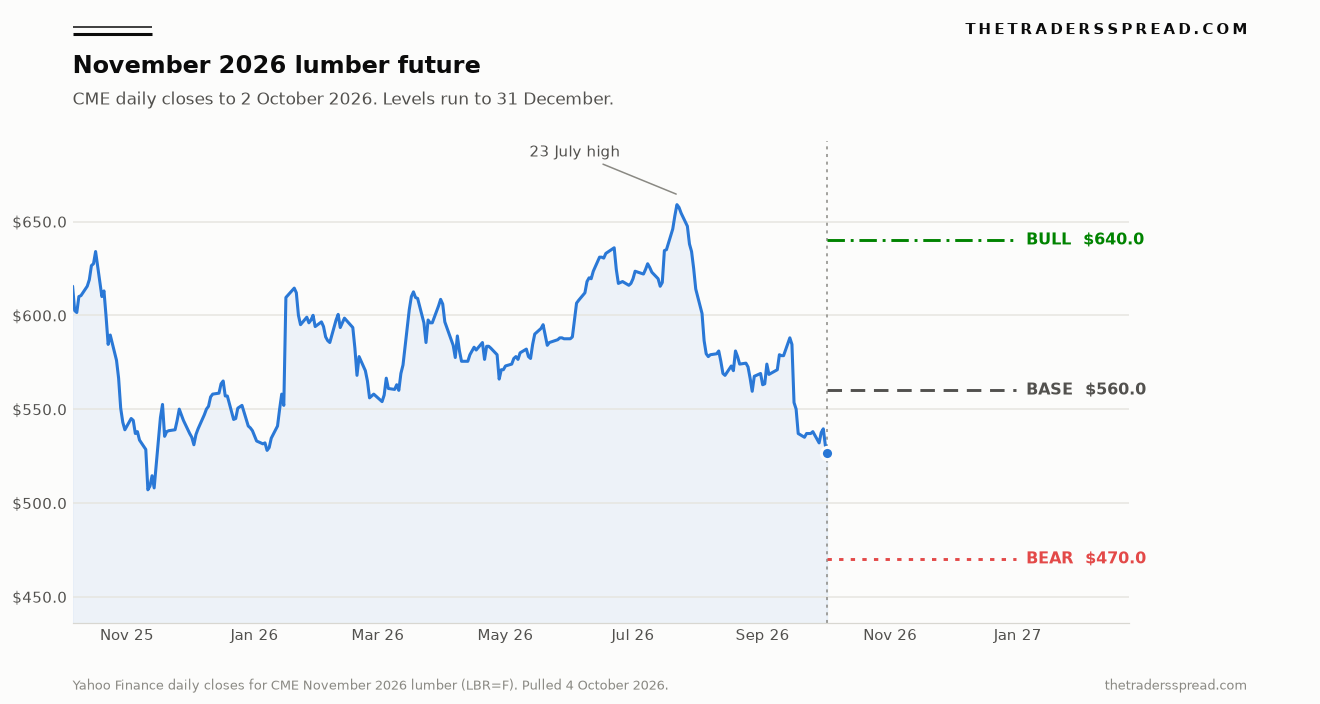 Daily closes for the November 2026 contract. The lines to the right of the last close are this desk's levels to 31 December, not exchange prices.
| Window, to the 2 October close | Starting close | Change |
|---|---|---|
| Five sessions, from 25 September | $538.00 | down 2.1% |
| One month, from 2 September | $563.50 | down 6.6% |
| Three months, from 2 July | $623.50 | down 15.6% |
| Six months, from 2 April | $596.50 | down 11.7% |
| From 31 December 2025 | $538.50 | down 2.2% |
The 31 August close was $569.00. The 30 September close was $539.50. Two sessions later the contract was at $526.50. The base case of $560 is a partial repair toward August, not a return to July. The percentages are calculated from these closes and rounded to one decimal.
What the mill said, and on which date
Weyerhaeuser's second-quarter release is Exhibit 99.1 to the report filed on 30 July 2026. Wood products net sales were $1,360 million, against $1,164 million in the first quarter. Adjusted EBITDA was $129 million, against $71 million. Lumber sales realizations rose 15% from the first-quarter average. Volumes were moderately higher, log costs slightly higher, and unit manufacturing costs higher, "partially driven by operational disruptions in response to transportation constraints." The better price and the higher cost arrived together.
Despite ongoing macroeconomic uncertainty and near-term inflationary pressures, we are encouraged by the recent increase in pricing for lumber and western logs.
That is Devin W. Stockfish, president and chief executive officer, in the 30 July release. That day the November future closed at $625.00, already $39 under the 23 July high and still $98.50 above the 2 October close. The encouragement describes a rally the screen has handed back.
The same release guided third-quarter earnings before special items, and adjusted EBITDA, to slightly lower than the second quarter, excluding changes in average lumber and oriented-strand-board realizations. For lumber it expected higher volumes, moderately higher log costs, and slightly lower unit manufacturing costs. Realizations were left out of that comparison on purpose.
On 24 September a further presentation adjusted the outlook. Wood products earnings before special items and adjusted EBITDA moved to moderately, about $30 million, lower than the second quarter, still excluding those realization changes. The slide attributes the variance primarily to higher-than-expected fuel costs and a mix shift in engineered wood. Fuel is a different contract. This desk follows it in the Brent crude price prediction, and I am not borrowing that piece's levels.
The $30 million is not a lumber-price story. Realizations were excluded, and they appear on the next slide, as of 18 September 2026. Quarter-to-date lumber realizations versus the second-quarter average were $10 per thousand board feet higher. Current realizations were $20 per thousand board feet lower. Oriented strand board, in its own unit, was $5 lower on both comparisons. A footnote says average realizations typically lag benchmark pricing because order files have length. The company's sensitivity: a $10 move per thousand board feet in lumber realizations is about $50 million of EBITDA a year.
A current gap of $20 is two of those steps, about $100 million of annual EBITDA, and only if it lasts a year. That is not guidance. The quarter-to-date average is still $10 the other way, because July is inside the quarter. Both figures were true on 18 September, when the future closed at $537.00. It has since closed at $526.50. The screen can move again before the average does.
The same presentation, citing Forest Economic Advisors, puts 2025 North American softwood lumber production at 55 billion board feet. I use that only as a yardstick for the futures position below.
August housing, the way Census wrote it
The housing print behind this contract is release CB26-147, from the Census Bureau and the Department of Housing and Urban Development at 8:30 a.m. Eastern on 17 September 2026. The figures below are from the release text.
Housing starts ran at a seasonally adjusted annual rate of 1,275,000. That is 2.6%, plus or minus 12.0 percentage points, below the revised July rate of 1,309,000, and 1.2%, plus or minus 10.8 points, below the August 2025 rate of 1,291,000. Both intervals include zero. The release says that when a 90% confidence interval includes zero, there is not enough evidence to conclude the change differs from zero. A 2.6% decline with a 12-point margin might be a rise. I will not call August a down month for starts.
Single-family starts were 918,000, 7.6% plus or minus 14.0 points above the revised July figure of 853,000. That interval includes zero too. The print is higher. Census will not call it an increase, and neither will I. Starts in buildings with five or more units were 344,000. The release does not give a board-foot coefficient, and I have not opened one, so I will not invent the framing in a start.
Completions clear the test. They ran at 1,128,000, 11.9% plus or minus 9.7 points below the revised July rate of 1,280,000, and 27.1% plus or minus 8.9 points below the August 2025 rate of 1,548,000. The 11.9 minus 9.7 to 11.9 plus 9.7 range is 2.2% to 21.6%. Zero is outside it. Single-family completions were 816,000, 10.4% plus or minus 9.3 points below July's revised 911,000, and that interval also excludes zero. Completions in larger buildings were 302,000.
Permits are separate. Authorizations were 1,394,000, 2.7% below the revised July rate of 1,433,000 and 3.5% above the August 2025 rate of 1,347,000. Single-family authorizations were 878,000, 1.8% below July's 894,000. Five-or-more authorizations were 467,000. Those sentences carry no sampling interval. The notes say the permit table is not subject to sampling error. I will not add an interval the release withheld.
The document also says these month-to-month moves are often irregular, and that a trend in starts or completions can take six months to establish. Preliminary estimates are revised 3.8% or less on average. On 1,275,000 starts, 3.8% is about 48,000 units. The September report is scheduled for 20 October 2026, inside this forecast.
A large official number is not a usable one. The desk drew that line on live cattle placements, where the headline was a record-low August. Anyone explaining the drop from $664.00 to $526.50 with "starts fell" has to get past a release that will not call the starts move real, and past a completions decline that is real and refers to homes already being finished. Starts are the next order file. They are not the same series.
A large short in a small futures market
The report I will use is the Commodity Futures Trading Commission's disaggregated commitments of traders, futures only, for Chicago Mercantile Exchange lumber as of 29 September 2026, with changes from 22 September. It measures the contract in units of 27,500 board feet. Open interest was 9,724, up 283. Longs plus spreading, and shorts plus spreading, each add to 9,724. The file is the whole of what I am willing to say about who holds what.
Managed money was long 307 contracts and short 6,209. That short is 63.9% of open interest. The long is 3.2%. Net short: 5,902 contracts. On the week the category cut 108 longs and added 144 shorts. Thirty-one traders are listed on the short side. The long-side count is a dot, and I will not invent a number for it. The whole complex is 99 traders.
Producers, merchants, processors and users were long 5,622 and short 472, a net long of 5,150 after adding 245 longs. That long is 57.8% of open interest, and it is not a mill bid. The form does not split producers from users. Swap dealers were nearly flat, 775 long against 738 short. Other reportables were long 1,952 and short 1,487, with 110 spreading. Nonreportable positions were long 958 and short 708. Four or fewer traders held 29.8% of the gross long and 26.7% of the gross short.
A futures book is not a physical book. The zinc backwardation note draws the same line: the curve and the stockpile were not the headline price.
At 27,500 board feet a contract, the 6,209-lot short is 170,747,500 board feet. Against the 55 billion board feet of 2025 North American production cited above, that is 0.31% of a year's physical output. Against the tape it is about sixteen times the 389-contract daily average of those 19 sessions. Sixteen days of volume, and only if every trade were a fund reducing a short. Markets do not clear that way.
The short grew in a flat week. The future closed at $537.00 on 22 September and at $537.50 on 29 September. The break came after the snapshot: $539.50 on 30 September, $530.50 on 1 October, $526.50 on 2 October. This report does not contain those three sessions. I do not know yet whether the short grew into the drop or was already being reduced.
RelatedWhat the Baltic Dry Index Measures Across Ship Classes
Base, bull and bear into 31 December
The working target is $560, not the bull case in the headline. It is 6.4% above the 2 October close and $9 under the 31 August close of $569.00. It says the contract stops making lows and repairs part of the late-summer break, without needing July back. That is the path if the current realization gap stops widening, if the 20 October housing release does not show a statistically clear drop in single-family starts, and if the speculative short does not get a fresh leg of price.
About half my weight sits on that base. About three in ten sits on the bear case at $470. About two in ten sits on the bull case at $640. Those are desk weights, not option-implied odds.
| Case | Level | Against $526.50 | What it requires |
|---|---|---|---|
| Base | $560 | 6.4% above | The year's range holds, and part of the drop from 31 August is retraced |
| Bull | $640 | 21.6% above | A return to within $24 of the 23 July high of $664 |
| Bear | $470 | 10.7% below | A break of the $496 low print and of the $507 low close |
$640 is a place this contract has already traded. The 23 July high was $664.00, with closes that month in the mid-$650s. Repeating that from $526.50 is a 21.6% rise inside one quarter, on a few hundred contracts a day, with managed money already short 6,209. I would move weight from $560 toward $640 only if at least two things showed up: a 20 October housing report firmer than August in a way Census will call significant, a current lumber realization back through the second-quarter average, and that short being reduced.
$470 is outside the year in the file. It is $26 under the $496.00 print of 14 November 2025 and $37 under the $507.00 close of 11 November. A bear case at $500 would only restate the low. This one is the range failing: the short getting longer after the early-October break, the commercial long standing aside, and a starts report on 20 October that removes the "not statistically a decline" defence. I weight it under the base because the close is still above both reference lows and the housing release in hand does not confirm a drop in starts. I do not weight it at zero. The trend since 23 July points down, and the largest speculative position is already there.
The weights move on specifics. Single-family starts down on 20 October, with an interval that excludes zero, shifts weight toward $470. A completions figure that stabilises shifts it back. The next commitments report either shows the managed-money short larger after the break or it does not. A later mill update that takes the current realization further under the second-quarter average, or back above it, matters more than another adjective on a slide. I do not have Weyerhaeuser's third-quarter release date, so I will not invent one.
A close under $496 invalidates the working idea, which is a drift toward $560 rather than a sprint to $640. Under that print the base is wrong and the bear case is what is being priced. A close above $600 would not make $640 the base. It would say the repair had passed August, and I would add weight to the bull case rather than declare it finished.
July is not the year. From 31 December the contract is down 2.2%, still above last November's low. The position is short, the order file is slow, and the housing release that would clarify demand is not out. That is a $560 contract with a live bear case, not a $640 contract that has been delayed.
Questions the tape actually raises
Which lumber contract is this?
The November 2026 CME lumber future, which Yahoo Finance carries as LBR=F. The anchor is the daily close of $526.50 on 2 October 2026, from a pull on 4 October. It is not a cash composite, and it is not stated here in dollars per thousand board feet. That unit is Weyerhaeuser's, for its own realizations. The two have not been converted.
Why is the bear case under the year's low?
A bear case inside the year's range only restates the base. $470 sits $26 under the $496 low print of 14 November 2025 and $37 under the lowest close, $507 on 11 November. It is the case in which the range fails before 31 December. I weight it less than the base, and more than zero, because the trend since July is down and the speculative book is already short.
Does the managed-money short mean the price falls from here?
No. As of 29 September, managed money was short 6,209 contracts and long 307. The short grew in a week when the future barely moved, and the report stops before 1 and 2 October. A short can be right, or it can be reduced. Reducing it, against a few hundred contracts a day, would be a large share of the tape. Neither outcome is scheduled.
What did August housing actually show?
Census and HUD, release CB26-147 on 17 September 2026, put August starts at 1,275,000, seasonally adjusted and annualised. The 2.6% move versus July has a 12-point margin and includes zero, so it is not a confirmed decline. Completions, at 1,128,000, were 11.9% below July with a 9.7-point margin, which excludes zero. The September report is due on 20 October.
Is $560 an instruction?
No. $560 is the base I weight most, and the working target. It is above the 2 October close. $640 is the bull case in the headline. $470 is the bear case. This is analysis of a futures price, not a recommendation. Capital is at risk, and a thin contract can trade through any of these levels in a handful of sessions.
This article is analysis, not a recommendation to trade lumber futures or any other instrument. Levels can fail. Past closes, including the July high and the November 2025 low, do not establish the 31 December close. Capital is at risk.