

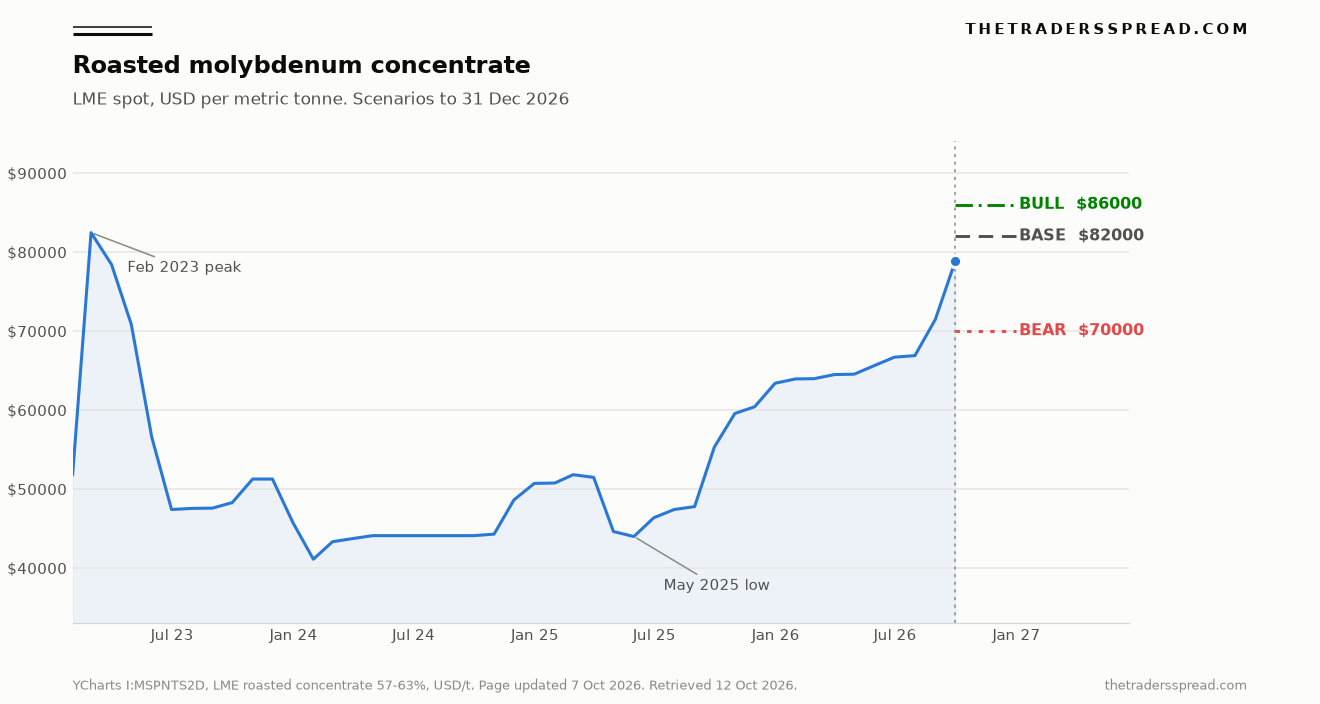
Molybdenum's LME roasted-concentrate spot price closed September at $78,815.26 a metric tonne. That print, for material specified at 57 to 63 percent purity, is the 30 September 2026 observation on the series YCharts publishes as I:MSPNTS2D, and the page was updated on 7 October 2026. August had finished at $71,466.52. September 2025 had finished at $55,315.99. The month was a 10.28 percent rise. The year was a 42.48 percent rise. The close sits 4.4 percent under the February 2023 peak of $82,452.89, the highest month-end this series has recorded back to the start of 2023. Sixteen consecutive month-ends have finished higher, from June 2025 through September 2026, off a May 2025 low of $43,982.22. A market that has climbed 79.2 percent from that low, then added another tenth in a single month, is no longer a recovery story. It is a test of the last spike.
October's other screens do not describe this contract. On 12 October, CTIA GROUP put Chinese molybdenum concentrate near RMB 5,460 per ton-degree and ferromolybdenum near RMB 342,000 a tonne, with few deals on the day. On 7 October, Shanghai Metals Market had seller indications for 57 percent oxide outside China at $33.25 to $33.40 a pound of contained metal, and said the top of the range was not confirmed by transactions. Multiply $33.40 by 2,204.6 pounds in a tonne and you land near $73,600, under the September close. That is a unit translation, not the same cargo. The World Bank Pink Sheet workbook, updated 2 October 2026, has dropped molybdenum, while copper, nickel and zinc remain. One screen is not these screens.
Key facts
- Roasted molybdenum concentrate, LME spot, closed at $78,815.26 per metric tonne on 30 September 2026, up 10.28 percent on the month and 42.48 percent on the year — YCharts series I:MSPNTS2D, page updated 7 October 2026.
- The prior peak on the same series was $82,452.89 on 28 February 2023. The May 2025 low was $43,982.22. From that low to the September close is 79.2 percent — YCharts, retrieved 12 October 2026.
- Freeport-McMoRan produced 23 million pounds of molybdenum and sold 25 million pounds in the second quarter of 2026, at an average realized price of $28.75 a pound. Full-year 2026 sales are guided at about 93 million pounds — Freeport exhibit 99.1, 23 July 2026.
- Freeport's second-half 2026 cash-flow case assumes $30 a pound of molybdenum. Each $1 a pound change is about $85 million a year in the 2027 to 2028 model — exhibit 99.1, and Maree Robertson on the 23 July 2026 call.
- Chinese September averages were RMB 5,465 per ton-degree for concentrate and RMB 342,682 a tonne for ferromolybdenum. Ferromolybdenum tender volume that month was about 12,000 tonnes — CTIA GROUP, September review, 8 October 2026.
- On 12 October the same desk had concentrate near RMB 5,460 per ton-degree and ferromolybdenum near RMB 342,000 a tonne, and cited August Chinese crude steel at 74.61 million tonnes, down 3.7 percent on the year — CTIA GROUP, 12 October 2026, citing World Steel Association figures for the steel line.
- Seller indications for 57 percent oxide outside China moved from $33.10 to $33.20 a pound on 1 October to $33.25 to $33.40 on 7 October. The upper end was not yet confirmed by transactions — Shanghai Metals Market, 8 October 2026.
February 2023 already traded this high
The September close is not a price this series has never seen. It is a price it saw, briefly, and then lost.
On 28 February 2023 the roasted-concentrate series printed $82,452.89. By 31 January 2024 it was $41,106.63, a 50.1 percent decline in eleven months. March 2023 was still $78,424.18, close to where September 2026 has arrived. By June 2023 the series was under $48,000. No one had to declare molybdenum obsolete. Offers met less urgency, and a spike made in one month was given back over a year.
Then it froze. From 30 April 2024 through 30 September 2024 the month-end was identical: $44,092.45, six times. A monthly assessment can sit still when the midpoint is not moving. That flat run is a property of the object being forecast. This is not a pit that prints because a lot of futures changed hands. When the market is quiet, the number repeats. When it is not, one month can do what September just did.
The next important low was 31 May 2025, at $43,982.22, a hair under that frozen plateau. April had already slipped to $44,608.53 from March's $51,467.44. Everything since the June 2025 print of $46,349.57 has been a higher month-end. September 2025 jumped to $55,315.99. December closed at $63,382.90. The first seven months of 2026 were a grind, from $63,934.06 in January to $66,881.54 in July. August broke it, to $71,466.52. September broke it again.
Sixteen higher closes, June 2025 through September 2026. That is the bull case in one fact, and the reason the bull case should stay modest. The last time the series sat this close to $82,000, the following eleven months cut it in half. A long run into a prior high is a location, not a promise that the next month cooperates.
Paths, not a smooth line
The chart uses only this series. Month-ends from January 2023 through September 2026, in dollars per metric tonne. The forward lines are scenarios to 31 December 2026. They are not a path the price must walk, and they are not instructions.
| Path | Level, USD per tonne | Against the 30 September close |
|---|---|---|
| Bear | 70,000 | 11.2 percent below $78,815.26 |
| September close | 78,815.26 | The series we are using |
| Base | 82,000 | 4.0 percent above the close, still under the February 2023 peak of $82,452.89 |
| Bull | 86,000 | 9.1 percent above the close, which would clear that peak |
Base is the awkward level, and the one we weight most. $82,000 tags the old high and does not clear it. A December reading there would mean September's jump was mostly kept, and that February 2023 still acts as a ceiling. Bull at $86,000 is a clearance of about nine percent, not a new regime, on a market already up 79 percent from the 2025 low. Bear at $70,000 sits just under the August close of $71,466.52. It says September was a one-month spike in the style of February 2023, given back before year-end. It is not a return to the 2024 plateau near $44,000. That would be a different article.
The February 2023 peak is $637 under our base and $3,547 under the bull case. The May 2025 low is so far below $70,000 that a retreat only to the bear line would leave most of the post-2025 advance intact. The question into year-end is narrow. Does the series hold above August, stall at the old high, or print a month-end the 2023 spike never quite reached.
Freeport's pound and the monthly tonne
Most molybdenum is not mined for its own sake. It comes out of copper porphyries as a by-product, which is why a concentrate forecast and a copper forecast can diverge for a year and still both be about the same holes in the ground. The mine manager watches the copper credit. The roaster watches the molybdenum midpoint. They do not clear the same contract.
Freeport-McMoRan is the cleanest public window onto that split. In the second quarter of 2026 the company produced 23 million pounds of molybdenum and sold 25 million, the extra sales coming from a stock draw. The average realized price was $28.75 a pound. Full-year sales are guided at about 93 million pounds, 22 million of them in the third quarter. The second-half planning case holds molybdenum at $30 a pound. On that case, with copper at $6 and gold at $4,000, the company pointed to about $8.3 billion of operating cash flow for 2026. All of those figures are in the 23 July exhibit 99.1.
Kathleen Quirk, President and Chief Executive Officer, put the quarter in one line in that release: "The Freeport team achieved strong results in the second quarter, supported by solid execution of our operating plans and favorable pricing for our products." The molybdenum number inside the sentence is $28.75, not the September concentrate print. Favorable against the company's own history is not a mark at $78,815 a tonne.
There are 2,204.6226 pounds in a metric tonne. Divide the December 2025 month-end of $63,382.90 by that factor and you get $28.75 a pound, the figure Freeport realized in the second quarter of 2026. The quarterly average lined up with a month-end from six months earlier. April through June 2026 on our series averaged $65,621.72, about $29.76 a pound. September's $78,815.26 is about $35.75 a pound on the same division. Freeport's second-half planning price of $30 a pound is about $66,140 a tonne, under our bear line. The largest listed seller's own case for the rest of 2026 is more conservative than a retreat to $70,000.
Maree Robertson, Executive Vice President and Chief Financial Officer, spelled out the earnings slope on the 23 July call. "To molybdenum, which has shown significant price strength in recent months. Each $1 per pound change in molybdenum approximates $85 million per annum." She was describing the 2027 to 2028 model, with molybdenum held at $30 a pound in the sensitivity slides. A dollar is a slope, not a forecast. On 93 million pounds of 2026 sales guidance, one dollar on the realized price is $93 million of revenue before payabilities and mix. Her $85 million sits in that neighbourhood, and it is the figure she used.
Inside the same filing, a $2 a pound move in molybdenum for the second half of 2026 shifts unit net cash costs at the copper mines by about $0.03 a pound of copper. The metal is still mostly a credit against copper, so a concentrate spike can run further than mine managers need. New pounds are slow. The exhibit describes a possible Bagdad expansion in Arizona adding 10 to 12 million pounds a year of molybdenum, with capital about 30 percent above a 2023 estimate of $3.5 billion. On the call, Quirk put the working figure near $4.5 billion, with a decision aimed at the second half of 2026 and a build of three to four years. None of those pounds arrive before year-end.
China's October is a different contract
Chinese September averages, in the CTIA GROUP review of 8 October, rose much less than the LME concentrate series. Concentrate averaged RMB 5,465 per ton-degree, up 1.02 percent on the month and 20.99 percent on the year. Ferromolybdenum averaged RMB 342,682 a tonne, up 0.62 percent and 19.26 percent. Oxide averaged RMB 5,575 per ton-degree, up 1.12 percent and 20.91 percent. Tender volume in ferromolybdenum was about 12,000 tonnes. On 15 and 16 September, mines raised offers and ferromolybdenum quotations moved about RMB 4,000 a tonne, then the last ten days went sideways. A firm domestic market. Not a 10 percent monthly spike.
By 12 October the tone was flatter. Concentrate near RMB 5,460 per ton-degree, ferromolybdenum near RMB 342,000 a tonne, ammonium heptamolybdate near RMB 333,000. Transactions were few. The note's firmer points were slow mine output and a steadier international market. The softer points were high prices, tight working capital downstream, and caution on future orders. September's LME jump and October's Chinese stall are the disagreement this forecast lives with. They are also different products in different currencies. The RMB prints stay in RMB. A ton-degree of Chinese concentrate is not a metric tonne of the LME roasted series.
Steel is the demand. The 12 October note cited World Steel Association figures for August: China at 74.61 million tonnes of crude steel, down 3.7 percent on the year; India at 14.8 million, up 4.6 percent; the United States at an estimated 7.3 million, up 3.0 percent; Japan at 6.7 million, up 0.4 percent. A weaker Chinese melt and a firmer Indian and American melt pull different ways. Iron units are a separate market, in our iron ore paths. Nickel, more a stainless metal than an engineering-steel one, has its own forecast. Neither replaces this series.
Early-October oxide did not confirm a fresh leg. SMM said 57 percent oxide, ex-warehouse and duty unpaid, held near $33.10 to $33.20 a pound early in the holiday and saw seller indications at $33.25 to $33.40 on 7 October. The top was an indication, not completed business. The same note recorded a 1 October accident at Codelco's Radomiro Tomic, with no disclosed molybdenum loss, and a 7 October strike at Centinela covering about 709 employees. Centinela produced about 3,400 tonnes of molybdenum in 2025 and said plans were still expected to hold. Until a tonne is lost, that is a risk premium, not a supply number.
RelatedRhodium Price Forecast: $11,000 Bull Case vs $7,500 Bear
$33.40 a pound is about $73,630 a tonne on the 2,204.6 factor. $33.25 is about $73,300. Both sit under $78,815 and above the $70,000 bear line. If the next monthly print merely met that translated oxide band, September would have been partly given back and the bear case would be in play without a 2024-style collapse. If October prints above $82,453, the base case, a stall at the old high, is the path that failed. YCharts' page puts the next release around 4 November 2026. Until that file moves, a $33 handle or an RMB ferromolybdenum quote is a change of subject.
Into 31 December
The working path into the 31 December reading is the base, at $82,000 a tonne. That is 4.0 percent above the 30 September close and about half a percent under the February 2023 peak. The sixteen-month advance is real, and this is a poor place for another large jump. Reaching $82,000 needs September not to reverse. It does not need a heroic month. The bull case, $86,000, clears the old high by roughly $3,500 a tonne, 9.1 percent above the close. The bear case, $70,000, is 11.2 percent below the close and just through August. Editorial weights, not frequencies: about half on the base, about three in ten on the bull case, about one in five on the bear case. The series points up, October is unprinted, and conviction stays low.
A month-end changes the weighting. An October close under $70,000 opens a path toward the mid-$60,000s, where Freeport's $30-a-pound planning case sits once it is written per tonne. An October close above $82,453 retires the base, and the 2023 rhyme is the thing that failed. A confirmed loss of Chilean concentrate, visible in receipts rather than in a strike notice, would lift the bull weight. SMM's account does not contain that loss. Ferromolybdenum tenders well under September's 12,000 tonnes, with oxide business stuck near the bottom of the early-October range, would lift the bear weight even if the monthly series lags.
The limit is the contract. This is not a forecast for ferromolybdenum in RMB, or for 57 percent oxide in dollars per pound. Both can move while this series sits still, as it did across six identical prints in the summer of 2024. The $86,000 and $70,000 figures belong only to roasted molybdenum concentrate on the LME spot series, in dollars per metric tonne, at month-end. If 31 December falls between them, the map was wide enough. If it falls outside, the map was wrong.
FAQ
Which molybdenum price is this prediction using?
Only one. The LME spot price for roasted molybdenum concentrate of 57 to 63 percent purity, in US dollars per metric tonne, as carried by YCharts series I:MSPNTS2D. The latest observation is the 30 September 2026 close of $78,815.26, on a page updated 7 October 2026. Bull, base and bear levels are scenarios for that same series out to 31 December 2026.
Why not use the $33 a pound oxide quote in the headline?
Because it is a different product. Shanghai Metals Market's 7 October seller indications for 57 percent oxide outside China were $33.25 to $33.40 per pound of contained metal, and the top of the range was not confirmed by transactions. Translating $33.40 at 2,204.6 pounds per tonne gives about $73,630, which is not $78,815. Mixing the two in one title would pretend those cargos are the same.
How does Freeport's $28.75 a pound fit this series?
It is an average realized price for the second quarter of 2026, from the company's 23 July exhibit, not a September spot print. On a factor of 2,204.6226 pounds per metric tonne, $28.75 a pound matches the December 2025 month-end of $63,382.90. The September close is about $35.75 a pound on that same arithmetic. Realizations and month-end assessments do not clear on the same day.
What would make $70,000 the relevant path?
A month-end on this series under $70,000, which would also be under the August close of $71,466.52. That would look like September giving back its jump, the pattern after February 2023, though not necessarily the full 50 percent decline that reached January 2024. Freeport's second-half planning price of $30 a pound is nearer $66,140 a tonne, so a break of $70,000 would still not match that case.
When does the next official reading arrive?
The series is monthly. YCharts lists the latest period as September 2026 and shows a next release around 4 November 2026. Nothing in the early-October oxide indications, or in CTIA's 12 October Chinese quotes, updates the 30 September concentrate close. Until that monthly file moves, those other markets stay context.
Disclaimer
This is analysis, not advice and not a solicitation to trade. Scenarios, weights and unit translations can be wrong, and molybdenum is quoted in more than one product. Figures are tied to the sources and dates named. Capital is at risk.