

The idea that US Gulf Coast jet fuel doubled in a year because America ran short of jet fuel does not survive a look inside the tanks. On 22 September 2026 the kerosene-type jet fuel spot price on the Gulf Coast settled at $4.354 a gallon, up 112.7% from $2.047 on the same date in 2025, according to the Energy Information Administration daily series retrieved on 25 September. Over roughly the same twelve months, US inventories of that fuel went up. Stocks stood at 45.466 million barrels in the week to 18 September, against 44.951 million a year earlier. Refiners were not hiding: they put 16.811 million barrels a day of crude through their units that week, 2.0% more than the 16.476 million of September 2025, at 94.0% utilisation against 93.0%. American jet fuel demand was 10.1% higher. Nothing in the domestic balance looks like a shortage.
What doubled was not scarcity in Houston. It was the price of the crude underneath the barrel and, far more than that, the margin stacked on top of it. A year ago a Gulf Coast refiner selling jet fuel against WTI Cushing spot captured $22.98 a barrel. On 22 September 2026 the same arithmetic gave $86.46. Crude itself rose 53.1% over the year; jet fuel rose 112.7%. Strip out the crude and the refining margin alone accounts for roughly two-thirds of the dollar move. That is the number worth carrying: the jet fuel market of September 2026 is a margin story wearing a crude costume, and the margin is being set thousands of miles from the Gulf Coast.
Key facts
- US Gulf Coast kerosene-type jet fuel spot closed at $4.354/gal on 22 September 2026, up 112.7% from $2.047 a year earlier — EIA series EER_EPJK_PF4_RGC_DPG, retrieved 25 September 2026
- The jet fuel margin over WTI Cushing spot widened from $22.98/bbl to $86.46/bbl over the same twelve months — computed from EIA daily spot series, 22 September 2026
- US jet fuel stocks were 45.466m barrels in the week to 18 September 2026, 1.1% above the 44.951m of a year before — EIA series WKJSTUS1
- US distillate stocks were 107.431m barrels, 12.7% below the 122.999m of a year earlier — EIA series WDISTUS1, week ending 18 September 2026
- Valero's US Gulf Coast refining margin was $24.42 per barrel of throughput in Q2 2026 against $11.78 a year before — Valero Energy Q2 2026 earnings release, filed 30 July 2026
- United Airlines guided Q3 2026 all-in fuel to about $3.69/gal off the Gulf Coast jet forward curve of 14 July 2026, with fuel up $575m for the quarter since 1 July — UAL Form 8-K exhibit 99.2
- Global oil inventories have drawn 507 million barrels since February, an average of 2.8m b/d — IEA Oil Market Report, September 2026
The series is three days old, and that matters
One housekeeping point first, because it changes how every number here should be read. The EIA daily spot series are not live quotes. They publish two to three business days in arrears, and the most recent row on the morning of 25 September 2026 was 22 September. Nobody should treat $4.354 as this morning's Gulf Coast assessment.
It also sits behind a divergence that otherwise looks like a contradiction. From 15 September, jet fuel is down 7.5%. From 21 August, up 11.1%. From 24 June, up 55.8%. From 22 September 2025, up 112.7%. All four are true, and picking one is an editorial decision rather than a statistical one.
The year is the right window here, and not because it produces the biggest number. The week-on-week fall is almost entirely a crude event: between 15 and 22 September WTI Cushing spot dropped 9.9% against jet fuel's 7.5%, so the margin barely moved. Only the twelve-month window spans the whole period before and after the supply shock, which is what separates the margin component from the crude component. Shorter windows measure the oil price. The year measures the refining system.
Where the scarcity actually sits
The EIA's own quarterly review is blunt about the trigger. Its Today in Energy note on first-quarter petroleum markets records that prices rose "particularly following military action in the Middle East on February 28 and the subsequent de facto closure of the Strait of Hormuz", with Brent front-month futures moving from $61 a barrel at the start of the year to $118 at the quarter's end. The agency calls that the largest quarterly increase on an inflation-adjusted basis in data going back to 1988. Iraq, Saudi Arabia and the UAE shut in production.
Crude, though, is the smaller half of what happened to jet fuel. The bigger half is that the Gulf exported refined product as well as crude, and that flow has not come back. The IEA's September report puts Gulf refined product and LPG exports nearly 60%, or 3.7 million barrels a day, below their February level, with net diesel and gasoil exports from Gulf countries averaging 390,000 b/d in August, "just over a quarter of pre-war levels". Add the near-halt in Russian product exports after intensified Ukrainian strikes on refineries, and the two sources that together supplied almost 45% of global seaborne diesel and gasoil trade in February were running 1.6 million b/d lighter by August.
Jet fuel and diesel come off the same part of the distillation tower. The EIA spells the linkage out: higher distillate prices pull jet fuel prices higher and vice versa, "because both come from similar distillation fractions in the refining process". That is why an American jet fuel buyer is exposed to a diesel shortage in the Atlantic Basin even when the domestic jet fuel balance looks comfortable. US distillate stocks on 18 September were 12.7% below a year earlier. Jet fuel stocks were 1.1% above. The fuel that is short is not the fuel whose tanks are empty.
Global refinery throughput reached a summer peak of 81.4 million b/d in August, the IEA reports, and that was still 4.2 million b/d below a year earlier. Refineries outside the affected regions are running as hard as they can. It is not enough.
The windows, side by side
The table below sets the jet fuel move against the crude move over four windows, all ending on the latest available EIA row. The final column is jet fuel expressed as a margin over WTI Cushing spot, in dollars per barrel, at 42 gallons to the barrel.
| Window to 22 Sep 2026 | Jet fuel $/gal | Jet fuel change | WTI Cushing $/bbl | WTI change | Jet margin over WTI |
|---|---|---|---|---|---|
| 1 week (from 15 Sep 2026) | 4.705 → 4.354 | −7.5% | 107.02 → 96.41 | −9.9% | $90.59 → $86.46 |
| 1 month (from 21 Aug 2026) | 3.918 → 4.354 | +11.1% | 87.21 → 96.41 | +10.5% | $77.35 → $86.46 |
| 3 months (from 24 Jun 2026) | 2.794 → 4.354 | +55.8% | 71.42 → 96.41 | +35.0% | $45.93 → $86.46 |
| 1 year (from 22 Sep 2025) | 2.047 → 4.354 | +112.7% | 62.99 → 96.41 | +53.1% | $22.98 → $86.46 |
Read across the rows and the pattern is hard to miss. In the week, crude fell faster than jet fuel. In the month, the two moved almost together. Across three months and a year, jet fuel pulled away. The margin column does the explaining: $22.98 to $86.46 over the year, from $45.93 as recently as late June.
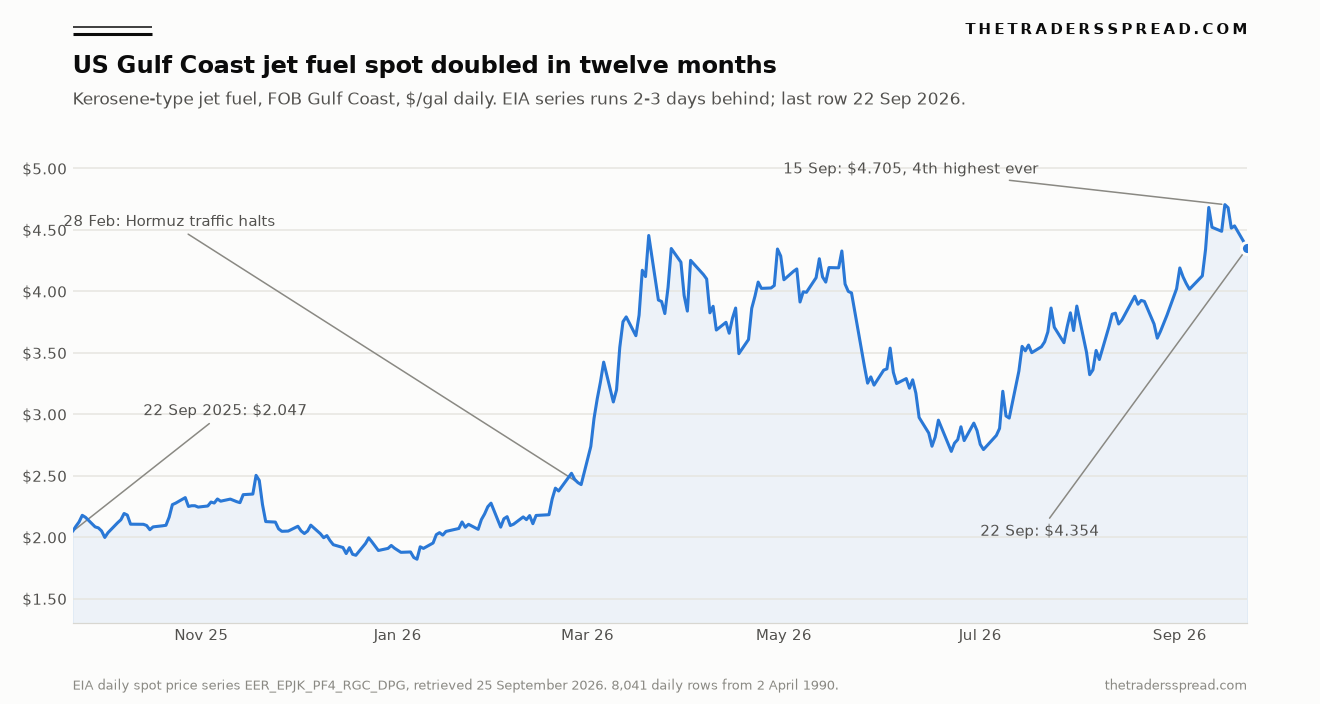
Two features of the chart deserve pointing at. The $4.705 print of 15 September is the fourth-highest daily value in a series that starts on 2 April 1990, behind only 28 April 2022, 12 September 2008 and 27 April 2022. And the line has already been here once this year: jet fuel touched $4.454 on 20 March, fell back to $2.698 by 22 June, then climbed again. The June trough is three months old.
Who banked the margin
The clearest evidence that this is a margin event rather than a crude event sits in refiners' own filings. Valero Energy reported second-quarter 2026 net income of $3.7 billion, or $12.62 a share, against $714 million and $2.28 a year earlier. Refining segment operating income went from $1.3 billion to $4.5 billion. On the US Gulf Coast, refining margin per barrel of throughput was $24.42 against $11.78, on throughput that barely moved: 1.829 million b/d against 1.841 million.
"We are pleased to report a strong second quarter, driven by excellent operations and commercial execution across all three of our business segments," said Lane Riggs, Chairman, Chief Executive Officer and President of Valero Energy, in the company's quarterly earnings release. "Our refineries, renewable diesel plants, and ethanol plants operated safely and reliably, helping to meet resilient demand for transportation fuels."
The yield tables in the same filing show the physical mechanism at work. Valero's distillate yield rose to 1.167 million b/d in Q2 2026 from 1.111 million a year earlier, while its gasoline and blendstock yield fell to 1.414 million from 1.444 million. Total throughput rose by only 28,000 b/d. The company did not find more crude; it sent a bigger slice of the same crude down the middle of the barrel. Every refiner with the flexibility to do that has been doing it, which is precisely why the gasoline market and the diesel market have been telling different stories from each other all year.
Who is paying for it
Airlines. The pass-through is not hypothetical and it is not evenly distributed.
IATA halved its industry profit forecast in June, taking 2026 net profit to $23 billion from $45 billion in 2025 and net margin to 2.0% from 4.2%. "All airline bottom lines are suffering from the rapid 70% rise in jet fuel prices," said Willie Walsh, IATA's Director General, in the association's financial outlook published at its annual general meeting in Rio de Janeiro. "Some of the additional cost is being recuperated by adjusting prices and improving efficiency, but it will not be sufficient to maintain profitability at the previous year's level." Net profit per passenger, IATA said, is expected to fall to $4.50, half the prior year's figure.
The regional split in that outlook is the part worth keeping. IATA notes that North American carriers have largely moved away from fuel hedging, so cost increases feed "more directly and rapidly" into their cost base, creating strong incentives for immediate pricing responses. Europe went into the crisis hedged at about 70% of its fuel needs, which delays rather than removes the hit as those hedges roll off. Two regions, the same spot price, different arrival times.
United Airlines showed what the direct version looks like. In its second-quarter investor update the carrier introduced a policy of basing guidance on the most current fuel prices, assumed roughly $3.69 a gallon all-in for the third quarter off the Gulf Coast jet forward curve as of 14 July 2026, and disclosed that since the beginning of July fuel had increased by $575 million, or $1.12 in adjusted diluted earnings per share, for that quarter alone.
Earlier in the year the problem was not price but availability. "The IEA's assessment of potential jet fuel shortages is sobering," Walsh said in an IATA statement on 17 April 2026. "We have also estimated that by the end of May we could start to see some cancellations in Europe for lack of jet fuel. This is already happening in parts of Asia." That physical risk sat behind the spring spike visible on the chart, and it has not been formally retired.
The American balance, in one table
Set the domestic weekly data against the same week of 2025 and the case that this is not a US supply problem gets easier to make.
| US weekly measure | Week to 18 Sep 2026 | Week to 19 Sep 2025 | Change |
|---|---|---|---|
| Jet fuel ending stocks (k bbl) | 45,466 | 44,951 | +1.1% |
| Jet fuel product supplied (k b/d) | 1,650 | 1,499 | +10.1% |
| Jet fuel exports (k b/d) | 267 | 304 | −12.2% |
| Refiner net crude input (k b/d) | 16,811 | 16,476 | +2.0% |
| Refinery utilisation (%) | 94.0 | 93.0 | +1.0 pt |
| Distillate ending stocks (k bbl) | 107,431 | 122,999 | −12.7% |
Source: EIA Weekly Petroleum Status Report series WKJSTUS1, WKJUPUS2, WKJEXUS2, WCRRIUS2, WPULEUS3 and WDISTUS1, retrieved 25 September 2026.
Exports down 12.2% year on year is the row that surprises people who expect a tight global market to be sucking American barrels overseas. It has not, at least not in jet fuel. The most plausible reading is arbitrage economics rather than patriotism: with the domestic crack this wide, a Gulf Coast barrel is already fetching close to what an export cargo would net back once freight is paid, and the IEA reports tanker costs up sharply on rising security risk and strong demand for ships. The distillate stock line, 12.7% down, is where the tightness is hiding.
RelatedRubber TSR 20 Rises 8.3% in a Month to 264.8 Cents
What this changes
The first consequence is that the jet fuel price has stopped being a proxy for the oil price and become a proxy for refining capacity in the Atlantic Basin. Anyone modelling airline fuel cost off a crude forecast alone has been wrong by the width of the crack all year. Models that take a crude deck and apply a historical differential need the differential re-estimated, not the deck.
The second is a distribution question inside aviation. Hedged carriers and unhedged carriers are now running materially different cost curves for the same physical fuel, and by IATA's account the unhedged ones are concentrated in North America. That shows up as faster fare adjustment there and delayed pain in Europe as hedges expire. It also means a resolution in the Middle East would hurt the hedged carriers' relative position at the same time as it helped everyone's absolute costs.
The third is the yield tug-of-war, and it is the reason this does not resolve quickly. Refiners can move product between jet fuel and diesel, but the pool is one pool. With US distillate stocks 12.7% below year-ago levels, every incremental barrel pushed toward jet fuel is a barrel not available to a diesel market that is already drawing down. American refiners cannot fix the jet fuel crack by making more jet fuel, because the constraint is the size of the middle-distillate cut, not the split within it. That constraint gets relieved by Gulf and Russian refining capacity coming back, or by demand falling, and the IEA is already forecasting the second: world oil demand down 2.5 million b/d in 2026, with losses "concentrated in middle distillates and petrochemical feedstock products".
The fourth is what would invalidate this reading. If jet fuel keeps falling from here while the WTI margin holds above $80, the twelve-month framing survives and the September high was simply crude froth. If the margin compresses back toward $45, the level it held as recently as 24 June, then the structural interpretation weakens badly and this becomes a story about a spike that mean-reverted, as the crude market has already done twice this year. Progress on Strait of Hormuz transits is the single variable most likely to force that second outcome, and it is not in anybody's control.
The last one is smaller but practical. The EIA discontinued its Weekly Petroleum Status Report highlights PDF on 23 September 2026, removing the summary document many desks had automated against. The underlying series are unaffected and remain on the weekly supply pages, but anyone pulling that PDF on a schedule found a broken pipeline this week.
Frequently asked questions
Why measure jet fuel over a year rather than the past week?
Because the two windows measure different things. Over the week to 22 September 2026 jet fuel fell 7.5% while WTI Cushing spot fell 9.9%, so the week is a crude story and the refining margin hardly moved. The twelve-month window spans the entire period before and after the February supply shock, which is the only way to isolate how much of the price move came from margin rather than from crude.
If US jet fuel stocks are higher than last year, why is the price so high?
Because jet fuel is priced off a global middle-distillate pool, not off Gulf Coast tank levels. Gulf country exports of refined product and LPG are nearly 60% below February levels according to the IEA, Russian product exports have been disrupted, and US distillate stocks are 12.7% below a year ago. Comfortable jet fuel inventories sit inside an uncomfortable distillate market.
What exactly is the jet fuel crack quoted here?
It is the Gulf Coast kerosene-type jet fuel spot price multiplied by 42 gallons, less the WTI Cushing spot price on the same date, both from EIA daily series. It is a simple gross margin proxy, not a refiner's realised margin, which also carries operating costs, crude transport differentials and the value of every other product in the barrel.
How current is the EIA daily spot number?
Not very. The daily spot series publish two to three business days in arrears. On the morning of 25 September 2026 the most recent available row was 22 September. Weekly stock and refinery data come from the Weekly Petroleum Status Report and were last published for the week ending 18 September 2026.
Could refiners simply make more jet fuel?
Only within limits, and not without a cost elsewhere. Jet fuel and diesel come from similar distillation fractions, so refiners can shift the split between them, as Valero's yield tables show. What they cannot easily do is enlarge the middle-distillate cut itself. With distillate stocks already 12.7% below last year, shifting more barrels to jet fuel tightens diesel by the same amount.
Disclaimer
This article is analysis and information, not investment advice. It does not recommend any position in jet fuel, crude oil, refining equities or airline shares. Commodity and equity markets carry risk and capital is at risk. Prices and data cited are from the named primary sources on the dates stated and were current when retrieved on 25 September 2026; the EIA daily spot series publish with a two-to-three business day lag. Readers should do their own research and consider professional advice before acting.