

Is the rubber market paying 264.8 US cents a kilogram for a difficult week in the tapping belt, or for a higher price of tyre-grade rubber through 2027? SGX SICOM TSR 20 November, the contract printed on the Rubber Trade Association of Singapore sheet dated 12 October 2026, settled at 264.8 cents. On the sheet dated 11 September the same November contract settled at 244.5 cents. The difference is 20.3 cents, which is 8.3%. January 2027 TSR 20 went from 242.1 cents to 261.6 over those same two sheets, a rise of 8.1%. A hole that existed only in this season's latex would have lifted November and left 2027 where it was. The strip did not do that. What the market is pricing is a near-parallel mark-up of TSR 20, not a one-month gap in supply.
Two other comparisons cut against a weather-only reading. RSS 3 November, a different product on the same two sheets, rose from 273.7 cents to 287.9, or 5.2%, so the premium of ribbed smoked sheet over TSR 20 narrowed from 29.2 cents to 23.1. Tyre-grade block rubber led sheet. The supply number has moved as well, and not every board has followed it. The Association of Natural Rubber Producing Countries now puts 2026 output at 15.039 million tonnes, growth of 0.6%, against a July figure of 15.279 million tonnes and 2.1%. The International Rubber Consortium site, opened on 13 October, still displays that older production total under an August label, next to the newer consumption figure.
Sheet figures
- SICOM TSR 20 November settled at 264.8 US cents per kg on the RTAS sheet dated 12 October 2026, up 8.3% from 244.5 on the sheet dated 11 September — Rubber Trade Association of Singapore, sheets of 11 September and 12 October 2026
- On that 12 October sheet the November session ranged from 253.9 to 266.1, and the settlement was 2.24% above the 259.0 print on the 9 October sheet — RTAS, 9 October and 12 October 2026
- January 2027 TSR 20 rose 8.1%, from 242.1 to 261.6, and every TSR 20 month shared by the two sheets rose between 7.8% and 8.3% — RTAS, 11 September and 12 October 2026
- RSS 3 November rose 5.2%, from 273.7 to 287.9, and its premium over TSR 20 November narrowed from 29.2 cents to 23.1 — RTAS, 11 September and 12 October 2026
- ANRPC said the SGX November 2026 contract averaged $2.24 per kg in August, 4.32% above July, while 2026 production growth was cut to 0.6% and 15.039 million tonnes — ANRPC, 30 September 2026
- On 12 October, Thai STR 20 was 267.45 cents, Indonesian SIR 20 was 264.70, Malaysian SMR 20 was 268.00 and Vietnamese SVR 10 was 265.00 — ASEAN Rubber Business Council, 12 October 2026
- Malaysia's Rubber Production Incentive was raised from RM3.00 to RM3.30 per kg in Budget 2027, while the same day's MRB seller indication for SMR 20 was 1,074.50 sen per kg — ARBC, citing the New Straits Times, 12 October 2026; RTAS sheet, 12 October 2026
What 264.8 cents refers to
The figure in the headline is not a blended "rubber price", and it is not a CFD. It is the settlement column for one listed month of one SGX contract.
On the RTAS daily quotation dated Monday 12 October 2026, the right-hand block is headed SICOM TSR 20 FOB Rubber Futures, in US cents per kilogram. November 2026 is the first line: high 266.1, low 253.9, settlement 264.8. The sheet writes that settlement as 264-8. The hyphen is the decimal point in this house style, which is why 264-8 and the 264.80 copied onto the ASEAN board are the same print. The left-hand block, SICOM RSS 3 Rubber Futures, is a separate contract. Its November settlement that day was 287.9. Mixing the two into one rubber price is how a 23-cent product gap disappears.
The legend above both blocks says the numbers are official settlement prices closed on the previous trading day, issued by SGX. The 8.3% move is therefore the change from the settlement published on the 11 September sheet to the settlement published on the 12 October sheet. It is not a claim about the clock time inside the SGX session. ASEAN Rubber Business Council dates the RTAS TSR 20 print of 264.80 to 12 October and footnotes the same previous-day convention. Anyone checking the council's column against this article needs one extra step. That column is the front month, not a fixed November series.
On the sheet dated Friday 11 September, the first TSR 20 line was still October 2026, settled at 246.0. November sat behind it at 244.5. The council's September file shows RTAS TSR 20 at 246.00 for the 11th, which matches the October contract on that PDF and does not match November. From 246.0 to 264.8 is 7.6%. That is a real front-month change. It is not the change in the title. The title holds the November contract constant: 244.5 to 264.8, 20.3 cents, 8.3%.
The roll itself is visible on the early October sheets. On 1 October, October 2026 was still the top line, at 258.7, with November at 254.8. On 2 October, November was the top line, at 255.4. From that session onward the council's single TSR 20 number and the November settlement are the same series. Before the roll they are not. A percentage that ignores the roll compares October rubber with November rubber.
Inside the 12 October sheet the path was wider than the 5.8 cent rise from the previous print. The prior sheet, dated 9 October, had November settled at 259.0, with a high of 259.8 and a low of 254.5. The next published session traded down to 253.9, which is 5.1 cents under that 259.0 settlement, and up to 266.1, then settled at 264.8. The close sat 1.3 cents under the high. Settlement to settlement, 264.8 against 259.0 is 2.24%. The low did not hold.
A parallel shift on the TSR 20 curve
November's path from 1 September is the chart. Each point is the TSR 20 November settlement on that day's RTAS sheet, from 236.5 to 264.8 on 12 October. The low in the window was 231.6 on 4 September. The 244.5 print on 11 September, the base of the 8.3%, sits in a pullback, not at that low. By 30 September it was 245.6. The October sheets then carried it to 264.8.
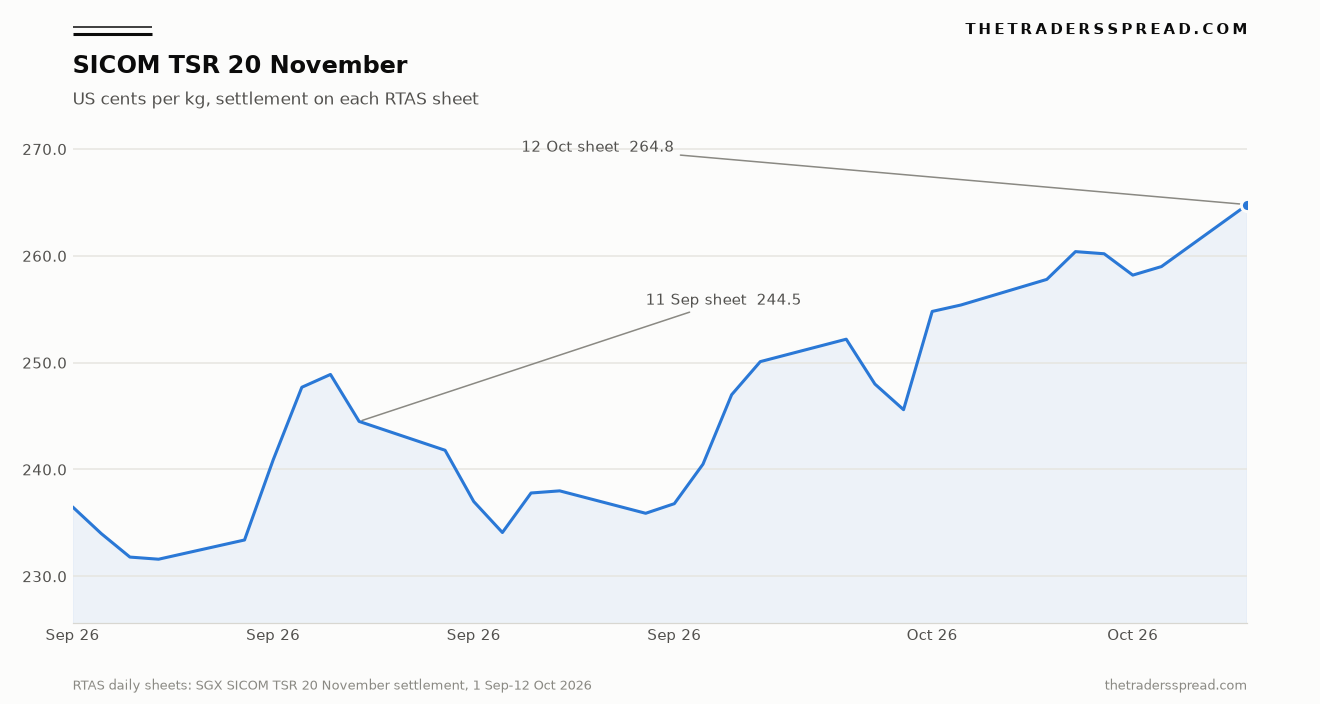
The rest of the curve moved with it. These are TSR 20 settlements, US cents per kg, from the sheets dated 11 September and 12 October 2026.
| Month | 11 Sep sheet | 12 Oct sheet | Change |
|---|---|---|---|
| Nov 2026 | 244.5 | 264.8 | +8.3% |
| Jan 2027 | 242.1 | 261.6 | +8.1% |
| May 2027 | 241.3 | 260.5 | +8.0% |
| Sep 2027 | 241.1 | 260.0 | +7.8% |
December 2026 through September 2027 rose between 7.8% and 8.1%. November, at 8.3%, was the top of that range, not a print sitting 20 cents clear of the board. On 12 October the strip runs from 264.8 in November to 260.0 or 260.5 through the middle of 2027.
Backwardation from November 2026 to October 2027 is 4.7 cents, about 1.8% of the front settlement. November over January is 3.2 cents. A market that feared a nearby hole, and did not fear 2027, would have blown that gap out. The level changed. The shape barely did.
Two longer windows stay out of the title because they answer a different question. ANRPC said the SGX November contract averaged $2.24 per kg in August. The 12 October settlement is 18.2% above that monthly mean, and a mean is not a daily settlement. The RTAS sheet of 4 August printed November at 210.2. From there to 264.8 is 26.0%, over more than two months, including sessions this desk did not open. From the 4 September low of 231.6 the rise is 14.3%. That uses a trough as the base. The headline uses 11 September.
ANRPC cut the 2026 crop
The parallel shift would be a curiosity if the only news in the crop were a rainy week. The official supply table was revised before these October sheets, and the revision is a full-year number, not a one-week tapping note.
Dr Suttipong Angthong, secretary-general of ANRPC, wrote in the foreword to the August statistical report, released on 30 September, that the month "was marked by a rise in natural rubber prices in some markets, supported by limitations in supply, and steady downstream demand, and ongoing geopolitical and macroeconomic uncertainty." The same foreword says production was affected by erratic rainfall and drier conditions across Southeast Asia.
The global production figure in that release is 15.039 million tonnes for 2026, up 0.6% from a revised 14.952 million tonnes in 2025. European Rubber Journal, on 1 October, reported the same August release and the size of the cut: the July forecast had been 15.279 million tonnes and 2.1% growth. Consumption in the August release is 15.356 million tonnes, up 0.4% from 15.301 million. Set against consumption of 15.356 million tonnes, the new production figure leaves a gap of 0.317 million tonnes. The July production figure leaves 0.077 million. The revision widens that full-year gap by about 240,000 tonnes. ANRPC published the two levels, not that subtraction.
The country lines, as ERJ reported them from the same release, are not one regional miss. Indonesia is forecast at 1.877 million tonnes, down 8% from 2.041 million in 2025. Malaysia is forecast at 300,000 tonnes, down 10.9%. Vietnam is forecast at 1.290 million tonnes, down 4.2%. Thailand is forecast at 4.834 million tonnes, up 1.9%. China production is forecast at 955,000 tonnes, up 2.9%, and Chinese consumption at 7.040 million tonnes, up 1.2%. A Thai crop still growing, beside an Indonesian crop marked down 8%, is not "Southeast Asia cannot tap".
August output on the same ANRPC page was 1.396 million tonnes, down 4.51% from 1.462 million a year earlier. The foreword also put August Brent at $91.08 a barrel, next to the $2.24 November rubber average. That barrel price is ANRPC's, not a figure taken from this site's Brent crude piece.
The Hormuz risk in the foreword is the episode in the WTI report on resumed US strikes. Crude can sit in the cost of synthetic rubber. It does not explain why January 2027 rose almost as much as November. The 12 October settlement is $2.648 a kilogram.
One public board has not absorbed the production cut. On 13 October the International Rubber Consortium homepage still showed 15.279 million tonnes of 2026 production, up 2.1%, in a block sourced to ANRPC for August 2026. The consumption line beside it, 15.356 million tonnes and 0.4%, matches the August release. The production line matches the July figure that release replaced. The page also carries a 1.333 million tonne gap for the first half of 2026. That half-year figure is not the 0.317 million tonne full-year gap, and the two do not add.
August prices, again from the ANRPC release, already showed the grade split that September and October then extended. SMR 20 in Kuala Lumpur averaged $2.31 per kg, up 4.25% on the month. STR 20 in Bangkok averaged $2.39, up 1.40%. RSS 3 fell 4.18% to $2.80. Latex-in-bulk fell 4.73% to $1.73. Block rubber was firm in August while sheet and latex were not.
RSS 3 lagged, and so did the Malaysian floor
Physical grades on 12 October did not leave the SICOM print behind. They sat on top of it. The council's daily row and the Malaysian Rubber Board seller line on the RTAS sheet itself read as follows, in US cents per kg.
| Grade | Where it comes from | |
|---|---|---|
| SICOM TSR 20 Nov | 264.8 | RTAS sheet, 12 October, SGX settlement |
| SIR 20, Indonesia | 264.70 | GAPKINDO, via ARBC, 12 October |
| SVR 10, Vietnam | 265.00 | VRA, via ARBC, 12 October. Grade 10, not 20 |
| STR 20, Thailand | 267.45 | Rubber Authority of Thailand, via ARBC, 12 October |
| SMR 20, Malaysia | 268.00 | MRE via ARBC, and the MRB seller line on the RTAS sheet |
| SICOM RSS 3 Nov | 287.9 | RTAS sheet, 12 October. A different contract |
SIR 20 was a tenth of a cent under the SICOM settlement. Thai STR 20 was 2.65 cents over it. SMR 20 was 3.2 cents over it. Futures sat inside the physical pack. SVR 10 at 265.00 is grade 10, not grade 20. RSS 3 at 287.9, and Thai RSS 3 at 292.44 on the same row, are sheet. They are not the 8.3%.
On 11 September, RSS 3 November was 29.2 cents above TSR 20. On 12 October the gap was 23.1 cents. Sheet rose. Block rubber rose more. Tyre plants that specify TSR 20 took the larger move.
RelatedAntimony Price Prediction: 112,000 Yuan Bull vs 94,000 Bear
Malaysia's budget line does not explain the print. Tabling Budget 2027 the previous Friday, Prime Minister Datuk Seri Anwar Ibrahim said the Rubber Production Incentive would rise from RM3 to RM3.30 per kilogram, the third rise since RM2.50 in 2022. Adzmi Hassan, president of the National Association of Small Farmers of Malaysia, said the increase would help smallholders cope with volatile prices and rising input costs, and that it mattered for keeping tapping viable. The same RTAS sheet shows the Malaysian Rubber Board seller indication for SMR 20 at 1,074.50 sen per kg, or RM10.745, and at 268.00 US cents. The incentive is a floor. The day's Malaysian reference was more than three times that floor.
Hassan's remarks also raised oil-palm replanting finance. Palm has not followed TSR 20. This site's late-September palm oil note recorded a 6.6% fall to 4,610 ringgit. Different market, different direction.
What this changes
The 12 October settlement changes the TSR 20 cost for more than one shipment month. Between the 11 September sheet and the 12 October sheet the shared months were marked up by about eight percent. There is no nearby month left at the old level. October 2027, the furthest TSR 20 line on the later sheet, settled at 260.1. That is still 15.6 cents above where November itself stood on 11 September.
The grade gap narrowed with it. RSS 3 rose 5.2% while TSR 20 rose 8.3%, so the extra cost of smoked sheet over block rubber shrank by 6.1 cents a kilogram. That is not a reason to rewrite a specification. It is a reason to stop quoting the two SICOM contracts as one rubber price. A page that uses the RSS settlement, or the front-month splice from 246.0, will not reproduce 8.3%.
The current supply number is the August release, not the July one still sitting on the IRCo homepage. Production of 15.279 million tonnes and growth of 2.1% was replaced, on 30 September, by 15.039 million tonnes and 0.6%. Consumption of 15.356 million tonnes is the figure both sources share. Pairing the old production total with the new consumption total understates the full-year gap by about 240,000 tonnes. The 1.333 million tonne first-half gap on the IRCo page is a different window.
A parallel move of about eight percent is a repricing of the strip, not a spike for one wet week. The path was not a straight line: November traded 253.9, under the prior settlement of 259.0, and closed at 264.8. The reading looks wrong if a later sheet opens a November-January gap much wider than the 3.2 cents on 12 October, or if SIR 20, STR 20 and SMR 20 print well clear of SICOM. On 12 October those three grades sat between 264.70 and 268.00, against a futures settlement of 264.8. The next RTAS sheet is the check on whether 264.8 was a one-print extreme. This article has no price target and no instruction to transact.
Questions the sheet actually answers
Which contract is the 264.8 cent rubber price?
It is the SGX SICOM TSR 20 FOB rubber future for November 2026, settlement 264.8 US cents per kilogram, as printed by the Rubber Trade Association of Singapore on the sheet dated 12 October 2026. The sheet says that print is the official settlement closed on the previous trading day. RSS 3 November on the same page settled at 287.9 and is a different contract.
How is the 8.3% calculated?
November TSR 20 settled at 244.5 cents on the RTAS sheet dated 11 September 2026 and at 264.8 on the sheet dated 12 October. The rise is 20.3 cents. Divide 20.3 by 244.5 and the result is 8.30%, which rounds to 8.3%. The front-month series, which switches from the October contract to November, rose from 246.0 to 264.8, or 7.6%. That is a different percentage, and it is not the one in the title.
Are TSR 20 and RSS 3 the same rubber?
No. TSR 20 is technically specified block rubber, the grade tyre plants use in volume, quoted FOB on SICOM. RSS 3 is ribbed smoked sheet, graded on appearance, and it has its own futures column. On 12 October the sheet premium was 23.1 cents a kilogram. Over the month back to 11 September, TSR 20 rose 8.3% and RSS 3 rose 5.2%. Quoting one as the other misstates both the level and the move.
Did the Malaysian incentive cause the rise?
The evidence on the sheet says no. Budget 2027 raised the Rubber Production Incentive from RM3 to RM3.30 per kilogram. On the same 12 October RTAS sheet the Malaysian Rubber Board's seller indication for SMR 20 was 1,074.50 sen, or RM10.745, equal to 268.00 US cents. The incentive is a smallholder floor. The SICOM settlement that day was a market print near 265 cents, in line with Indonesian SIR 20 at 264.70.
This article is market analysis, not advice and not a solicitation. It does not recommend any purchase or sale of rubber futures, physical rubber, tyre stocks or related contracts. Settlements change with the next sheet. Capital put at risk in these markets can be lost.