

Thirty-six per cent. That is how far Eli Lilly (LLY) let its realised prices fall outside the United States in the second quarter of 2026, according to the company's 5 August earnings release, and international revenue still rose 80% to $8.6 billion because volume more than doubled, up 113%. Read that as the operating model now, not a one-quarter accident. Lilly is deliberately swapping price for patients, and the $1.12 trillion valuation rests on whether the swap keeps paying. With the shares at $1,184.78 at the 28 September close, 7.5% under the 19 August record close of $1,280.34, this forecast sets a $1,420 bull case and a $960 bear case to 31 March 2027.
Here is the part most previews skip. Lilly's own full-year guidance of $85 billion to $87 billion implies second-half revenue of roughly $42.2 billion to $44.2 billion, because the first half already delivered $42.77 billion. Split across two quarters, that is $21.1 billion to $22.1 billion each, below the $22.97 billion booked in Q2. Management flagged why: the first half "benefited from sales based milestones and adjustments for rebates and discounts." Yet the Zacks consensus that Nasdaq publishes puts full-year EPS at $36.62, above the top of Lilly's own $35.50 to $36.50 range. The Street is already betting that guidance is sandbagged. That gap, not the obesity headlines, is what the 29 October print has to close.
Key facts
- LLY closed at $1,184.78 on 28 September 2026 and traded at $1,185.46 pre-market on 29 September — Nasdaq quote and daily history, retrieved 29 Sep 2026
- Q2 2026 revenue rose 48% to $22.97 billion on a 60% volume gain and a 13% fall in realised price — Lilly Q2 8-K, 5 Aug 2026
- Mounjaro sold $5.2 billion outside the US against $4.8 billion inside it in Q2 — Lilly Q2 8-K, 5 Aug 2026
- 2026 revenue guidance raised to $85 billion to $87 billion; EPS guidance $35.50 to $36.50 after $3.03 of acquired IPR&D charges — Lilly Q2 8-K, 5 Aug 2026
- Consensus EPS is $36.62 for 2026 and $46.75 for 2027, nine estimates each — Zacks via Nasdaq, retrieved 29 Sep 2026
- 700,000 seniors have started a GLP-1 since Medicare coverage began in July, about 70% on Lilly drugs — CNBC interview with CEO David Ricks, 21 Sep 2026
- The stock is up 63.1% from its 29 September 2025 close of $726.51 and 10.2% year to date — Nasdaq daily closes, TTS calculation
Price against volume: the mechanism behind the 48%
Strip the quarter down and it is a simple trade. Worldwide, Lilly sold 60% more product at 13% lower realised prices. In the US the mix was gentler: volume up 37%, price down 3%. The company added a detail that matters for anyone modelling 2027. Without favourable adjustments to rebate and discount estimates, mostly on Trulicity, Zepbound and Mounjaro, US price would have fallen about 9%. So the headline US price decline was flattered by accounting true-ups that do not repeat on a schedule.
Outside the US the swap was brutal and deliberate. Mounjaro joined China's National Reimbursement Drug List in the first quarter, which cut the price Lilly realises there but opened a reimbursed market of a size no Western payer can match. International Mounjaro revenue jumped 172% to $5.2 billion. That is the second quarter running in which the diabetes brand earned more abroad than at home ($4.4 billion against $4.2 billion in Q1), after trailing $3.3 billion to $4.1 billion as recently as Q4 2025, per Lilly's quarterly releases.
Why does this matter for a price forecast? Because gross margin went up, not down. Reported gross margin reached 85.8% of revenue, 1.5 percentage points higher than a year earlier, which the release credits to "improved cost of production and favorable product mix." A company that can cut price by a third in a large market and still widen margin has manufacturing scale competitors lack. That is the bull thesis in one line of the income statement.
The risk is that the same swap runs into diminishing returns at home. US prices are being pushed down from three directions at once: the direct-to-consumer cash channel, the government-brokered pricing deals struck last November, and Novo Nordisk's plan to list its GLP-1 medicines at $675 a month from January 2027, a 50% cut to Wegovy's list price, as BioSpace reported in February. BMO Capital Markets analysts called that move "a repositioning for Novo, but remain too early as the company continues to lose ground to Lilly." Early or not, it lands inside our forecast window.
Who is on the other side of the trade
Novo Nordisk is the obvious counterparty, and its year has been rough. At its 5 August results, the Danish group raised guidance to adjusted sales between a 6% decline and flat at constant currency, and chief executive Mike Doustdar defended the economics of the Wegovy pill in an interview with CNBC. "I could see a future where actually this market is, to a large extent, a pill market," Doustdar said, while noting the launch was only six months old. Novo shares then fell as much as 9% after its 21 September Capital Markets Day, The Pharmaletter reported, as investors questioned its pricing power.
The pill is where Lilly is behind. Foundayo, approved by the FDA on 1 April, sold $98 million in Q2 against a consensus of $104 million cited by RBC, while Novo's Wegovy pill sold about $494 million, according to BioPharma Dive. Lilly shares still rose 4.86% on results day.
Then came the Medicare numbers. On 21 September, Lilly chair and CEO David Ricks told CNBC that 700,000 seniors had started a GLP-1 since the temporary Medicare "Bridge" programme opened in July at a $50 monthly co-pay. "We're capturing about seven out of 10 of those new patients, and a lot are still on Zepbound," Ricks said. He added that Foundayo is taking one-third of new oral GLP-1 patients. Three sessions later, on 24 September, LLY closed up 2.68% at $1,181.89. It had bottomed at $1,115.70 on 11 September, so the Medicare figures extended a recovery that was already under way.
Sell-side positioning is lopsided. Nasdaq's consensus table shows 20 buy ratings, one hold and one sell, with a mean target of $1,381, a high of $1,600 and a low of $940. Per The Motley Fool, the $1,600 belongs to Citigroup and the $940, with a reduce rating, to HSBC. When 20 of 22 analysts agree, the marginal buyer is hard to find and the marginal disappointment is expensive.
The chart, the levels and what each one is worth
Twelve months of closes tell two stories. The first is the rerating: from $726.51 on 29 September 2025 the stock more than doubled by mid-August, a 76% run measured close to close. The second is the April air pocket. LLY fell to $851.21 on 29 April, the 2026 closing low, then jumped 9.80% the next day on first-quarter results and never looked back until August.
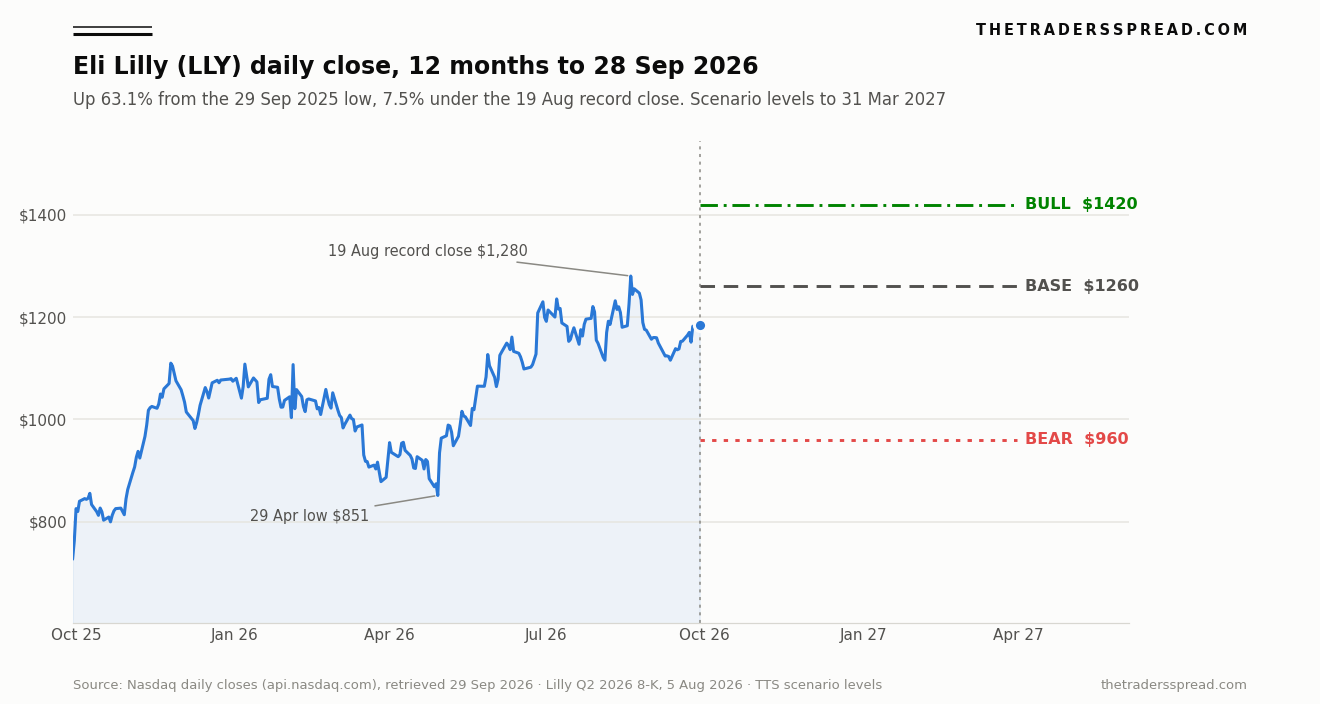
Moving averages frame the near term. On our calculation from Nasdaq closes, the 50-day average sits at $1,177.53, practically on top of spot, the 100-day at $1,143.47 and the 200-day at $1,071.11. Realised volatility over the last 60 sessions annualises at 29.7%, which is high for a trillion-dollar company and explains why single sessions of 4% to 7% have become routine: 26 June (+7.13%), 5 August (+4.86%) and 19 August (+4.46%) all qualify.
| Scenario | Price by 31 Mar 2027 | Move from $1,184.78 | Multiple of 2027 consensus EPS ($46.75) | Probability |
|---|---|---|---|---|
| Bull | $1,420 | +19.9% | 30.4x | 25% |
| Base | $1,260 | +6.3% | 27.0x | 50% |
| Bear | $960 | -19.0% | 20.5x | 25% |
The multiples column is where the argument really lives. At $1,184.78, LLY trades at 32.4 times 2026 consensus EPS and 25.3 times 2027. For comparison, our S&P 500 forecast works with an index that Motley Fool data put up about 12.5% this year as of 26 September, against Lilly's 10.2%, so the stock has lagged the benchmark in 2026 despite 48% revenue growth. Earnings caught up with the price. The price did not run further.
| Window (anchor close) | Anchor date | LLY change to $1,184.78 |
|---|---|---|
| 1 week ($1,164.89) | 21 Sep 2026 | +1.71% |
| 1 month ($1,174.61) | 28 Aug 2026 | +0.87% |
| 3 months ($1,229.93) | 29 Jun 2026 | -3.67% |
| Year to date ($1,074.68) | 31 Dec 2025 | +10.24% |
| 1 year ($724.54) | 26 Sep 2025 | +63.52% |
All percentages above are recomputed from Nasdaq daily closes retrieved on 29 September 2026, not taken from any headline field. One data vendor put the 19 August gain at 5.18%; the closes give 4.46%.
What the consensus misses about the second half
Go back to that implied second-half number. If Lilly lands at the midpoint of $86 billion, Q3 and Q4 average about $21.6 billion each. Q2 was $22.97 billion, including a $250 million Jardiance sales milestone from Boehringer Ingelheim and those favourable rebate adjustments. Remove the milestone alone and Q2 was about $22.7 billion. The guidance therefore assumes some combination of a sequential dip and conservatism. History favours conservatism: Lilly has raised its revenue range at both reported quarters this year, from $80 billion to $83 billion at the start, per the Q4 2025 release, to $82 billion to $85 billion in April and $85 billion to $87 billion in August.
Earnings per share are messier because of dealmaking. Q2 carried $3.03 per share of acquired in-process R&D charges from the Orna Therapeutics and Ajax Therapeutics acquisitions, and the guidance excludes any IPR&D booked after 30 June. Since quarter end Lilly has closed three infectious-disease acquisitions and agreed to buy AtaiBeckley. Each deal can knock dollars off reported EPS without touching the operating business, which means a Q3 "miss" on headline EPS could be pure accounting. The Zacks Q3 consensus is $9.80 against $7.02 a year ago.
Two other items belong in any model. First, Lilly committed an additional $4.5 billion to Indiana manufacturing in the quarter, so capital spending stays heavy. Second, the dividend rose 15% to $1.73 a quarter, a yield near 0.6% that offers no valuation floor worth mentioning. Investors own LLY for growth, and it gets priced that way.
Retatrutide is the catalyst the market is least able to price. Lilly says the clinical package supporting global registrations for obesity, obstructive sleep apnoea and knee osteoarthritis pain is complete, with a US Biologics License Application planned for the first quarter of 2027. That filing falls inside our window; approval does not.
The disconfirmation case
A bear does not need Lilly to stumble. It needs price to fall faster than volume grows. If Novo's $675 list price from January resets payer negotiations, and if the Medicare Bridge programme stays temporary rather than becoming permanent Part D coverage, US realised prices could slide by double digits in 2027 while volume growth slows from a larger base. At 20.5 times $46.75, the market would be treating Lilly as a big pharma company with one franchise, which is roughly what it paid in the spring when the stock sat near $850.
Concentration makes that multiple defensible. Mounjaro and Zepbound together earned $14.87 billion of Q2's $22.97 billion, about 65% of revenue. Add Foundayo and the GLP-1 share barely moves. Lilly has been buying diversification, and its immunology, oncology and neuroscience key products grew 121% in Q2, but from a small base: Jaypirca, Ebglyss, Kisunla and Omvoh combined sold $662 million.
Other large-cap health names show how fast sentiment turns on a single dataset. Our Moderna melanoma-data coverage recorded a 16% fall on a single readout, and our Amgen Sjögren's Phase 3 report showed the reverse. Lilly is much larger, but at 29.7% realised volatility it trades less like a utility than its size suggests.
Rotation is the last bear input. Market commentary on 19 August tied part of that day's jump to money leaving expensive technology; if that flow reverses into a Nasdaq 100 rebound, defensive growth names can lag without any bad news of their own.
RelatedApplied Materials (AMAT) Falls 19.3% in the Week to 16 Oct
The call: base $1,260, bull $1,420, bear $960
Base case, 50%: $1,260 by 31 March 2027. Lilly beats the $9.80 Q3 consensus on 29 October, as the calendar published by Nasdaq expects, lifts the bottom of its revenue range again, and files retatrutide on schedule. The stock retests but does not clear the August record while the market digests Novo's January price cut. That lands at 27 times 2027 consensus, below the multiple LLY carried at the peak.
Bull case, 25%: $1,420. Q3 revenue prints above $23 billion, meaning the second-half dip in guidance never shows up. Medicare uptake keeps compounding from 700,000 starts, Foundayo's one-third share of new oral patients moves toward half, and 2027 estimates rise toward the $50.99 high in the Zacks range. At $1,420 the stock would trade at 30.4 times current 2027 consensus, or about 28 times if estimates drift to $50.
Bear case, 25%: $960. US net price falls faster than 10% after January, Q3 shows a sequential revenue decline, and a heavy IPR&D charge from AtaiBeckley or later deals makes the reported numbers ugly. The multiple compresses toward 20.5 times 2027 EPS. That level also sits 12.8% above the 29 April closing low of $851.21 and below the 200-day average, so a break there would erase most of the post-April rerating.
What would change my mind? A daily close below $1,040, 12.2% under the 28 September close and well under the 200-day average, would turn the base case bearish, because it would mean the market had stopped paying for the Q2 beat. On the other side, a close above the $1,280.34 record before the Q3 print would pull the bull case forward. Neither level is a trade instruction; they are the points where the evidence would have shifted.
FAQ
What is the Eli Lilly (LLY) stock forecast for 2027?
Our base case is $1,260 by 31 March 2027, with a $1,420 bull case and a $960 bear case, weighted 50%, 25% and 25%. The spread reflects how much of the story rests on US pricing after Novo Nordisk's January list-price cut and on whether Lilly's second-half guidance is conservative.
Why did Lilly stock fall after hitting a record in August?
LLY closed at a record $1,280.34 on 19 August and fell to $1,115.70 by 11 September, a 12.9% pullback. There was no single trigger in Lilly's filings; the move followed a 50% rally from the April low and came as investors weighed price competition with Novo. It recovered to $1,184.78 by 28 September.
How much of Lilly's revenue comes from Mounjaro and Zepbound?
About 65%. In Q2 2026 Mounjaro sold $9.94 billion and Zepbound $4.93 billion out of total revenue of $22.97 billion, per Lilly's 5 August release. Mounjaro's sales outside the US, $5.2 billion, exceeded its US sales of $4.8 billion for the quarter.
When does Eli Lilly report third-quarter 2026 earnings?
Nasdaq's earnings calendar, citing Zacks, expects the Q3 report on 29 October 2026 before the market opens, with consensus EPS of $9.80 against $7.02 a year earlier. The date remains provisional until Lilly confirms it on its investor site.
Is Eli Lilly stock expensive?
At $1,184.78 it trades at 32.4 times 2026 consensus EPS of $36.62 and 25.3 times 2027 consensus of $46.75, based on Zacks estimates published by Nasdaq. Whether that is expensive depends on 2027 growth: the multiple falls quickly if earnings rise 28% as the consensus implies.
Disclaimer: This article is analysis and information only, not investment advice or a recommendation to buy, sell or hold any security. Scenario levels and probabilities are the author's estimates and can be wrong. Share prices can fall as well as rise and you may lose capital. Do your own research and consider independent advice before making any financial decision.