

Amgen (NASDAQ: AMGN) closed Tuesday at $410.24, up 4.34% on the day, after announcing that dazodalibep met the primary endpoint of a Phase 3 trial in Sjögren's disease. The release gave no effect size. It did not say how far disease activity fell, what share of patients responded or how the placebo arm did. Two weeks earlier the same stock did the opposite with more information in hand: on 8 September Amgen published what it called "landmark" overall survival data for Imdelltra in first-line small cell lung cancer, and the shares fell 10.08% in the session, their largest one-day move in the past twelve months of Nasdaq closes. The drop had nothing to do with Imdelltra. It came from a Novartis cardiovascular trial that failed over the long weekend, and from what that failure implies for a drug Amgen has not yet tested to completion. So the market paid for a headline without numbers and ignored a survival result with them.
Here is the part the Tuesday coverage skipped. Put the two sessions side by side and the arithmetic is lopsided. Using the 544 million diluted shares Amgen reported for the second quarter, the 8 September fall removed roughly $24 billion of market value on read-across from a competitor's lipoprotein(a) trial, and Tuesday's rise added back roughly $9.3 billion on a first-party Phase 3 win. Even after Tuesday, Amgen sits 6.2% below its 4 September close of $437.23. The market has not reversed its verdict on olpasiran, the Lp(a) drug still in its outcomes trial. It has priced a second, unrelated asset on top of it. That tells you which question investors think is bigger, and it is not Sjögren's disease.
- Amgen closed at $410.24 on 22 September 2026, up $17.08 or 4.34% from $393.16 on 21 September — Nasdaq historical data, retrieved 23 Sep 2026
- OASIZ 301 met its primary endpoint, change in ESSDAI at Week 48, with improvement seen from Week 4 — Amgen press release, 22 Sep 2026
- On 8 September Amgen fell 10.08%, from $437.23 to $393.17, the first session after Novartis said pelacarsen missed its primary endpoint — Nasdaq historical data; Novartis release, 4 Sep 2026
- Novartis ADRs fell 13.93% the same session, from $159.99 to $137.70 — Nasdaq historical data, retrieved 23 Sep 2026
- Second-quarter revenue rose 10% to $10.1 billion, with Imdelltra sales up 115% to $288 million — Amgen Q2 2026 results, 4 Aug 2026
- 2026 guidance: revenue of $38.2 billion to $39.4 billion and non-GAAP EPS of $22.30 to $23.50 — Amgen Q2 2026 results, 4 Aug 2026
- The OASIZ 301 registry entry lists 651 enrolled patients and a primary completion date of 23 July 2026 — ClinicalTrials.gov NCT06104124, last updated 14 Sep 2026
A positive readout with the numbers held back
Amgen put the dazodalibep release out at 09:00 ET on Tuesday, thirty minutes before the US open. The core claim is short. OASIZ 301, a randomised, double-blind, placebo-controlled study in adults with Sjögren's disease and moderate-to-severe systemic activity (ESSDAI of 5 or more), showed a statistically significant and clinically meaningful improvement in ESSDAI at Week 48. ESSDAI is the EULAR index that scores disease activity organ by organ, from glands and joints to lungs, kidneys and the nervous system.
The release adds that improvement appeared as early as Week 4 and held through Week 48. That detail matters more than it looks, because a drug that separates from placebo in the first month gives prescribers something to watch for, and gives payers an early stopping rule.
What is missing is every number an analyst would use to size the result: the mean ESSDAI change in each arm, the placebo-adjusted difference, and the results on the key secondary endpoints, which Amgen lists as dryness, tender and swollen joints, fatigue and an ESSDAI response defined as a drop of at least five points. The release says those endpoints were "evaluated". It does not say they were met. Detailed data will come "at an upcoming medical meeting".
Safety reads cleanly on paper. The most common adverse events that ran higher on dazodalibep than placebo were nasopharyngitis, urinary tract infection, hypertension and infusion-related reactions, mostly mild to moderate. Amgen also singled out two risks for a specific statement: no imbalance in thromboembolic events or opportunistic infections across the arms. Companies rarely volunteer a negative finding on a named risk unless they expect to be asked about it, and for an immune-signalling blocker those are the two obvious questions.
"The rapid and sustained improvement observed in systemic disease activity reinforces our confidence in dazodalibep and the broader Phase 3 program," said Jay Bradner, Executive Vice President, Research and Development, Artificial Intelligence and Data at Amgen. The trial's lead investigator was more specific about the gap the drug is aimed at. "Patients with Sjogren's disease contend with debilitating symptoms and systemic manifestations for which no approved disease-modifying therapy exists," said Ghaith Noaiseh, Associate Professor of Medicine at the University of Kansas Medical Center.
One small inconsistency is worth a line. The release describes OASIZ 301 as "n=approximately 621", while the ClinicalTrials.gov record for NCT06104124 shows 651 patients as actual enrolment, a completed status and a primary completion date of 23 July. Registry counts often include every randomised patient and press releases often round from protocol targets, so this is probably not meaningful. It is the kind of gap that the full data presentation should close.
Why a Novartis trial cost Amgen $24 billion
The more important event in Amgen's September was not an Amgen event at all. At 22:30 Basel time on Friday 4 September, after the US close, Novartis said its Lp(a)HORIZON trial of pelacarsen had failed. The study enrolled 8,323 patients with elevated lipoprotein(a) and established cardiovascular disease, and it did not reduce the composite of cardiovascular death, heart attack, stroke and urgent revascularisation compared with placebo. Pelacarsen did lower Lp(a). Lowering Lp(a) just did not translate into fewer events in a population already on guideline-directed lipid and blood-pressure treatment.
"Although lower Lp(a) levels were observed with pelacarsen, the findings did not demonstrate that this translated into reduced cardiovascular risk in the overall study population," said Shreeram Aradhye, President, Development and Chief Medical Officer at Novartis.
That sentence is the whole problem for Amgen. Olpasiran is a small interfering RNA that cuts Lp(a) production in the liver, a different chemistry from pelacarsen's antisense approach but the same biological bet. Amgen's own second-quarter release lists three Phase 3 studies for it: OCEAN(a)-Outcomes in secondary prevention, which is ongoing; OCEAN(a)-PreEvent in primary prevention, which is enrolling; and a coronary plaque imaging study. Novartis tested the hypothesis first, in the population where it should have been easiest to show, and came up short.
Because US markets were shut for Labor Day on Monday 7 September, the first chance to trade that news was Tuesday 8 September. Amgen opened at $408.90 against a Friday close of $437.23, traded no higher than $410.03, and closed at $393.17 on 6.83 million shares. That volume was about 2.8 times the average of the prior fifty sessions. Novartis fell harder, 13.93%, because pelacarsen was its asset and a drug it had already spent years developing. Amgen's decline was pure inference.
There is a real case that the inference is too blunt. Different molecules produce different degrees of Lp(a) lowering, and a trial with a deeper reduction or a different patient mix could land differently. Nobody outside Amgen knows yet, and OCEAN(a)-Outcomes has no reported readout date in the Q2 release. What the tape shows is that investors were not willing to wait to find out. They cut the stock on the day Amgen itself reported survival data that one outside oncologist called "among the most compelling survival results I have seen", according to Jacob Sands, Associate Chief of the Lowe Center for Thoracic Oncology at Dana-Farber Cancer Institute.
Tuesday on the tape, and the three weeks around it
Amgen gapped up to $405.25 at the open on Tuesday, about 3.1% above Monday's close. The low of the day was $398.52, which means the stock never traded below 1.4% up. It finished near the top of its range at $410.24 on 3.72 million shares, roughly 1.36 times its fifty-session average. That is a firm move but not a violent one, and it compares with 2.8 times average volume on the 8 September sell-off. Buyers were less urgent on the way up than sellers were on the way down.
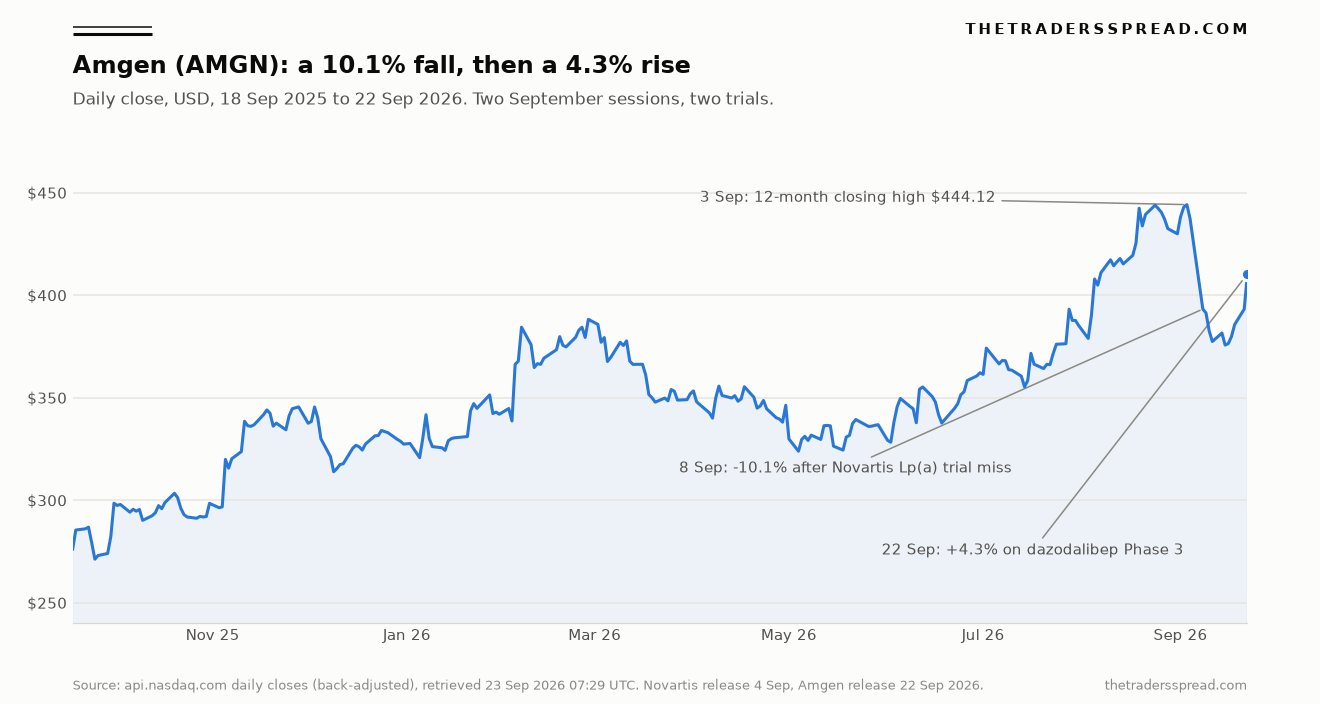
The chart makes the size of the September gap plain. Amgen spent the summer climbing to a 12-month closing high of $444.12 on 3 September, then dropped to a post-Novartis closing low of $375.65 on 15 September. Tuesday's close is 9.2% above that low and still 7.6% under the high. Over the full series the stock is up 48.7% from $275.83 on 18 September 2025, and up 25.3% from its 31 December 2025 close of $327.31.
| Session (close) | Amgen close | Amgen move | Novartis ADR close | Novartis move | What happened |
|---|---|---|---|---|---|
| Fri 4 Sep 2026 | $437.23 | n/a | $159.99 | n/a | Novartis releases Lp(a)HORIZON miss after US close |
| Tue 8 Sep 2026 | $393.17 | -10.08% | $137.70 | -13.93% | First session after the release; Amgen also reports DeLLphi-305 |
| Tue 15 Sep 2026 | $375.65 | -4.46% vs 8 Sep | n/a | n/a | Lowest Amgen close since the Novartis news |
| Mon 21 Sep 2026 | $393.16 | +4.66% vs 15 Sep | $140.98 | +2.38% vs 8 Sep | Session before the dazodalibep release |
| Tue 22 Sep 2026 | $410.24 | +4.34% | $141.28 | +0.21% | OASIZ 301 topline at 09:00 ET |
Source for every close: Nasdaq historical daily data for AMGN and NVS, retrieved 23 September 2026. Moves are close to close over the windows shown.
For readers tracking the index effect, Amgen is one of the 30 stocks in the Dow Jones Industrial Average, where price weighting gives a $17 move more pull than it would carry in a cap-weighted index. Our Dow Jones forecast sets out the index scenarios, and Amgen also sits in the Nasdaq 100.
Novartis got to Sjögren's first
The Amgen release repeats a line that is true today: there is no FDA-approved medicine for Sjögren's disease. It may not stay true for long, and the company most likely to change that is, again, Novartis.
In January the FDA granted Breakthrough Therapy designation to ianalumab, a B-cell-depleting antibody that also blocks BAFF-R, based on two Phase 3 trials, NEPTUNUS-1 and NEPTUNUS-2. Novartis said it planned to file with regulators globally "starting in early 2026". "This Breakthrough Therapy designation recognizes the potential for ianalumab to substantially improve the standard of care for people with Sjögren's disease, who currently don't have effective treatment options," said Angelika Jahreis, Global Head, Development, Immunology at Novartis.
So Amgen is not racing to be first. It is racing to be different. Dazodalibep works on a separate lever, blocking the CD40 ligand signal that lets T cells switch on B cells and other antigen-presenting cells, rather than removing B cells. If the full dataset shows a larger or faster effect, or a cleaner safety profile than B-cell depletion, a second-to-market drug can still take a large share of a disease that Novartis's January release puts at about 0.25% of the population, with an estimated half of cases undiagnosed. If the effect size turns out to be similar, the first approval sets the price and the formulary position, and Amgen negotiates from behind.
The registry adds a second test that matters more for market size. OASIZ 303 enrolled 434 patients with high symptom burden and low systemic activity. Its primary endpoints are ESSPRI and a patient diary index, which measure how people feel (dryness, fatigue, pain) rather than organ involvement. Primary completion is listed for 22 October 2026, and Amgen now says the study will complete in the fourth quarter. The August results release had said both dazodalibep Phase 3 studies would complete in the second half, so the timing is consistent. It is also the readout that decides whether dazodalibep is a drug for organ involvement only, or for the dryness, fatigue and pain that most patients describe first.
The case against reading too much into Tuesday
A 4.3% move in a company worth about $223 billion on its diluted share count is large for a single mid-pipeline readout, and some of it may be relief rather than new information. Amgen had drifted down for a week after 8 September, and the stock had already climbed 4.7% above its 15 September low by Monday's close. Part of Tuesday was probably positioning catching up with a stock that had overshot.
Novartis's own move is a useful control. Its ADRs added only 0.21% on Tuesday. If the whole market had rotated back into large-cap pharma that day, Novartis would have moved with it. It did not, which suggests Tuesday's buying was specific to Amgen and to the release. That supports reading the rise as a genuine response to dazodalibep, even with the numbers held back.
RelatedMaxLinear (MXL) Falls 12.7% in the 8 October Session
Then there is valuation. At $410.24 and the midpoint of 2026 non-GAAP EPS guidance, $22.90, Amgen trades at roughly 17.9 times this year's adjusted earnings on our calculation. The balance sheet carried $57.3 billion of debt against $14.0 billion of cash at 30 June, and share repurchases for 2026 are capped at $3.0 billion. A single immunology asset years from peak sales does not move that picture much, which is another reason to treat Tuesday's $9.3 billion as a sentiment number rather than a cash-flow one. We made a similar point about how quickly trial-driven gains can reverse in our note on Moderna's fall from its melanoma-data close.
What this changes
Tuesday changes Amgen's rare-autoimmune story from a promise to a filing candidate. Before 22 September, dazodalibep was a Phase 3 asset with two unreported studies. It now has one positive pivotal trial on a regulator-recognised disease-activity endpoint, a headline safety statement with no clotting or opportunistic-infection imbalance, and a second readout due in the fourth quarter. If OASIZ 303 also succeeds, Amgen will have Phase 3 evidence in both the systemic and the symptom-heavy halves of the disease.
It does not change the question that took $24 billion off the stock on 8 September. The olpasiran outcomes trial is still running, and until it reports, the Lp(a) discount stays in the price. Tuesday's close at $410.24 is 6.2% below 4 September's $437.23. That gap is the market's running estimate of the Novartis read-across, and it barely moved on dazodalibep because the two assets have nothing to do with each other.
What would change the picture from here, in either direction:
- The full OASIZ 301 presentation. A placebo-adjusted ESSDAI difference, and whether the key secondary endpoints were met, will decide whether Tuesday's 4.3% was too much or too little.
- OASIZ 303 in the fourth quarter. A miss on symptoms would narrow dazodalibep to the systemic subgroup and leave Novartis's ianalumab as the broader option.
- Any FDA action on ianalumab. An approval sets the first reference price in the disease.
- Full Lp(a)HORIZON data at a medical congress. If Novartis shows a benefit in a subgroup, such as the Lp(a) of 90 mg/dL or higher cohort it pre-specified, part of the olpasiran discount could unwind well before Amgen reports.
None of these is a price call. They are the dated events that will tell you whether September's two trials were priced in proportion to what they mean for Amgen's cash flows.
FAQ
Why did Amgen stock rise on 22 September 2026?
Amgen said at 09:00 ET that dazodalibep met the primary endpoint of OASIZ 301, a Phase 3 trial in Sjögren's disease with moderate-to-severe systemic activity. The shares opened 3.1% higher and closed up 4.34% at $410.24, on Nasdaq's back-adjusted daily data. The company has not yet released the effect size or the secondary endpoint results.
Why did Amgen fall 10% on 8 September?
Novartis said after the US close on 4 September that its pelacarsen trial failed to cut cardiovascular events despite lowering lipoprotein(a). Amgen is developing olpasiran, which also lowers Lp(a), so investors marked down its chances. After the Labor Day holiday, the first session was 8 September, when Amgen fell 10.08% and Novartis ADRs fell 13.93%.
What is dazodalibep?
Dazodalibep is an investigational fusion protein that blocks CD40 ligand, a signal T cells use to activate B cells and other immune cells. Amgen is testing it in two Phase 3 Sjögren's studies. It was registered earlier under the code VIB4920 on ClinicalTrials.gov. It is not approved anywhere, and Amgen says the scientific information remains preliminary.
Is there an approved treatment for Sjögren's disease?
Both Amgen and Novartis state that no targeted or systemic therapy is approved for Sjögren's disease. Novartis's ianalumab received FDA Breakthrough Therapy designation in January 2026 on two Phase 3 trials, and Novartis said it would file with regulators from early 2026. The FDA has not announced a decision.
When is the next dazodalibep readout?
OASIZ 303, which tests dazodalibep in patients with heavy symptoms but low systemic activity, is expected to complete in the fourth quarter of 2026, according to Amgen. Its ClinicalTrials.gov record lists 434 enrolled patients and a primary completion date of 22 October 2026. Full OASIZ 301 data is due at an upcoming medical meeting.
Disclaimer
This article is analysis and news reporting, not investment advice or a recommendation to trade any security. Share prices can fall as well as rise and you can lose some or all of the capital you put at risk. Figures are drawn from company releases, ClinicalTrials.gov and Nasdaq data as of the dates stated. Do your own research and consider independent advice before making decisions.