

Moderna (MRNA) closed at $146.69 on Monday 14 September, 133% above the $62.96 it fetched the evening before Merck and Moderna said their individualised melanoma therapy had beaten Keytruda alone in a Phase 3 trial. It also closed 15.9% below the $174.38 it reached at the end of that same data day, 19 August, and nothing in the trial has gone wrong since. Both numbers come from the same 18 sessions of trading, and they cannot both be comfortable. If the data justified $174.38, the stock has leaked a sixth of its value on no bad news. If $146.69 is closer to fair, the first close priced in something the release never disclosed. In between, the company raised $3bn of convertible notes that only turn into shares above $210.58, and two of its officers sold stock under trading plans written before anyone knew the result.
The missing number is the hazard ratio. The 19 August release said intismeran autogene plus Keytruda met its primary endpoint of recurrence-free survival at a pre-specified interim analysis, yet it printed no hazard ratio, no confidence interval and no event count. The only hazard ratio anyone can cite is still the Phase 2b figure of 0.51. On the 10-Q share count, the day added about $44.5bn of market value (399.2 million shares times the $111.42 move), and all of it was priced on the words "statistically significant and clinically meaningful". The short-interest data hides a second problem. The 31 August print of 39.15 million shares short already includes hedges set by the funds that bought the convertible, so the older short sellers probably covered far more than the 13.7 million-share fall suggests.
Key facts
- Moderna closed at $146.69 on 14 September (+1.89%) and traded at $146.85 after hours, a market value of about $58.6bn on 399,235,889 shares. Sources: stockanalysis.com quote, read 15 Sep 2026 at 06:45 UTC; Moderna 10-Q share count as of 24 Jul 2026.
- On 19 August the stock closed at $174.38, up 176.97%, on 199,252,328 shares. That is 34.5 times the 5.77 million average daily volume in Nasdaq's 14 August short-interest period. Sources: stockanalysis.com daily history, read 15 Sep 2026; Nasdaq short-interest table, read 15 Sep 2026.
- INTerpath-001 enrolled 1,137 patients, randomised 2:1, and met its recurrence-free survival endpoint and a key distant metastasis-free survival endpoint at an interim analysis. Source: Merck and Moderna joint release, 19 Aug 2026.
- Moderna sold $3.0bn of 0.00% convertible senior notes due 2032 with a $210.58 conversion price. It paid $328.8m for capped calls struck up to $392.62. Source: Moderna 8-K, filed 1 Sep 2026.
- Short interest fell from 52,809,184 shares at the 14 August settlement to 39,151,532 at 31 August, a 25.9% drop. Source: Nasdaq short-interest data, read 15 Sep 2026.
- Chief executive Stéphane Bancel sold 499,246 shares on 5 August at weighted prices of $56.21 to $58.79, under a Rule 10b5-1 plan adopted on 4 May 2026. Source: Form 4, filed 7 Aug 2026.
- Cash, equivalents and investments stood at $6.9bn at 30 June, before a $950m litigation payment in July. Source: Q2 2026 results release, 31 Jul 2026.
What the 19 August release said, and the number it left out
INTerpath-001 is a randomised, double-blind global Phase 3 trial in patients whose stage IIB to IV cutaneous melanoma had been completely removed by surgery. Patients got either intismeran, dosed at 1mg every three weeks for up to nine doses, with Keytruda at 400mg every six weeks, or Keytruda alone for about a year. The primary endpoint is recurrence-free survival. The release says the combination produced "statistically significant and clinically meaningful improvements" in that measure and in distant metastasis-free survival, with no new safety signals. Overall survival is still being tracked, and the full data will go to "an upcoming international medical meeting" and to regulators.
That is the whole disclosure. The release gave no effect size.
The companies restated the older evidence. The five-year Phase 2b KEYNOTE-942 follow-up presented at ASCO 2026 showed a 49% reduction in the risk of recurrence or death (hazard ratio 0.51, 95% confidence interval 0.294 to 0.887) and a 59% reduction in the risk of distant metastasis or death (hazard ratio 0.411). Those intervals are wide. The upper bound of the first sits at 0.887, close enough to 1.0 that a Phase 3 result anywhere between "modest" and "dramatic" would have been consistent with the smaller trial. Traders on 19 August guessed high, and the next session took back 23.55%.
One structural detail supports the optimists. Group-sequential trials usually set a stricter significance bar at an interim look than at the final analysis, so an interim win tends to require a sizeable effect. The public trial record has not caught up. On 15 September, ClinicalTrials.gov entry NCT05933577 still showed an estimated enrolment of 1,089 and a primary completion date of 26 October 2029, and it was last updated on 24 September 2025. The release says 1,137 patients enrolled. Hitting the primary endpoint roughly three years before the registered completion date is the strongest signal in the public record that the effect is not marginal. It is still an inference, not a number.
The three people quoted chose their words carefully. "This is the first Phase 3 study to show that intismeran, a treatment designed based on the unique mutational 'fingerprint' of a patient's own tumor, given in combination with pembrolizumab can reduce the risk of recurrence or death," said Professor Georgina Long, principal investigator and medical director of Melanoma Institute Australia, in the joint release. Dr. Dean Y. Li, president of Merck Research Laboratories, said the findings "reinforce the promise of a more personalized approach to cancer treatment." Stéphane Bancel, chief executive officer at Moderna, called them "a pivotal moment for the field of cancer research" and added: "For many years, the idea of creating an mRNA treatment designed specifically for an individual patient's cancer was aspirational."
None of them gave a magnitude. That silence is normal before a congress presentation, and it is the gap a 177% move had to fill with assumption.
386 million shares in three sessions
From 19 to 21 August, 386,068,334 Moderna shares changed hands, equal to 96.7% of the shares outstanding. On the first day alone, turnover ran at 34.5 times the average Nasdaq recorded for the fortnight before. For scale, a 9.3% guidance-day jump in Nvidia counts as a big move for a mega-cap. Moderna did nineteen of those in a single session.
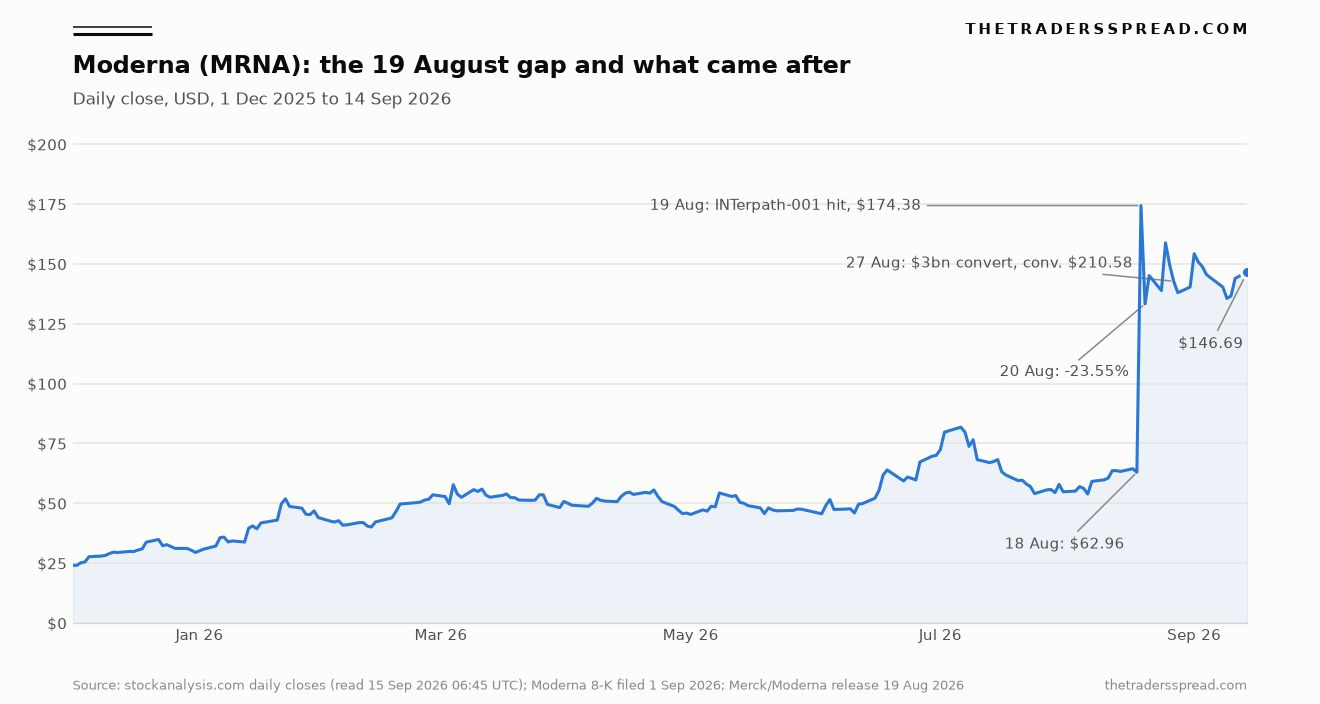
The chart also shows that the gap did not come from nowhere. Moderna closed 2025 at $29.49 and was already up 113% for the year on 18 August, helped by the 6 August US approval of its mRNA flu vaccine. The 52-week low of $22.28 was set on 21 November 2025.
| Session | Close | Change | Volume | What was on the record |
|---|---|---|---|---|
| 18 Aug | $62.96 | -2.33% | 4,304,996 | Last close before the data |
| 19 Aug | $174.38 | +176.97% | 199,252,328 | INTerpath-001 topline released |
| 20 Aug | $133.32 | -23.55% | 99,499,941 | No new company disclosure |
| 21 Aug | $145.13 | +8.86% | 87,316,065 | Volume still 15 times the prior average |
| 25 Aug | $158.83 | +14.36% | 49,225,650 | Largest post-data gain; no Moderna filing that day |
| 27 Aug | $142.77 | -4.60% | 24,993,236 | Convertible launched; this close sets the conversion premium |
| 1 Sep | $154.27 | +9.93% | 25,831,743 | $3.0bn of notes closed; 8-K filed |
| 14 Sep | $146.69 | +1.89% | 10,529,207 | Latest close; after-hours $146.85 |
Sources: stockanalysis.com daily history (read 15 Sep 2026, 06:45 UTC) and Moderna's EDGAR filing index. Volume has decayed steadily. The quietest post-data session, 10 September, still traded 7.75 million shares, above the 5.77 million pre-event average, and Monday added 10.5 million. Since 20 August the stock has traded in a roughly $130 to $160 band, and the 19 August close of $174.38 has not been revisited.
Why a 0% coupon was on offer
Six sessions after the data, Moderna went to the bond market. On 27 August it announced a $2.0bn private placement of convertible senior notes due 2032. By the next day the deal had been upsized to $2.6bn, and the banks later took their full $400m option, for $3.0bn in total. The notes pay no regular interest and do not accrete. Each $1,000 converts into 4.7487 shares, a conversion price of about $210.58, which the company set at a 47.5% premium to the $142.77 close on 27 August. Against Monday's close the premium is 43.6%.
Investors accept a zero coupon because they are buying an option on the stock, and an option's value rises with implied volatility, and few large companies have swung the way Moderna did in late August, so the company could raise money with no interest cost. Moderna also spent $328.8m of the $2,957.3m net proceeds on capped calls, which offset dilution up to $392.62 a share, a 175% premium to the reference price. That leaves about $2.63bn of new cash, earmarked in the filing for "general corporate purposes, which may include the flexibility to invest in the growth of our oncology business and repayment of debt".
The dilution is small unless the stock more than doubles. At the initial rate, the notes convert into 14,246,100 shares, or 3.57% of the 399.2 million outstanding, rising to a maximum of 21,012,600 under make-whole provisions. Before December 2031, the main route to conversion opens only in a quarter after the stock has traded at 150% of the conversion price, around $315.87, for 20 of 30 trading days, and not before 2027; a trading-price test, a redemption call or specified corporate events can also open it. Moderna cannot call the notes before 6 September 2029.
Moderna reported Q2 revenue of $145m and a net loss of $0.8bn. Before the notes, it guided to year-end 2026 cash of $4.7bn to $5.2bn, excluding $0.9bn still available under a credit facility. The new money lifts the low end of that range by more than half. The company's own launch release also warned that the counterparties' initial hedging "could increase (or reduce the size of any decrease in) the market price" of the stock around pricing. That sentence belongs next to any reading of the 9.93% jump on 1 September, the day the notes closed.
Who was still short after the squeeze?
Before the data, Moderna carried a heavy short book. Nasdaq's table shows 52,809,184 shares short at the 14 August settlement, 13.2% of shares outstanding. At the 5.77 million average daily volume, that equalled 9.15 days to cover. A short book that size, meeting a 177% gap, forces buying regardless of anyone's view on melanoma.
The next print, for 31 August, showed 39,151,532 shares, down 25.9%. With average volume inflated to 50.2 million a day by the data sessions, days to cover collapsed to 1.0. On its face, about 13.7 million shares of covering.
That headline figure is almost certainly too small. Convertible buyers are mostly arbitrage funds that hedge by holding a short position in the stock, sized to the option's delta. They set those hedges on 27 and 28 August, inside the second reporting window. If the $3.0bn of notes were hedged at a delta of 0.5 to 0.6, typical for a bond struck around 45% above the stock, that is 7.1 million to 8.5 million shares of new short interest. Strip that out and the legacy short book fell by roughly 20.8 million to 22.2 million shares, about 40% of the pre-data position, not 26%. The delta range is our assumption, not a disclosed figure. The direction of the adjustment does not depend on it.
What remains is still large: 9.8% of shares outstanding, or 10.5% of the float on stockanalysis.com's count. Some of those shares now hedge a bond rather than bet against the drug. A convert arbitrage short gets covered as the stock rises and delta climbs. A fundamental short gets covered when the thesis breaks.
Officers sold under old plans
The insider filings since 19 August are routine in form and awkward in timing.
Bancel's notable sale came before the data, not after. On 5 August he exercised two option awards at $19.15 that were due to expire on 10 August and sold 499,246 shares at weighted averages of $56.21 to $58.79, about $28.7m in total at our weighted average of $57.52. The Form 4 footnote says the sale ran under a Rule 10b5-1 plan adopted on 4 May 2026. After a further exercise on 6 August he held 6,440,260 shares directly, worth about $945m at Monday's close.
After the data, chief legal officer Shannon Thyme Klinger sold 3,471 shares at $139.95 on 1 September under a plan adopted on 9 September 2025. Chief financial officer James Mock sold 34,836 shares at $134.49 on 10 September under a plan adopted on 9 June 2026, according to his Form 4. President Stephen Hoge filed a Form 144 on 14 September covering 40,294 shares from an option exercise, with an aggregate market value of $5,807,745.84. A Form 144 is a notice of intent, not a trade record; we explained the difference when Silver Lake kept selling Dell. No Hoge Form 4 had appeared on EDGAR at 06:45 UTC on 15 September.
Moderna's EDGAR index from 19 August to 14 September has no tender-offer document, no merger proxy, no Schedule 13D and no 424B prospectus for a registered share sale. The only 13G in the period came from Capital World Investors on 12 August and reported a position as of 30 June, before the gap.
What this changes
This piece makes no price call. The event changes four things.
First, the argument has moved. Before 19 August the valuation rested on respiratory vaccines. Those produced $145m of revenue last quarter, and the company is targeting up to 10% growth for 2026. At $58.6bn, the market is now valuing an oncology platform with nine Phase 2 and Phase 3 trials under way, and none of it is yet approved or priced.
RelatedCompare Lam Research (LRCX) Earnings, Line by Line
Second, the next hard number is the hazard ratio at the medical meeting. If it comes in near or below the Phase 2b's 0.51, the 19 August close starts to look like the right reaction, merely early. If it lands closer to 0.75, a statistically clean win with a modest effect, the $130 to $160 band looks generous and the 20 August reversal looks like the better read.
Third, the regulatory road is not smooth. On 3 February 2026 the FDA's biologics centre issued Moderna a refusal-to-file letter for its flu vaccine. The same product won approval as mFLUSIVA on 6 August. As of the 31 July update, its flu and COVID combination was still awaiting FDA guidance on refiling. Intismeran's filing timing is not disclosed.
Fourth, the capital structure has changed. The company now has $3.0bn of notes that dilute only above $210.58, which removes any near-term need to issue shares. The shorts that remain are partly hedges.
What would change this reading: an effect size below the Phase 2b range, a regulatory filing pushed into 2027, or a jump in short interest on the next settlement print that cannot be explained by the convertible. Moderna's analyst day on 12 November is the scheduled company date on the calendar. The Federal Reserve decides on rates on 16 September, and our prediction-markets desk has tracked how the odds moved.
Frequently asked questions
Why did Moderna stock jump 177% on 19 August 2026?
Merck and Moderna said the Phase 3 INTerpath-001 trial of intismeran autogene plus Keytruda met its primary endpoint of recurrence-free survival in resected stage IIB to IV melanoma, and a key secondary endpoint of distant metastasis-free survival. It was the first positive Phase 3 result for an mRNA cancer therapy. Heavy short interest, 52.8 million shares at the prior settlement, amplified the move.
What is intismeran autogene?
Intismeran autogene, also called mRNA-4157 or V940, is an individualised neoantigen therapy developed jointly by Moderna and Merck. It is built from a patient's own tumour sample: each dose carries mRNA coding for up to 34 neoantigens specific to that tumour, which trains T cells to recognise the cancer.
What are the terms of Moderna's $3bn convertible notes?
The notes carry a 0.00% coupon, mature on 1 March 2032 and convert at about $210.58 a share (4.7487 shares per $1,000). Moderna cannot redeem them before 6 September 2029. It bought capped calls up to $392.62 for $328.8m, and net proceeds were about $2,957.3m, according to its 8-K filed on 1 September 2026.
Did Moderna insiders sell after the melanoma data?
Yes, in small amounts under pre-set plans. The chief legal officer sold 3,471 shares on 1 September and the CFO sold 34,836 shares on 10 September, both under Rule 10b5-1 plans adopted before the data. President Stephen Hoge filed a Form 144 for 40,294 shares on 14 September. The CEO's larger sale of 499,246 shares took place on 5 August, before the result.
When will the full INTerpath-001 results be published?
The companies have said only that the data will be presented at an upcoming international medical meeting and shared with regulators, without naming the meeting or a date. Overall survival, a key secondary endpoint, is still being followed. Moderna's next scheduled corporate event is its analyst day on 12 November 2026.
How much of Moderna's stock is sold short?
Nasdaq data show 39,151,532 shares short at the 31 August settlement, about 9.8% of shares outstanding, down from 52,809,184 on 14 August. Part of the later figure is probably hedging by convertible-note buyers who went short at pricing on 27 to 28 August, so fundamental short interest is likely lower than the headline.
Disclaimer
This article is analysis and information, not investment advice or a recommendation to trade any security. Share prices can fall as well as rise, and your capital is at risk. Figures are drawn from the sources linked and were accurate at the time of reading; check primary filings before making any decision.