

$567.29 is where Dell Technologies closed on Friday 11 September, 11.98% above Thursday's $506.62 and the highest close the Class C shares have ever recorded. The session high of $567.75 is now the 52-week high as well. The 52-week low, $110.22, printed on 21 January, which makes the twelve-month change 352.5% measured from the $125.37 close of 11 September 2025. On the 635.8 million shares outstanding cited in a Silver Lake filing dated the same Friday, that prices the company at roughly $360.7 billion. Volume reached about 14.5 million shares, 1.68 times the 20-session average, according to the stockanalysis.com quote and daily history read at 07:12 UTC on 14 September. The public trigger was a brokerage initiation: RBC Capital Markets started coverage at outperform with a $640 price target, 12.8% above the close. After hours the stock traded at $569.84.
Read the filings from the same week and the record looks different. Between 3 and 9 September, Silver Lake's funds sold 810,000 Dell shares for about $422 million, and Egon Durban, Silver Lake's chief executive and a Dell director, sold 42,300 more. On Friday, five Silver Lake entities lodged notices to sell another 195,000. Two days earlier Dell priced $5 billion of new bonds. And the quarter that set up the rally produced $986 million of free cash flow against $3.8 billion of buybacks, while inventory doubled in six months. The rating made the headline. The paperwork shows a long-time private-equity holder distributing stock into strength and a company refinancing at 5.1% to 5.9%.
Key facts
- Dell closed at $567.29 on 11 Sep, up 11.98% (+$60.67), on about 14.5 million shares — stockanalysis.com quote API, read 14 Sep 2026 07:12 UTC
- 52-week range $110.22 to $567.75; one-year change +352.5% from $125.37 — stockanalysis.com daily history, read 14 Sep 2026
- RBC Capital Markets initiated coverage at outperform with a $640 target — CNBC, 11 Sep 2026
- Q2 FY27 revenue $47.0 billion, up 58%; AI server orders $60.9 billion; backlog $95 billion; FY27 revenue guidance raised to $192 billion — Dell 8-K exhibit 99.1, 1 Sep 2026
- Silver Lake funds sold 810,000 shares (about $422 million) from 3 to 9 Sep and still beneficially own 42.8 million shares, 6.7% of the total — Schedule 13D/A No. 15, filed 11 Sep 2026
- $5.0 billion of senior notes priced at 5.100% to 5.900% coupons, settling 15 Sep, to repay 4.900% first-lien notes due 1 Oct 2026 — pricing term sheet 9 Sep and 424B2 filed 11 Sep 2026
What moved Dell on Friday, and what nobody has shown
RBC's note is the only Dell-specific public event of the session we could find. The company filed no 8-K on 11 September; its filings that day were the final bond prospectus, the Silver Lake 13D amendment, five Form 4s and a string of Form 144 notices, none of them good news in the usual sense. CNBC reported the initiation and quoted the analyst who wrote it.
"With no signs of slowing, we believe DELL continues to be well positioned to benefit from a multi-year AI infrastructure spending cycle," wrote David Paige, analyst at RBC Capital Markets, in the note dated Thursday. He framed the supply chain as the edge: "Dell's best-in-class supply chain represents a competitive moat that differentiates the company during periods of supply disruption, as customers increasingly turn to Dell for a 'calming hand' during periods of supply volatility/constraints." RBC also cited the $95 billion server backlog and the $16.4 billion of AI server revenue booked in the second quarter.
Here is the problem with crediting the whole 12% to one note. Hewlett Packard Enterprise, the closest listed peer in general-purpose and AI servers, rose 12.44% to $62.09 the same day, and HPE's most recent 8-K was its 2 September results release. Super Micro Computer gained 7.28%. Nvidia, the GPU supplier behind the AI racks Dell ships, finished at $218.29, down 0.03%. The broad tape was firm but ordinary: the S&P 500 closed up 0.86% at 7,656.98 and the Nasdaq-100 up 0.91%, on CNBC's daily bars.
So the money went to the companies that assemble and ship the machines, not to the chip designer. That pattern fits a sector re-rating of server builders at least as well as it fits a single initiation. We found no published breakdown of Friday's order flow, no index event and no customer announcement naming Dell. What is known: an outperform initiation with a $640 target, a peer moving by the same amount, and a flat Nvidia. What is not known: how the 12% splits between them. Our Nvidia coverage of its $108 billion quarterly guide is the upstream half of the same demand story.
A year in one chart: $111 to $567
The Friday print is the latest step in a run that began from a low close of $111.07 on 20 January. The chart shows how uneven the path has been. Dell added 21.9% on 27 February, 32.8% on 29 May alone, and fell 9.8% on 15 July before resuming. Results day was not smooth either: the stock dropped 6.8% to $425.00 on 1 September, the day the release was published ahead of a 3:30 p.m. Central conference call, then jumped 15.8% to $492.20 on 2 September on 36.7 million shares.
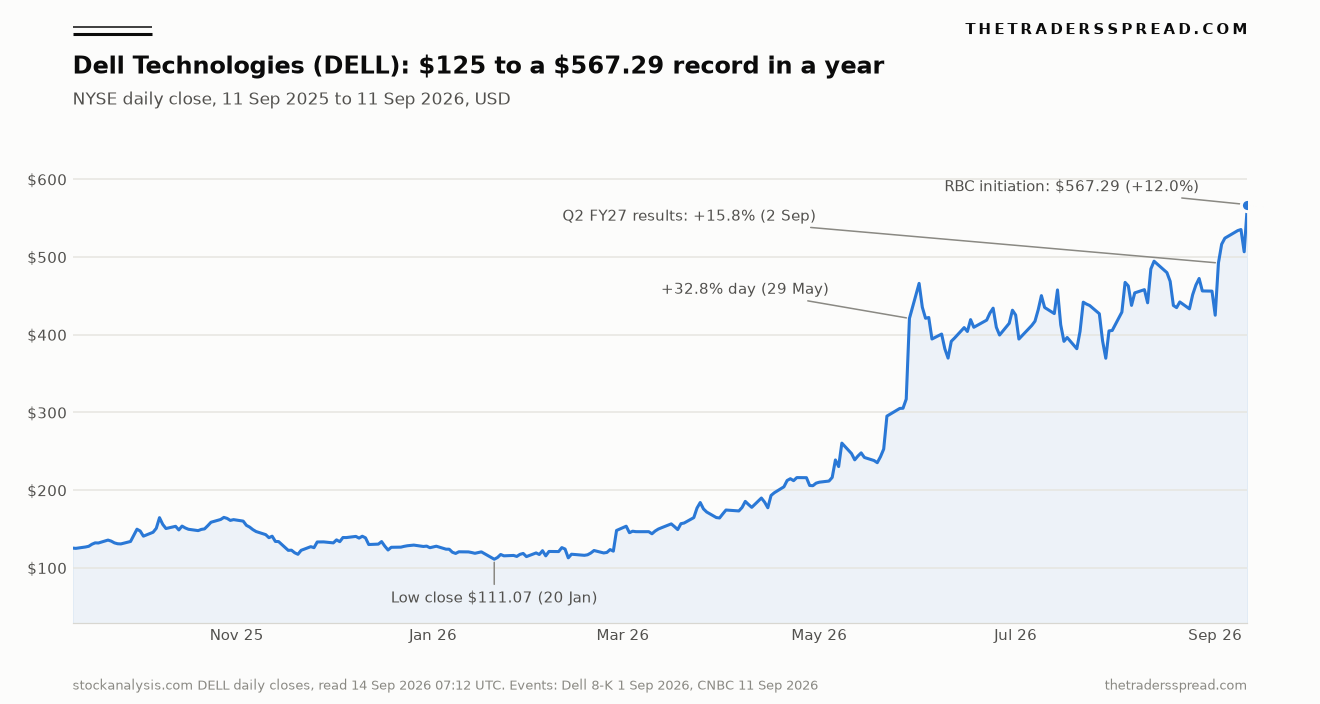
Set against peers, Dell's year stands alone. The table uses stockanalysis.com daily closes read on 14 September; "since 31 Aug" runs from the last close before the results week.
| Company | Close 11 Sep | Day change | Since 31 Aug | One year |
|---|---|---|---|---|
| Dell Technologies (DELL) | $567.29 | +11.98% | +24.4% | +352.5% |
| Hewlett Packard Enterprise (HPE) | $62.09 | +12.44% | +18.9% | +149.8% |
| Super Micro Computer (SMCI) | $40.10 | +7.28% | +7.6% | -8.8% |
| Nvidia (NVDA) | $218.29 | -0.03% | -1.1% | +23.2% |
Super Micro is the useful contrast. It sells into the same GPU server demand and is down 8.8% over the year, which says the market is not paying for exposure to AI racks as such. It is paying for balance sheets and supply access that can turn orders into shipped revenue. For the component side of that trade, see our Broadcom stock forecast and our report on AMD's margin guidance.
The fundamentals behind the chart are large. In the quarter to 31 July, Dell's results release showed revenue of $47.0 billion, up 58%, AI-optimised server revenue of $16.4 billion, up 100%, and traditional servers and networking up 122% to $10.5 billion. Infrastructure operating margin reached 15.0% against 8.8% a year earlier. Guidance went from $167 billion to $192 billion of FY27 revenue, and from $60 billion to $74 billion of AI server revenue. Jeff Clarke, vice chairman and chief operating officer at Dell Technologies, said in that release that in the AI server business "we booked a record $60.9 billion in orders, recognized a record $16.4 billion in revenue and exited the quarter with a record $95 billion backlog."
Who is selling into the record
Silver Lake has reported its Dell position on Schedule 13D since February 2019. Its 15th amendment to the Schedule 13D, filed on 11 September, lists every open-market sale in the 60 days to 9 September in its Annex B. There were none before 3 September. Then the funds sold 410,000 shares at an average of $512.94 on 3 September, 135,000 at $521.34 on 4 September, 135,000 at $527.07 on 8 September and 130,000 at $540.39 on 9 September. Durban sold 37,500, 2,900 and 1,900 shares on 4, 8 and 9 September at $520.71 to $534.45. Each tranche was fed by converting Class B stock, which carries ten votes, into one-vote Class C: 585,193 shares on 3 September, then roughly 190,000 a day.
Scale matters here. After those sales the group still beneficially owns 42,809,317 Class C shares on an as-converted basis, 6.7% of Dell's 635,812,750 total shares and 12.1% of the combined vote. The 810,000 sold equals 1.9% of the remaining position.
Friday brought fresh notices. Five Silver Lake entities filed Form 144s for 195,000 shares through Merrill Lynch, with an aggregate market value of $98.8 million, equivalent to $506.62 a share, Thursday's close. Durban filed for 1,900 through BofA Securities. Two Dell officers, Peter Trizzino and Richard J. Rothberg, filed for 37,735 and 6,000 shares acquired through restricted stock vesting, valued at $21.1 million and $3.3 million. Earlier in the month, chief human resources officer Jennifer Saavedra sold 25,251 shares at $520 and chief marketing officer Jane Tunnell sold 5,436 at $523.52, both on 4 September, according to their Form 4s. The filings we read do not say whether any of the sales run under a Rule 10b5-1 plan.
A Form 144 is a notice of intent, not proof of a trade. Section 16 filers must report executed sales within two business days, so the Form 4s for Friday are due by Tuesday 15 September. They will show whether Silver Lake sold into the $567 close, and at what price. At Friday's close, 195,000 shares would be worth about $110.6 million, or 1.35% of the day's volume.
$5 billion of new paper and the cash-flow gap
The bond deal is the other filing that shipped into the rally. The pricing term sheet of 9 September and the final 424B2 prospectus supplement filed on 11 September set out four series issued by Dell International and EMC Corporation, rated Baa2 by Moody's and BBB+ by S&P and Fitch, settling on 15 September.
| Series | Amount | Coupon | Yield at issue | Spread to Treasuries |
|---|---|---|---|---|
| Notes due 15 Sep 2029 | $1.25bn | 5.100% | 5.117% | +60bp |
| Notes due 15 Sep 2031 | $1.25bn | 5.400% | 5.438% | +82bp |
| Notes due 15 Sep 2033 | $1.50bn | 5.600% | 5.692% | +97bp |
| Notes due 1 Apr 2037 | $1.00bn | 5.900% | 5.939% | +110bp |
Net proceeds of about $4,965 million go first to repaying the 4.900% First Lien Notes due 1 October 2026, then to general corporate purposes, "which may include the repayment of other debt". The prospectus capitalization table shows existing notes falling from $25.0 billion to $23.3 billion, implying a $1.75 billion maturity, while total debt principal rises from $34.7 billion to $38.0 billion and cash from $11.6 billion to $14.8 billion. Shareholders' equity stays in deficit at minus $1.43 billion. Swapping secured paper for unsecured senior notes is a credit-quality signal in its own right. The price is higher: a weighted coupon near 5.49% on $5 billion is roughly $274 million a year of interest, against about $86 million on the notes being retired.
Why borrow with a $95 billion backlog? The cash-flow statement answers it. Operating cash flow in the quarter was $2.2 billion, down 13% on the year even as revenue rose 58%. After $1.24 billion of capital spending, Dell's own free cash flow line was $986 million, down 47%. Against that, it repurchased $3.8 billion of stock and paid $405 million of dividends. Inventory stood at $21.3 billion on 31 July against $10.4 billion on 30 January, and payables rose 48% to $49.7 billion. Dell's adjusted free cash flow measure, which adjusts for customer financing receivables, came to $8.1 billion. Both numbers are in the release. Which one you weight decides whether the buyback looks funded or borrowed.
For the customer side of the AI build, where the racks end up, see our Oracle stock forecast.
What would break the story
Three things could undo the re-rating, and each is checkable on a calendar.
First, conversion. A $95 billion backlog is worth what ships. FY27 AI server guidance of $74 billion already assumes a steep second half, and CNBC reported that Dell executives told investors on the results call that prices are rising with component costs such as memory. If memory prices move faster than Dell can pass them on, margin guidance is exposed before revenue is.
Second, valuation. At $567.29 the stock trades at 22.2 times the $25.50 FY27 non-GAAP EPS guide and 23.3 times the $24.37 GAAP guide. That is not extreme for the growth on offer, but it prices the $49.0 billion third-quarter revenue guide as a floor. A miss against a number the company raised by $25 billion for the year would land hard.
Third, supply of stock. Silver Lake holds more than 42 million shares and has sold on every trading day from 3 to 9 September. Tuesday's Form 4s show the pace. The Federal Reserve's calendar has the FOMC meeting on 15 and 16 September, with projections, and rate expectations weigh most on stocks priced for years of growth. For the buyer side, see our Microsoft stock forecast.
RelatedWhich Five Factors Move UnitedHealth (UNH) Shares?
What this changes
For Dell's equity story, Friday moves the argument from "can Dell win AI server share" to "can Dell fund the working capital that share requires". The first question was answered by the 1 September release: $60.9 billion of AI orders in a quarter and a guide raised to $192 billion. The second is newer. Inventory up $10.9 billion in six months, operating cash flow down 13% in a 58%-growth quarter, and $5 billion of fresh bonds at up to 5.9% are the costs of that answer, and every one of them was on EDGAR by Friday's close.
For the shareholder register, the change is that Silver Lake has moved from holding to distributing. Four straight days of sales, a 13D amendment and new 144 notices on the day of the record establish a pattern; they do not establish its size. The group owns 6.7% of the company, so the overhang is measured in tens of millions of shares, and each Form 4 now becomes a data point the market will read.
For the peer group, the same-day 12.44% move in HPE and the flat close in Nvidia point to a rotation into server integrators. That makes Dell's next leg more dependent on sector flows than on its own news, which cuts both ways.
For the credit side, nothing breaks. The new notes are rated investment grade, spreads of 60 to 110 basis points over Treasuries are orderly, and the proceeds retire secured debt. The balance sheet is larger and more indebted, not weaker in rating terms.
What we do not know, and will not guess: the exact contribution of RBC's initiation to the 12% move, whether Silver Lake executed the Friday notices, and the date of Dell's third-quarter report, which the company has not yet announced in any filing we read.
Frequently asked questions
Why did Dell stock rise 12% on 11 September 2026?
RBC Capital Markets initiated coverage with an outperform rating and a $640 target, as CNBC reported. That is the only Dell-specific public event of the day we found. Hewlett Packard Enterprise rose 12.44% the same session without a comparable filing, so part of the move looks sector-wide. No source has shown how the gain splits between the two.
Is Silver Lake selling its Dell stake?
It is selling part of it. Silver Lake's funds sold 810,000 shares between 3 and 9 September at averages of $512.94 to $540.39, about $422 million, and filed notices on 11 September to sell 195,000 more. After the reported sales the group still beneficially owns 42.8 million shares, 6.7% of Dell's total share count.
What are Dell's new $5 billion notes for?
Net proceeds of about $4.97 billion will first repay Dell's 4.900% First Lien Notes due 1 October 2026, with the rest for general corporate purposes that may include repaying other debt. The four series carry coupons of 5.100% to 5.900%, mature between 2029 and 2037, and settle on 15 September 2026.
How much has Dell stock risen over the past year?
From a close of $125.37 on 11 September 2025 to $567.29 on 11 September 2026, Dell gained 352.5%. From the low close of $111.07 on 20 January 2026 the gain is 410.7%. The 52-week range runs from an intraday $110.22 to $567.75, according to stockanalysis.com data read on 14 September.
When will we know whether Silver Lake sold on Friday?
Insiders subject to Section 16 must file a Form 4 within two business days of a trade, so any sales executed on Friday 11 September should appear on EDGAR by Tuesday 15 September. The Form 144 notices filed on Friday signal intent to sell but do not confirm that a trade took place or at what price.
Disclaimer
This article is analysis and information, not investment advice or a recommendation to trade any security. Share prices can fall as well as rise, and your capital is at risk. Figures are drawn from the sources linked and were accurate at the time of reading; check primary filings before making any decision.