

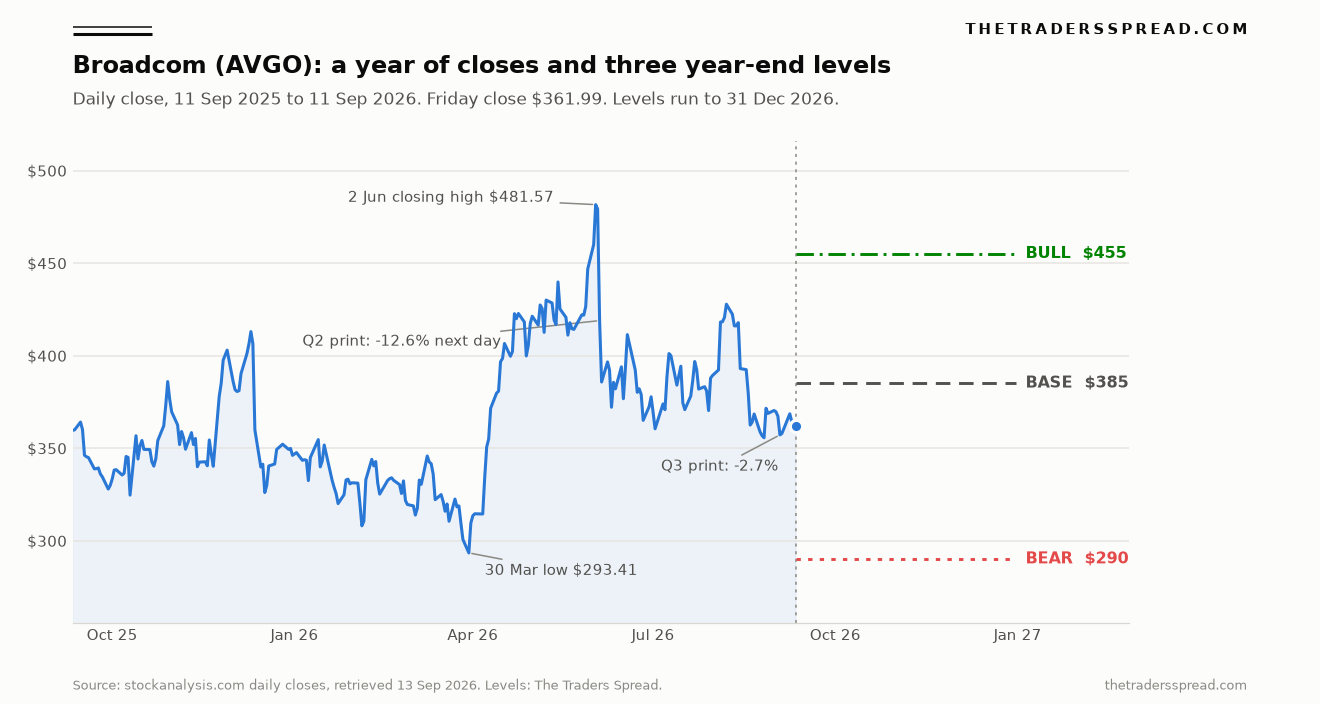
Broadcom grew revenue 86% in the quarter to 2 August, to $29.6 billion, and told investors its AI chip sales would roughly double again to about $115 billion in fiscal 2027. At Friday's close, 11 September, the shares stood at $361.99. That is 0.7% above where they closed on the same date a year earlier, and 24.8% below the $481.57 closing high of 2 June. A company whose sales nearly doubled has a stock that went nowhere. Either the market is mispricing the business, or it has found something in the filings that the revenue line does not show. This forecast sets a $455 bull case, a $385 base case and a $290 bear case for Broadcom (AVGO) to 31 December 2026, a window that includes the fiscal fourth-quarter report. Every number below comes from the company's own 8-K, its 10-Q or the earnings-call transcript, and all prices are Friday closes.
The market has found something, and it sits in note 10 of the 10-Q filed on 10 September. Broadcom has started underwriting the customers who purchase its chips. During the quarter it agreed to backstop one customer's five-year lease payments on AI racks built around its custom accelerators, with a maximum undiscounted liability of about $29 billion. The same note says the customer may, under certain conditions, issue Broadcom convertible notes of up to $42 billion. Taken together, the two ceilings come to $71 billion of contingent exposure, almost three times the $24.0 billion of cash Broadcom held at quarter end. The backstop's fair value is booked as not material and nothing has been paid under it. Even so, the worst session since early June, a 5.9% fall on 14 August, came on a day Broadcom filed nothing with the SEC. That was the day a Bank of America note, as reported by 24/7 Wall St., put a $370 billion senior-debt estimate on the financing vehicle behind these deals. The discount is about who pays for the racks. Demand for them is not in question.
Key facts
- Fiscal Q3 2026 revenue was $29.6bn, up 86% year on year, and AI semiconductor revenue was $16.7bn, up 221% — Broadcom 8-K Exhibit 99.1, 2 Sep 2026
- Q4 guidance is about $34.8bn of revenue (up 93%), with $21.7bn of it from AI chips and a non-GAAP operating margin of about 66% — Broadcom 8-K and earnings call, 2 Sep 2026
- Remaining performance obligations are about $179.2bn, and roughly 25% is expected to become revenue within 12 months — Broadcom 10-Q, filed 10 Sep 2026
- The maximum lease backstop liability is about $29bn, and the customer may issue Broadcom up to $42bn of convertible notes — Broadcom 10-Q, filed 10 Sep 2026
- Unconditional purchase commitments total $126.8bn, and $125.6bn of that falls due in fiscal 2027 and 2028 — Broadcom 10-Q, filed 10 Sep 2026
- AVGO closed at $361.99 on 11 Sep, 24.8% below its 2 Jun closing high and up 0.7% year on year — stockanalysis.com, retrieved 13 Sep 2026
- Broadcom's top five end customers made up about 50% of revenue over the first three fiscal quarters — Broadcom 10-Q, filed 10 Sep 2026
Inside the $29 billion backstop
The structure has a name. In June Broadcom set up what it calls the AI XPV Platform, with Apollo and Blackstone as the financial partners. On the 2 September call, Amie Thuener, Chief Financial Officer at Broadcom, said the platform is meant "to enable more than 20 GW of compute infrastructure for OpenAI and Anthropic by the end of 2028." She said the first $35 billion tranche closed in June to fund Anthropic's 1 GW deployment, which is already under way.
The 10-Q explains how the money flows. A financial partner takes over the agreements to purchase the racks and the leases that give the customer access to the compute. Broadcom then guarantees the customer's lease payments to that partner for five years. If the customer defaults, Broadcom owes the difference between 85% of the lease amounts still outstanding and whatever the racks fetch when they are sold. Broadcom has three ways to limit the loss. It can take over the lease, return the racks to the original vendor at a fixed price under certain conditions, or arrange a sale itself. The filing does not name the customer. The only closed tranche anyone has described is Anthropic's.
Management's defence is short. "Where necessary, we may provide modest residual value guarantees, which are contingent liabilities we view as low risk, supported by the strong profitability trajectory of these labs and the sustaining value of the underlying assets," Thuener said in her prepared remarks. An analyst from Melius asked whether $29 billion was the right order of magnitude for each future gigawatt tranche. She would not give a figure: "we don't have anything to announce today on residual value guarantees or backstop."
The chief executive put the case in commercial terms. "It makes economic sense for Broadcom to invest and enable these guys," said Hock Tan, President and CEO at Broadcom, after arguing that a lab can generate $30 billion of annual recurring revenue for every gigawatt it deploys. He also said the financing vehicles cover two of Broadcom's six XPU customers, and that the other four fund themselves.
There is a weak point here. Broadcom only recovers its money if racks of custom silicon, designed for a single lab's models, can be sold in a hurry. That is an asset with no public resale price history. So the $29 billion is a ceiling that depends on the lab's creditworthiness and on a secondhand market that barely exists yet. Scale it to 20 GW and the question behind the Bank of America note becomes plain, even though the $370 billion is the vehicle's debt and not Broadcom's.
Two beats, two down days: the price record
Broadcom has beaten its own guidance and raised it at each of the last two reports. Both times the stock fell. The fiscal second-quarter release on 3 June, issued after the close, guided third-quarter revenue to $29.4 billion and AI revenue to $16.0 billion (Q2 release). The shares fell 12.6% the next session to $418.91, then another 7.9% the session after. The third quarter beat that guidance on both lines: revenue came in at $29.59 billion and AI revenue at $16.7 billion. Management also lifted full-year AI revenue to $58 billion. On 3 September the stock traded as low as $342.33, 6.8% below the prior close, before finishing the day down 2.7% at $357.16.
Friday's close sits 23.4% above the 30 March closing low of $293.41 and 24.8% below the June high.
The valuation does not look stretched against peers. The table uses stockanalysis.com statistics pages retrieved on 13 September 2026, with prices at Friday's close.
| Company | Close, 11 Sep | 52-week high | Below high | Forward P/E | Price/sales (ttm) | Market cap |
|---|---|---|---|---|---|---|
| Broadcom (AVGO) | $361.99 | $495.00 | -26.9% | 20.9 | 19.4 | $1.73T |
| Nvidia (NVDA) | $218.29 | $236.54 | -7.7% | 18.1 | 17.4 | $5.27T |
| AMD | $516.13 | $584.73 | -11.7% | 46.7 | 20.4 | $842.6B |
| Marvell (MRVL) | $236.10 | $329.88 | -28.4% | 43.3 | 21.9 | $207.0B |
| Qualcomm (QCOM) | $181.97 | $259.92 | -30.0% | 19.6 | 4.4 | $194.4B |
Source: AVGO, NVDA, AMD, MRVL and QCOM statistics and quote pages, retrieved 13 Sep 2026. The 52-week highs are intraday highs.
By this measure Broadcom is priced almost exactly like Nvidia, a little above Qualcomm and far below AMD or Marvell. Its fall from the high, however, looks like Marvell's and Qualcomm's rather than Nvidia's. Our AMD margin-guidance piece found the same summer derating across every merchant-silicon name except Nvidia. Nvidia's own $108 billion quarterly guide shows what the market rewards when it does not have to ask who is funding the customer.
Where the margin goes when the chips carry more memory
The second pressure is mechanical, and management expects it. Non-GAAP gross margin was 78.4% in the third quarter of fiscal 2025. It fell to 77.1% in the second quarter of this year, then to 75.0% in the third, and management guides it to about 73% for the fourth. On the earnings call, Thuener tied the decline to "the increasing mix of XPUs with their increasing memory content." Later in the call she corrected an earlier figure, saying the semiconductor segment's gross margin was about 67% in the third quarter, not the 76% she had first given. Tan's answer was blunt: "stop focusing on gross margin is what we are saying." Operating margin, his preferred measure, was 67.9% in the third quarter and is guided to about 66%.
The balance sheet shows the supply build behind those targets. Inventory doubled from $2.27 billion in November to $4.52 billion. Trade receivables went from $7.1 billion to $13.7 billion. Working capital climbed from $13.1 billion to $31.3 billion. The biggest number is the $126.8 billion of unconditional purchase commitments, with $52.7 billion due in fiscal 2027 and $73.0 billion in 2028. Tan said Broadcom has "secured the supply" to double AI revenue to about $115 billion in 2027 and again to $230 billion in 2028. Those commitments are what securing the supply costs. Set them against the $179.2 billion of firm remaining obligations and the cover looks adequate. Only about $44.8 billion of that backlog converts within 12 months, though, and the purchase bills arrive on a fixed schedule.
Put simply, Broadcom has promised to pay for components before its customers pay for racks.
The half of Broadcom the tape ignores
Most coverage stops at AI. Infrastructure software, which is largely VMware, produced $8.75 billion of third-quarter revenue, up 29%. Its segment operating income was $7.3 billion, against $12.8 billion from semiconductors, according to the 10-Q segment table. Thuener put software gross margin at 94% and operating margin at about 84%, with annual recurring revenue up 15%. The fourth-quarter guide flattens it at about $8.7 billion, so the software segment funds the dividend without adding growth. Non-AI chips add another $4.2 billion a quarter, up 5% year on year.
Capital returns and debt reduction have continued while the financing arrangements grew. Debt principal fell from $67.1 billion in November to $61.1 billion at quarter end. The third quarter alone retired $5.6 billion of senior notes through tender offers and redemptions, and another $1.5 billion was repaid at maturity after the quarter closed. Over the three fiscal quarters Broadcom repurchased 25 million shares for $8.45 billion, and $10.1 billion of authorisation remains through 31 December 2026. The $0.65 quarterly dividend is payable on 30 September to holders of record on 21 September, a 0.72% annualised yield at Friday's close.
Customer breadth is thinner than the six-customer count suggests. The top five end customers accounted for about half of revenue over the first three fiscal quarters, and 70.8% of third-quarter revenue shipped to Asia Pacific. On 6 July Broadcom disclosed in an 8-K new multi-year agreements to supply Apple with custom ASICs through 2031. Google remains the anchor customer: Tan said Broadcom plans to deliver "multi-tens of billions of dollars of TPUs annually over the next several years." That relationship sits under our Alphabet forecast. Meta takes three generations of MTIA accelerators, 3 GW through 2028 on management's count, and is covered in our Meta settlement piece.
The call: $455, $385 or $290 by 31 December
Start with the arithmetic, which is our own estimate. Assume fiscal 2027 AI revenue of $115 billion, and that the rest of the business runs at the fourth-quarter guide of $13.0 billion a quarter. That gives about $167 billion of revenue. At a 64% operating margin, two points below the Q4 guide to allow for more mix dilution, less $2.8 billion of interest and a 16% tax rate, spread over 4.94 billion shares, the result is roughly $17.70 of non-GAAP EPS. Spot is 20.5 times that, close to the 20.9 times forward P/E that stockanalysis.com shows. The next test is the fiscal fourth-quarter report, which a year ago landed on 11 December.
Base case, $385 (+6.4%), 45%. Q4 lands near $34.8 billion, the $115 billion outlook for 2027 is repeated, and the 10-K shows no step-up in guarantees. The stock recovers part of the June gap at 21.8 times our estimate.
Bull case, $455 (+25.7%), 25%. Q4 beats again, and the OpenAI tranche closes with a smaller Broadcom guarantee per gigawatt than Anthropic's. At that point the market starts pricing Tan's statement that Broadcom is "very much on target to exceed $30 in earnings per share in fiscal 2028." $455 is 15.2 times that figure.
RelatedWhich Five Factors Move UnitedHealth (UNH) Shares?
Bear case, $290 (-19.9%), 30%. Two routes lead here. One is the 10-K disclosing new backstops at Anthropic scale. The other is a lab funding round that stalls, or a gross margin guide below 73%. At 16.4 times our estimate the stock would be back at its March low.
Weighted, those outcomes give $374, or 3.3% above spot, which is a neutral stance. The base case is invalidated by a close below $340, under the post-earnings low. What would change our mind: a second XPV tranche closing with no Broadcom guarantee attached would move 10 points from the bear case to the bull case. A backstop ceiling above $60 billion in the 10-K would move the bear case to 40%.
FAQ
What is the Broadcom stock forecast for the end of 2026?
Our scenarios to 31 December 2026 are $455 in the bull case, $385 in the base case and $290 in the bear case, against Friday's close of $361.99. We weight them at 25%, 45% and 30%, which gives an expected value of about $374. Those are 20.5 times, 25.7 times and 16.4 times our fiscal 2027 EPS estimate of $17.70. The base case is invalidated by a close below $340.
When did Broadcom report its fiscal third-quarter 2026 results?
After the close on 2 September 2026, in an 8-K with Item 2.02. Revenue was $29.6 billion, up 86%, and non-GAAP EPS was $3.32. The 10-Q followed on 10 September. The fiscal year ends on 1 November, and last year's fourth-quarter report came on 11 December, so the next print should land inside this forecast window.
What is Broadcom's AI XPV Platform?
It is a financing structure set up in June with Apollo and Blackstone. Financial partners fund racks of Broadcom-designed accelerators and lease the compute to AI labs. Management says the goal is more than 20 GW for OpenAI and Anthropic by the end of 2028. Broadcom guarantees part of the lease payments. On the first deal its maximum exposure is about $29 billion over five years.
How much AI revenue does Broadcom expect?
$21.7 billion in the fiscal fourth quarter and $58 billion for fiscal 2026. Management's outlook is about $115 billion for fiscal 2027 and $230 billion for fiscal 2028, and it says it has secured supply for both. Tan described the combined $350 billion as a figure Broadcom believes it will ship "with a pretty high degree of confidence."
Why did Broadcom stock fall after beating earnings?
The price moves line up with financing worries more than with the results. The stock fell 12.6% after the June report and 2.7% after September's. The worst session since then, a 5.9% drop on 14 August, came when Bank of America put a $370 billion debt estimate on the financing vehicle. Gross margin, heading to 73%, adds a second concern.
Does Broadcom pay a dividend?
Yes. The board declared $0.65 a share for the quarter, payable on 30 September 2026 to holders of record on 21 September. That is $2.60 a year, or a 0.72% yield at Friday's close of $361.99. Over the first three fiscal quarters Broadcom paid $9.28 billion in dividends and spent $8.45 billion on buybacks.
Disclaimer
This article is analysis, not investment advice. The scenario levels and probabilities are our own estimates and may prove wrong. Shares can fall as well as rise, and trading them puts your capital at risk. Readers should do their own research and consider their own circumstances before making any decision. Figures are from company filings and third-party data sources as dated in the text.