

The most repeated line about Costco, that the membership card is the profit and the merchandise is sold at cost, did not survive the company's own fiscal 2026 accounts. Membership fees came to $5.907 billion against $11.685 billion of operating income in the 52 weeks to 30 August, or 50.6%, the lowest share of the last four fiscal years. In the last two quarters the fee line was below half: 48.8% in the third quarter and 48.7% in the 16-week fourth quarter reported on 24 September. The warehouse floor, not the card, did most of the growing. Costco Wholesale (COST) closed Friday 25 September at $922.765, up 2.93% on the day on roughly twice its normal volume. It is tempting to read that pop as the end of the de-rating that began in May. The same filing that produced the rally says the fee engine is about to slow, and the share price is still 15.8% below its high.
Here is the part most results coverage skipped. Fee income grew 14.0% in the first quarter of fiscal 2026, 13.6% in the second, 10.7% in the third and 7.3% in the fourth. That is not a demand problem. It is the September 2024 fee increase rolling out of the comparison, and chief financial officer Gary Millerchip told analysts the fourth quarter was the last one to carry any benefit from it. From the first quarter of fiscal 2027, the fee line grows at its underlying rate, which Costco put at 6.8% excluding the increase and currency. Operating profit outside the fee line grew 20.7% in the fourth quarter. Put the two together and the investment case has quietly changed shape: Costco now needs the merchandise business to keep carrying the growth that the fee hike carried for two years.
- Q4 fiscal 2026 net sales rose 11.2% to $93.873 billion; comparable sales rose 9.4%, or 6.7% excluding gasoline prices and currency (Costco 8-K Exhibit 99.1, 24 Sep 2026)
- Q4 net income was $2.998 billion, or $6.75 per diluted share, including a one-off $0.15 per share benefit from IEEPA tariff refunds (Costco 8-K, 24 Sep 2026)
- Membership fees were $1.850 billion in Q4, up 7.3%, and $5.907 billion for the year, up 11.0% (Costco 8-K, 24 Sep 2026)
- Fees equalled 48.7% of Q4 operating income of $3.801 billion, down from 51.6% a year earlier (The Traders Spread calculation from the 8-K income statements, 24 Sep 2026 and 25 Sep 2025)
- US and Canada renewal rate 92.3%, worldwide 89.8%, both identical to a year earlier; paid members 84.1 million, up 3.8% (Costco Q4 supplement, Exhibit 99.2, 24 Sep 2026)
- COST closed at $922.765 on 25 Sep 2026, up 2.93%, on 4.63 million shares against a 20-session average of 2.21 million (stockanalysis.com, retrieved 28 Sep 2026)
Where the operating income actually came from
Costco's income statement is simple enough to take apart by hand. Revenue is net sales plus membership fees. Costs are merchandise and selling, general and administrative expense. Subtract the fee line from operating income and what is left is the profit the warehouses earn on goods, gasoline, pharmacy, travel and everything else members pay for at the till. Nothing about that split requires an adjustment or an estimate; every number below is read straight off the filed statements.
| Period | Membership fees ($m) | Operating income ($m) | Fees as % of operating income | Operating income ex-fees ($m) |
|---|---|---|---|---|
| FY2023 | 4,580 | 8,114 | 56.4% | 3,534 |
| FY2024 | 4,828 | 9,285 | 52.0% | 4,457 |
| FY2025 | 5,323 | 10,383 | 51.3% | 5,060 |
| FY2026 | 5,907 | 11,685 | 50.6% | 5,778 |
| Q1 FY2026 (12 wks) | 1,329 | 2,463 | 54.0% | 1,134 |
| Q2 FY2026 (12 wks) | 1,355 | 2,606 | 52.0% | 1,251 |
| Q3 FY2026 (12 wks) | 1,373 | 2,815 | 48.8% | 1,442 |
| Q4 FY2026 (16 wks) | 1,850 | 3,801 | 48.7% | 1,951 |
Sources: Costco 10-K for fiscal 2025 (fiscal 2023 to 2025 fees), SEC XBRL company facts (fiscal 2023 to 2025 operating income), and the quarterly earnings releases filed on 11 December 2025, 5 March 2026, 28 May 2026 and 24 September 2026. The four quarters sum exactly to the full-year figures.
Three years ago the fee line was 56.4% of operating income. It is now 50.6%, and the decline happened while fees were rising by double digits, which tells you how fast the rest of the business has been compounding. Operating income outside the fee line rose from $3.534 billion to $5.778 billion over three fiscal years, a 63.5% increase. Fees rose 29.0% over the same stretch.
Why does the split matter for a stock that trades on its reputation for predictability? Because the two halves carry very different risk. A renewal rate above 90% makes the fee line close to an annuity. The ex-fee line depends on gross margin in a business that runs at an 11% margin rate, on gasoline prices, on the LIFO inventory charge and on what Costco chooses to hand back to members in price. A company that earns 56% of its operating profit from an annuity deserves a different multiple from one that earns 49% from it. The market has not had to think about that distinction because both halves grew together. From October it has to.
The fee engine slows on a timetable Costco published
Costco raised its annual fees in the US and Canada on 1 September 2024. Because fee revenue is recognised ratably over each 12-month membership, the increase trickled into the income statement across two fiscal years. The 10-K for fiscal 2025 said it accounted for approximately 40% of that year's membership income growth. By the fourth quarter of fiscal 2026 it had almost gone.
"The September 2024 U.S. and Canada membership fee increase accounted for less than 1% of fee growth. And as a reminder, Q4 marks the last quarter in which we will see a year-over-year benefit from the membership fee increase."
That was Gary Millerchip, Executive Vice President and Chief Financial Officer at Costco, on the fourth-quarter call on 24 September (transcript via TradingKey). Excluding the increase and currency moves, he put underlying membership income growth at 6.8%, driven by more Executive members and a larger base.
The member counts explain why 6.8% is roughly the right run rate rather than a floor. Paid memberships grew 6.3% in the year to the fourth quarter of fiscal 2025, then 5.2%, 4.8%, 4.1% and now 3.8% in successive quarters, according to Costco's quarterly supplements. Executive memberships, which cost more and renew better, rose 9.4% to 42.3 million and account for 75.6% of sales. Renewal rates ticked up 10 basis points from the third quarter to 92.3% in the US and Canada and 89.8% worldwide; both figures are exactly where they stood at the end of fiscal 2025. Stable, not improving.
Management framed the slower sign-up growth as digestion rather than damage. Ron Vachris, President and Chief Executive Officer at Costco, told the same call: "Our membership continues to be the most important item we sell and the additional benefits we introduced for Executive Members last year continue to resonate well." Millerchip added that the younger, digitally recruited members who joined in the last two years are now flowing through the renewal calculation, which he described as "a normalization" in growth.
Nothing in that is alarming. The arithmetic is what matters: roughly 49% of operating income is about to grow at high single digits instead of low double digits. To keep total operating income compounding at the 12.5% it managed in fiscal 2026, the non-fee half has to grow faster than it already is.
Friday's 2.9% against twelve months of de-rating
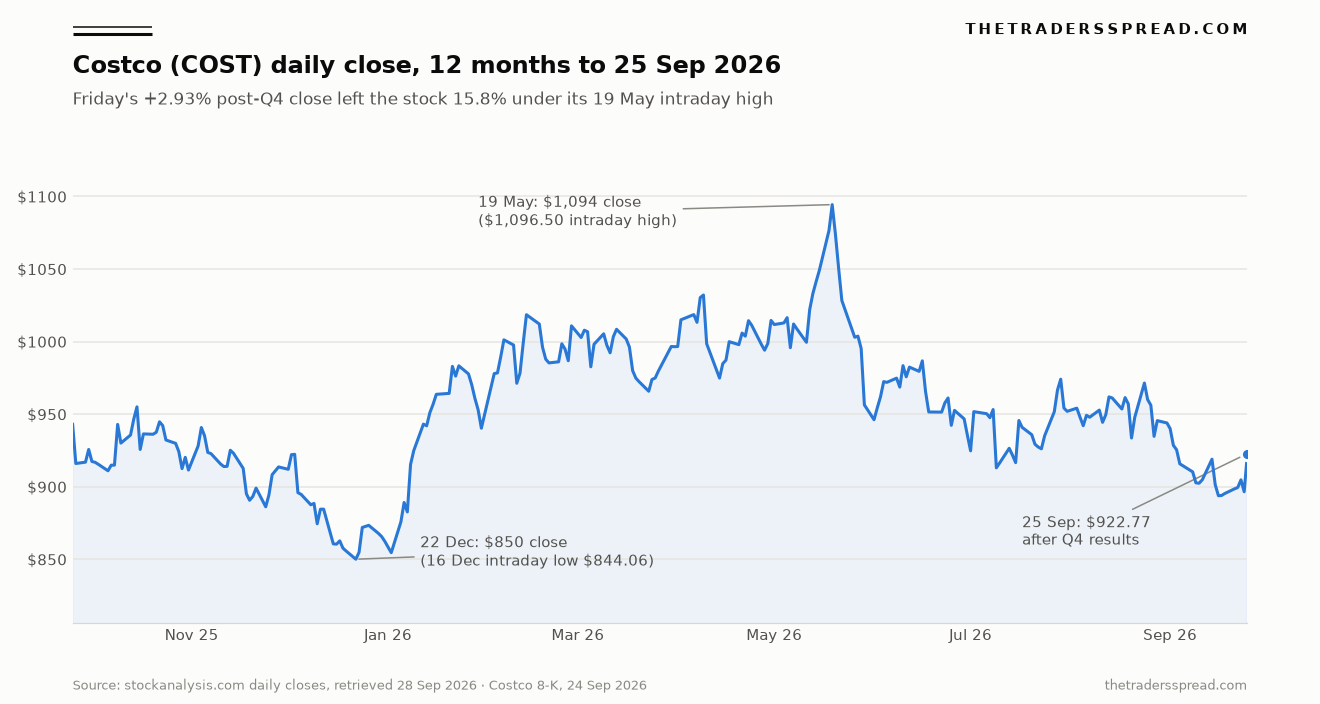
The chart below is the context the one-day move lacks. COST set an intraday high of $1,096.50 on 19 May 2026, closed that day at $1,094.32, and then gave back almost everything it had gained since the December low. Friday's close at $922.765 sits 15.8% under that high.
| Window | Anchor date | Anchor close | Change to $922.765 |
|---|---|---|---|
| 1 day | 24 Sep 2026 | $896.48 | +2.93% |
| 5 days | 18 Sep 2026 | $895.31 | +3.07% |
| 1 month | 26 Aug 2026 | $956.12 | -3.49% |
| 3 months | 26 Jun 2026 | $952.54 | -3.13% |
| 6 months | 26 Mar 2026 | $979.65 | -5.81% |
| Year to date | 31 Dec 2025 | $862.34 | +7.01% |
| 1 year | 25 Sep 2025 | $943.31 | -2.18% |
| From 52-week high | 19 May 2026 (intraday) | $1,096.50 | -15.84% |
All windows computed from daily closes published by stockanalysis.com, retrieved 28 September 2026; vendor percentage fields were not used.
Four of the seven trailing windows are negative. The post-results close only returned the stock to where it traded on 3 September ($925.41). Volume of 4.63 million shares was 2.1 times the 20-session average, which says institutions did engage with the print, but the move reversed less than a single month of the slide.
Valuation shows the same thing from another angle. On fiscal 2026 diluted earnings of $20.76, Friday's close is 44.4 times earnings. The May high was 52.8 times that same figure. With 443.3 million shares outstanding at year-end, the market value is about $409 billion. The multiple has come down by about eight points, and the question for the next leg is whether a stock whose fee growth is halving deserves the old one back. For the index backdrop against which that multiple is judged, see our S&P 500 scenario piece.
What flattered the quarter, and what did not
Two things lifted the fourth quarter that will not repeat on the same scale. The first is tariff refunds. Costco received $184 million in the quarter, $174 million of refunds plus $10 million of interest, relating to tariffs imposed under the International Emergency Economic Powers Act. It reinvested part of that in lower prices and still booked a net benefit worth $0.15 a share. Strip it out and net income grew 12.3%, not 14.9%. Millerchip said the quarter's receipts were a little more than a third of the total expected and that a similar amount has already arrived in the first quarter of fiscal 2027, with most of it earmarked for price cuts.
Wall Street read that reinvestment kindly. "Costco is prioritizing tariff refunds for price investments," Kate McShane, analyst at Goldman Sachs, wrote in a note on Friday, as reported by CNBC. Goldman kept its positive rating while cutting its price target to $1,134 from $1,159. A target cut after a beat is the more telling detail.
The second flatterer is gasoline. Higher pump prices, which Millerchip tied in part to the conflict in the Middle East, pushed reported comparable sales up by roughly three percentage points, according to the call. Oil's run is covered in our piece on WTI's 21% climb to $91. Gas sales are low-margin, so they inflate revenue more than profit, and they dragged the reported gross margin rate down 11 basis points to 11.02% even as it rose 20 basis points excluding gas.
Not everyone on the call accepted that price cuts were paying off. Michael Lasser, analyst at UBS, put it directly: "we really haven't seen a meaningful change in the trajectory of the monthly sales as of yet. And if anything, it has moderated a touch." Millerchip's answer was that adjusted comparable sales have held in a 6% to 7% range all year and that the price cuts are about returning tariff money, not buying traffic.
What did not flatter the quarter was LIFO. The inventory charge was $152 million against $43 million a year earlier, driven by memory chip costs in consumer electronics and petroleum-linked items. That is a real cost, and it was absorbed.
Adjust for the refund benefit (about 9 basis points of net sales, or roughly $84 million, by our estimate from the gross margin bridge) and non-fee operating income still grew around 15% in the quarter. That is the genuine good news in the print, and it is the half of the business now expected to do the heavy lifting.
Where the next growth has to come from
Costco is spending to make that happen. Capital expenditure was $6.4 billion in fiscal 2026 and is planned at about $7.5 billion for fiscal 2027, funding 33 openings including five relocations toward a target of 30 net new warehouses a year. The company ended the year with 939 warehouses and $20.2 billion of cash. Digitally enabled comparable sales rose 19.5%, delivery partnerships with Uber Eats and DoorDash widened, and the extended online marketplace, Costco Next, is being folded into the main app. Online competition is a live risk in the bear case for the wider sector, discussed in our Amazon (AMZN) forecast.
Non-food was the best category in the quarter, with gold and jewellery at the top. Kirkland Signature one-ounce silver bars were a new item, which ties part of the ticket to precious metals prices tracked in our note on silver's climb to $69.57.
The balance sheet is not the constraint. Costco ended the year with $20.2 billion of cash against $6.2 billion of long-term debt including the current portion, after paying $2.458 billion in dividends and buying back $848 million of stock during fiscal 2026. The filing announces no new capital return.
RelatedTSMC (TSM) Falls 3.4% Ahead of the Q3 Earnings Print
What this changes
This is a news piece and it sets no price target. What the fourth quarter changes is the job description of the stock. Until now, anyone modelling COST could lean on double-digit fee growth that required nothing from the shopper. From the first quarter of fiscal 2027 that support is gone by Costco's own statement, and fee growth should settle near the 6.8% underlying rate Millerchip gave.
Base case, probability 55%: fee growth runs at 6% to 8%, non-fee operating income grows low double digits, and total operating income growth drifts from 12.5% toward 9% to 11%. On those numbers the multiple has little reason to return to the 52.8 times paid in May, and the stock tracks earnings rather than re-rating.
Upside case, 25%: the price cuts do lift traffic, Executive upgrades push the fee line above 8%, and non-fee profit keeps growing in the teens. Then fiscal 2027 operating income could grow at the fiscal 2026 pace despite the fee comparison, and the de-rating has room to reverse.
Downside case, 20%: gasoline falls back, tariff-refund reinvestment compresses core margin, and paid member growth slips under 3.5%. The fee line then grows below 6% while the ex-fee half stalls, and a 44 times multiple has further to give.
What would change this read: the September sales report, covering the five weeks to 4 October and due after the close on Wednesday 7 October, is the first post-results read on traffic and ticket, and the first test of whether the price cuts moved either. A renewal rate above 92.5% in the first-quarter supplement in December would argue for the upside case; a paid member growth figure under 3.5% would argue for the downside one.
Frequently asked questions
Why did Costco stock rise after its Q4 fiscal 2026 results?
COST rose 2.93% to $922.765 on Friday 25 September after reporting fourth-quarter EPS of $6.75, which included a $0.15 tariff-refund benefit. Excluding that benefit, EPS of $6.60 still exceeded the LSEG consensus of $6.53 that CNBC cited. Net sales rose 11.2% to $93.9 billion and volume ran at about twice the recent average.
How much of Costco's profit comes from membership fees?
In fiscal 2026, membership fees of $5.907 billion equalled 50.6% of operating income of $11.685 billion. In the third and fourth quarters the share fell below half, to 48.8% and 48.7%. Three years earlier, in fiscal 2023, fees were 56.4% of operating income, so the merchandise side has been growing faster than the fee line.
Is Costco's membership fee growth slowing?
Yes. Fee income grew 14.0%, 13.6%, 10.7% and 7.3% across the four quarters of fiscal 2026 as the September 2024 fee increase dropped out of the comparison. CFO Gary Millerchip said the fourth quarter was the last to benefit from it. Underlying growth, excluding the increase and currency, was 6.8%.
What is Costco's membership renewal rate?
At the end of fiscal 2026, the renewal rate was 92.3% in the US and Canada and 89.8% worldwide, each up 10 basis points from the third quarter and identical to the rates reported at the end of fiscal 2025. Paid memberships reached 84.1 million, up 3.8%, and Executive memberships 42.3 million, up 9.4%.
How far is Costco stock below its high?
The 25 September close of $922.765 is 15.84% below the intraday high of $1,096.50 set on 19 May 2026. The stock is down 3.49% over one month, 5.81% over six months and 2.18% over one year, but up 7.01% since the 31 December 2025 close of $862.34.
When does Costco report next?
Costco said on its 24 September call that it will release September sales, covering the five weeks ending Sunday 4 October, on Wednesday 7 October after the market close. First-quarter fiscal 2027 results, with the next membership supplement, would follow in December on the company's usual calendar.
This article is analysis and information, not investment advice. It does not recommend buying or selling any security. Share prices can fall as well as rise and you can lose capital. Figures are taken from the sources linked and dated above; the 25 September 2026 close is the latest completed US session at the time of writing.