

On 17 August 2026, AMD's counsel filed a Third Supplemental Indenture hanging off a base indenture dated 9 June 2022. The document is dull in the way that only bond paperwork can be, and the substance sits in a four-row table: $1.25bn at 4.600% maturing 2029, $1.50bn at 5.000% maturing 2031, $1.00bn at 5.250% maturing 2033, and $1.00bn at 5.500% maturing 2036. Barclays, BofA Securities, Citigroup, J.P. Morgan, Morgan Stanley and Wells Fargo took the paper. The stated use of proceeds is the standard formula: general corporate purposes, which may include the repayment of debt (AMD Form 8-K, 17 August 2026).
Twelve days earlier, AMD's own 10-Q had reported total debt principal of $3.25bn, a figure that had not moved since 27 December 2025 (AMD Form 10-Q, filed 5 August 2026). The same filing showed $13.1bn of cash, cash equivalents and short-term investments, and $5.3bn of operating cash flow generated in six months. A company in that position does not need $4.75bn. It raised it anyway.
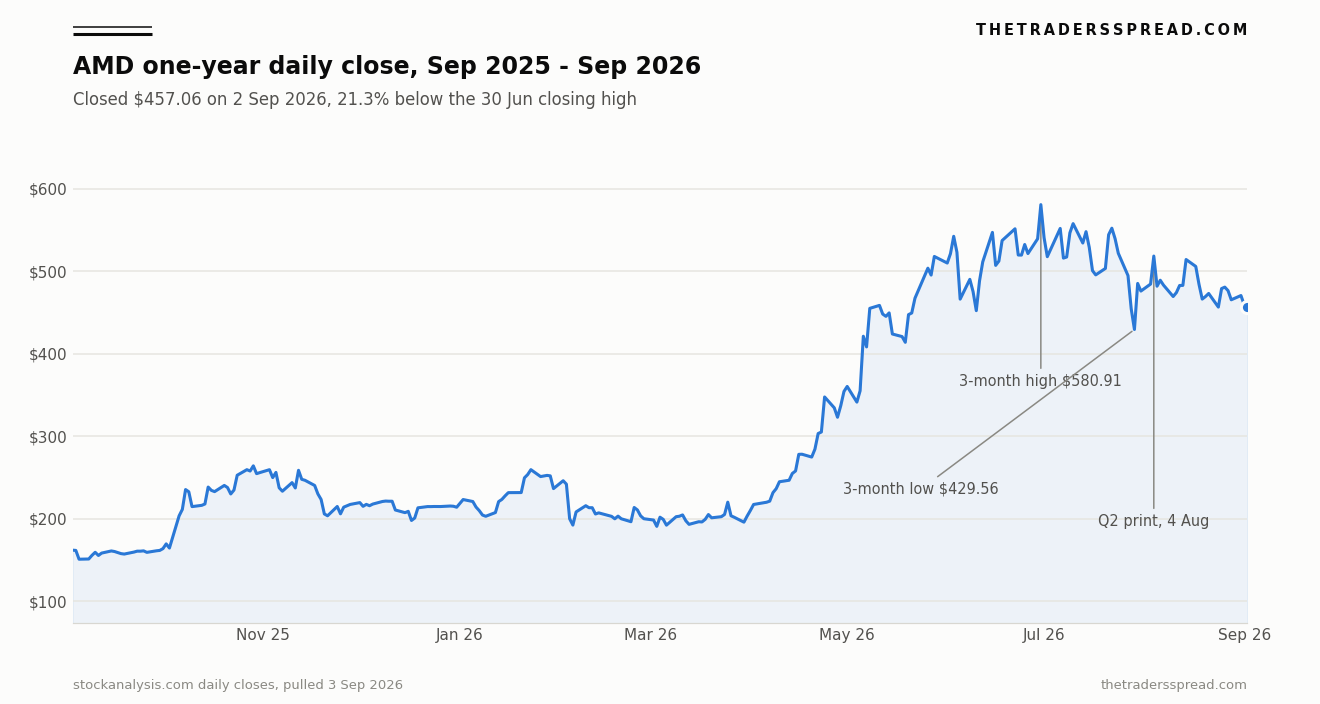
AMD closed at $457.06 on 2 September 2026, down 0.55% on the session and down 11.9% from the $518.58 it printed on 4 August, the last close before its second-quarter results (stockanalysis.com daily closes, pulled 3 September 2026). That is 21.3% below the $580.91 closing high of 30 June. The month contains a record quarter, two upgrades from named analysts, and a stock that has lost roughly $97bn of market value.
The insight the tape is expressing is not scepticism about AMD's demand. Demand is documented, contracted and in some cases collateralised. What the market spent August repricing is the cost of converting that demand into gross profit, and every input to that calculation is visible in AMD's own filings rather than in anyone's channel checks: a gross-margin guide that refuses to expand at a richer product mix, $30.3bn of unconditional purchase commitments against a $13.1bn cash pile, a billion dollars of prepayments to suppliers inside six months, and warrants over 320 million shares issued to the two customers who account for the headline gigawatts. Growth is not in question. The price of the growth is.
These are the numbers the month turned on
- AMD closed at $457.06 on 2 September 2026, 11.9% below its 4 August pre-earnings close of $518.58 and 21.3% below the 30 June closing high of $580.91 — stockanalysis.com daily closes, pulled 3 September 2026
- Q2 2026 revenue was $11.536bn, up 50% year over year, with GAAP gross margin of 54% and non-GAAP gross margin of 56% — AMD Q2 2026 results, 4 August 2026
- Q3 guidance is revenue of about $13bn and non-GAAP gross margin of about 56%, flat sequentially despite a richer mix — AMD Q3 2026 outlook, 4 August 2026
- AMD carried $30.3bn of unconditional commitments at quarter-end, $17.4bn of it falling due in the remainder of fiscal 2026, against $13.1bn of cash and short-term investments — AMD Form 10-Q, 5 August 2026
- The company issued warrants to OpenAI and to Meta for up to 160 million shares each at $0.01, a combined 19.6% of the 1,632,475,042 shares outstanding at 29 July 2026 — AMD Form 10-Q, 5 August 2026
- On 17 August AMD sold $4.75bn of senior notes at coupons from 4.600% to 5.500%, taking gross debt principal from $3.25bn to roughly $8.0bn — AMD Form 8-K, 17 August 2026
The margin bridge does not clear at this mix
The number that moved the stock on 5 August was not revenue and not earnings per share. AMD beat on both, printing $11.536bn against a Data Center segment that grew 107% year over year, and non-GAAP diluted earnings of $1.66. What mattered was the third-quarter gross-margin guide of approximately 56% on a non-GAAP basis, identical to the 56% just delivered, on revenue guided about 13% higher sequentially. Instinct accelerators and Helios racks carry the highest average selling prices AMD has ever shipped, so a mix shifting toward them should lift the blended margin mechanically. The guide says it will not. Shares fell 7.04% the next session on 49.6 million shares, roughly double the twenty-session average.
Read the segment table and the reason becomes structural rather than conservative.
| Segment (Q2 2026) | Revenue | Share of total | Operating income | Operating margin | Q2 2025 margin |
|---|---|---|---|---|---|
| Data Center | $6,718m | 58.2% | $2,103m | 31% | (5)% |
| Client and Gaming | $3,841m | 33.3% | $582m | 15% | 21% |
| Embedded | $977m | 8.5% | $386m | 40% | 33% |
| Total | $11,536m | 100% | $2.0bn reported | 54% GAAP GM | 40% GAAP GM |
Source: AMD Q2 2026 results, 4 August 2026. Segment operating income sums to $3,071m; the gap to $2.0bn reported is the unallocated "All Other" category, carrying acquisition amortisation and stock-based compensation.
Embedded, at 8.5% of revenue, still runs the highest operating margin in the company at 40%, and it grew slowest in dollar terms, adding $153m year over year while Data Center added $3.5bn. Client and Gaming, a third of revenue, saw its operating margin compress from 21% to 15%. The mix is shifting away from AMD's most profitable business toward one that, while handsomely profitable at 31%, sits below where the company's own bull case needs it to go. That is the bridge that does not clear: the arithmetic of a rack-scale system, where AMD sells not a die but an assembled 72-GPU cabinet carrying HBM4, networking silicon, power delivery and integration labour, most of which it buys rather than makes. Every dollar of bought-in content dilutes percentage margin even as it adds gross profit dollars.
Stock-based compensation does quiet work here too: $503m expensed in the quarter against $369m a year earlier, on $2.0bn of reported operating income.
The commitments schedule is where the Instinct ramp actually lives
Public discussion of AMD's AI position runs on gigawatts and design wins. The filings run on obligations, and the obligations are the better guide to what the company has already spent to secure supply. At 27 June 2026, AMD disclosed approximately $30.3bn of unconditional commitments, of which $17.4bn falls due in the remainder of fiscal 2026 alone, relating primarily to purchases of wafers, substrates and components from third parties plus multi-year cloud service arrangements. Set that $17.4bn against a second half that, on the company's own $13bn third-quarter guide, might produce roughly $27bn of revenue, and about two-thirds of that revenue is pre-committed to suppliers before a customer signs a purchase order.
The cash-flow statement shows the same thing from a different angle. Across the first six months of 2026, prepaid expenses and other assets rose by $1.0bn, which AMD attributes primarily to prepayments of supply agreements. Foundry capacity at leading-edge nodes, advanced packaging slots and HBM allocation are not bought on thirty-day terms in 2026; they are bought with cash up front, years ahead.
Inventory tells the third part of the story, and it is the part most likely to be misread as a warning.
| Inventory component | 27 June 2026 | 27 December 2025 | Change |
|---|---|---|---|
| Raw materials | $946m | $909m | +4.1% |
| Work in process | $5,265m | $4,768m | +10.4% |
| Finished goods | $2,257m | $2,243m | +0.6% |
| Total inventories | $8,468m | $7,920m | +6.9% |
Source: AMD Form 10-Q, Note 3, filed 5 August 2026.
Work in process is 62% of the total and accounts for essentially all of the build. Finished goods barely moved. That pattern is consistent with wafers committed to a ramp rather than product sitting unsold in a channel, which is the benign reading and probably the right one. It is also, on Q2 cost of sales of roughly $5.3bn implied by the 54% GAAP gross margin, about 1.6 quarters of inventory on hand, or 146 days by our calculation from AMD's figures. Capital is parked in silicon a long way ahead of the revenue it supports, at a moment when AMD has also guaranteed up to $4.1bn of commercial partners' data-centre lease obligations on terms running as long as fifteen years, an exposure it books as a credit derivative and which the filing notes may be issued in exchange for warrants.
Then there is what landed after the quarter closed: investment commitments of up to $5.0bn through fiscal 2028, and long-term data-centre leases carrying aggregate future payments of $9.5bn over terms of up to sixteen years, expected to commence in 2027 and 2028. None of that appears in the balance sheet the market read on 4 August. All of it appears in the subsequent-events paragraph.
Two customers hold warrants over 320 million shares
In October 2025 AMD issued OpenAI a warrant to purchase up to 160 million shares at an exercise price of one cent. In February 2026 it issued Meta an identical instrument. The tranches vest against Instinct GPU purchase milestones and specified AMD share-price targets, with the OpenAI warrant additionally conditioned on stock-performance thresholds, and each vested tranche subject to further technical and commercial conditions before it becomes exercisable. They run to 5 October 2030 and 23 February 2031 respectively. As of 27 June 2026 nothing had vested.
The combined 320 million shares represent 19.6% of the 1,632,475,042 shares outstanding at 29 July 2026. Against a 2 September market capitalisation of roughly $746bn on that share count, full vesting would transfer near $146bn of value to two customers, at a penny a share, for buying the product. Whether that is a brilliant trade turns on whether the 12 gigawatts those agreements contemplate would have come to AMD anyway.
It is also an accounting overhang. AMD states the warrants will be classified as liabilities until the conditions for equity classification are met, so once tranches begin to vest, fair-value movements start running through the income statement — and they move with AMD's own share price, since the vesting conditions are partly share-price triggers. A rising stock makes the liability larger. Investors in MicroStrategy's mark-to-market mechanics will recognise the shape of that problem, if not the underlying asset.
Customer concentration and shareholder dilution are the same fact here, wearing different clothes.
Nvidia's print made the divergence impossible to read as sector beta
On 26 August, after the close, Nvidia reported second-quarter fiscal 2027 revenue of $96.2bn, up 106% year over year, at GAAP and non-GAAP gross margins of 75.0%, and guided the October quarter to $108.0bn plus or minus 2% at a 74.0% gross margin. Nvidia closed the following session up 8.74%, a move we covered at the time. AMD closed that same session down 0.89%, then fell 2.33% the day after. Two companies selling into the same capital-expenditure wave, one at a 75% gross margin and one at 56%, treated by the tape as different asset classes.
The tempting conclusion is that AMD is losing. The peer table argues something narrower and more useful.
| Stock | Close, 2 Sep 2026 | 1 month | 3 months | Below 3-month closing high |
|---|---|---|---|---|
| AMD | $457.06 | -11.9% | -15.8% | -21.3% |
| Nvidia (NVDA) | $224.41 | +5.9% | +4.5% | -1.6% |
| Broadcom (AVGO) | $367.24 | -12.2% | -23.4% | -14.1% |
| Marvell (MRVL) | $206.48 | -5.5% | -31.5% | -34.7% |
| Intel (INTC) | $90.05 | -10.7% | -20.1% | -36.1% |
Source: stockanalysis.com daily closing series for each ticker, pulled 3 September 2026. Percentages calculated from closes, not intraday extremes.
AMD's one-month decline is worse than Marvell's and better than Broadcom's. Its three-month decline is the mildest in the table apart from Nvidia's gain. Every merchant-silicon name that is not Nvidia has been de-rated over the summer, which makes the honest description of August a general repricing of second-source AI hardware, with Nvidia's results as the conspicuous exception rather than AMD as the conspicuous casualty. That distinction points at multiple compression across a group rather than company-specific deterioration, and the same rotation showed up in software names selling off while chips rallied earlier this week.
RelatedMaxLinear (MXL) Falls 12.7% in the 8 October Session
Two named analysts moved the other way inside the drawdown. Tristan Gerra of Baird doubled his target to $1,250 from $625 on 14 August with an Outperform rating, on a model that has AI GPU platform revenue reaching $147bn by 2030 with AMD holding roughly 15% share (24/7 Wall St, 14 August 2026). On 25 August, Simon Leopold of Raymond James upgraded to Strong Buy from Outperform and raised his target to $641 from $565, writing that "AMD offers the strongest combination of direct earnings leverage, datacenter positioning and market-share gains" (The Globe and Mail, 25 August 2026). AMD rose 4.91% on the Leopold upgrade and gave the move back within four sessions.
What this changes
The near-term consequence is a change in what the next print has to prove. Before 4 August, AMD's third quarter was a revenue question; after the flat gross-margin guide, it is a gross-margin question, and the company has set the bar at its own number. A non-GAAP gross margin that arrives at 56% on roughly $13bn confirms that rack-scale content dilutes percentage margin structurally. A print above it, with Instinct mix rising, would be the first hard evidence that the 2027 inflection the bull case requires is real rather than modelled.
The second-order consequence is that AMD's balance sheet is now a live variable rather than a footnote. Gross debt of roughly $8.0bn on a company generating $5.3bn of operating cash flow in six months is not stress by any conventional measure. But the direction reversed after eight months of no new issuance, in the same window that added $9.5bn of future lease payments, up to $5.0bn of investment commitments and $4.1bn of partner lease guarantees. Those obligations do not fluctuate with demand. Revenue does.
Three disclosures are worth watching into the October quarter. The split between Instinct and EPYC revenue inside the Data Center segment, which AMD does not currently break out, determines whether the 31% segment operating margin is being carried by server CPUs. The work-in-process line matters next: a further build without a corresponding step up in finished goods and revenue would change the benign reading of this quarter's inventory. Then the first vesting tranche of either warrant, the moment dilution stops being a disclosure and becomes a liability marked through earnings.
What has not changed is the demand picture. OpenAI's first gigawatt of MI450 capacity is still scheduled to deploy in the second half of 2026, Meta's agreement still contemplates six gigawatts, and Forrest Norrod, executive vice president and general manager of AMD's Data Center Solutions Group, still has a Helios rack carrying 72 MI450 GPUs and up to 432GB of HBM4 apiece to ship. August was not a verdict on whether AMD sells the silicon. It was a verdict on what AMD had to promise, prepay and pledge to be able to.
Frequently asked questions
Why did AMD stock fall if data centre revenue doubled?
Revenue and earnings both beat. The third-quarter guide for non-GAAP gross margin came in at approximately 56%, unchanged from the second quarter, even though revenue was guided about 13% higher with a richer Instinct and Helios mix. Investors had modelled margin expansion from those higher-priced products. The stock fell 7.04% on 5 August, the session after the 4 August release.
How much debt did AMD raise in August 2026?
AMD sold $4.75bn of senior notes that settled on 17 August 2026, in four tranches: $1.25bn at 4.600% due 2029, $1.50bn at 5.000% due 2031, $1.00bn at 5.250% due 2033 and $1.00bn at 5.500% due 2036. That takes gross debt principal from $3.25bn to roughly $8.0bn. Stated use of proceeds was general corporate purposes, which may include repayment of debt.
How dilutive are the OpenAI and Meta warrants?
Each warrant covers up to 160 million shares at an exercise price of $0.01, so 320 million combined. Against 1,632,475,042 shares outstanding at 29 July 2026, full vesting and exercise would be 19.6% dilution. Nothing had vested as of 27 June 2026. Vesting depends on Instinct purchase milestones and AMD share-price conditions, and the warrants sit as liabilities until equity-classification conditions are met.
Is AMD's decline worse than other semiconductor stocks?
Not on a three-month view. Using closing prices to 2 September 2026, AMD is down 15.8% over three months against Marvell down 31.5%, Broadcom down 23.4% and Intel down 20.1%. Nvidia is the outlier on the upside at plus 4.5%. Over one month AMD's 11.9% decline sits between Marvell's 5.5% and Broadcom's 12.2%.
What are AMD's unconditional purchase commitments?
At 27 June 2026 AMD disclosed approximately $30.3bn of unconditional commitments, with $17.4bn due in the remainder of fiscal 2026. The company says these relate primarily to purchases of wafers, substrates and components from third parties, along with multi-year cloud service arrangements and technology licences. Cash and short-term investments stood at $13.1bn.
Disclaimer
This article is analysis and information, not investment advice, and no part of it is a recommendation to buy, sell or hold any security. Figures are sourced and dated as shown and were accurate at publication; prices and company disclosures change. Trading and investing carry risk, including the risk of losing more than your initial capital. Readers should do their own research and consider independent, regulated financial advice.