

What is the market actually pricing when it values Netflix at $296 billion? Not whether the company is profitable, and not whether it lost Warner Bros. The question underneath the $71.145 close on Friday 25 September 2026 is narrower: is the slide in revenue growth, from 17.6% in the fourth quarter of 2025 to a guided 11.7% for the third quarter of 2026, a pause or the new cruising speed? Our answer, built from the company's own filings, is that the share price already treats it as permanent. At roughly 23 times our estimate of 2026 earnings with the one-off Warner Bros. money stripped out, Netflix is priced like a business whose operating profit grows at the pace of its revenue. Management is guiding 2026 operating income up more than 20%. The gap between those two ideas is where the bull and bear cases live, and the 20 October earnings interview is the first date that can close it.
Here is the part the stock screens miss. The 22.4x trailing price-to-earnings multiple quoted on most quote pages includes the $2.8 billion termination fee Paramount Skydance paid Netflix on 27 February, which the company booked in "interest and other income" in the first quarter. Taxed at that quarter's 19.3% effective rate, the fee is worth about $0.53 of the $3.18 in diluted earnings per share Netflix reported over the four quarters to June. Take it out and the trailing multiple is 26.8x, not 22.4x. The stock is cheaper than it was, but not as cheap as it looks, and that changes which side of the argument has to do the work.
Key facts
- Netflix closed at $71.145 on Friday 25 September 2026, 43.0% below its split-adjusted 52-week intraday high of $124.86 set on 21 October 2025 — Nasdaq historical quotes, retrieved 26 Sep 2026
- Q2 2026 revenue was $12.56bn, up 13.4% year on year, with an operating margin of 33.4% — Netflix Q2 2026 shareholder letter, 16 Jul 2026
- Q3 2026 guidance: revenue $12.86bn (+11.7%) and operating margin 33.2%; full-year revenue narrowed to $51.0bn to $51.4bn — Netflix Q2 2026 shareholder letter, 16 Jul 2026
- Netflix bought back 52,934,688 shares for $4.7bn in Q2, and $27.1bn of authorisation remained at 30 June — Form 10-Q for Q2 2026, filed 17 Jul 2026
- The $2.8bn Warner Bros. termination fee lifted Q1 2026 diluted EPS to $1.23 against a $0.76 forecast — Netflix Q1 2026 shareholder letter, 16 Apr 2026
- Wells Fargo cut Netflix to underweight with a $57 target on 18 September; the stock fell 4.67% that day on 114.4m shares — The Motley Fool, 18 Sep 2026; volume from Nasdaq historical quotes
- The next earnings interview is scheduled for 20 October 2026 at 1:45pm PT — Netflix investor relations, retrieved 26 Sep 2026
Where the growth went: the regional table nobody quotes
Netflix's quarterly letters carry no subscriber count, so the cleanest read on demand is revenue by region, which it still discloses every quarter. The United States and Canada (UCAN) region is where the deceleration is sharpest.
| Region, revenue growth y/y | Q4 2025 | Q1 2026 | Q2 2026 | Q2 2026 FX-neutral |
|---|---|---|---|---|
| UCAN | 18% | 14% | 10% | 10% |
| EMEA | 18% | 17% | 14% | 11% |
| LATAM | 15% | 19% | 21% | 16% |
| APAC | 17% | 20% | 16% | 18% |
| Total revenue ($bn) | 12.05 | 12.25 | 12.56 | n/a |
Source: regional breakdown, Netflix Q2 2026 shareholder letter, 16 Jul 2026.
UCAN fell from 18% growth to 10% in two quarters. The company's explanation, in the same letter, is timing: Q2 UCAN growth "reflects only a partial quarter impact from our recent price change." That is a checkable claim. If the US price rise was only partly in the Q2 number, UCAN growth should re-accelerate in Q3, and the company's Q3 group guide of 12% (11% FX-neutral) leaves room for that without requiring it.
Two things weigh on the other side. Latin America's reported 21% flatters its FX-neutral 16%. And view hours, the engagement number investors used as a proxy for pricing power, grew only 2% in the first half of 2026, per the letter. Netflix then told shareholders it would stop publishing its twice-yearly What We Watched report alongside earnings and move to a single annual release from 2027.
Less disclosure on engagement, at exactly the moment engagement became the bear argument, reads badly. It does not prove anything about the numbers.
The arithmetic of the full-year guide matters more than the tone. Netflix is targeting a 31.5% operating margin on $51.0bn to $51.4bn of revenue. At the $51.2bn midpoint that is about $16.1bn of operating income. Subtract the $3.96bn reported in Q1, $4.19bn in Q2 and $4.27bn guided for Q3, and the fourth quarter is left carrying roughly $3.71bn on about $13.5bn of revenue: a 27.4% margin, up about 25% on Q4 2025's $2.96bn. Those are our derivations from the company's figures, not company guidance for Q4. They show that a soft fourth-quarter margin is already built into the annual target, which removes one easy bear talking point and puts the burden on revenue.
The drawdown in one chart, and the three sessions that built it
The stock split ten-for-one in November 2025, with split-adjusted trading from 17 November 2025, so every price below is on the adjusted basis. That also explains the $71 share price against a $296bn market value: 4,163,939,676 shares were outstanding on 30 June, per the 10-Q cover.
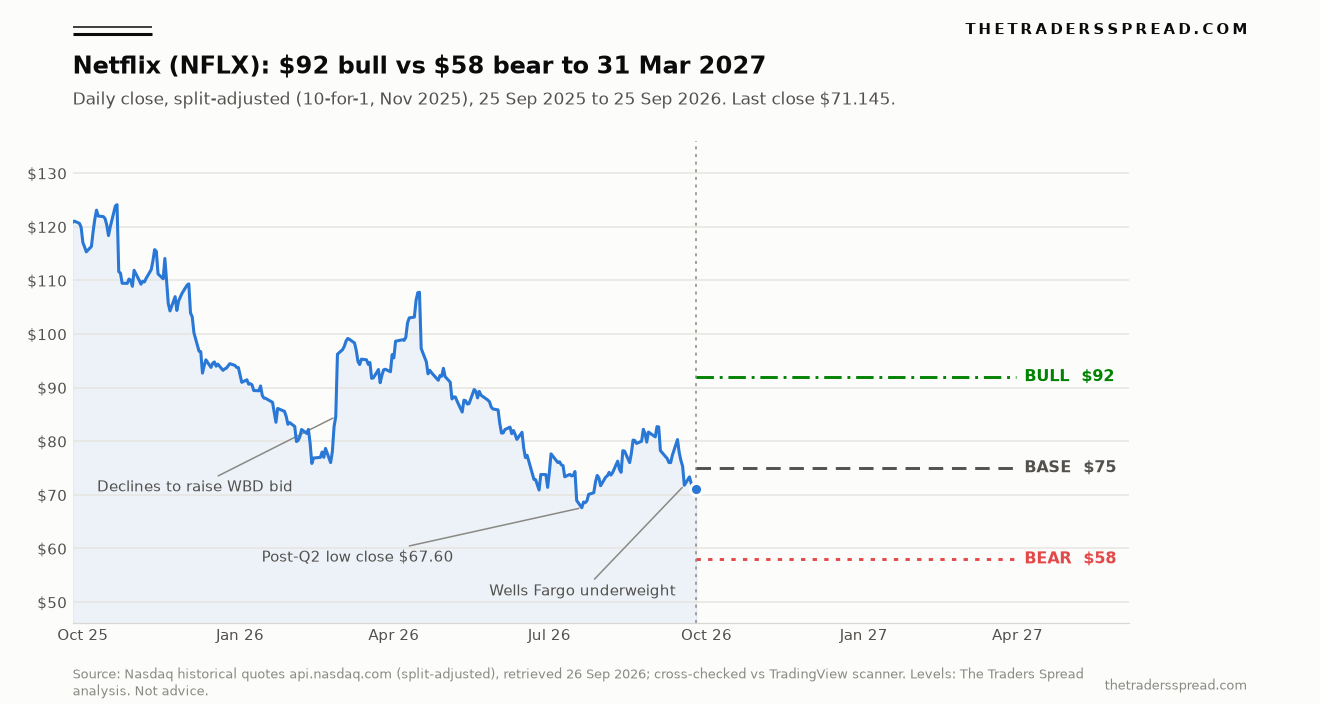
Most of the 43% fall happened in a handful of sessions, and each one has a filing or a named source behind it.
| Session | Close | Move | Volume | What happened |
|---|---|---|---|---|
| Fri 27 Feb 2026 | $96.24 | +13.77% | 200.8m | Netflix declined to match Paramount Skydance for Warner Bros.; $2.8bn fee received |
| Fri 17 Apr 2026 | $97.31 | -9.72% | 126.0m | Day after Q1 results; Reed Hastings said he would not stand for re-election to the board |
| Fri 17 Jul 2026 | $68.95 | -7.26% | 142.0m | Day after Q2 results; intraday low $65.08, the 52-week low |
| Fri 18 Sep 2026 | $71.79 | -4.67% | 114.4m | Wells Fargo downgrade to underweight, $57 target |
| Fri 25 Sep 2026 | $71.145 | -0.80% | 23.2m | Latest session; US markets shut until Monday 28 Sep |
Source: Nasdaq historical quotes (split-adjusted), retrieved 26 Sep 2026; Hastings disclosure from the Form 8-K filed 16 April 2026. The 25 Sep close and volume matched the TradingView scanner feed (close 71.145, 23.2m shares).
The February rally is the one to sit with. The market paid Netflix 13.8% in a day for walking away from the largest deal in its history, which says investors feared the acquisition more than they wanted the library. Everything since has been a slow repricing of the standalone business. From the $80.32 close on 14 September to Friday, the stock gave up another 11.4% in nine sessions, and the post-Q2 low close of $67.60 on 20 July sits only 5.0% below the current price.
For readers tracking the other side of that deal, our Warner Bros. Discovery forecast covers the Paramount Skydance transaction from the seller's end. Netflix also sits in the Nasdaq 100, so index flows matter; our Nasdaq 100 forecast sets out the index view that NFLX has badly lagged this year.
Wells Fargo's engagement case versus the buyback's arithmetic
The sharpest bear argument on the tape is Steven Cahall's. The Wells Fargo analyst cut the stock to underweight on 18 September and set a $57 target, roughly 20% below the price at the time. "Engagement trends look worrying to us," Cahall said, according to The Motley Fool's report of the note. "Netflix has lacked big original series, and it's showing." He estimated that views for Netflix's top 100 original shows could fall by more than 20%.
His case links engagement to the advertising plan. Netflix expects ad revenue to roughly double to about $3bn in 2026, and ad inventory is sold on hours watched. Flat hours cap the inventory; a hit drought caps the pricing. It is a coherent chain, and the 2% view-hour growth in the first half does nothing to break it.
Management's counter is the capital return, and it is large. In April the board added a $25bn repurchase authorisation. In the second quarter Netflix retired 52.9m shares for $4.7bn, an average of about $88.79 a share by our calculation from the 10-Q, some 25% above Friday's close. The remaining $27.1bn equals about 9.1% of the current market value. Full-year free cash flow guidance is about $12.5bn. The Q1 letter attributed the step up from an earlier $11bn projection mainly to the after-tax fee, so the underlying run-rate is closer to $11bn, a free-cash-flow yield near 3.7%.
Co-CEOs Ted Sarandos and Greg Peters framed the walk-away in terms investors should hold them to. The Warner Bros. transaction "was always a 'nice to have' at the right price, not a 'must have' at any price," they said in the company statement of 26 February 2026, adding that the business was "healthy, strong and growing organically." Seven months later, organic is exactly what the market doubts.
The balance sheet leaves room for both camps. Gross debt was $14.4bn and cash $9.1bn at 30 June, and on 22 July Netflix sold $1bn of 5.250% notes due 2036 to refinance the 4.375% notes maturing this year. Nothing there forces a decision.
What the price is really assuming
Our 2026 earnings estimate starts from reported and guided quarters: $1.23 in Q1, $0.80 in Q2, $0.82 guided for Q3 and roughly $0.71 for Q4, the last derived from the implied $3.71bn operating income at Q2's ratio of net income to operating income. That sums to about $3.56. Remove the $0.53 fee and the recurring figure is about $3.04, which puts the stock on 23.4x.
For a company guiding 20%-plus operating income growth this year, that is a modest multiple by its own history. It stops being modest if 2027 growth drops to the high single digits and margin expansion stalls. The market is not pricing a collapse. It is pricing a Netflix that grows like a media company rather than a platform, and the 43% drawdown from the October high is the cost of that reclassification.
Streaming competition for attention is the variable no filing resolves. Netflix itself told shareholders in its Q1 letter that it holds "an estimated ~5% of TV view share globally," and critics cited by Deadline after the Q2 print argued it is losing ground to YouTube and TikTok. Our Alphabet stock forecast covers that side. Live events are Netflix's answer, and an expensive one: the company expects live programming to be just over 5% of 2026 content spend for about 1% of view hours, justified by sign-ups rather than viewing.
Our call: base, bull and bear to 31 March 2027
The window runs to 31 March 2027, which captures the 20 October Q3 print and the January Q4 print with its 2027 guidance.
Base case, 50%: $68 to $82, centred on $75 (+5.4% from $71.145). Q3 lands close to the $12.86bn revenue and 33.2% margin guide, UCAN growth ticks back above 10% as the price rise annualises, and 2027 guidance lands at low double-digit revenue growth. The multiple holds at about 23x to 25x recurring earnings, and buybacks absorb supply without creating a rally.
RelatedJohnson & Johnson (JNJ) Forecast: $270 Bull vs $220 Bear
Bull case, 25%: $92 (+29.3%). Revenue grows about 11% in 2027 to roughly $56.8bn with margin reaching 33.5%, giving our scenario EPS of about $3.76 on a share count reduced to 4.1bn. At 24.5x that is $92, near the $88.79 average Netflix paid for its own stock in Q2. The trigger would be a UCAN re-acceleration in the October print plus an ad business on track for the $3bn target.
Bear case, 25%: $58 (-18.5%). Q3 revenue misses, UCAN stays at or below 10%, and January guidance points to single-digit growth for 2027. The market then applies about 19x to our $3.04 recurring 2026 figure, which is $58, a dollar above the Wells Fargo target. A break of the $65.08 July intraday low would be the first signal that this path is under way.
Weighted, the three paths average near $75, a little above Friday's close, which is why our bias is only mildly constructive and conviction is low at 2 out of 5. The reference entry is the $71.145 close of 25 September. The thesis is invalidated on a close below $65, under the 52-week low.
What would change my mind: a Q3 letter that guides Q4 revenue growth below 10%, or any sign that the $3bn ad target is slipping, would move us to the bear case outright. A second consecutive quarter of UCAN growth above 12% would move us toward the bull case before the January print.
FAQ
Why is Netflix stock around $71 when it traded above $1,000 in 2025?
Netflix split its stock ten-for-one, with split-adjusted trading starting on 17 November 2025. A pre-split price near $1,241 is about $124 on today's basis. The 43% fall from the October 2025 high is real, but the jump from four digits to two is only the split. Every price in this article uses the split-adjusted Nasdaq series.
When does Netflix report third-quarter 2026 results?
Netflix's investor relations calendar lists the Q3 2026 earnings interview for Tuesday 20 October 2026 at 1:45pm Pacific time. In recent quarters the shareholder letter has been published the same day as the interview. The Q2 letter guided Q3 revenue of $12.86bn, up 11.7%, and diluted EPS of $0.82, so those are the numbers the print will be measured against.
Is Netflix's P/E really 22x?
On reported numbers, yes: $71.145 divided by $3.18 of trailing diluted EPS is 22.4x. That trailing figure includes the $2.8bn Warner Bros. termination fee booked in Q1 2026. Stripping out our estimate of its after-tax value, about $0.53 per share, puts the trailing multiple at 26.8x. On our 2026 recurring estimate of about $3.04 it is 23.4x.
What did Wells Fargo say about Netflix?
On 18 September 2026 Wells Fargo analyst Steven Cahall downgraded Netflix to underweight and set a $57 price target, citing weak engagement and a shortage of hit original series. He estimated views of the top 100 originals could fall more than 20%. The stock fell 4.67% that session on 114.4m shares, about 3.2 times its 50-session average volume.
How much stock is Netflix buying back?
In the second quarter of 2026 Netflix repurchased 52.9 million shares for $4.7bn, its largest quarterly buyback, and had $27.1bn of authorisation left at 30 June after the board added $25bn in April. At Friday's price that remaining capacity equals roughly 9.1% of the company's market value. Buybacks are discretionary and can stop at any time.
Disclaimer
This article is analysis and commentary, not investment advice or a recommendation to trade any security. Price levels, scenarios and probabilities are The Traders Spread's estimates and can be wrong. Share prices can fall as well as rise and you can lose some or all of the capital you put at risk. Figures are from the sources cited, retrieved on 26 September 2026; the latest US equity session referenced is Friday 25 September 2026.