

Boeing (BA) did not cut its 2026 free cash flow forecast on 16 September, whatever the 3.7% slide that afternoon implied. At Morgan Stanley's Laguna conference, chief financial officer Jay Malave reaffirmed the $1 billion to $3 billion range set in January and said the company was still steering to the roughly $2 billion midpoint. What changed was timing. Chief executive Kelly Ortberg told the room the 737 line is "driving at 47 a month, but we are not stable yet," with wing production in Renton the bottleneck, and he pushed the 787 move to 10 a month toward year-end. The shares closed that day at $201.96 on 12.7 million shares, roughly three times the volume of the sessions before it, and kept sliding. By Friday 25 September, the last session before this weekend, Boeing closed at $198.07 on the NYSE. Markets are shut today, Sunday, so every price in this piece is that Friday close, not a live quote.
The reaffirmed number hides a harder one. Boeing burned $823 million of free cash flow in the first half, and on the July call Malave guided third-quarter free cash flow to "the low-hundreds of millions of dollars" after a $700 million Justice Department payment. Getting from minus $823 million to a $2 billion year therefore leaves somewhere near $2.4 billion to $2.6 billion for the fourth quarter alone, about four times the $631 million it generated in the second quarter. That fourth quarter opens with the engineers' contract expiring on 6 October. The guidance survived Laguna. Its margin for error did not.
Key facts: Boeing (BA) at the Friday close
- Last close $198.07, up 0.65% on Friday 25 September 2026; after-hours $198.40 — stockanalysis.com quote API, retrieved 27 Sep 2026
- 52-week range $176.77 to $254.35; the close sits 21.4% below the 23 January closing high of $252.15 — stockanalysis.com daily history, retrieved 27 Sep 2026
- Second-quarter revenue $24.56 billion, up 8%, with a GAAP loss of $0.67 a share and free cash flow of $631 million — Boeing Q2 release, SEC Form 8-K, 28 Jul 2026
- Total backlog a record $715 billion, including over 6,200 commercial airplanes worth $597 billion — same release, 28 Jul 2026
- Cash and marketable securities $20.0 billion against consolidated debt of $45.9 billion at 30 June — same release, 28 Jul 2026
- 790,370,020 common shares outstanding on 21 July, which puts the equity at about $156.5 billion at Friday's close — Boeing Form 10-Q, filed 28 Jul 2026
- SPEEA voting on Boeing's second contract offer closes at noon Pacific on 1 October; the current contract expires 6 October — SPEEA, 24 Sep 2026
What Laguna actually moved, and what it left alone
Read the corrected transcript Boeing posted to its investor site and the sell-off looks like a reaction to tone rather than to numbers. It was Malave, not Ortberg, who addressed cash, and his words were measured.
"Yes. We still believe out in the $1 billion to $3 billion of the prior guidance that we had laid out back in January. We had guided really more towards the midpoint."
Jay Malave, Executive Vice President and Chief Financial Officer at Boeing, Morgan Stanley Laguna conference, 16 September 2026
He then conceded that beating the midpoint, which required heavier deliveries in the second half, had become "a little bit less likely than it was before" because the 737 and 787 rate steps are sliding toward year-end. So the upper third of the range has been quietly retired. That is a real change for anyone who priced $3 billion. It is not a cut.
The operational news carried the weight. Ortberg was blunt about the single-aisle line.
"We're now driving at 47 a month, but we are not stable yet at 47 a month. That's been our task here to get stable. I'd say that's probably taken us a little bit longer than what I had anticipated maybe when we talked at the earnings call."
Kelly Ortberg, President and Chief Executive Officer at Boeing, Morgan Stanley Laguna conference, 16 September 2026
He located the problem precisely. Engines from CFM are not the constraint this time. Boeing builds every 737 MAX wing in Renton, and those wing shops "have not seen the flow improvements that we expected in the timeframe." The next step, rate 52, now depends on two conditions: stability at 47 in Renton, and a certified, producing North Line in Everett, where Boeing is building four aircraft first to certify the line. Ortberg said those flow enablers, and with them the next rate, would come "next year." On the 787 he said Boeing had stabilised at eight a month but had not yet seen GE engine deliveries good enough for 10, which is "probably moving towards the end of the year."
Put those two statements next to the cash arithmetic and the market's reaction makes sense. A fourth quarter that must deliver four times Boeing's best recent quarterly cash flow depends on exactly the delivery volume that just slipped.
The Boeing (BA) chart since the January peak
The stock has spent eight months unwinding a run that peaked on 23 January at a $252.15 close, with an intraday high of $254.35 four sessions later. Returns below are computed from stockanalysis.com daily closes, each anchored to the last trading day on or before the date shown, and all measured to the 25 September close of $198.07.
| Window | Anchor close (date) | Return to $198.07 |
|---|---|---|
| 1 week | $198.20 (18 Sep 2026) | -0.07% |
| 1 month | $212.09 (26 Aug 2026) | -6.61% |
| 3 months | $217.25 (26 Jun 2026) | -8.83% |
| 6 months | $190.52 (27 Mar 2026) | +3.96% |
| Year to date | $217.12 (31 Dec 2025) | -8.77% |
| 1 year | $213.53 (25 Sep 2025) | -7.24% |
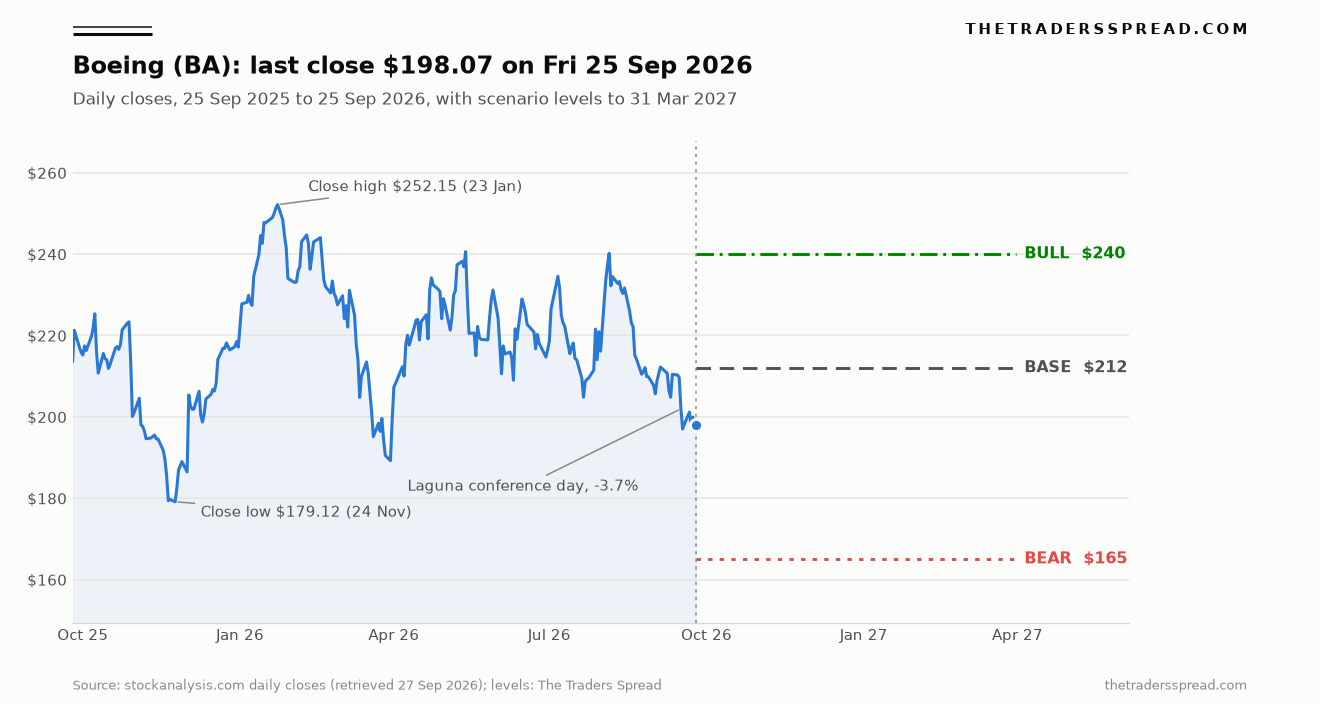
Two reference points matter more than the rest. The 50-day average of closes stands at $214.37 and the 200-day average at $221.08 (both our calculation from the same series), so the stock sits 7.6% and 10.4% beneath them. And the one-year closing low, $179.12 on 24 November 2025, is only 9.6% below Friday's close. The low was set shortly before Boeing completed its Spirit AeroSystems acquisition on 8 December 2025, a date confirmed in the 10-Q. Since the Laguna session the stock has closed between $196.80 and $201.15 for seven straight days, a tight band after a violent week.
Volume tells the same story. The four sessions from 16 to 18 September and 23 September each printed between 9.7 million and 12.7 million shares, against 3.3 million to 4.6 million in the six quiet sessions from 8 to 15 September. Friday's 5.3 million looked like a market waiting for the union vote.
The contract vote that frames the fourth quarter
SPEEA, the union representing Boeing's engineers and technical workers in the Pacific Northwest, rejected the company's first offer in August. Boeing came back with a richer one. Its own negotiations update page describes 34% in total wage funds over four years, 26% of that guaranteed for every represented employee, a guaranteed 10% raise effective 2 October and another guaranteed 4% in March 2027. The union's Professional and Technical Bargaining Unit Councils both voted on 22 September to recommend acceptance, saying the offers "meet most of the needs of the members". Voting runs until noon Pacific on 1 October.
Ortberg did not soften what a no vote would mean. A strike, he said at Laguna, would shut down the 777X certification programme "until we get the engineers back," with "ripple effect even into our production." The contingency plan aims to keep some 737 output going, although he conceded Boeing "probably will not be able to sustain the rates of 737 in a strike." The 787 in South Carolina sits outside the unit.
Look at the concentration. The rate-47 stabilisation, the North Line certification, the 737-10 paperwork now with the FAA, and the 777X flight-test programme that already lacks ETOPS authorisation all run through the same engineering workforce. The shareholder question on 1 October is not whether Boeing can absorb a higher wage bill. It is whether the fourth-quarter cash build can happen at all without those engineers.
Balance sheet, dilution and the $171.59 line
Boeing's liquidity is not the pressure point it was in 2024. The company held $20.0 billion of cash and marketable securities at 30 June, cut consolidated debt by $8.2 billion in the first half, and on 24 August refreshed its bank lines. An 8-K filed 28 August shows a new $3.0 billion 364-day revolver plus extensions of the $4.0 billion and $3.0 billion five-year facilities to 2030 and 2029. All three now carry a covenant requiring at least $5.0 billion of liquidity, and the new revolver caps consolidated debt at 60% of total capital. With $10 billion of undrawn facilities on top of $20 billion of cash, that floor is distant.
The less discussed detail sits in the equity section of the 10-Q. Boeing's 6.00% Series A mandatory convertible preferred, 5.75 million shares with a $5.75 billion liquidation preference, converts automatically on 15 October 2027. Above an applicable market value of $171.5854 each preferred share becomes 5.828 common shares, about 33.5 million in total. Below $142.9797 the rate rises to 6.994, or about 40.2 million. Between those prices the share count floats with the stock. A move below $171.59, which is 13.4% under Friday's close, would begin to add dilution precisely when sentiment is worst. The bear case below sits under that line on purpose.
There is also a management transition in finance. An 8-K dated 21 August names Ryan Shedd, an Ernst & Young assurance partner, as incoming controller and principal accounting officer, succeeding Michael Cleary after the 2026 annual report. It is routine. It still means a new signatory on the accounts in a year when the cash guidance leans heavily on one quarter.
What consensus is missing on the 737-10 and the stored jets
Most coverage treats certification of the 737-7 and 737-10 as a 2027 revenue story. The cash story arrives sooner and runs longer. Malave told the Laguna audience that Boeing has 737-7s pre-built in storage and is building 737-10s now, which it expects to deliver "really next year and probably over an 18-month period" once certification lands. Ortberg said roughly 30% of the 737 backlog is the -10, that flight testing is complete, and that the remaining work is FAA documentation. EASA pilots flew the aircraft the week before the conference.
Those stored aircraft are inventory Boeing has already paid to build. Each delivery converts sunk cost into cash with little new spending, Malave listed three sources of working-capital release: the stored jets, a narrowing gap between cash margins and booked margins on the 737 and 787, and excess commodity inventory, where he put the opportunity at "multiple billions of dollars" over several years. None of it is in the 2026 guidance with any precision, and he declined to put a number on 2027 when the host cited a $6.2 billion consensus. He did say he expects it to grow, while warning that pricing penalties and excess advances "will still burden cash flow in 2027."
That is the asymmetry this call rests on. The near-term calendar is loaded with binary risk: the SPEEA vote, the fourth-quarter cash build, and the ongoing 777X engine seal fix at GE. The medium-term cash pipeline, stored 737-7s and -10s plus the rate-52 step in 2027, is largely independent of whether Boeing hits $1.8 billion or $2.2 billion this year. A market that marks the stock on the first set and ignores the second tends to overshoot on both sides.
For the index backdrop, see our Dow Jones forecast, an index Boeing belongs to, and our S&P 500 outlook. Airline customers' fuel bills matter to delivery appetite too; our look at why US Gulf Coast jet fuel rose 112.7% in the year to 22 September covers that side, alongside the crude move in WTI's 21% climb to $91.
Where we could be wrong
Three things would break this framework. First, a second rejection by SPEEA members. The councils' 60% supermajority recommendation is a strong signal, but the first offer was also negotiated with the union's bargaining team before members turned it down, as Ortberg acknowledged. Second, delivery softness of the August kind lasting into the fourth quarter: Boeing delivered 51 aircraft in August, including only four 787s, according to CNBC's report of the monthly figures on 8 September, and a spokesperson said 90 to 100 787s were still expected for the year. Third, another reach-forward loss in defence. The second quarter already carried $280 million on the VC-25B, and Ortberg said only that he does not anticipate "a return to a lot of charges."
On the other side, a fast 737-10 certification and a clean ratification could pull the rate-52 decision forward and lift the stock quickly, because the shares already discount a lot of friction at 21% below January's closing high.
RelatedTSMC (TSM) Falls 3.4% Ahead of the Q3 Earnings Print
The Boeing (BA) stock forecast: base, bull and bear to 31 March 2027
All levels are measured against Friday 25 September's $198.07 close. The horizon runs to 31 March 2027, which captures the SPEEA outcome, third- and fourth-quarter results and, on Boeing's own timetable, the 737-10 certification.
Base case, $212 (+7.0%, above the close), probability 50%. SPEEA ratifies on 1 October. Fourth-quarter free cash flow lands close enough to the $2 billion midpoint that the full year prints between $1.5 billion and $2 billion. The 737 stabilises at 47 around the turn of the year and the North Line certifies, but rate 52 is announced rather than achieved. The stock drifts toward its 50-day average.
Bull case, $240 (+21.2%, above the close), probability 25%. Ratification, a 737-10 certification before year-end, and a full-year cash figure at or above $2 billion. A 2027 framework near consensus in January would put the stock back in the $230 to $245 band where 17 of February's 19 closes sat.
Bear case, $165 (-16.7%, below the close), probability 25%. A no vote and a strike after 6 October that pauses 777X testing and trims 737 output, a free cash flow result at the bottom of the $1 billion to $3 billion range or below it, and a 2027 outlook pushed out. That takes the stock through the $176.77 52-week low and under the $171.59 conversion threshold on the preferred.
The probability-weighted value is about $207, 4.6% above the close, which is why our bias is modestly bullish with low conviction, 2 on a five-point scale. The structural invalidation is a close below $175, 11.7% under Friday's price and below the 52-week low; there the market would be pricing a strike, not debating one.
What would change our mind: a SPEEA rejection on 1 October, or any Boeing statement that the 2026 range no longer holds, would move us to bearish regardless of price. Evidence that Renton wing flow has recovered, such as 737 deliveries back in the mid-40s a month, would lift conviction.
Frequently asked questions
Did Boeing lower its 2026 free cash flow guidance in September?
No. At the Morgan Stanley Laguna conference on 16 September, CFO Jay Malave reaffirmed the $1 billion to $3 billion range and said Boeing still expects roughly the $2 billion midpoint. He said the chance of beating the midpoint had fallen because 737 and 787 rate increases are moving toward year-end. The shares fell 3.7% that day.
What is Boeing's current share price?
US markets are closed on Sunday 27 September 2026. The last close was $198.07 on Friday 25 September on the NYSE, up 0.65% on the day, with an after-hours print of $198.40. The 52-week range is $176.77 to $254.35, and the stock is down 8.77% since the end of 2025.
When does the SPEEA engineers' vote end, and why does it matter?
Voting on Boeing's second offer closes at noon Pacific on 1 October, and the current contract expires on 6 October. Kelly Ortberg said a strike would shut down 777X certification and ripple into production, and that Boeing probably could not sustain 737 rates. Both union councils have recommended a yes vote.
Why is the 737 not stable at 47 jets a month?
Ortberg said the constraint is wing production in Renton, where Boeing builds all 737 MAX wings, rather than engines or the wider supply chain. Moving to 52 a month also requires the new North Line in Everett to be certified and producing, which he expects to happen next year.
How could the mandatory convertible preferred affect Boeing shareholders?
The 5.75 million Series A preferred shares convert on 15 October 2027. Above $171.59 they become about 33.5 million common shares; below $142.98 they become about 40.2 million. Between those prices the number floats, so a weaker share price means more dilution on conversion, according to the 10-Q.
Disclaimer
This article is analysis and commentary, not investment advice or a recommendation to trade any security. Scenario levels and probabilities are the author's estimates and can be wrong. Share prices can fall as well as rise, and trading involves the risk of losing capital. Data are the last available figures from the named sources as of 27 September 2026.