

Arm Holdings closed on Thursday 24 September at $306.34, down 7.88% on the session and on 9,559,476 shares, roughly 1.76 times its average daily volume over the previous 63 sessions. On that same session AMD, the other listed company whose entire pitch is that AI data centres are about to need far more CPU, closed up 2.38%.
Both of those cannot be a verdict on AI compute demand. One of them is a verdict on Arm Holdings specifically. The stock is still up 180.2% from its last close of 2025 and 117.8% over twelve months, and it is also 30.3% below the $439.46 it closed at on 18 June. A company can be all four of those things at once, and Arm is, which is why the arithmetic in the headline move matters less than what sits underneath it.
Here is the part that rarely makes the coverage. Arm publishes a metric called annualised contract value, which exists precisely to strip the lumpiness out of licence revenue, and in the June quarter it grew 13% year over year to $1,732 million. Headline revenue grew 22%. The normalised run-rate of the licensing business is therefore expanding at a little over half the rate of the number that gets quoted. In the same quarter, on a record $1,289 million of revenue, Arm's GAAP operating margin fell to 7.1% from 10.8% a year earlier, because GAAP operating expenses of $1,162 million consumed 93% of GAAP gross profit. The market pays 314 times trailing earnings for that.
Key facts
- Arm Holdings closed at $306.34 on Thursday 24 September, down 7.88%, the 12th-largest single-day fall in its last 250 sessions — Nasdaq back-adjusted daily history and TradingView screener, retrieved 25 September 2026
- Q1 FYE27 revenue was a record $1,289 million, up 22% year over year; royalty revenue $715 million, licence and other revenue $574 million — Arm Holdings shareholder letter, Form 6-K, 29 July 2026
- Annualised contract value grew only 13% to $1,732 million over the same period — Arm Holdings shareholder letter, 29 July 2026
- GAAP operating margin fell to 7.1% from 10.8%; GAAP diluted EPS was $0.25 against non-GAAP EPS of $0.45 — Arm Holdings shareholder letter, 29 July 2026
- Customer demand for the Arm AGI CPU now exceeds $2 billion across fiscal 2027 and 2028, against the $1 billion opportunity guided a quarter earlier — Arm Holdings shareholder letter, 29 July 2026
- Arm trades on 314.3 times trailing earnings and 69.5 times sales, the highest of any large-cap AI semiconductor name we checked — TradingView screener, 25 September 2026
- CFO Jason Child sold 10,400 ADSs at $300.00 on 21 September under a Rule 10b5-1 plan adopted on 22 May 2026 — Form 4, filed 23 September 2026
A 7.88% fall that the sector did not share
The convenient explanation for Thursday was an AI selloff. The tape does not support it.
Oracle sent a force majeure notice to the developer of Project Jupiter, its New Mexico data centre campus, in a move first reported by Bloomberg and confirmed by CNBC. The notice would let Oracle defer payments if the site misses its 2028 opening. Oracle told CNBC that "Project Jupiter remains on our planned schedule" and that the company is "fully committed to New Mexico and confident in our path forward". The developer, a unit of Blue Owl Capital, said the notice "does not change the financial commitments to this multi-year project".
Oracle itself fell 3.47%. Arm fell more than twice as far as the company that actually sent the letter, and the rest of the complex barely moved.
| Ticker | Close, Thu 24 Sep | Day change | P/E (ttm) | P/S | Gross margin |
|---|---|---|---|---|---|
| Arm Holdings (ARM) | $306.34 | −7.88% | 314.3 | 69.5 | 93.9% |
| Oracle (ORCL) | $139.54 | −3.47% | 21.9 | 6.0 | 61.9% |
| Qualcomm (QCOM) | $194.26 | −1.51% | 22.5 | 4.8 | 54.2% |
| Broadcom (AVGO) | $350.36 | −1.30% | 44.7 | 19.5 | 66.5% |
| NVIDIA (NVDA) | $224.58 | −0.41% | 28.4 | 18.1 | 74.7% |
| AMD | $629.26 | +2.38% | 161.5 | 24.7 | 50.4% |
Source: TradingView screener, retrieved 25 September 2026, 15-minute delayed close data for the 24 September session. Our published views on two of these names sit at Oracle and Broadcom.
The table answers the question the headline move raises. Arm did not fall because AI compute demand was repriced. It fell because it carries the highest multiple in the group by a wide margin, and a delay to a data centre build lands on a multiple like that with far more force than it lands on Oracle's own 21.9 times earnings. Nothing about Thursday required a change in the demand outlook. It only required a change in how confidently anyone can date the revenue.
What happens when an IP licensor starts shipping silicon
For thirty years the answer to "what does Arm sell" was: instructions, and the right to build chips that follow them. That business carries a 97.2% GAAP gross margin, no fabs, no inventory and essentially no cost of goods. It is the reason a 69.5 times sales multiple was ever arguable.
In March 2026 that changed. Arm introduced the Arm AGI CPU, which is not IP but production silicon that Arm sells. In the June quarter the company said it had delivered initial product to multiple customers and had secured the manufacturing capacity to support what it had framed as a $1 billion opportunity across fiscal 2027 and 2028. It then said demand had run past that figure.
The chief executive put it this way in the shareholder letter filed with the SEC:
"Arm delivered a record first quarter, with data center royalties more than doubling year over year as the transition of AI infrastructure to Arm continued to accelerate. Demand for the Arm AGI CPU has continued to exceed our initial expectations, and our continued work to expand manufacturing capacity with our partners gives us increasing confidence that we can deliver at the scale our customers require."
Rene Haas, Chief Executive Officer at Arm Holdings plc, in the company's Q1 FYE27 shareholder letter, furnished on Form 6-K on 29 July 2026.
Read that again with a margin analyst's eye rather than a growth investor's. "Expand manufacturing capacity with our partners" is a sentence about cost of goods sold, and an IP licensor does not have one worth mentioning. Physical silicon does not ship at 97% gross margin. Nobody's does. Every incremental dollar of AGI CPU revenue arrives at a materially lower margin than the royalty dollar it sits beside, which means the blended figure has to fall as the product scales. Arm has not yet told the market where it lands.
That is the structural tension in this stock, and it is not a bearish reading of the business. It is a bearish reading of the multiple applied to the business. The same pivot that makes the revenue line bigger makes the margin profile that justified 69.5 times sales look less like a licensing company and more like Broadcom at 66.5%, or the x86 incumbent Arm is displacing, Intel. Growth and derating can arrive together. They usually do.
Arm publishes a growth number that is half its headline
Licence revenue is lumpy by construction. A single large agreement can land in one quarter and distort the comparison for a year, which is why Arm reports annualised contract value alongside it. ACV is the company's own attempt to show what the licensing base is doing once timing is removed.
In the June quarter ACV grew 13% year over year to $1,732 million, while licence and other revenue grew 23% to $574 million and total revenue grew 22% to $1,289 million. Arm attributes the licence strength partly to "fluctuation in the timing and size of multiple high-value license agreements and contributions from backlog", which is the company telling you, in its own filing, that the 23% is not the run-rate.
The gap between 13% and 22% is where a large part of this valuation argument actually lives. On a 314 times trailing multiple, the difference between a business compounding its contracted base in the low teens and one compounding in the low twenties is not a rounding error. It is most of the terminal value.
The other disclosure that does not get read is the expense line. GAAP operating expenses were $1,162 million against GAAP gross profit of $1,253 million, leaving $91 million of GAAP operating income on record revenue. Non-GAAP operating income was $531 million. The $440 million wedge between them is mostly share-based compensation, and it is real dilution even where it is excluded from the adjusted figures. GAAP diluted EPS was $0.25. Non-GAAP was $0.45. The 314 multiple in the table above is computed on trailing GAAP earnings of $0.9748 per share, which is the honest denominator.
Why a New Mexico contract notice reached Cambridge
The link between Oracle's letter and Arm's 7.88% is not a rumour. It is on Arm's own newsroom.
Oracle Cloud Infrastructure joined the Arm AGI CPU ecosystem on 2 June 2026, announced at COMPUTEX, alongside a list that already included Cerebras, Cloudflare, F5, Meta, OpenAI, Positron, Rebellions, SAP, SK Telecom and Verda. By the 8 September update, Arm was naming Oracle among the companies "developing solutions around Arm AGI CPU" next to OpenAI, Meta, Cloudflare, SAP, Lenovo and Supermicro.
The language Oracle used when it joined is worth holding against the $2 billion demand figure:
"OCI has seen strong momentum with Arm-based infrastructure across large-scale cloud-native workloads, including customers such as Uber, and we're excited to explore how the Arm AGI CPU can extend those benefits into next-generation agentic AI systems. By combining high-performance Arm compute with OCI's scalable cloud infrastructure, we believe the Arm AGI CPU has the potential to help customers deploy more efficient and orchestrated AI environments at scale."
Mahesh Thiagarajan, Executive Vice President of Oracle Cloud Infrastructure, quoted in Arm's 2 June 2026 announcement.
"Excited to explore." "Has the potential to." That is the language of an evaluation, not a purchase order, and it is the strongest public statement Oracle has made about the product. Arm's $2 billion is characterised as demand and pipeline across two fiscal years, not as backlog. When the market saw a named ecosystem participant tell its landlord it might not need the building on schedule, it marked down the confidence interval around the date, and a stock priced for near-term delivery took the hit. Oracle's own shares fell less because Oracle is not priced for it.
None of which says Project Jupiter is an AGI CPU site. There is no disclosure that it is, and we found none. The connection is one of timing and sentiment rather than contract, and that distinction is the whole reason the move was an overreaction on the primary facts available.
What the price series says about a 7.88% day
It says almost nothing, and that is the finding.
Thursday's fall was the 12th largest of Arm's last 250 sessions. Twelve sessions in a trailing year fell 7.88% or more, which is one roughly every three weeks. Realised volatility over the last 60 sessions annualises at 84.9%, and over the full year at 77.6%. The largest single-day fall in the window was 12.84% on 5 June; the largest rise was 17.36% on 4 August. On Monday 21 September the stock gained 17.16% in one session.
The clearest illustration is 29 July. Arm published a record quarter that beat the top end of its own EPS guidance, and the stock closed down 8.11% at $224.89. Six sessions later it closed at $280.56.
RelatedSalesforce (CRM) Rises 2.09% After BofA's Double Upgrade
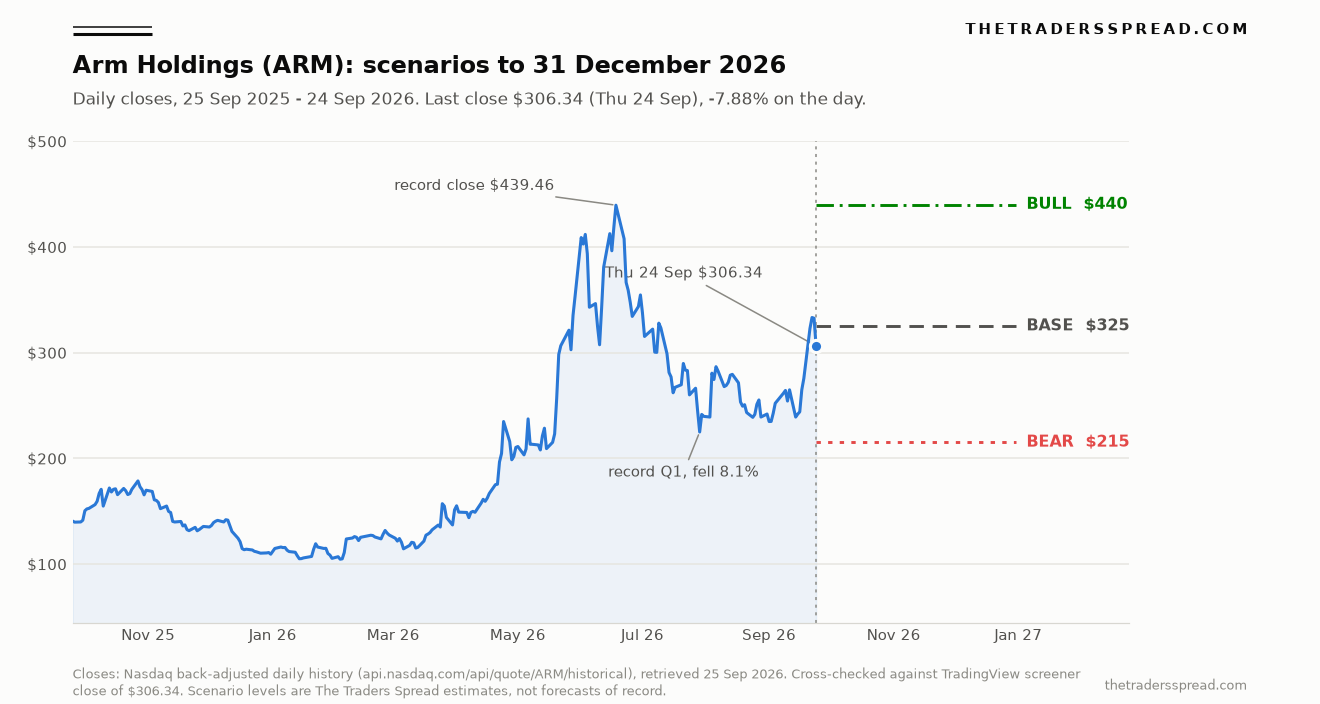
At $306.34 the stock sits 16.3% above its 50-day moving average of $263.35 and 45.2% above its 200-day of $210.98. It has recovered from a 52-week closing low of $104.55 on 3 February and remains 30.3% below the 18 June closing high. Anyone sizing a view on this name against a 5% band is using the wrong instrument, which is why the scenarios below are deliberately wide.
One further data point sits in the filings. The CFO sold into the spike, though not opportunistically. Form 4 shows Jason Child disposing of 10,400 ADSs on 21 September at $300.00, leaving him 153,442 shares, under a Rule 10b5-1 plan adopted on 22 May 2026. The Form 144 shows the prior tranche: the same 10,400 shares on 27 August for $2,655,432, an average of $255.33. A pre-set plan executing on schedule carries no signal about intent. It does confirm the series: the 27 August close in our price history is $255.21.
The call: $440 bull, $325 base, $215 bear to 31 December 2026
Our base case is $325, about 6.1% above Thursday's close, and we put 45% on it. Arm guided Q2 FYE27 revenue to $1.38 billion plus or minus $50 million and non-GAAP EPS to $0.47 plus or minus $0.04. Meeting that, with data centre royalties still compounding and no margin disclosure yet forced on the AGI CPU line, leaves the multiple roughly where it is and the price roughly where it is. Drift, not direction.
The bull case is $440, 43.6% above the close, at 25%. This requires the October quarter to convert AGI CPU pipeline into recognised revenue faster than guided, ACV growth to re-accelerate out of the low teens toward the headline rate, and the blended gross margin to hold above 95% while it happens. That is a demanding combination, but it is the combination the stock reached on 18 June, when it closed at $439.46. The level is a retest, not an invention.
The bear case is $215, 29.8% below the close, at 30%. It does not need a demand shock. It needs the first quarter in which AGI CPU revenue is large enough to move the blended gross margin down a visible amount, arriving alongside ACV still growing at 13%, in a stock priced at 314 times earnings. That combination compresses the multiple without any revenue miss at all. The level corresponds closely to the 200-day moving average at $210.98, which the stock has not closed below since April.
What would change our mind. On the bull side: an AGI CPU disclosure that quantifies gross margin at or near the group average, or a conversion of the $2 billion demand figure into stated backlog. Either would remove the specific uncertainty this whole piece rests on. On the bear side: ACV growth slipping below 13% in the October report, or a second named ecosystem participant publicly moving a data centre timetable. We will re-run the levels when Q2 FYE27 lands.
What was Arm Holdings' share price on Thursday 24 September 2026?
Arm Holdings closed at $306.34 on Nasdaq on Thursday 24 September 2026, down 7.88% from the previous close of $332.56, on 9,559,476 shares. That is roughly 1.76 times its average daily volume over the prior 63 sessions. The figure is taken from Nasdaq's back-adjusted daily history and cross-checked against the TradingView screener on 25 September 2026.
Why did Arm Holdings stock fall when AMD rose the same day?
Because the move was specific to Arm rather than to AI semiconductors. Oracle, a named participant in Arm's AGI CPU ecosystem, sent a force majeure notice on a data centre campus that day. Arm carries the highest valuation multiple in its peer group at 314.3 times earnings, so a change in the timing of data centre revenue affects it far more than it affects lower-multiple names.
What is annualised contract value and why does it matter for Arm Holdings?
ACV is Arm's own normalised measure of licence revenue, designed to remove the distortion created by large one-off agreements landing in a single quarter. In the June 2026 quarter it grew 13% year over year to $1,732 million while headline revenue grew 22%. The gap indicates the underlying contracted base is compounding considerably more slowly than the reported top line.
What is the Arm AGI CPU and how does it change the business?
Introduced in March 2026, it is production silicon that Arm sells directly, rather than intellectual property it licenses. Arm reported customer demand exceeding $2 billion across fiscal 2027 and 2028, above its earlier $1 billion framing. Selling physical chips carries a materially lower gross margin than licensing, so growth in this line should compress Arm's blended 97.2% GAAP gross margin over time.
How volatile is Arm Holdings stock?
Substantially. Realised volatility over the last 60 sessions annualises at 84.9%, and at 77.6% across the full trailing year. Twelve of the last 250 sessions saw falls of 7.88% or more, and the stock gained 17.16% in a single session on 21 September 2026. Scenario bands on this name need to be wide to be meaningful.
Disclaimer
This article is analysis and information, not investment advice, and it does not recommend any course of action in Arm Holdings or any other security. Price scenarios are estimates based on the sources named and dated in the text, and they carry no guarantee. Markets move against expectations routinely. Capital is at risk, and past performance does not indicate future results. Readers should reach their own conclusions or consult a regulated adviser. Further coverage of the index Arm Holdings trades within is at Nasdaq 100, and of the memory cycle at Micron.