

ON Semiconductor filed its 1 October 2026 current report from 5701 N. Pima Road in Scottsdale, the address on the Form 8-K. In that filing the company, its merger subsidiary Sonic Acquisition Corp. and Synaptics replaced the 25 June stock agreement with cash: $123.00 a share, no interest, for each eligible Synaptics share. The joint release put the new aggregate at about $5.7 billion, against about $7 billion in June. The release is dated 1 October. The response is in the next Nasdaq session. ON opened on 2 October at $84.75, against a prior close of $80.08, and closed at $84.89, up $4.81 or 6.01% on 22,908,330 shares. The close was 14 cents above the open, so nearly all of the day's gain was the gap. A quote pull on 3 October still stamped the last trade "Oct 1, 2026". The $84.89 used here is the 2 October row on Nasdaq's historical table, which matches that lagging last-sale price.
Cutting the headline from about $7 billion to about $5.7 billion is the wrong yardstick for the live stock. June paid 1.350 ON shares per Synaptics share. At $84.89 that ratio is worth $114.60. Cash at $123 is $8.40 more, about 7.3%. On 25 June, with ON at $118.74, the same 1.350 shares were worth $160.30. One side gets a fixed sum above a collapsed ratio. The other stops issuing stock.
None of that cash leaves in 2026. The company still expects to close by mid-2027. Accretion to non-GAAP earnings, if it comes, comes then. A 31 December price is a view on whether that path holds, and on the third-quarter guide, not a cheque that has to clear this quarter.
The gap priced one session. It did not close the argument.
- Close: $84.89 on 2 October 2026, up 6.01% from $80.08, volume 22,908,330. Nasdaq historical table, retrieved 3 October 2026.
- 52-week range on that pull: high $134.92 on 3 June 2026, low $44.56 on 21 November 2025. Market cap shown: $33,049,257,058. Average volume: 9,785,638.
- Amended deal, ON Semiconductor Form 8-K dated 1 October 2026: $123.00 cash per Synaptics share, aggregate about $5.7 billion.
- June deal: 1.350 ON shares, aggregate about $7 billion. At the 25 June close of $118.74 the ratio was worth $160.30.
- Balance sheet at 3 July 2026: cash $3,514.5 million, short-term investments $350.0 million, debt $4,459.4 million. Second-quarter earnings release.
- Third-quarter guide, 3 August 2026: revenue $1,650 million to $1,750 million, non-GAAP diluted earnings per share $0.81 to $0.93.
- This desk's 31 December 2026 marks, not the company's: bull $110, base $94, bear $62.
A ratio that died with the share price
The 25 June 8-K was accepted on EDGAR at 16:55:15 that day. The cash session had already closed at $118.74, above the 24 June close of $115.74. The break came on 26 June. ON closed at $90.65, down 23.7% from $118.74, on 44,223,500 shares. That is about 4.5 times the average volume of 9,785,638 shown on Nasdaq's summary on 3 October. The 2 October volume was about 2.3 times that same average. Heavy, not a repeat of June.
Mark the old ratio to the 26 June close and it is already worth $122.38. Three months before the contract was rewritten, the stock being offered had fallen to within a dollar of the cash price ON eventually signed. The summer was the market marking a fixed exchange ratio to a falling share.
From the 3 June high of $134.92 the stock is down 37.1%, and the close that day was $133.93. From the 2 October 2025 close of $48.74 it is up 74.2%, and from the 31 December 2025 close of $54.15 it is up 56.8%. Same tape. The deal sits between those two readings.
After the June break, the closing low was $66.60 on 16 September, with a session low of $65.80. The climb had started before the amendment: $76.87 on 30 September and $80.08 on 1 October. This forecast does not give the new contract credit for that earlier move.
What the 1 October agreement changed
Sonic Acquisition Corp. merges into Synaptics, which survives as a wholly owned subsidiary. Each eligible share becomes a right to $123.00. Dissenting shares can seek appraisal. The structure is no longer a section 368 reorganisation, the 8-K says onsemi intends to withdraw the share-issue registration, and a Synaptics director is no longer required on the onsemi board at closing.
Unvested Synaptics awards mostly convert into onsemi awards, using $123 divided by ON's five-day volume-weighted price. Vested awards, awards that vest on closing, and non-employee director awards are cancelled for the same $123 cash. Share count can still move. It does not move by the 12% from June.
June's joint call, in a transcript filed with the SEC, put pro forma ownership at 88% onsemi and 12% Synaptics. Cash deletes that slice. The cost moves to cash and debt. Terms and the loan sit in the 1 October 8-K. The quotes below are from the joint release.
Hassane El-Khoury, president and chief executive of onsemi, said: "The all-cash transaction delivers higher value to our shareholders through lower total cost consideration, and we now expect the transaction to be immediately accretive to non-GAAP EPS upon closing." He also cited benefits past a previously announced $200 million of annual run-rate synergies, expected after the first 18 months post-close. That is a company expectation, not a 2026 earnings line.
Rahul Patel, president and chief executive of Synaptics, said: "By transitioning to an all-cash structure, we are providing value certainty at a meaningful premium as compared to current value." The premium is against a ratio that, at $84.89, no longer clears $123. Certainty is what ON stopped being able to offer in its own shares without handing over a shrinking parcel.
An unsolicited proposal forced the rewrite. The 8-K calls the bidder "Party A", the name in the registration statement filed on 21 August 2026, and does not identify it. The new contract costs ON less in headline dollars than June, and more than the broken ratio.
| 25 June 2026 agreement | 1 October 2026 amendment | |
|---|---|---|
| Consideration | 1.350 shares of ON common stock | $123.00 cash, no interest |
| Aggregate, company figure | about $7 billion | about $5.7 billion |
| Old ratio at a real close | $160.30 at $118.74 on 25 June | $114.60 at $84.89 on 2 October |
| Ownership | 88% onsemi, 12% Synaptics, as described on the June call | No Synaptics equity stake |
| Close | mid-2027 | mid-2027, Synaptics vote still required |
| Financing | Stock, not a cash raise | Up to $2.45 billion term loan. No financing condition |
US antitrust is further along than the vote. Hart-Scott-Rodino notices went in on 17 July 2026 and the Federal Trade Commission ended the waiting period early on 12 August 2026. The October release says the FTC has approved the deal and that other regulators are still looking. Synaptics shareholders have not voted. Mid-2027 is the company's timetable, not a date to treat as firm.
Cash on hand, and a loan whose price is redacted
At 3 July 2026, the last balance sheet in the second-quarter earnings release, cash was $3,514.5 million and short-term investments were $350.0 million, $3,864.5 million together. Current debt was $802.1 million and long-term debt was $3,657.3 million, $4,459.4 million gross. Net debt on that arithmetic is $594.9 million. Next to a $33.05 billion equity value, the standalone balance sheet is not a stretched one.
Morgan Stanley Senior Funding, Inc. committed on 1 October 2026 to up to $2.45 billion of senior secured term loans. Financing is not a closing condition. That commitment plus the 3 July cash and short-term investments is $6.31 billion, above the approximate $5.7 billion aggregate. Capacity, not a drawdown. Cash or the loan, net debt rises once the consideration is paid.
Add the whole $5.7 billion to the 3 July net debt and, with nothing else moving, pro forma net debt is about $6.3 billion. That ignores fees, cash after 3 July, and the calendar. Close is still pencilled in for mid-2027. The year-end accounts will not show a $5.7 billion hole. They may show a promise to dig one later.
Pricing on the loan is not public. The commitment letter redacts fees and the coupon. Second-quarter interest expense was $13.7 million. A $2.45 billion term loan will not cost that, and this piece does not invent a rate.
A second tension is unresolved. The June call described returning free cash flow through repurchases until close, and the second-quarter release reported $332 million of repurchases. The 1 October release does not mention them. It finances the deal with cash on hand and the committed debt, and it does not say which instruction wins.
The quarter underneath the contract
For the quarter ended 3 July 2026, revenue was $1,603.5 million, up 9% from $1,468.7 million a year earlier and up 6% from $1,513.3 million in the prior quarter. GAAP gross margin was 38.4% and non-GAAP gross margin 39.3%. GAAP operating margin was 16.1% and non-GAAP operating margin 20.8%. GAAP diluted earnings per share were $0.56. Non-GAAP diluted earnings per share were $0.74. GAAP net income attributable to the company was $226.8 million. The non-GAAP figure was $293.8 million.
Thad Trent, executive vice president and chief financial officer, said in the 3 August release: "Year-over-year earnings per share grew four times faster than revenue, driven by gross margin expansion and disciplined cost management." He put the free-cash-flow margin expansion at about 7% to 27%. The release shows free cash flow of $425.4 million. Cash from operations was $459.7 million and capital spending $34.3 million. Subtract the second from the first and you get the $425.4 million. Capital spending was 2.1% of revenue.
Segment dollars did not move together. PSG was $829.0 million, 51.7% of the quarter, up 19% from a year earlier. AMG was $545.7 million, 34.0%, down 2%. ISG was $228.8 million, 14.3%, up 7%. El-Khoury said AI data-centre revenue should more than double in 2026. The same release cited Nvidia's MGX ecosystem, Great Wall, a gallium nitride range called GaNEXUS, and Rivian's R2. Those are company claims, not a unit count from this desk.
Nvidia's guidance jump is a separate print. It matters here only because onsemi keeps tying power devices to that build-out. Micron is the memory ticket in the same servers, not a proxy for a power-chip margin. Synaptics, in the joint release, describes edge compute and sensing under the Astra name. Arm Holdings is the cleaner read on what the market pays for edge-compute architecture. It is not a substitute for the cash maths on ON.
Basic weighted-average shares were 390.3 million in the quarter, diluted 404.4 million. Dividing Nasdaq's $33,049,257,058 market cap by $84.89 implies about 389.3 million shares, close to that basic count.
Latest outlook, still the 3 August guide: revenue of $1,650 million to $1,750 million. Against $1,603.5 million that is up 2.9% at the bottom and 9.1% at the top. The midpoint, $1,700 million, is 6.0% higher. Non-GAAP diluted earnings per share are guided at $0.81 to $0.93, a midpoint of $0.87, 17.6% above the second-quarter $0.74. Non-GAAP gross margin is guided at 40.0% to 42.0%. No third-quarter result is in the filings reviewed here.
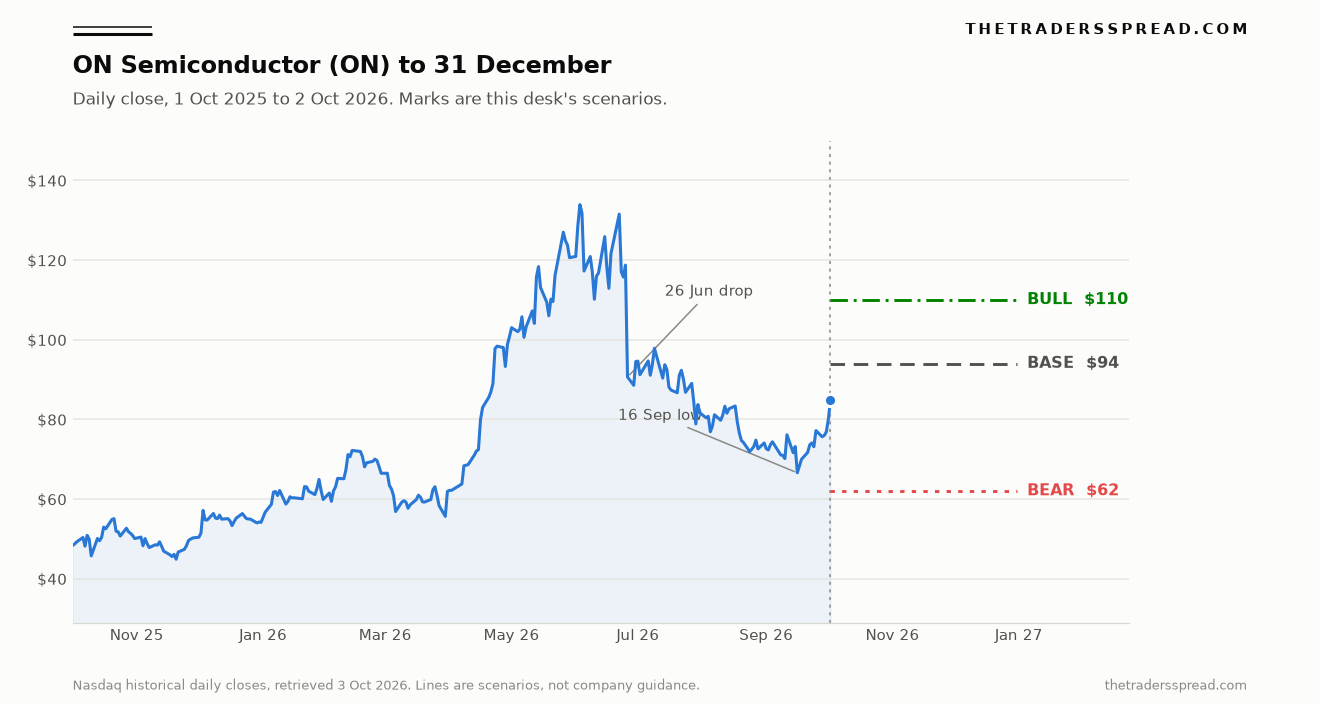
From 1 October 2025 the line runs to the 2 October 2026 close, then three marks extend to 31 December. Bull at $110 sits under the June peak. Base at $94 is just under the 30 June close of $94.54. Bear at $62 is under the 16 September low of $65.80.
Three marks for 31 December
Base case: $94, 10.7% above $84.89. That is a return to the first month-end after the stock deal, not a new high. It needs a third quarter inside the August range, no fresh contract from Party A, and a market that stops charging for dilution the amendment removed. Nasdaq's 3 October summary showed a one-year target of $95.00. Different horizon. This $94 is tied to the 30 June close of $94.54.
Bull case: $110, 29.6% above the last close and $8.74 below the 25 June close of $118.74. It needs the quarter at the top of the guide or beyond it, Synaptics still recommending the cash deal, and a market that hands back most of the post-announcement de-rating before any 2027 accretion is reported. It does not need $134.92. A full retrace of the spring high would treat the cash commitment as free. It is not due this year.
RelatedWhich Five Factors Move UnitedHealth (UNH) Shares?
Broadcom is another semiconductor acquirer on this desk, at another size. About $5.7 billion of consideration is 17.2% of the $33.05 billion equity value. Large enough to matter, and small enough that the power business still sets the year-end price. A bull case that needs a 2026 close is the wrong bull case.
Bear case: $62, 27.0% below the last close. Not a retest of 16 September, when the close was $66.60 and the low was $65.80. Sixty-two dollars is through that shelf. It is a quarter under $1,650 million of revenue, a broken Synaptics recommendation, or a market that treats the 2 October gap as a one-day mistake. A drift back towards $76 would hurt. It would not be this case.
Weight them as a judgement, not an option price: 40% base, 30% bull, 30% bear. The weighted mark is $89, about $4 above the last close. The vote, the foreign reviews and the third-quarter print are all still ahead, and the cash does not leave this year. If the stock simply sits between $80 and $90 into December, the base was early and the bear was unused. Conviction is 3 out of 5. Reference entry is $84.89. Central target is $94. The bull path is invalidated at $62.
What would move the marks
Revenue above $1,750 million, or non-GAAP earnings per share above $0.93, with Synaptics still recommending the deal, would pull the base towards $110 before year-end. This desk would not lift the bull case through the 25 June close of $118.74 on one quarter. That close was a pre-reaction price. Getting back there means the market has forgiven the June crash and accepted the new debt. One beat does not do both.
A print under $1,650 million retires $94. So does a change of recommendation at Synaptics, or a disclosed loan cost that makes "immediately accretive" hard to square with $13.7 million of quarterly interest on the old debt. The first shelf in that version is $65.80. The $62 mark is where the bull path in this piece is treated as broken. It is not an instruction.
Party A is the variable ON does not control. A named rival at a higher cash price would reopen the Synaptics board's duty. Both boards approved the amended deal on 1 October. That judgement is dated. Foreign regulators are the other open item in the release. The FTC step is the one that is done.
Questions the filing actually answers
What did ON Semiconductor agree to pay for Synaptics?
The amended agreement dated 1 October 2026 converts each eligible Synaptics share into $123.00 of cash, with no interest. The joint release put the aggregate at about $5.7 billion, against about $7 billion for the 25 June stock deal. The old ratio was 1.350 ON shares. At the 2 October close of $84.89 that ratio is worth $114.60, below the cash price. The $7 billion figure used June's share price.
When is the deal supposed to close?
The company still says mid-2027. Closing needs a Synaptics shareholder vote, regulatory approvals outside the United States, and other customary conditions. The FTC waiting period ended early on 12 August 2026, and the October release says the US authority has approved the deal. There is no financing condition. None of that puts the cash out the door in the fourth quarter of 2026.
How much cash and debt did the company last report?
At 3 July 2026 cash was $3,514.5 million and short-term investments were $350.0 million. Gross debt was $4,459.4 million, so net debt was $594.9 million. Morgan Stanley Senior Funding has committed up to $2.45 billion of term loans. The price of that loan is redacted. Adding the approximate $5.7 billion consideration to July's net debt gives about $6.3 billion, before fees and before any cash earned after 3 July. That is not the 31 December balance sheet.
What did onsemi guide for the third quarter?
On 3 August 2026 the company guided revenue to $1,650 million to $1,750 million, against $1,603.5 million just reported. Non-GAAP diluted earnings per share were guided to $0.81 to $0.93, against $0.74. Non-GAAP gross margin was guided to 40.0% to 42.0%. The filings used here do not include a reported third-quarter result. The base case assumes the company lands inside that range.
What bull and bear prices does this forecast use?
For 31 December 2026 the bull case is $110, the base is $94 and the bear case is $62. The anchor is the $84.89 close on 2 October, so the bull case is above the price and the bear case is below it. The base tracks the 30 June close, not Nasdaq's displayed one-year target of $95. A 40/30/30 weighting of base, bull and bear is this desk's judgement, and it lands near $89.
Has US clearance removed the deal risk?
It has removed one piece. Early termination of the US waiting period came on 12 August 2026, and the October release says the FTC has approved the deal. Other jurisdictions are still reviewing it. Synaptics shareholders still have to vote. A rival proposal is what forced the rewrite. Clearance in Washington is not a closed merger, and it does not reveal the interest rate on the term loan.
This is analysis, not a recommendation. It is not an instruction to trade ON Semiconductor or any other security. Deals slip, guides miss and capital is at risk. Closes are Nasdaq's, retrieved 3 October 2026. Contract terms are the company's filings. The $110, $94 and $62 marks are this desk's, and they can be wrong.