

Why did Jabil (JBL) fall 10% on 30 September after a quarter the company called better than its own outlook? That is the question the market is actually pricing. The beat is not the part in dispute.
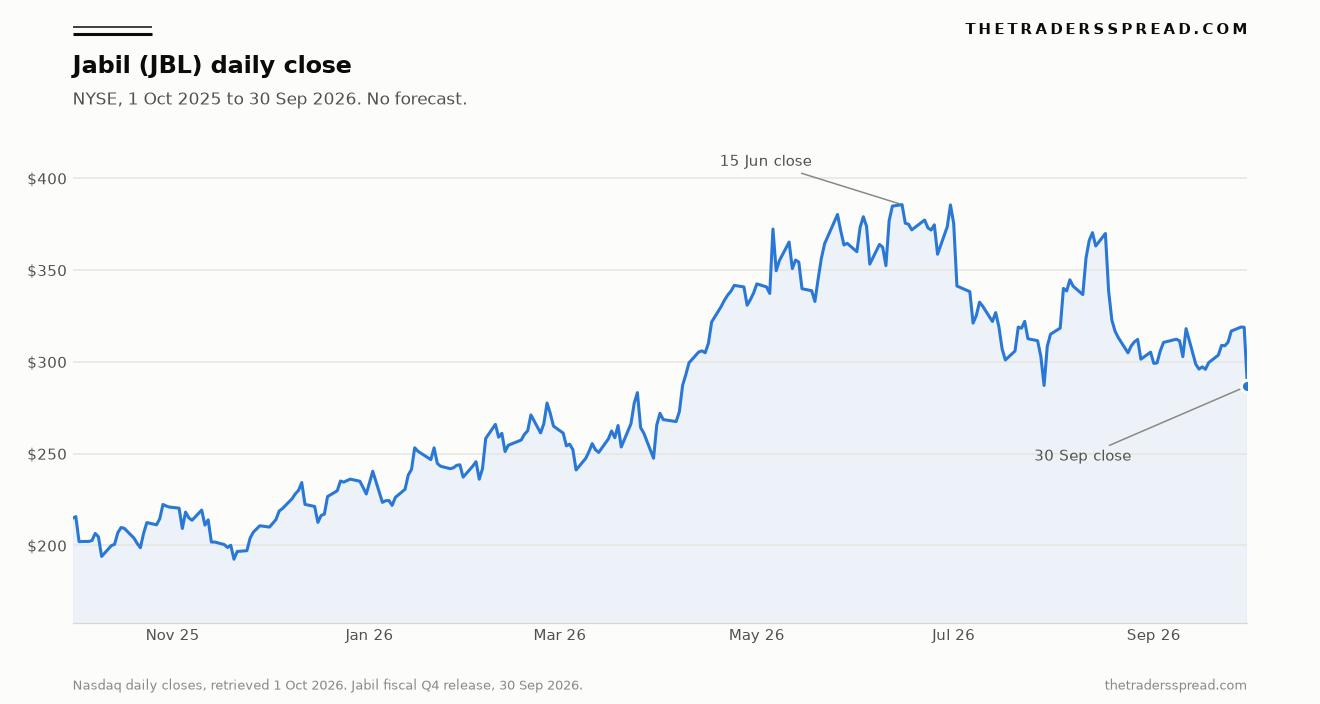
The shares closed at $286.86. Tuesday's close was $318.84. Divide the difference by that prior close and the ratio, before any rounding, is −0.10030. At two decimals that is −10.03%, the same figure Nasdaq prints on the stock, with a net change of −$31.98. The path matters more than the close. Jabil opened at $306.00, 4.03% under Tuesday, traded up to $328.00, which was 2.87% above Tuesday's close, and finished $2.47 above the session low of $284.39. For a while after the open, the beat was being marked higher than the day before. By the bell it was not.
A rally through the prior close that fails is a different event from a gap that never comes back.
Two growth rates are being swapped in the secondary write-ups, and they are not the same period. In the 30 September release, chief executive Mike Dastoor said fiscal 2026 revenue grew 21%. The income statement, furnished that day as Exhibit 99.1 to the Form 8-K, shows $35,954 million against $29,802 million. That is a 20.6% increase, which rounds to the 21% he used. The quarter is the other line: $10,616 million against $8,252 million, a 28.6% increase. On the call, chief financial officer Gregory B. Hebard, who signed the 8-K, described revenue of about $10.6 billion as up 29% and more than $1 billion above the midpoint of the June outlook. Quote 29% for the year, or 21% for the quarter, and the two lines have been crossed.
The figures that matter
- Close of $286.86 on 30 September 2026, from $318.84 on 29 September. Unrounded change −10.030%, which rounds to −10.03%. — Nasdaq historical closes, retrieved 1 October 2026
- Session range $284.39 to $328.00, open $306.00, volume 4,929,870 shares, about 4.1 times the prior 20-session average of roughly 1.20 million. — Nasdaq, 30 September 2026
- Fiscal fourth-quarter net revenue $10,616 million, against $8,252 million. GAAP diluted earnings per share $3.76. Core diluted earnings per share $4.40, against $3.29. — Jabil release and Exhibit 99.1, 30 September 2026
- Fiscal 2026 net revenue $35,954 million, against $29,802 million. Core diluted earnings per share $13.09, against $9.75. Adjusted free cash flow $1,532 million. — same filing
- Fiscal 2027 outlook: revenue $44.5 billion, core operating margin 6.1%, core diluted earnings per share $17.55, adjusted free cash flow about $1.6 billion. — Jabil release, 30 September 2026
- First-quarter fiscal 2027 outlook: revenue $10.6 billion to $11.4 billion, core diluted earnings per share $3.80 to $4.20. — same release
- From the 15 June 2026 close of $385.63, the 30 September close is down 25.61%. From the 31 December 2025 close of $228.02, it is up 25.80%. — Nasdaq daily closes
The print, line by line
Jabil's year ends 31 August, so this "fourth quarter" is June through August. The release is labelled preliminary and unaudited. Dastoor still put a clean sentence on it. "We delivered a fourth quarter that exceeded our expectations, closing an exceptional fiscal 2026 in which we grew revenue 21%, expanded core operating margin 40 basis points and generated more than $1.5 billion in adjusted free cash flow," he said.
The reconciliation is less flattering than the GAAP jump, and more useful. GAAP operating income was $602 million, a 5.7% margin, against $337 million and 4.1% a year earlier. The year-ago quarter carried a $98 million loss from the divestiture of businesses, tied in the footnote mainly to the Italy exit. Core operating income, which strips that item out along with stock-based pay, amortisation and restructuring, was $675 million against $519 million. Core margin was 6.4%, against 6.3%. Ten basis points. The 40 basis points Dastoor cited belong to the year: core margin of 5.8%, against 5.4%. The quarter itself was not a margin surprise.
Core diluted earnings per share of $4.40 compare with $3.29. That is 33.7%. Hebard, on the call transcript, called it 34%, ordinary rounding. GAAP diluted earnings per share were $3.76, against $1.99, and that comparison inherits the Italy charge. Full-year core earnings per share were $13.09, against $9.75. Diluted shares in the quarter averaged 106.0 million, against 109.2 million.
The beat sat in one segment. Hebard said intelligent-infrastructure revenue was about $5.8 billion, up 56% and roughly $900 million above the June outlook, on AI demand that ran ahead of a forecast already built for growth, and on capacity that arrived early enough to serve the ramps. Regulated industries were $3.4 billion, up 9%. Connected living and digital commerce were about $1.4 billion, roughly flat. Core margins on the three were 6.5%, 5.8% and 7.1%.
| Line | Q4 FY2026 | Q4 FY2025 | FY2026 | FY2027 outlook |
|---|---|---|---|---|
| Net revenue | $10,616 million | $8,252 million | $35,954 million | $44.5 billion |
| GAAP diluted EPS | $3.76 | $1.99 | $9.75 | Not a point guide |
| Core diluted EPS | $4.40 | $3.29 | $13.09 | $17.55 |
| Core operating margin | 6.4% | 6.3% | 5.8% | 6.1% |
| Adjusted free cash flow | $541 million on the call | $1,532 million | About $1.6 billion |
Statement figures are from the 30 September filing. The $541 million quarterly free-cash figure is Hebard's, not a line in the annual cash-flow statement. The fiscal 2027 column is the outlook in the release.
A session that traded above Tuesday, then failed
At the $306 open the stock was already 4% under Tuesday. The high at $328 is what kills a lazy reading that the print was simply disliked. For part of the session, buyers paid more than Tuesday's close for a company that had just guided fiscal 2027 to $44.5 billion of revenue, core earnings per share of $17.55 and a 6.1% core margin. Then they did not.
From that high to the close is 12.54%. The close sat $2.47 above the low, so the last print was where the day ended, not a wick. Volume of 4,929,870 shares was about 4.1 times the prior 20-session average. A quiet drift does not do that. This was a heavy session inside a beat.
On the year, it is another step down from a high that is already months old. The highest close in the Nasdaq series from 1 October 2025 is $385.63, on 15 June 2026. By 29 September the close was $318.84, 17.32% under that June print, before the earnings session took another 10.03% off. From 15 June to 30 September the drawdown is 25.61%. The shares are still 25.80% above the 31 December 2025 close of $228.02.
One-day moves of this size show up when a narrative breaks, even if the break is about timing rather than a missed number. Adobe fell 12% in a session on a chief-executive announcement, a different cause and a similar magnitude.
A respectable quarter does not, by itself, put a stock back on an earlier high. Costco rose 2.9% after its own fourth quarter and was still 15.8% under the May high. Jabil's version is harsher: the post-print close is the low of the move, not a small up day under the high. The print and the distance from the prior peak are separate facts. The market traded the second one.
Where the 2027 dollars are supposed to come from
The release states the year in one block. Revenue of $44.5 billion, described as up 24%. Core operating margin of 6.1%, 30 basis points above the 5.8% just reported. Core diluted earnings per share of $17.55, 34.1% above the $13.09 just booked, which is the "growth of 34%" in Dastoor's second paragraph. Adjusted free cash flow of about $1.6 billion, against $1,532 million.
He was explicit that the year will not earn in a straight line. Revenue, he told analysts, should land about 45% in the first half and 55% in the second. Margins are the awkward half of that. "Initially the first one or two quarters in any ramp, the costs are going to be much higher, as a result of which margins can be a little bit lower in the first half." He added that the first quarter is still up 20 basis points on margin from a year earlier.
The first-quarter guide writes that shape as a range. Revenue of $10.6 billion to $11.4 billion midpoints at $11.0 billion, 3.6% above the $10,616 million just reported. Core diluted earnings per share of $3.80 to $4.20 midpoint at $4.00, 9.1% under the $4.40 just reported. Revenue nudged up. Earnings per share nudged down. GAAP diluted earnings per share for the quarter are guided at $2.78 to $3.18.
Hebard's segment points for the quarter add to that midpoint. Intelligent infrastructure about $6.3 billion, up about 63% from a year earlier. Regulated industries about $3.5 billion, up about 12%. Intelligent devices and robotics about $1.2 billion, down about 10%. Sum: $11.0 billion. The 63% is a year-ago rate. Against the $5.8 billion just reported in intelligent infrastructure, $6.3 billion is a high-single-digit sequential step. The growth rate and the incremental dollar are different sentences.
For the year, Dastoor put AI-related revenue at about $14.4 billion in fiscal 2026, up $5.4 billion from the year before, and at about $22.1 billion in fiscal 2027, up 54%. Intelligent infrastructure as a whole is about $25.6 billion, up about 43%. Inside it, cloud and data-centre work is about $17.5 billion, up about 52%, and capital equipment about $4.2 billion, up about 40%. That equipment step leans on wafer-fabrication tools and test. Intel's own forecast is a different company, but it is the same end market.
He also expects the second hyperscale customer to be a 10%-plus customer in fiscal 2027. A third, discussed in June, is still framed as modest this year. The release already lists dependence on a limited number of customers among the risks. The growth guide and the concentration warning describe the same accounts twice.
Memory, with a name on it
The line that does not sound like a victory lap came from Frank McKay, chief supply chain and procurement officer. "We're seeing real constraints today. Memory, in particular, is being reallocated towards AI and hyperscale demand, tightening supply across many of the diversified end markets that we serve." He called it a structural shift in global capacity, with geopolitical disruption on top.
Dastoor applied the same constraint to one book. Connected living is expected to fall about 15% to about $2.3 billion, and he said the company is staying conservative around memory constraints in that market. Digital commerce and robotics, about $3 billion and up about 11%, do not fill the hole. The renamed devices segment lands near $5.3 billion, down about 2%. Regulated industries, about $13.6 billion and up about 7%, are the breadth he wants set next to the AI number: automotive, healthcare, energy, defence, warehouse automation. Breadth is real. It is not where the large incremental dollars are coming from. AI is.
The same reallocation that fills the hyperscale factories tightens the other end markets Jabil uses as evidence it is not a single-theme contractor. Both sentences can be true. The 30 September close does not say the AI demand is fake. It says the constraint was news.
Payables funded the inventory
Inventories were $7,413 million at 31 August, against $4,681 million, up $2,732 million. Receivables were $6,513 million, against $4,039 million. Prepaid expenses and other current assets were $4,559 million, against $2,010 million. Cash was $1,739 million, against $1,933 million.
Accounts payable were $14,444 million, against $7,937 million, up $6,507 million. That increase is larger than the inventory build and the receivable build combined. Accrued expenses rose from $5,185 million to $6,619 million. Cash from operations was still $2,002 million for the year, against $1,640 million. Adjusted free cash flow, operating cash less capital spending plus proceeds from asset sales, was $1,532 million against $1,318 million. The difference is $214 million, which is the "more than $200 million" in Dastoor's remarks.
Hebard said net inventory days were 64, including deposits, down about four days from the third quarter and still above the company's range of 55 to 60. Gross inventory days were about 82. He expects the net figure back inside that range through fiscal 2027. Cash from operations in the quarter was $733 million on his account. Net capital spending was $470 million for the year, 1.3% of revenue. Debt to core EBITDA was 1.3 times. The balance sheet shows $499 million of current debt and $2,880 million longer-dated, $3,379 million together, in line with his "about $3.4 billion".
RelatedBlackRock (BLK) Forecast: $1,280 Bull vs $960 Bear
Treasury-stock purchases on the cash-flow statement were $1,060 million. Hebard said about $169 million of repurchases fell in the fourth quarter, and that about $1.4 billion remained on the $1.5 billion authorisation from July. The frame he repeated is to return 80% or more of adjusted free cash flow over time. The decline on 30 September did not coincide with a broken conversion cycle. It coincided with a cycle that still converts, and with a forward margin management has already said will sag while the plants fill.
What this changes
The quarter removes "Jabil missed". Revenue, core earnings per share and the fiscal 2027 frame were ahead of what management had said in June, on Hebard's and Dastoor's own descriptions.
What remains is timing, parts and customers. The timing question is a first-quarter core midpoint of $4.00 under a $4.40 print, in a year whose margins Dastoor has parked in the back half. The parts question is McKay's memory point, with connected living guided down 15%. The customer question is a second hyperscaler at more than 10% of the company, against a risk factor the release already prints.
What would make Wednesday look too harsh is operational, not a price. A first quarter toward the top of the $3.80 to $4.20 core range, inventory days moving back toward 55 to 60, and no cut to the $44.5 billion, would say the ramp costs were the dip management described. What would say Wednesday had a point is a memory squeeze in the non-AI book, or a first-half margin that misses the "up 20 basis points year on year" remark Dastoor attached to the first quarter. Neither is a forecast of the share price. Both are visible in the next two reports.
Until then the stock is up 25.80% from New Year's Eve and down 25.61% from the 15 June close. The market is not pricing a broken 2026. It is pricing how much of a later, tighter 2027 it wants to own after a session that had the chance to hold $328 and did not.
Questions the tape leaves open
Why did Jabil fall if the quarter beat the June outlook?
The close was a judgment on the shape of fiscal 2027, not a rejection of $10,616 million. The shares traded to $328, above the prior close of $318.84, and finished at $286.86. The next quarter's core earnings midpoint sits under the quarter just reported, and management said first-half margins can be lower while capacity ramps. The beat stood. The path of the earnings did not hold the price the stock was asked to keep.
What did Jabil report for the quarter and the year?
For the quarter ended 31 August 2026, net revenue was $10,616 million, GAAP diluted earnings per share were $3.76 and core diluted earnings per share were $4.40. For the year, revenue was $35,954 million, GAAP diluted earnings per share were $9.75 and core diluted earnings per share were $13.09. Adjusted free cash flow was $1,532 million. Those figures are in the 30 September release and the 8-K exhibit.
Is the 21% growth rate the same as the 29% rate?
No. The 21% is Dastoor's description of the full year, and it matches a 20.6% increase from $29,802 million to $35,954 million. The 29% is Hebard's description of the quarter, against a statement increase of 28.6% from $8,252 million to $10,616 million. The filing keeps the two periods apart.
What did Jabil say about memory?
Frank McKay said the company is seeing real constraints, and that memory is being reallocated toward AI and hyperscale demand, which tightens supply in other end markets. Dastoor then guided connected living down about 15% and said Jabil is staying conservative on memory constraints in that market.
What is the fiscal 2027 guide, and what is the first quarter?
The year is guided to $44.5 billion of revenue, a 6.1% core operating margin, core diluted earnings per share of $17.55 and adjusted free cash flow of about $1.6 billion. The first quarter is a range: revenue of $10.6 billion to $11.4 billion and core diluted earnings per share of $3.80 to $4.20. The revenue midpoint is slightly above the quarter just reported. The earnings midpoint is below it.
How far is the stock from the June close?
The highest close in the Nasdaq daily series from 1 October 2025 through 30 September 2026 is $385.63, on 15 June. The 30 September close of $286.86 is 25.61% under that print, and 25.80% above the 31 December 2025 close of $228.02. The earnings session was the last 10.03% of the drawdown. By 29 September the stock was already 17.32% under the June close.
This is analysis, not advice. Capital is at risk. The figures above come from Jabil's 30 September 2026 earnings release, Exhibit 99.1 to the Form 8-K filed that day, the earnings call as transcribed by Benzinga, and Nasdaq daily closes retrieved on 1 October 2026. Nothing here is an instruction to transact in Jabil or in any other security.