

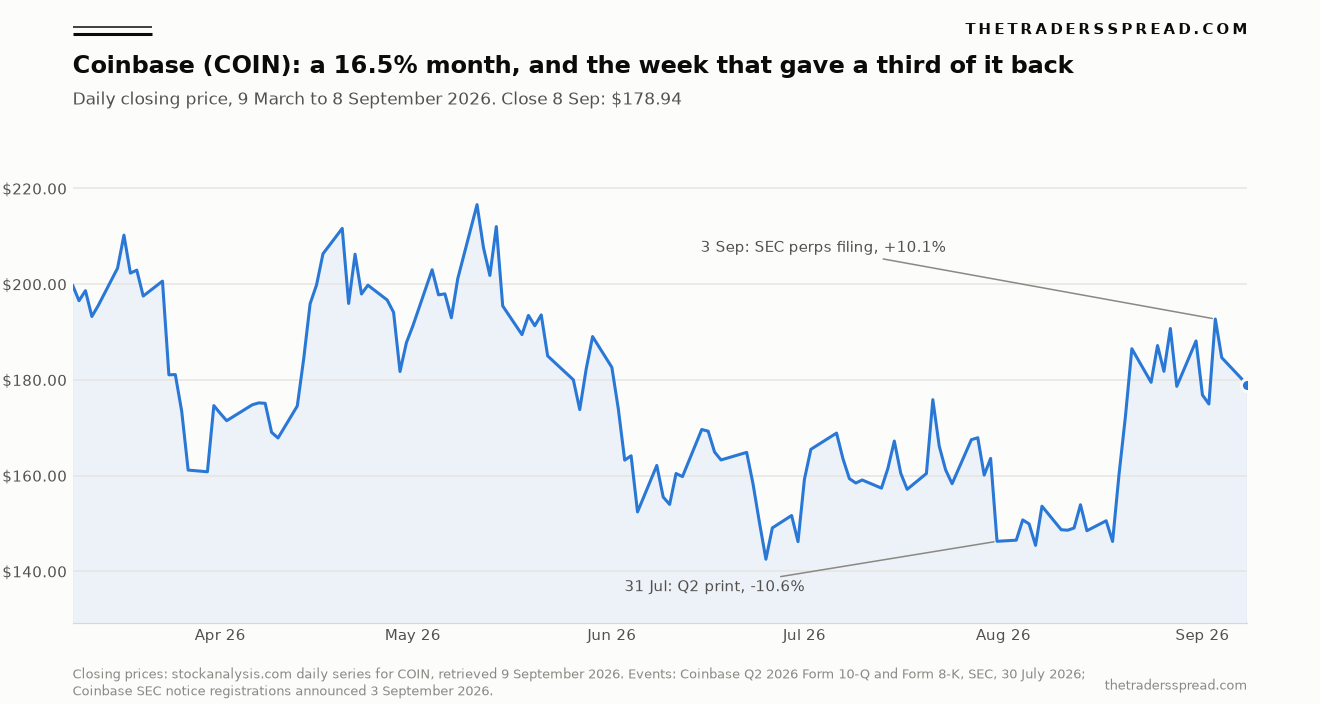
Page 31 of the Coinbase (COIN) earnings deck furnished to the SEC on 30 July 2026 carries a table headed "Q3'26 Outlook". The first row is transaction revenue. The number in it is not a forecast, because Coinbase stopped giving one: it is "~$130M QTD Through July 26", the money the exchange had actually taken in fees over the first twenty-six days of the quarter. Beside it, in the drivers column, sits a four-word instruction to anyone tempted to do the arithmetic: Caution extrapolating results. Six weeks later the stock had gone up anyway. Coinbase closed at $178.94 on Tuesday 8 September 2026, down 3.09% on the session on 5.97 million shares, and up 16.50% from the $153.60 it closed at on 7 August. That is the month the headlines have been describing as a Coinbase recovery.
Here is what the headlines leave out. Over exactly that window bitcoin rose 23.08%, from $64,263 to $79,093 on CoinGecko's daily series; the iShares Bitcoin Trust (IBIT) rose 20.63%; and Robinhood (HOOD), the other large listed venue that retail uses to buy crypto, rose 25.78%. Coinbase came fourth in a field of four. The largest regulated crypto exchange in the United States, in a month when its own single-stock perpetuals filing produced the biggest one-day gain of its year, still delivered less than a passive bitcoin trust. A stock that rises 16.5% while the asset it is levered to rises 23.1% is not being re-rated. It is being carried, and grudgingly.
Key facts
- Coinbase (COIN) closed at $178.94 on 8 September 2026, −3.09% on the day; +16.50% from the 7 August close of $153.60 — stockanalysis.com daily series for COIN, retrieved 9 September 2026.
- Over the same 7 August to 8 September window bitcoin rose 23.08% ($64,263 to $79,093) and Robinhood rose 25.78% — CoinGecko daily prices and stockanalysis.com, retrieved 9 September 2026.
- Q2 2026 net revenue was $1,154.3 million, down 17.3% year on year; transaction revenue $599.2 million, down 21.6%; consumer transaction revenue $451.7 million, down 30.5% — Coinbase Q2 2026 Form 10-Q, SEC, 30 July 2026.
- Coinbase reported a net loss of $359.5 million ($1.36 a share) against net income of $1,428.9 million a year earlier; Adjusted EBITDA fell 59.4% to $207.8 million — same filing.
- One counterparty accounted for 26% of total revenue in Q2 2026, up from 22% a year earlier — same filing, Note 5.
- Coinbase Derivatives filed Form 1-N and Coinbase Financial Markets filed Form BD-N with the SEC on 1 September 2026, seeking a route to US single-stock perpetual futures; CFTC approval is still required — announced 3 September 2026 by Chief Policy Officer Faryar Shirzad.
- The month added roughly $6.69 billion of market value on 263.8 million shares outstanding, taking the equity to about $47.2 billion, or 10.2 times annualised Q2 net revenue — our calculation from the 10-Q cover page and stockanalysis.com closes.
Where the 16.5% actually came from
The month was not a drift. It was two bursts and a leak.
The first burst ran from 18 to 21 August. Coinbase closed at $146.23 on the 18th and $186.49 on the 21st, a gain of 27.53% across three sessions, with 22.7 million shares traded on the final day. Nothing was filed with the SEC in that window; the company's next filing of any kind was a Form 4 on 24 August. What moved was the asset class. Bitcoin went from $64,686 on 19 August to $73,021 on 21 August, and every listed name the market files under "crypto" was bought together — the same reflex, in the opposite direction, that we measured in Robinhood's 5% fall on the day bitcoin lost $80,000 a week later.
The second burst was one day, and it did have a filing behind it. On 3 September Coinbase rose 10.14% to $192.70, its largest single-session gain of 2026, on 13.7 million shares and an intraday high of $195.85. Two sessions later it had given back $14.06 of the $17.74 it made.
That is the leak. From the 31 August close of $188.12 to 8 September the stock fell 4.88%, surrendering 36% of the entire month's advance in six sessions. Zoom out further and the picture is less flattering still: at $178.94 Coinbase sits 10.44% below the $199.79 it closed at on 9 March 2026, and less than half its 52-week high of $402.16.
| Instrument | 7 Aug 2026 close | 8 Sep 2026 close | Change |
|---|---|---|---|
| Robinhood (HOOD) | $93.29 | $117.34 | +25.78% |
| Bitcoin (spot) | $64,263 | $79,093 | +23.08% |
| iShares Bitcoin Trust (IBIT) | $36.80 | $44.39 | +20.63% |
| Coinbase (COIN) | $153.60 | $178.94 | +16.50% |
Equity and ETF closes from stockanalysis.com daily series; bitcoin from CoinGecko's daily USD series. All retrieved 9 September 2026.
Two forms, filed on 1 September
The 3 September move is the one worth understanding, because it is the only part of the month that belongs to Coinbase rather than to bitcoin.
On 1 September the company lodged two notice registrations with the SEC. Coinbase Derivatives filed a Form 1-N to register as a security futures exchange; Coinbase Financial Markets filed a Form BD-N as a limited-purpose broker-dealer. The pairing is the point. Security futures sit under joint SEC and CFTC oversight, a structure created by the Commodity Futures Modernization Act of 2000 and used since then by almost nobody, and it is the only existing statutory door through which a perpetual contract on a single US-listed share can walk onshore.
Faryar Shirzad, Coinbase's Chief Policy Officer, made it public two days later. "We're working to bring single stock perps to the US. This week, we filed SEC-notice registrations for our derivatives exchange and broker," he wrote, adding that the company would be "collaborating closely with the SEC and CFTC to bring more major financial products onshore", as reported on 3 September 2026.
None of this is hypothetical product. Coinbase already runs single-stock perpetuals for eligible customers outside the United States on Apple, Microsoft, Alphabet, Amazon, Nvidia, Meta and Tesla, plus certain ETFs, trading continuously and settling in USDC. The filing is not an attempt to invent a market. It is an attempt to move an existing offshore book onto US soil, where the fee pool is larger and the customer is currently forbidden. The gating item is the CFTC, which has not signed off, and the deck's own roadmap lists "Bringing US customers into global perpetuals liquidity via CFTC-regulated pathway" under "Coming Soon" rather than under anything shipped.
Perpetuals are also where Coinbase has been winning. Crypto derivatives trading volume ran at more than $4.2 trillion on a trailing-twelve-month basis in Q2 2026, flat while the wider derivatives market fell 12%, and the company recorded a third consecutive quarter of derivatives share gains. The Deribit acquisition that supplied most of that book cost $4.3 billion in August 2025, of which $3.57 billion was paid in Coinbase stock. Readers following the onshoring theme from the venue side will recognise the pattern from Hyperliquid's 52% run on the same CFTC push.
The other side of the perps trade
Somebody is losing if this works, and that somebody has already gone to court.
CME Group announced in June 2026 that it would sue the CFTC over the agency's late-May approval of Kalshi's BTCPERP contract and a parallel action clearing Coinbase to route US customers to its offshore Deribit affiliate. Terrence Duffy, CME Group's chief executive, put the legal theory bluntly on CNBC's Fast Money: "Under the Dodd-Frank Act, it clearly defines what a swap is and what a future is, and when there's two parties exchanging payments to each other, that's deemed a swap." If a perpetual is a swap rather than a future, the CFTC's self-certification route does not apply and the whole onshoring path has to be rebuilt.
CFTC Chair Michael Selig has defended the approvals in the same forum, telling Fast Money that "it's time to approve regulated futures contracts that have no expiration date". The commission has moved to dismiss on standing grounds; US District Judge Colleen Kollar-Kotelly, sitting in the District of Columbia, denied an earlier CFTC request to be excused from filing the administrative record and ordered both sides to submit a combined briefing schedule by 4 September 2026, per The Defiant's reporting.
The legislative track is tighter. Senate Majority Leader John Thune has filed cloture on the motion to proceed to the Digital Asset Market Clarity Act, with the vote eligible at 2.15pm Eastern on 15 September 2026, one day after the Senate returns. Cloture needs 60 votes; Republicans hold 53 seats, so at least seven Democrats have to cross. A failure there does not merely delay the bill, it removes the statutory clarity that every "regulatory tailwind" line in the current Coinbase bull case quietly assumes. We put a number on that risk in our note on Clarity Act passage odds at 12.5%.
What the accounts say the business earned
Set the narrative aside and read the quarter.
Coinbase's Q2 2026 Form 10-Q, filed on 30 July, reports net revenue of $1,154.3 million against $1,396.5 million a year earlier, a fall of 17.3%. Transaction revenue dropped 21.6% to $599.2 million. Inside that line the split matters more than the total: consumer transaction revenue fell 30.5% to $451.7 million, while institutional transaction revenue rose 64.5% to $100.1 million. Subscription and services revenue slipped 12.2% to $555.1 million, which is 48.1% of net revenue, the highest share Coinbase has reported. The company lost $359.5 million, or $1.36 a share, having earned $1,428.9 million in the same quarter of 2025. Adjusted EBITDA fell 59.4%.
| Net revenue line, Q2 2026 | Q2 2026 | Q2 2025 | Change |
|---|---|---|---|
| Consumer transaction, net | $451.7m | $649.9m | −30.5% |
| Institutional transaction, net | $100.1m | $60.8m | +64.5% |
| Stablecoin revenue | $292.1m | $308.9m | −5.4% |
| Blockchain rewards | $83.3m | $144.5m | −42.3% |
| Interest and finance fee income | $66.1m | $59.3m | +11.5% |
| Total net revenue | $1,154.3m | $1,396.5m | −17.3% |
Coinbase Global Q2 2026 Form 10-Q, Note 5 (Revenue), filed with the SEC on 30 July 2026.
Three things in that table do not get said often enough.
The first is concentration. Note 5 discloses that "one counterparty accounted for 26% of total revenue" in the quarter, against 22% a year earlier. The filing does not name it. What the same document does say is that there is "no change to the Company's arrangement with Circle Internet Financial, LLC", and stablecoin revenue on its own was $292.1 million, or 23.9% of total revenue. Whatever the exact identity, a quarter of Coinbase's revenue arrives from a single commercial relationship rather than from customers, and that dependency deepened while the trading business shrank. Stablecoin revenue is now equal to 64.7% of consumer transaction revenue; a year ago it was 47.5%.
The second is a metric that quietly disappeared. "Beginning in the second quarter of 2026, we no longer include Trading Volume as a key metric," the 10-Q states, on the grounds that a spot-crypto volume figure "no longer reflects the breadth of our business". The reasoning is defensible. The timing is remarkable: the exchange retired its trading-volume disclosure in the same quarter the equity market started paying it a growth multiple for trading new things.
The third is the size of the option being priced. Prediction markets, the business line most often cited as the reason to own Coinbase in 2026, crossed $100 million in annualised revenue in Q2 and grew 106% quarter on quarter. That is real and it is fast. It is also roughly 2% of an annualised net revenue base, against which the market added about $6.69 billion of value in a single month. Brian Armstrong, Coinbase's co-founder and chief executive, framed the quarter as proof that "our Everything Exchange can deliver in all market conditions", and CFO Alesia Haas said the company continued "to execute well on what we can control", in the shareholder letter of 30 July 2026. Both statements are defensible. Neither of them is a revenue line.
Then there is the run-rate the deck published and told everyone not to annualise. Transaction revenue was about $130 million through 26 July, twenty-six days into a ninety-two-day quarter. Held flat, that arithmetic lands near $460 million against Q2's $599.2 million, and Coinbase's own guidance for subscription and services revenue of $500 million to $580 million implies roughly flat performance on that side. The company's caution is warranted, since July was a low-volatility month and September has not been. But the market is not pricing a soft Q3. It is pricing what happens after the CFTC answers.
RelatedApplied Materials (AMAT) Falls 19.3% in the Week to 16 Oct
What this changes
The first thing it changes is how a Coinbase move should be read for the rest of 2026. A month in which the stock underperformed spot bitcoin by 6.6 percentage points, a bitcoin ETF by 4.1 and its closest listed peer by 9.3 tells you the equity is not carrying a premium for the perpetuals story yet. It is carrying a discount for the earnings. Anyone treating COIN as a leveraged bitcoin proxy should note that over this particular month the leverage ran the wrong way, exactly as the beta arithmetic did for MicroStrategy when its bitcoin stack sat 3% above cost.
The second is that the next repricing event is a regulatory decision, not a print. Coinbase does not report Q3 until late October. Before then the Senate votes on cloture on 15 September, the CME's challenge to the CFTC's perpetuals approvals proceeds on a briefing schedule filed on 4 September, and the CFTC has an open question in front of it about Form 1-N. Each is binary and none of them is in the company's control. That is an unusual risk profile for a $47 billion equity, and it is why single-session moves of 10% up and 4% down inside the same week are not an aberration here; they are the shape of the thing.
The third is a balance-sheet detail that will matter if stablecoin economics move. Of the $8,614 million Coinbase held in cash and equivalents at 30 June 2026, $2,957 million, or 34.3%, was itself held in payment stablecoins. USDC's market capitalisation stood at $74.43 billion when we pulled CoinGecko on 9 September 2026, and average USDC held in Coinbase products hit an all-time high of $20 billion in Q2. The company earns on that float, holds its own treasury partly in it, and reports a quarter of revenue from a single counterparty tied to it. Interest rates, not bitcoin, are the variable that moves all three at once. For the underlying asset itself, our standing framework is set out in the bitcoin bull and bear case.
What we will be watching: whether the CFTC acts on the Form 1-N before year-end; whether the 15 September cloture vote clears 60; whether consumer transaction revenue stabilises in Q3 or extends a fourth consecutive quarterly decline; and whether the counterparty concentration in Note 5 goes above 26% when the Q3 10-Q lands. Those four answers will decide more about the share price than the next 20% move in bitcoin.
FAQ
Why did Coinbase stock rise 16.5% in a month if revenue is falling?
Because crypto rose more. Bitcoin gained 23.08% over the same 7 August to 8 September window and Robinhood gained 25.78%, so Coinbase's advance was a partial participation in a sector rally rather than a company-specific re-rating. The one clearly idiosyncratic day was 3 September, when the stock added 10.14% after the SEC perpetual-futures notice registrations became public.
What exactly did Coinbase file on 1 September 2026?
Two notice registrations. Coinbase Derivatives filed a Form 1-N to register as a security futures exchange, and Coinbase Financial Markets filed a Form BD-N as a limited-purpose broker-dealer. Security futures fall under joint SEC and CFTC jurisdiction under the Commodity Futures Modernization Act of 2000, and CFTC approval is still outstanding before any US launch of single-stock perpetual contracts.
How much of Coinbase's revenue still comes from trading?
Transaction revenue was $599.2 million of $1,154.3 million net revenue in Q2 2026, or 51.9%. Subscription and services revenue supplied the other 48.1%, the highest share the company has reported. Within transactions, consumer activity fell 30.5% year on year while institutional activity grew 64.5%.
What is the 26% counterparty disclosure in the 10-Q?
Note 5 of the Q2 2026 Form 10-Q states that one counterparty accounted for 26% of total revenue, up from 22% a year earlier. The filing does not name the counterparty. It separately confirms no change to Coinbase's arrangement with Circle Internet Financial, LLC, and reports stablecoin revenue of $292.1 million, equal to 23.9% of total revenue.
When does Coinbase next report results?
Coinbase filed its Q2 2026 results on 30 July 2026 for the quarter ended 30 June. On its recent cadence the Q3 report falls in late October. The company guided Q3 subscription and services revenue to $500 million to $580 million and disclosed roughly $130 million of transaction revenue through 26 July, while explicitly cautioning against extrapolating that figure.
Does the CME lawsuit threaten the perpetuals business?
It threatens the legal basis for onshoring it. CME Group argues perpetual futures are swaps under the Dodd-Frank Act rather than futures, which would remove the self-certification route the CFTC used. The CFTC has moved to dismiss on standing, and a combined briefing schedule was due on 4 September 2026 before Judge Colleen Kollar-Kotelly in the District of Columbia. Coinbase's existing offshore book is unaffected.
This article is analysis and information, not investment advice. Prices, filings and regulatory positions are stated as at the dates given and change without notice. Trading and investing carry risk, including the total loss of capital. The Traders Spread holds no position in any security mentioned.