

The Clarity Act has already cleared one chamber of Congress by 294 votes to 134, sits on the Senate Legislative Calendar as General Order No. 423, and has a cloture vote booked for 2:15 p.m. Eastern on 15 September. Traders price it at 12.5 cents on the dollar to become law this year.
Those two sentences describe the same bill on the same morning. One of them is a legislative record pulled from congress.gov; the other is a live quote off an order book with $12.52m of matched volume behind it. Reconciling them is the whole trade, and the reconciliation is not about crypto policy at all. It is about how many days the United States Senate has left to work in 2026, and how few of those days arrive before senators stop taking hard votes.
We counted them. There are 36.
The information the price is actually carrying
Prediction markets are usually accused of over-reacting to headlines. This one has done something more interesting: it has decayed almost monotonically for seven months while the bill's legislative position improved. Our own pull of the Polymarket price history shows the contract opening at 65 cents on 12 January 2026, peaking at 81.5 cents in February, still holding 60.5 cents on 31 May, then falling to 39.5 cents on 1 July, 28.5 cents on 31 July, 13.5 cents on 31 August and 12.5 cents this morning. Across that same window the bill was ordered reported by Senate Banking, printed on the calendar, and given floor time. The policy got closer. The price got smaller. That divergence is the signature of a market pricing a clock rather than a controversy, and it is why the Clarity Act market on Polymarket is worth decomposing rather than accepting whole. Links to Polymarket are affiliate links, from which The Traders Spread may earn a commission at no cost to you.
Key facts
- Polymarket quotes YES at $0.125 and NO at $0.875, with a best bid of $0.12 and a best ask of $0.13 — Polymarket gamma API, pulled 4 September 2026
- Matched volume on the contract is $12,522,062 against $750,306 of resting liquidity — Polymarket gamma API, 4 September 2026
- H.R.3633 passed the House on 17 July 2025 by 294–134, Roll No. 199 — congress.gov bill actions, retrieved 4 September 2026
- Senate Banking ordered it reported with an amendment in the nature of a substitute on 14 May 2026; it was reported by Senator Tim Scott on 1 June 2026 and placed on the calendar as General Order No. 423 the same day — congress.gov, retrieved 4 September 2026
- A motion to proceed and a cloture motion on that motion were entered on 8 August 2026, recorded at Congressional Record page S4557 — congress.gov, retrieved 4 September 2026
- 36 session days remain on the Senate's published 2026 calendar, of which 14 fall before Election Day on 3 November — 2026 Senate Calendar issued by the Majority Leader's office
- Galaxy Research cut its own probability of 2026 enactment from 60% to 50% on 27 June 2026, citing floor time rather than policy — The Block, 29 June 2026
What the congressional record shows, and what it does not
Start with the paper trail, because a lot of commentary on this bill describes a version of it that does not exist.
H.R.3633, the Digital Asset Market Clarity Act, was introduced by Representative J. French Hill of Arkansas on 29 May 2025 and referred jointly to House Financial Services and House Agriculture. Both committees ordered it reported on 10 June 2025, Agriculture by 47–6 and Financial Services by 32–19. It was reported on 23 June 2025 as House Report 119-168, Parts I and II, placed on the Union Calendar, and passed the House on 17 July 2025 under the structured rule in H. Res. 580. The Senate received it on 18 September 2025 and referred it to Banking, Housing and Urban Affairs, where it sat for eight months.
Then the record thins out. Senate Banking ordered the bill reported with a substitute on 14 May 2026 and reported it without a written report on 1 June. No written report means no committee explanation of the substitute text, which matters more than it sounds: the version now on the Senate calendar is not the version 294 House members voted for, and nobody has published a section-by-section account of the difference.
The last recorded action is dated 8 August 2026. Majority Leader John Thune entered a motion to proceed and filed cloture on it in the early hours of a Saturday, after the Senate's last scheduled summer session day had already passed. Congress.gov records nothing since. As of this morning the Senate has not voted on anything to do with this bill in the 2026 session — not on the motion to proceed, not on cloture, not on a single amendment.
Thune's own framing was blunt. "The Dems are insistent on no Clarity vote. I worked with sponsors of the bill," he told reporters, before adding of the September plan: "We're getting that queued up first thing when we come back." Those quotes are from American Banker on 7 August 2026, and they are the closest thing to a leadership commitment on the record.
Thirty-six days on the calendar, fourteen of them usable
Here is the count, and here is where it comes from.
The 2026 Senate Calendar published by the Majority Leader's office marks non-session dates in red. Reading it forward from today: the Senate returns on 14 September and sits for 12 days in September, 2 days in October, 8 days in November and 14 days in December. That is 36 scheduled session days between now and the 31 December resolution deadline. Roll Call reported in November 2025 that the target adjournment date is 18 December, which the calendar confirms — the last shaded day of the year is Friday 18 December.
Split that 36 at Election Day and the picture changes shape. Fourteen session days fall before 3 November. Twenty-two fall after it, in a lame-duck session whose composition nobody knows yet. A cloture petition on a contested crypto bill needs 60 votes; Republicans hold 53 seats, so on the arithmetic reported in August the sponsors need at least seven Democrats or independents even with a unanimous conference, and they do not have a unanimous conference.
Fourteen days. One of the three unresolved issues, the ethics carve-out, is waiting on White House language that had not come back as of 11 August. A second, the illicit-finance title, has no published compromise text at all. The third, folding Senate Agriculture's text into the Banking substitute, needs a committee that has produced no public markup on this bill.
Alex Thorn, head of firmwide research at Galaxy, was making this argument in June, when the contract still traded above 40 cents. "i'm again reducing my odds of CLARITY act passage in 2026, mostly due to the shortening calendar and growing competition for floor time from other items," he wrote, per crypto.news on 27 June 2026. He cut Galaxy's number from 60% to 50% and kept the framing: "We still think enactment this year has a strong chance — for a bill of this magnitude and complexity, 50-50 are pretty good odds." Galaxy has not published a revision since. The market now sits 37.5 points below that firm's last published number.
Four gates, priced separately
A single 12.5-cent quote hides the structure. Enactment by 31 December requires four distinct events in sequence, and each one has a different failure mode.
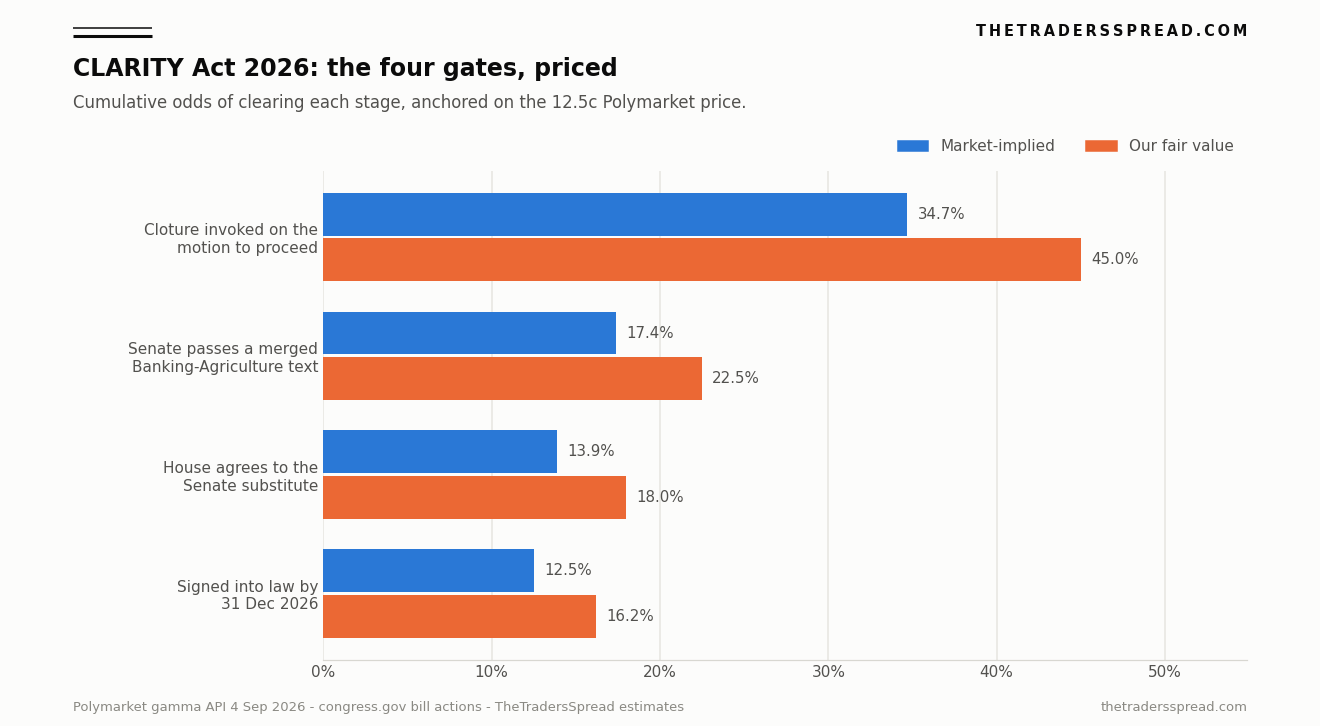
The chart holds our conditional pass-through rates for gates two, three and four constant and solves backwards from the 12.5-cent terminal price to recover what the market must be assuming about the first gate. On that construction the market is paying roughly 34.7% for cloture being invoked on the motion to proceed. We put it at 45%.
| Gate | Conditional odds | Cumulative (ours) | Cumulative (market) |
|---|---|---|---|
| Cloture invoked on the motion to proceed | 45% | 45.0% | 34.7% |
| Senate passes a merged Banking–Agriculture text | 50% | 22.5% | 17.4% |
| House agrees to the Senate substitute | 80% | 18.0% | 13.9% |
| Signed by 31 December 2026 | 90% | 16.2% | 12.5% |
The gap between 16.2% and 12.5% is 3.7 percentage points, on a contract whose bid-ask spread is a single cent. Three-quarters of that gap sits in the first row. The second row is where we agree with the pessimists: even if the Senate agrees to take the bill up, a merged text that satisfies Josh Hawley on deposit flight and Ruben Gallego on ethics has not been drafted, and drafting it inside a fortnight of floor time is the hard part. Anyone comparing the two columns for themselves can pull the same numbers off the event page in about thirty seconds.
The named objections, and who owns them
Three blocs stand between this bill and 60 votes, and they want incompatible things.
The first is Republican. Senator Josh Hawley of Missouri and Senator Jerry Moran of Kansas have both objected to the stablecoin-yield language on community-bank grounds, arguing the restrictions are too thin to stop deposits leaving small banks for yield-bearing tokens, per American Banker's 7 August reporting. That is a substantive fight about bank funding, not a crypto fight, and it does not resolve by adding a definition.
The second is Democratic and centres on ethics. Democrats have objected to a provision they read as carving out the President's own digital-asset holdings. Senator Ruben Gallego of Arizona and Senator Thom Tillis of North Carolina put a compromise to the White House before the recess and, according to Troutman Pepper's financial services blog on 11 August 2026, had received nothing back. A negotiation in which one side has not replied is not a negotiation that closes in eleven days.
The third is jurisdictional and gets the least attention. The CFTC title has to come from Senate Agriculture, and the congress.gov action list for H.R.3633 contains no Senate Agriculture activity whatsoever. The bill was referred to Banking alone. Whatever the Agriculture text turns out to be, it will arrive as a floor amendment or a leadership-negotiated substitute rather than as reported committee product, which means it will be new to most senators on the day they vote on it.
Industry is publicly upbeat and privately counting the same days. Ji Hun Kim, chief executive of the Crypto Council for Innovation, called the cloture filing "a critical step forward" in The Block on 8 August 2026. He is right that it is a step. It is also the cheapest possible step: filing cloture costs a leader nothing and can be withdrawn.
What the consensus is getting wrong
The dominant read is that 15 September is the decision point. It is not.
Cloture on a motion to proceed is a vote about whether to begin debating, and invoking it starts a 30-hour clock on the motion itself before the bill is even the pending business. After that comes an amendment process on a substitute nobody outside two committees has read, then a second cloture threshold on the bill, then a House vote on whatever the Senate produces. The House passed a different text thirteen months ago; it has to pass this one. And the House is out for most of October too.
The second misread is treating a failed cloture vote as terminal. Leaders re-file. Motions get vitiated and re-entered. A 52–46 loss on 15 September would probably knock the contract to single digits, and that reaction would itself be an over-reaction, because the lame duck still contains 22 session days and lame ducks are where controversial financial bills historically get attached to must-pass vehicles.
The third is a category error we have written about before in a different market: confusing a milestone with the outcome. A prediction market that resolves on a document existing by a date is a paperwork market, and paperwork markets reward reading the filing calendar rather than the news flow — the same discipline that applies to the Anthropic IPO contract, where no S-1 was on file, applies here.
What this changes
Our fair value is 16.2%, against a market at 12.5%. Both numbers say the same thing in plain language: this bill probably does not become law in 2026. The disagreement is about how probably.
RelatedBank of England November Decision: 25bp Hike at 89.5%
Base case, 50% weight. Cloture fails or is pulled on 15 September, talks continue through the pre-election fortnight, and the bill returns in the lame duck with a merged text. The contract spends October in the 5–9 cent range and re-rates in mid-November if a second cloture petition appears on the calendar.
Upside case, 16%. The White House returns ethics language before 14 September, Gallego brings eight to ten Democrats, cloture is invoked on 15 or 16 September, and the Senate uses its 12 September days on amendments. Enactment lands in October or in the first week of December. This is the branch that carries the 16.2% fair value.
Downside case, 34%. Cloture fails badly, the ethics fight becomes a midterm attack line, and the bill is not called up again in 2026 at all. The contract goes to 2–3 cents and stays there. Note that the downside and the base case both resolve NO; the distinction is whether the price bleeds slowly or gaps.
What would change our minds, in order of information value: a Senate Agriculture markup notice, which would be the single strongest signal that a merged text exists; a White House response on the ethics provision reported by a named senator; and Thune scheduling a second cloture petition before the September vote, which leaders do when they expect to win. Absent all three by 14 September, our 45% first-gate estimate is too high and the whole chain should come down toward the market. Traders tracking that chain in real time can watch the order book move on Polymarket as each signal lands.
One second-order note for anyone holding crypto rather than contracts. This bill has been a standing bid under US-listed digital-asset risk for a year, and its failure removes a catalyst rather than adding a shock, which is a different thing from the bearish case laid out in our Bitcoin bull and bear scenarios. Regulatory disappointment that was 82% priced in February and is 12.5% priced in September has mostly been absorbed already.
FAQ
What exactly does the Polymarket contract resolve on?
It resolves YES if the Digital Asset Market Clarity Act, H.R.3633, is passed by both chambers and signed into law by 31 December 2026 at 11:59 p.m. Eastern. The stated primary resolution source is the congress.gov legislation tracker for the bill. The event itself closes on 1 January 2027, so a signature on 31 December still counts and a signature on 2 January does not.
Why is the 15 September vote not a vote on the bill?
Because it is a cloture vote on the motion to proceed. Invoking cloture limits debate on the question of whether to take the bill up; it does not pass the bill, does not begin amendment consideration, and does not bind anyone to a final vote. It requires 60 votes, the same threshold the bill itself would face later.
Where does the figure of 36 Senate session days come from?
From the 2026 Senate Calendar published by the Majority Leader's office, which prints non-session dates in red. Counting the black dates from 14 September onward gives 12 in September, 2 in October, 8 in November and 14 in December. Fourteen of the 36 fall before Election Day on 3 November.
Has the Senate Agriculture Committee acted on the bill?
The congress.gov action list for H.R.3633 shows no Senate Agriculture activity. On receipt from the House in September 2025 the bill went to Banking, Housing and Urban Affairs alone. How the CFTC title is folded in remains one of the three publicly identified sticking points.
How liquid is this market compared with other political contracts?
Matched volume is $12.52m with $750,306 of resting liquidity and a one-cent spread, which is deep for a legislative contract and thin next to a national election book. For contrast, our work on the Brazilian presidential contract covers a market with a very different depth profile and a fixed resolution date rather than a procedural one.
What happens to the contract if cloture is invoked on 15 September?
Historically, procedural wins on contested bills produce sharp repricing. Our chain implies the contract would move toward the low-to-mid 30s on a successful first gate, since the remaining conditional path multiplies out to roughly 36%. That is an estimate from our own model, not a quoted forward price.
This article is analysis and information, not financial or investment advice, and nothing in it is a recommendation to take any position. Prediction market contracts can settle at zero and capital is at risk. Legislative outcomes are uncertain and the figures above are estimates that may be wrong. Do your own research and consider your circumstances before acting.