

42,790,223 shares. That is how much SpaceX (SPCX) Class A stock the Valor Equity Partners funds handed to their own investors on 11 September, according to a Form 4 filed by SpaceX director Antonio Gracias on 15 September. At that day's $151.21 close the block was worth about $6.5bn. It landed two sessions after the third automatic release in SpaceX's staged lock-up, and the tape barely flinched: the stock closed Friday 18 September at $152.71, up 1.0% from the 11 September close. Stretch the window back to 5 August, the last close before the first release, and SpaceX has risen 41.0% while roughly a third of its 180-day lock-up pool was freed. The fourth release arrives on Thursday 24 September. The number that matters for it is not the price. It is how few of the newly freed shares have actually changed hands in a way the filings can see.
Two details in the paperwork change the arithmetic most coverage uses. First, the prospectus offered holders a bonus 10% release if SpaceX closed at least 30% above the $135 offer price, meaning $175.50 or higher, on five of the ten sessions ending 4 August. The highest close in that window was $125.33, so the bonus never triggered. After Thursday, the cumulative release stands at 41% of the pool, not 51%. Second, Valor's own 10-Q-disclosed trading plan allows distributions of up to 225,857,490 shares. The September hand-out used 19% of that capacity, which leaves more than 183 million shares of scheduled supply sitting in a plan that runs to 30 September 2027.
Key facts
- SpaceX closed at $152.71 on Friday 18 September, down $2.10 on the day, on 335.7m shares, about 4.3 times the 77.9m average of the prior 20 sessions — Nasdaq historical data, read 21 Sep 2026
- From the 5 August close of $108.27 to Friday's $152.71 the stock rose 41.0%, a window spanning the 6 Aug, 20 Aug and 9 Sep lock-up releases — Nasdaq historical closes, 21 Sep 2026
- Valor-affiliated entities distributed 42,790,223 Class A shares in kind on 11 September and still hold 460,624,307 shares indirectly — SpaceX Form 4 (Antonio J. Gracias), SEC, 15 Sep 2026
- The 180-day pool releases 7% more on 24 September, then 7% on 9 and 24 October, 28% after third-quarter results, and the rest on 8 December — SpaceX 424B4 prospectus, SEC, 11 Jun 2026
- The IPO sold 555,555,555 shares at $135.00 for $75.0bn gross; Friday's close is 13.1% above that price — SpaceX 424B4, SEC, 11 Jun 2026; Nasdaq, 21 Sep 2026
- Second-quarter revenue was $7.81bn, up 92% year on year, while capital spending reached $18.37bn — SpaceX Q2 2026 earnings release (Exhibit 99.1), SEC, 4 Aug 2026
Release days on the chart: two 4% dips, both bought
SpaceX has traded for 68 sessions, so the chart below is its entire public life rather than a six-month sample. From a $160.95 first close on 12 June the stock ran to $201.80 on 16 June, then slid for seven weeks to a $108.27 closing low on 5 August. That low is the part worth pausing on: it printed on the first full session after second-quarter results (the 8-K was accepted at 16:01 ET on 4 August), and one session before the first 20% of the 180-day pool became transferable. Holders front-running the unlock would have sold into that close. Everything after it has gone the other way.
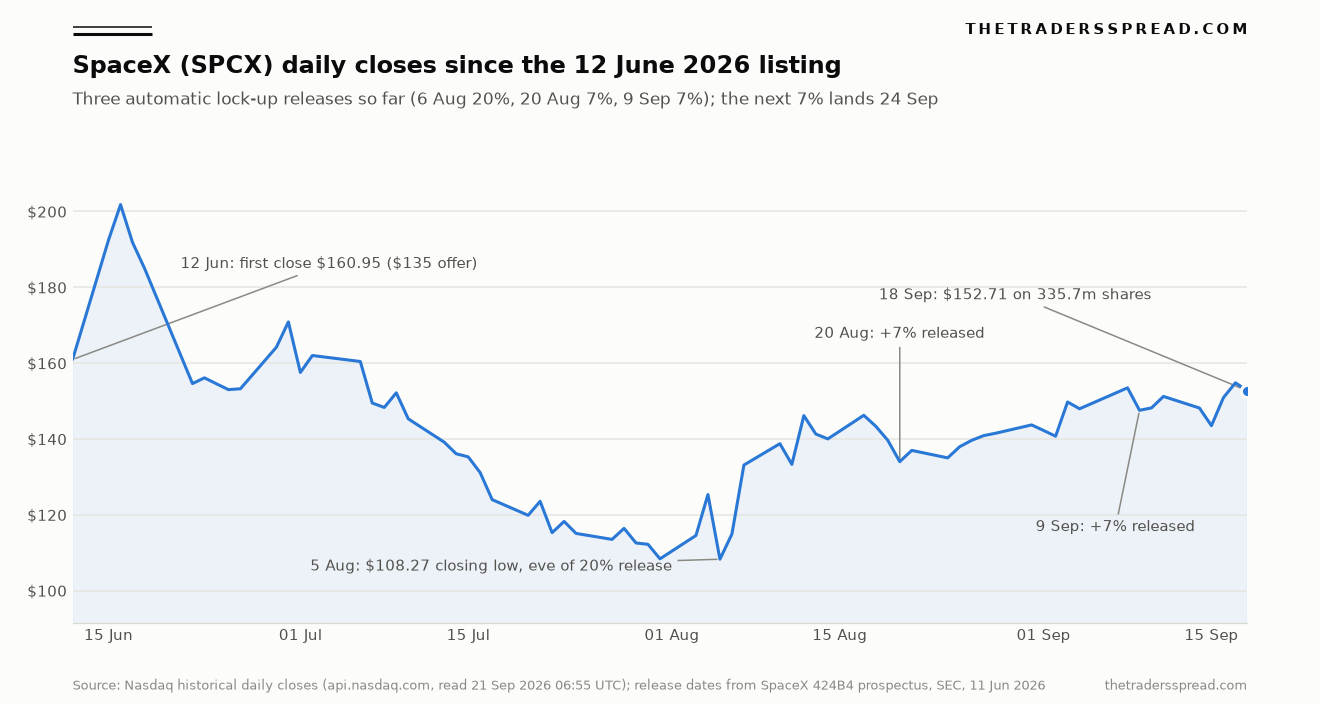
The two 7% releases produced near-identical first days. On 20 August the stock fell 4.0% to $134.00. On 9 September it fell 3.9% to $147.55. Both dips were recovered within days.
| Release date | Share of 180-day pool | Cumulative | Close that day | Move vs prior close |
|---|---|---|---|---|
| 6 Aug 2026 (second full session after Q2 results) | 20% | 20% | $114.92 | +6.1% |
| Bonus if ≥$175.50 on 5 of 10 days to 4 Aug | 10% (not triggered) | 20% | n/a | n/a |
| 20 Aug 2026 (day 70) | 7% | 27% | $134.00 | −4.0% |
| 9 Sep 2026 (day 90) | 7% | 34% | $147.55 | −3.9% |
| 24 Sep 2026 (day 105) | 7% | 41% | pending | pending |
| 9 Oct 2026 (day 120) | 7% | 48% | pending | pending |
| 24 Oct 2026 (day 135) | 7% | 55% | pending | pending |
| Second full session after Q3 results | 28% | 83% | pending | pending |
| 8 Dec 2026 (day 180) | remainder | 100% | pending | pending |
Schedule from the SpaceX 424B4 prospectus (Underwriting, Lock-up Agreements); closes from Nasdaq historical data, read 21 Sep 2026 at 06:55 UTC.
Friday's session is the outlier. Volume of 335.7m shares was the heaviest since the first day of trading on 12 June, and it came with a 1.4% decline rather than a collapse. We could not tie it to any SpaceX filing. 18 September was the third Friday of the quarter, the date on which quarterly equity options and index futures expire, and SpaceX sits in the Nasdaq-100 according to Nasdaq's own quote record, so index-linked flows are a plausible cause. Plausible is not proven, and nothing in the public record settles it.
Who actually moved stock, according to the filings
Valor's distribution is the only post-IPO disposal reported on Form 4 by a SpaceX insider through 18 September. The Form 4 describes it as "pro rata distributions in-kind, without consideration" by five Valor vehicles, carried out under a Rule 10b5-1 plan adopted on 12 June 2026, the day SpaceX listed. An in-kind distribution moves shares from a fund to its limited partners; it is not a sale on the exchange, and recipients need not file a Form 4 unless they are themselves insiders. The filing tells us how many shares became liquid in new hands, not how many hit the tape.
Scale helps. Gracias reported a 6.5% stake in the Class A shares on a Schedule 13G filed on 11 August, calculated on 7,696,293,669 Class A shares outstanding at 28 July. The 42.8m distributed plus the 460.6m still held come to about 503.4m, which reconciles with that 6.5%. So Valor pushed out roughly 8.5% of its position, then stopped.
Other insiders have bound themselves more tightly. The 10-Q discloses that chief financial officer Bret Johnsen put "the vast majority of his shares" into the extended lock-up and adopted a trading plan covering up to 919,497 shares that "does not commence sales until 2027". Gwynne Shotwell, president and chief operating officer, also put most of her shares into the extended lock-up and adopted a plan for up to 585,605 shares. Elon Musk's shares, including 849.5m Class A and 5.22bn Class B shares at listing, cannot move until the close of the 366th day after the prospectus, with no early-release provisions.
| Holder | Filed position | Lock-up treatment | Source |
|---|---|---|---|
| Elon Musk | 48.4% of Class A on an as-converted basis | 366 days, no early release | Schedule 13G, 13 Aug 2026 |
| Google / Alphabet | 7.2% of Class A | Not specified in filing | Schedule 13G, 14 Aug 2026 |
| Antonio Gracias (Valor) | 6.5% of Class A; 460.6m held after 11 Sep | 10b5-1 distribution plan up to 225.9m shares | 13G 11 Aug; Form 4 15 Sep 2026 |
| Founders Fund II | 2.0% of Class A | Not specified in filing | Schedule 13G, 14 Aug 2026 |
What the filings do not show is just as informative. No Form 144 naming SpaceX as issuer turned up in an EDGAR full-text search for 1 August to 21 September. Affiliates selling under Rule 144 have to file one, so the absence says affiliates have not been selling in size, though it says nothing about the non-affiliated employees and early investors whose freed shares need no notice at all.
How the 180-day pool actually unwinds
SpaceX split its pre-IPO shareholders into two camps. Roughly 7.8bn shares, described in the prospectus as more than 63% of the stock outstanding before the offering, sit in the extended camp: Musk's holdings for 366 days, and a group of large holders whose shares release in stages starting after fourth-quarter 2026 results and finishing after second-quarter 2027 results. Everything else falls into the 180-day pool, which is the one unwinding now.
The prospectus does not print the pool's size. Our estimate, using its own share counts: 13.08bn Class A and Class B shares outstanding after the offering, less the 555.6m IPO shares, leaves 12.52bn pre-IPO shares. Taking the extended camp at the "greater than 63%" floor of 7.89bn puts the 180-day pool at about 4.6bn shares; using the rounder 7.8bn figure gives 4.7bn. Each 7% slice is therefore about 320m to 330m shares, worth roughly $49bn to $50bn at Friday's close. That is close to Friday's 335.7m-share session, a sense of scale and nothing more: freed shares are permission to sell, not an order to.
Three structural features reduce the bite. The first is the bonus tranche that failed. Because the stock traded below its offer price through late July, the holders who might have been most eager to sell were denied an extra 10% in August. The second is Rule 144. Affiliates can sell no more than the greater of 1% of outstanding Class A shares, which the prospectus put at about 73.8m at listing, or the average weekly volume over four weeks, in any three-month window. The third is the 28% slice tied to third-quarter results, which puts the largest single release next to fresh numbers, when buyers have something new to price.
A fourth feature cuts the other way. On 14 August SpaceX closed its $60bn purchase of Cursor, issuing 389,289,254 Class A shares plus 1,752,426 shares for vested restricted stock units, according to the completion 8-K. Those shares were issued in a private placement, and the 8-K is silent on any lock-up attached to them, so their timing is a gap in the public record.
What the consensus reading misses
The standard lock-up playbook says stocks sag into expiry and recover after. SpaceX has done the opposite at the pool level: its worst close came on the eve of the first release, and its best stretch followed. The likelier explanation sits in the fundamentals that landed on 4 August, one session before the low. The second-quarter release showed revenue of $7.81bn against $4.07bn a year earlier, adjusted EBITDA of $3.54bn, a net loss narrowed to $541m, 12.0m Starlink subscribers against 6.0m, and $100bn of cash and marketable securities.
The same release carries the counterweight. Capital spending hit $18.37bn in the quarter, $15.83bn of it in the AI segment, more than five times adjusted EBITDA. Management has been open about how it intends to pay for that. In a pre-IPO interview SpaceX filed with the SEC, Bret Johnsen, Chief Financial Officer at SpaceX, said the build-out "will be huge amounts of capital" but "will largely be funded from the business", adding: "So, you tap the IG debt market, you have the cash flows from the business, and that's basically the answer for how we're going to fund it." Holders freed on Thursday will weigh that sentence against a quarter in which capex ran at more than five times adjusted EBITDA.
A second blind spot is the distribution channel. Valor's in-kind hand-out is a common exit route for venture and growth funds, because it lets each limited partner decide whether and when to sell. That spreads selling across many hands and many days. It also means the Form 4 count is the start of the supply story, not the end, and the next Valor filing will show whether the remaining 183m shares of plan capacity are being drawn down in steps.
Precedent is thin because nothing this size has listed with a calendar this granular. The nearest house example of a large holder feeding stock into a rising market is Dell's run to a record while Silver Lake kept selling, where steady disposals by Silver Lake coincided with a record high. The difference here is volume: SpaceX's pool releases are measured in hundreds of millions of shares per step, and they feed a stock that already sits inside the benchmark covered in our Nasdaq 100 forecast.
Where this reading breaks
Three things would say the calm is borrowed. The first is a Thursday session that looks like Friday's but closes down 5% or more, which would show freed holders selling into index demand rather than alongside it. The second is a fresh Valor Form 4 inside a fortnight, or a Form 144 from any director or 10% holder, either of which would tell us disposals are accelerating rather than staged. The third is the third-quarter print. The 28% slice attached to it is the largest single release on the schedule, and a quarter in which AI capex keeps climbing while the adjusted EBITDA gain stalls would put that release against weaker numbers.
Management itself has asked investors to discount the long-range plan. In the same SEC-filed interview material, Elon Musk, Chief Executive Officer at SpaceX, told viewers that "people should take this with a grain of salt to some degree because this is just our best guess. So, this is not a promise of what we'll do." He was speaking about orbital compute timelines, the part of the story that the capex line is funding.
There is also the price level. Friday's close sits 13.1% above the $135 offer but 5.1% below the $160.95 first close, and 24.3% below the $201.80 peak. Many aftermarket buyers from June are under water while pre-IPO holders sit on large gains, a split in which freed shares tend to find sellers on rallies. The chart's flat run from 8 to 18 September, when the stock went nowhere (down 0.5%) across a release and a $6.5bn distribution, may be the first sign of that ceiling.
RelatedCelestica Stock Forecast (CLS): $520 Bull, $280 Bear
What this changes
The 41% rise through three releases changes the question investors should be asking about SpaceX. It is no longer whether the lock-up will crush the stock, because the first 34% of the pool came free into a rally. The question is whether the rest of the calendar lands on better or worse fundamentals than the first third did. On the evidence of 20 August and 9 September, a single-day dip of about 4% is the pattern Thursday gets tested against. A clean break from that pattern would be the first real information the unlock has produced.
The second-order effect runs through the funds. Valor has shown the method, a Rule 10b5-1 in-kind distribution, and the scale, about 8.5% of its position in one step. If other large pre-IPO holders copy that approach as their shares free up, supply reaches the market through limited partners over weeks, not through block trades on release days. The Form 4 and 13G record, not the release calendar, is where that supply shows up first.
Size puts the releases in proportion. At Friday's close the company is worth about $2.01tn on the share count in its 10-Q, or roughly $2.07tn including the Cursor shares. A 7% step of the 180-day pool is about 2.5% of that value. So far each step has been absorbed within days, the base case the next three dated releases have to disprove.
What to watch, in order: the 24 September close and volume against the 4% pattern; any Valor Form 4 before the 9 October release; the date SpaceX sets for third-quarter results, which fixes the 28% release; and whether 8 December arrives with the stock above or below the $135 offer. Tesla's Cybercab registrations are a reminder that Musk-company stocks move on operational news no lock-up table predicts, and our prediction-market read on which company will be 2026's biggest IPO shows how much of the year's listing story still runs through SpaceX's $75.0bn raise.
FAQ
When is the next SpaceX lock-up release?
Thursday 24 September 2026, day 105 after the prospectus, when holders in the 180-day pool may transfer an additional 7% of their shares. That lifts the cumulative release to 41%. Further 7% steps follow on 9 and 24 October, a 28% step two full sessions after third-quarter results, and the remainder on 8 December, per the 424B4 prospectus.
Did Valor sell 42.8 million SpaceX shares?
Not on the exchange, according to its filing. The Form 4 filed on 15 September reports a pro rata in-kind distribution of 42,790,223 shares, without consideration, from Valor vehicles to their investors on 11 September under a Rule 10b5-1 plan adopted on 12 June. The recipients can sell or hold, and most do not have to report either way.
Why did the 10% bonus release not happen?
The prospectus required SpaceX to close at least 30% above its $135 offer price, so $175.50 or higher, on at least five of the ten sessions ending on the first earnings release date, 4 August. Nasdaq data shows closes between $108.37 and $125.33 over that window, so the condition failed and the extra 10% never became transferable.
Are Elon Musk's SpaceX shares affected by these releases?
No. The prospectus places all of Musk's shares under a 366-day restriction ending after the close on the 366th day after the 11 June 2026 prospectus, with no early-release provisions. The staged releases described here apply to the 180-day pool, and separate staged releases for the extended group begin only after fourth-quarter 2026 results.
How much stock does each 7% release free?
SpaceX does not publish the pool's size. Using the prospectus share counts, the 180-day pool is roughly 4.6bn to 4.7bn shares, so each 7% step frees about 320m to 330m shares, worth about $49bn to $50bn at Friday's $152.71 close. That is an estimate, and freed shares are not the same as shares sold.
Disclaimer: This article is analysis and information only, not investment advice or a recommendation to buy or sell any security. Share prices can fall as well as rise, and capital is at risk. Figures are drawn from SEC filings and Nasdaq data as dated in the text; check the primary documents before relying on them.