

Nike pays its shareholders $1.64 a share a year. In fiscal 2026 Nike earned $1.58 a share once a one-off $986 million refund of struck-down tariffs is taken out of the numbers. Those two figures sit side by side in the same fourth-quarter release of 30 June 2026, and the stock has spent the three months since then deciding which one to believe. At Wednesday's close of $36.05 the shares yield 4.55%, a figure more usual for a utility than for a company that describes itself as the world's leading designer of athletic footwear, and they sit 49.4% below where they closed on 24 September 2025. Our Nike price prediction runs to 31 December 2026: a $46 bull case, a $29 bear case and a $37 base case, with the first real test arriving after the close on Thursday 1 October, when Nike reports its fiscal 2027 first quarter.
The information most coverage skips is in the 10-K, and it concerns cash. Of the $986 million tariff recovery booked in the May quarter, only $302 million had arrived by 31 May; the other $684 million sat in receivables, and Nike says it collected "substantially all" of it after the year closed. That money lands in the August quarter. So the cash-flow statement published on 1 October will carry a refund worth roughly 46 cents a share before tax that has nothing to do with selling shoes. Full-year operating cash of $2.87 billion minus $684 million of capital spending left $2.18 billion of free cash flow against $2.41 billion of dividends paid. The payout was already uncovered before the refund cash turns up and makes it look covered again.
Key facts
- NKE closed at $36.05 on Wednesday 23 September 2026, down 49.4% from $71.22 a year earlier and 43.4% below its 31 December 2025 close of $63.71 — Nasdaq historical daily data, retrieved 24 Sep 2026.
- Fiscal 2026 diluted EPS was $2.10, including a $0.52 benefit from the expected recovery of IEEPA tariffs; excluding it, EPS was $1.58 — Nike Q4 FY26 release, 30 Jun 2026.
- The quarterly dividend is $0.41, or $1.64 annualised, a 4.55% yield at Wednesday's close — Nike Q4 FY26 release, 30 Jun 2026.
- Fiscal 2026 free cash flow was $2.18 billion against $2.41 billion of dividends paid — Nike 10-K, filed 15 Jul 2026.
- Nike has repurchased 124.4 million shares at an average $97.57 under its $18 billion programme and bought none in the May quarter — Nike 10-K, filed 15 Jul 2026.
- Greater China revenue fell 12% reported in the May quarter and Converse fell 32% — Nike Q4 FY26 release, 30 Jun 2026.
- First-quarter fiscal 2027 results are due on Thursday 1 October 2026 at about 1:15 p.m. PT — Nike Investor Relations, announced 28 Aug 2026.
A 17x multiple that is really closer to 23x
Screen Nike on trailing earnings and it looks like a fallen quality name on sale. TradingView's scanner carried a trailing P/E of 17.2 at Wednesday's close, which is simply $36.05 divided by the reported $2.10. The trouble is that $0.52 of that $2.10 came from one line in the cost of sales.
The mechanism is spelled out in the annual report. On 20 February 2026 the US Supreme Court ruled that tariffs imposed under the International Emergency Economic Powers Act were unauthorised. In the fourth quarter Nike judged recovery of the duties it had paid to be probable and recognised a $986 million benefit, $965 million of it in North America. That benefit lifted the quarter's gross margin by about 900 basis points. Reported gross margin rose 890 basis points to 49.2%, which means the underlying figure was roughly 40.2%, against 40.3% a year earlier. Flat, in other words, after a year of what management called foundational actions.
Strip the refund and the numbers change shape. Fourth-quarter EPS drops from $0.72 to $0.20. Full-year EPS drops to $1.58, and the shares trade on 22.8 times that figure. Lululemon, which carries its own weaker growth story, sat on a trailing multiple of 8.4 on the same scanner; Deckers on 11.2. Nike is not cheap on clean earnings. It is expensive for a company whose revenue fell 2% on a currency-neutral basis last year, and the market is still paying for the brand rather than the current profit line. For the full breakdown of how that per-share figure is built, our glossary entry on earnings per share covers the basics.
Board members bought at $58.97 and again near $42
If the valuation argument points one way, the Form 4 filings point the other. Insiders have used their own money through the slide, on two separate occasions, and every one of those purchases is now under water.
Elliott Hill, President and Chief Executive Officer, bought 16,388 shares at $61.10 on 29 December 2025 and a further 23,660 at $42.27 on 13 April 2026, about $1.0 million each time, according to his April Form 4. Tim Cook, a Nike director, bought 50,000 shares at $58.97 on 22 December and another 25,000 at $42.43 on 10 April, per his filing. Directors Robert Swan, John Rogers Jr. and Jørgen Vig Knudstorp also made open-market purchases between November and April.
| Insider | Date | Shares | Price | vs $36.05 |
|---|---|---|---|---|
| Jørgen Vig Knudstorp | 7 Nov 2025 | 16,150 | $62.09 | -41.9% |
| Tim Cook | 22 Dec 2025 | 50,000 | $58.97 | -38.9% |
| Elliott Hill | 29 Dec 2025 | 16,388 | $61.10 | -41.0% |
| Robert Swan | 7 Apr 2026 | 11,781 | $42.44 | -15.1% |
| Tim Cook | 10 Apr 2026 | 25,000 | $42.43 | -15.0% |
| Elliott Hill | 13 Apr 2026 | 23,660 | $42.27 | -14.7% |
Two readings are available. The generous one: the people with the best view of order books kept adding. The less generous one is that both rounds of buying were followed by further declines, and the directors' combined purchases total well under $10 million against a $53.5 billion company. The company's own buying tells a harsher story. Nike retired 124.4 million shares at an average of $97.57, spending about $12.1 billion; at Wednesday's price those shares would be worth about $4.5 billion. Repurchases were paused in the first quarter of fiscal 2026 and none were made in the May quarter. There is also a governance signal that got little attention. At the 8 September annual meeting, roughly 32% of votes cast opposed the pay package, and one Class B director, Thasunda Duckett, saw about 38% of votes withheld.
Twelve months on the tape, and four earnings nights
The chart below plots every daily close from 24 September 2025 to Wednesday. The shape matters more than the percentage. Nike did not collapse on one headline; it stepped down after results.
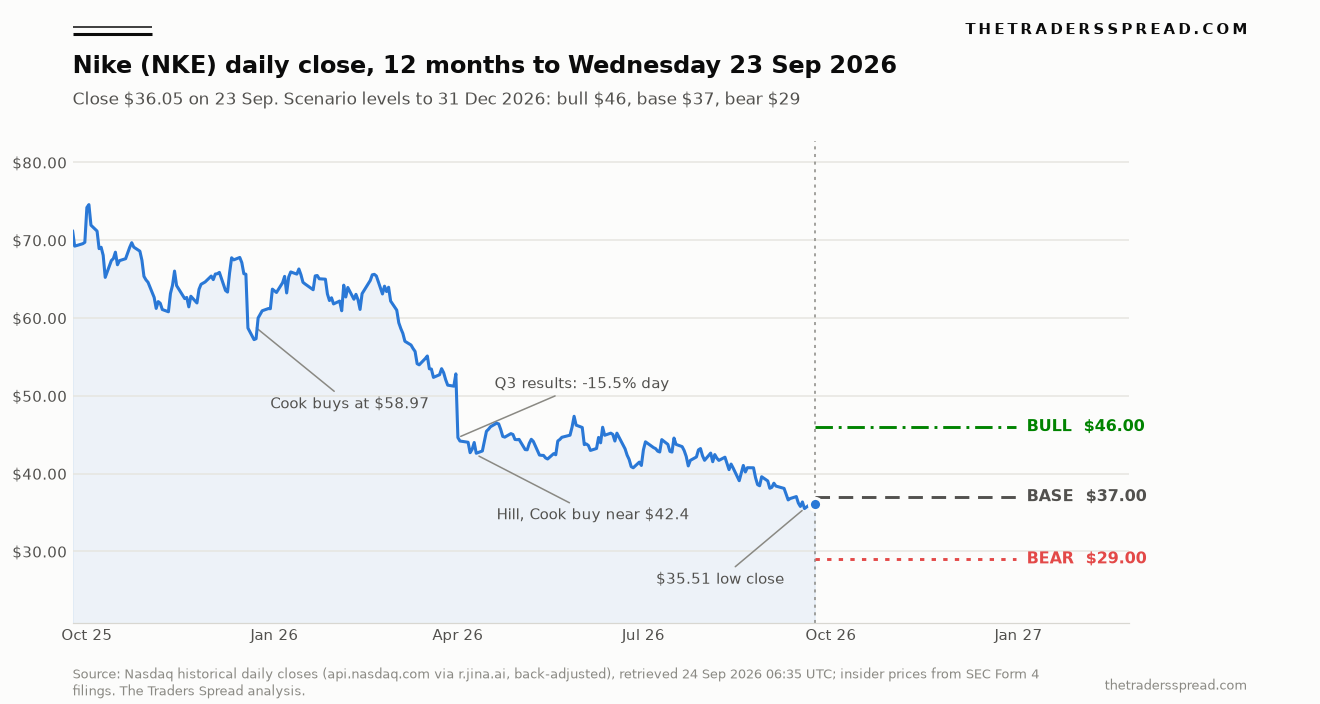
Two of the last four reports produced double-digit one-day falls, and the two rallies were smaller. Each row below compares the close on the report date with the next session's close.
| Report | Report-day close | Next close | Move |
|---|---|---|---|
| Q1 FY26 (30 Sep 2025) | $69.73 | $74.20 | +6.4% |
| Q2 FY26 (18 Dec 2025) | $65.63 | $58.71 | -10.5% |
| Q3 FY26 (31 Mar 2026) | $52.82 | $44.63 | -15.5% |
| Q4 FY26 (30 Jun 2026) | $41.05 | $43.06 | +4.9% |
The April drop came on 114.2 million shares, more than four times the 50-day average of 26.4 million. Since then the stock has set lower highs and lower lows. The 50-day average stands at $39.99 and the 200-day at $49.78, so the price is below both, and the 200-day is still falling. Last week produced the year's lowest close, $35.51 on 18 September, on 52.1 million shares. Intraday, the low was $35.35 on Monday 21 September.
Peers make the point that this is partly a sector move and partly a Nike one. On TradingView's delayed data at Wednesday's close, one-year returns were -40.6% for Lululemon, -34.1% for On Holding, -30.7% for Deckers and -6.0% for Under Armour, against +15.2% for the SPDR S&P 500 ETF. Nike's -49.6% on the same measure is the worst of the group. Our Lululemon forecast from August covers the premium athleisure side of the same consumer squeeze, and our S&P 500 year-end forecast sets out the index backdrop against which a 15% benchmark gain makes Nike's underperformance starker.
| Stock | Close 23 Sep | Trailing P/E | 1-year return | Dividend yield |
|---|---|---|---|---|
| Nike (NKE) | $36.05 | 17.2 | -49.6% | 4.5% |
| Lululemon (LULU) | $102.28 | 8.4 | -40.6% | none |
| On Holding (ONON) | $30.16 | 20.2 | -34.1% | none |
| Deckers (DECK) | $78.59 | 11.2 | -30.7% | none |
Source for the peer table: scanner.tradingview.com, 15-minute delayed values for the 23 September close, retrieved 24 September 2026 at 06:38 UTC.
Where the drag lives
North America is not the problem. Revenue there rose 3% in the May quarter and 5% for the year, to $20.5 billion. The damage is concentrated in three places, and the 10-K says two of them will stay damaged.
Greater China revenue fell 12% reported and 17% currency-neutral in the quarter, to $1.30 billion, and 11% for the year. The annual report describes "declining store traffic, elevated promotional activity and higher levels of inventory across the marketplace." Converse revenue fell 32% in the quarter to $244 million and 31% for the year, with declines in every territory. The filing is blunt about the outlook: "We expect negative impacts from Greater China and Converse to continue throughout fiscal 2027."
The third problem is Nike's own storefront. NIKE Direct revenue fell 7% reported in the quarter to $4.1 billion, with Nike Brand Digital down 12%. That is the highest-margin channel shrinking while wholesale, at lower margins, grew 4%. The shift toward wholesale partners is deliberate, but it caps how fast gross margin can recover even once the tariff noise is gone.
Management's language has moved accordingly. "While we continue to face top-line headwinds, we're encouraged by progress in performance product and are focused on consistent execution, improved profitability and scaling our wins to realize our full potential," said Elliott Hill, President and Chief Executive Officer at NIKE, Inc., on 30 June. His outgoing finance chief was starker in the same release. Nike was "demonstrating financial discipline in an increasingly challenging operating environment, where sell-through remains challenged," said Matthew Friend, Executive Vice President and Chief Financial Officer at NIKE, Inc.
Friend has since left. David Denton, previously finance chief at Pfizer and Lowe's, took over on 17 August under a transition announced on 23 June, and since 4 September he has also been acting principal accounting officer after the corporate controller resigned. The 1 October call will be his first. New finance chiefs have a habit of resetting expectations low in their first quarter, and that is the single largest risk to anyone modelling a clean beat. The board is changing too: Alexandre Arnault, deputy CEO of LVMH's Moët Hennessy, joined on 15 September. "Alexandre has earned a reputation for helping iconic global brands evolve, innovate and grow in a changing, complex marketplace," said Mark Parker, Executive Chairman at NIKE, Inc. A luxury-brand operator on the board says something about where Nike thinks its pricing power should come from. It says nothing about the next two quarters.
What would prove the bear wrong
The case against Nike rests on arithmetic that can be overturned by one quarter. If first-quarter gross margin, excluding any tariff items, comes in above last year's level, the dividend stops looking stretched, because the gap between $1.58 and $1.64 is only six cents a share. A 100-basis-point improvement on roughly $46 billion of annual revenue is worth about $460 million before tax, or roughly 25 cents a share after tax. That would close the gap and then some.
The balance sheet also gives the company time. Cash and short-term investments stood at $9.0 billion on 31 May against $7.9 billion of long-term debt, $2.0 billion of it due within a year. There is no near-term funding pressure forcing a dividend decision. The FedEx refinancing we covered this month shows another large US company putting debt back on after paying it down; Nike has not needed to.
And the market has already priced a good deal of damage. Nike's equity was worth $53.5 billion at Wednesday's close; on 28 November 2025 the shares held by non-affiliates alone were valued at $80.5 billion. The board lifted the quarterly dividend to $0.41 from $0.40 during fiscal 2026, which is not the behaviour of a board preparing to cut.
The call: $46, $37 or $29 by 31 December
Base case, $37 (45% probability, +2.6% from $36.05). The first quarter shows no clear turn in underlying margin, the refund cash inflates operating cash flow, and the market reads through it. Greater China and Converse remain negative as the 10-K warns. The stock trades a $32 to $42 range into the December report and finishes the year near where it started October, supported by a yield above 4.4% but capped by the falling 200-day average.
RelatedJPMorgan (JPM) Forecast: $368 Bull vs $283 Bear Case
Bear case, $29 (35%, -19.6%). Denton uses his first call to reset the fiscal 2027 outlook lower, underlying gross margin slips below last year, and the dividend's coverage becomes the headline. At $29 the shares would trade on about 18.4 times the $1.58 of clean earnings and yield 5.7%, which is what a market pricing a possible dividend freeze or cut looks like. The April gap shows how far a disappointing print can move this stock in one session.
Bull case, $46 (20%, +27.6%). Clean gross margin rises year on year, North America keeps growing and China shows its first stabilisation. The stock retraces to the level that held from April to June, still below the 200-day average. $46 is 20 times earnings of $2.30, which would need clean EPS to recover past the $2.16 Nike reported for fiscal 2025, and the yield there would be 3.6%.
The probability-weighted value comes to $36.00, essentially Wednesday's close, but the downside path is nearly twice as likely as the upside one. That is why our bias is bearish at low conviction, with the thesis invalidated by a daily close above $42.50, the level where directors last bought.
What would change my mind: a first-quarter gross margin that is up year on year excluding tariff items, together with a flat or growing Greater China. Either one alone is not enough; together they would make the dividend covered by earnings again and remove the core of the bear argument.
Frequently asked questions
When does Nike report its next earnings?
Nike will release first-quarter fiscal 2027 results on Thursday 1 October 2026 at about 1:15 p.m. Pacific time, after the US market close, according to its investor relations announcement of 28 August. The conference call follows at 2:00 p.m. Pacific. It will be the first call led on the finance side by new chief financial officer David Denton.
Is Nike's 4.5% dividend yield safe?
Nothing in Nike's filings signals a cut, and it holds $9.0 billion of cash and short-term investments. The concern is coverage. Fiscal 2026 earnings excluding a one-time $0.52 tariff refund were $1.58 a share, below the $1.64 annual dividend, and free cash flow of $2.18 billion was below the $2.41 billion paid out.
Why did Nike stock fall so much in the past year?
The shares fell 49.4% between 24 September 2025 and 23 September 2026, from $71.22 to $36.05. Most of the damage came after results, including a 15.5% one-day fall on 1 April 2026. Greater China revenue fell 11% for the year, Converse fell 31% and Nike's own digital sales fell 12%.
What was the IEEPA tariff refund?
After the Supreme Court ruled on 20 February 2026 that tariffs under the International Emergency Economic Powers Act were unauthorised, Nike booked a $986 million expected recovery in its May quarter. It lifted quarterly gross margin by about 900 basis points and EPS by $0.52. Only $302 million had been received by 31 May.
Have Nike insiders been buying the stock?
Yes. SEC Form 4 filings show open-market purchases by chief executive Elliott Hill in December 2025 and April 2026, by director Tim Cook on the same two occasions, and by directors Robert Swan, John Rogers Jr. and Jørgen Vig Knudstorp. Every one of those purchases was made above Wednesday's $36.05 close.
Disclaimer
This article is analysis and commentary, not investment advice or a recommendation to trade any security. Scenario levels and probabilities are the author's estimates and can be wrong. Share prices can fall as well as rise and you may lose some or all of your capital. Figures are drawn from the sources linked and were correct at the time of writing on 24 September 2026. Consider your own circumstances and seek independent advice before making any financial decision.