

Page 10 of the quarterly report Warner Bros. Discovery filed on 6 August carries a number with eight decimal places: $0.00277778. It is the daily "Ticking Consideration" that Paramount Skydance owes every Warner Bros. Discovery (WBD) shareholder for each calendar day the merger stays open after 30 September 2026, capped at $0.25 per 90-day period. Multiply it by the 2,510,703,314 shares outstanding on 23 July and the meter runs at roughly $6.97 million a day. That clock, more than any speech in Los Angeles, explains why Paramount settled on Monday 21 September with the 12 state attorneys general who had sued to block the deal. WBD closed that day at $30.80, up $3.00 or 10.79%, on 234.1 million shares, about 11 times its 60-session average. The stock now sits 20 cents under a $31.00 cash price, so what follows is less a growth story than a question of timing and one remaining signature.
Here is the part most coverage skipped. At $30.80 the market is no longer debating whether Warner Bros. Discovery is worth more than $31. It is pricing the odds that a federal judge signs off on the states' settlement and that Paramount closes within weeks. Run the arithmetic against a 4.14% three-month Treasury bill and a close around 5 October, and the remaining spread implies roughly a 97% chance the deal completes if a failure sends the shares back to $25. The upside from here is capped by contract. The downside is not.
- WBD closed at $30.80 on 21 Sep 2026, up $3.00 (+10.79%) on 234,091,400 shares — api.nasdaq.com historical data, retrieved 22 Sep 2026 06:41 UTC
- Merger consideration is $31.00 cash per share, plus $0.00277778 per day after 30 Sep 2026, capped at $0.25 per 90 days — WBD Form 10-Q, filed 6 Aug 2026
- Paramount owes WBD a $7.0 billion termination fee in specified circumstances, about $2.79 per share; WBD owes Paramount $3.0 billion in others — WBD Form 10-Q, 6 Aug 2026
- Larry Ellison and an affiliated trust guarantee $45.72 billion of the merger consideration — WBD Form 10-Q, 6 Aug 2026
- The states' settlement is "pending approval by the court" and includes a $47.5 million worker fund and at least $1.5 billion of added domestic film production — California Department of Justice, 21 Sep 2026
- The Writers Guild of America settled separately for a $17.5 million health-fund payment and a five-year bar on writer layoffs at CBS News — CNBC, 21 Sep 2026
- WBD's second-quarter revenue fell 11.2% to $8.717 billion and advertising fell 22.2% to $1.724 billion — WBD Form 10-Q, 6 Aug 2026
Twenty cents of upside, five dollars of air
Nine months of daily closes tell the story of a stock that has behaved like a bond with a court date attached. WBD started 2026 at $28.51 on 2 January. It closed at $28.17 on 27 February, the day the board terminated the Netflix agreement and signed with Paramount Skydance at $31.00. Between then and 18 September the gap to the deal price ranged from $2.10 to $5.72, which is what a contested merger looks like on a price chart.
The low came after the lawsuits. The states filed on 13 July; the court granted a temporary restraining order on 20 July; on 24 July the defendants agreed not to close until the earlier of five days after a merits ruling or 1 June 2027. WBD closed at $25.28 on 27 July, its lowest close since the Paramount agreement was signed. A 12-day trial was then set for 2 to 19 March 2027. The stock traded as high as $28.90 on 25 August and closed Friday 18 September at $27.80. Monday's close at $30.80 removed most of what was left.
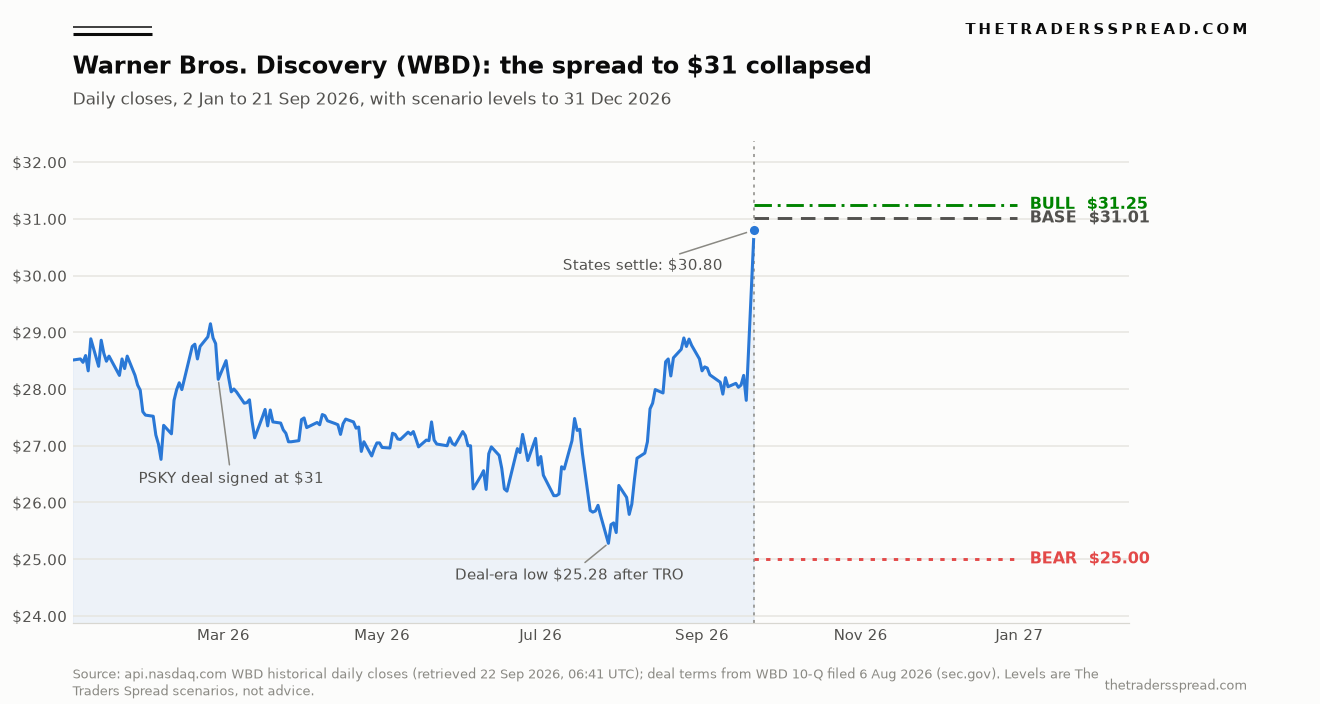
The chart shows the asymmetry plainly. Our bull level sits at $31.25, 1.46% above Monday's close. Base is $31.01, 0.68% above. Bear is $25.00, 18.83% below. Those numbers are not a forecast of what Warner Bros. Discovery's studios and networks are worth. They are what the contract pays under different closing dates, and what the market paid for the stock the last time the deal looked stuck.
| Scenario | What happens | Value per WBD share | vs $30.80 close | Our probability |
|---|---|---|---|---|
| Base | Court approves settlement, deal closes by 31 Oct | $31.00 plus 5 to 31 days of ticking ($31.01 to $31.09) | +0.7% to +0.9% | 85% |
| Bull | Approval drags, deal still closes by 29 Dec | $31.25 (full first 90-day ticking cap) | +1.5% | 10% |
| Bear | Settlement stalls or a new challenge revives the standstill | About $25.00, below the $25.28 deal-era low | -18.8% | 5% |
The bull line deserves one clarification. A later closing pays more dollars per share but pays them later, so the "bull" price and the best annualised return are not the same outcome. A holder paid $31.01 on 5 October earns about 0.69% in two weeks, which is roughly 18% simple annualised. Paid $31.25 on 29 December, the same holder earns 1.46% over 14 weeks, or under 6% annualised. In a merger arbitrage book it is everything.
What 12 states actually extracted
The settlement does not break up the deal. It rents out Paramount's behaviour for five years. According to the California Attorney General's office, the combined company must keep a court-enforceable film output commitment, add at least $1.5 billion of domestic production, fund $47.5 million for affected workers, and accept limits on how it bundles cable channels in carriage talks. CNBC's account of Rob Bonta's press conference adds the detail: at least 30 theatrical releases a year for two years and 32 for the following three, a $30 million penalty per missed film with 90% going to workers, and a forced divestiture of Miramax if the release floor is not met.
"Let me be clear: This settlement is not a vote of support for this merger," said Rob Bonta, Attorney General of California, in the release announcing the deal. He argued the terms resolve "our antitrust concerns in every market alleged in our case."
Not every state in the coalition was satisfied. "Connecticut wanted and demanded full divestiture of CNN and CBS News," William Tong, Attorney General of Connecticut, said in a statement quoted by NPR. "I am deeply disappointed that we could not do more." Tong's remark matters to WBD holders for one reason: the states chose a behavioural remedy over a structural one, and behavioural remedies do not require Paramount to find a buyer for anything before closing. That is why the closing timeline could compress to weeks.
On Paramount's side, the tone was relief. "Our shared aim was an outcome that best serves consumers, workers and — most importantly — the creative community so vital to the art of visual storytelling," David Ellison, Chairman and CEO of Paramount Skydance, said in a statement reported by CNBC. The same report says Ellison told employees in a memo that the company is looking to close in about two weeks.
Why would a buyer that says it had already won approval from competition authorities in nearly 70 jurisdictions settle rather than fight to March? Go back to the eight decimal places. At about $6.97 million a day, a closing pushed from October to a June 2027 outside date would have cost Paramount roughly $1.7 billion in ticking consideration alone, before legal fees and the financing carry on the debt raised for the bid. Settling on output pledges is cheap by comparison, even with a $30 million penalty hanging over every missed film.
The one signature left, and who could still object
The live obstacle is court approval of the states' settlement. The California release says it is "pending approval by the court", and NPR reports the agreement "still must be approved by a judge". The case sits in the Northern District of California before the same judge who granted the July restraining order. We could not find the proposed judgment's filing date or a hearing schedule at a primary source on 22 September, and that gap is the single largest uncertainty in this analysis.
Next comes the 24 July standstill. Under the 10-Q, Paramount and WBD agreed not to close until the earlier of five days after a merits determination or 1 June 2027. A settlement presumably ends the merits question, but the filings we can read do not say how or when the standstill is formally lifted. If it requires the court's entry of the settlement plus five days, a two-week timetable is tight but possible.
Then there is the Writers Guild. Its lawsuit, consolidated for trial with the states' case, was the other open front. The WGA settled on Monday and, in a statement carried by CNBC, said it "must contend with the reality of forging ahead alone, with no backing from government enforcers." That is a guild explaining why it stopped, not a guild preparing a new filing.
Could someone else sue? In principle, yes. Advocacy groups criticised the settlement on Monday, and the Federal Communications Commission's foreign-ownership ruling on 18 September, which NPR reports allows the combined company to be 49.5% foreign-owned, remains contentious. Neither has a pending injunction attached to it that we could find. A new private suit would need to win emergency relief quickly to matter, and private plaintiffs rarely get that in merger cases once the government enforcers have settled.
Money was never the constraint. The 10-Q records that Larry Ellison and an affiliated trust jointly guarantee $45.72 billion of the merger consideration, and CNBC reports RedBird and the Ellison family are financing $43.6 billion of the transaction. Readers who follow the Ellison family's other large holding will find more on it in our Oracle price forecast. "I think this type of consolidation and business planning is needed for Hollywood and for the content creation industries in a world where technology is disrupting everything," Gerry Cardinale, founder, managing partner and chief investment officer at RedBird Capital Partners, told CNBC.
Reading the spread as a probability
A takeover spread is an interest rate with a default risk inside it. Strip out the time value and what remains is the market's view of failure.
Start with the numbers. Assume the deal closes on 5 October, which matches "about two weeks" from Monday. The payout is $31.00 plus five days of ticking consideration, or about $31.014. The three-month Treasury bill yielded 4.14% on 18 September according to FRED series DGS3MO, and the Fed's upper target stands at 4.00% after the 16 September hike. Fourteen days of T-bill carry on $30.80 is worth about five cents, so a risk-free WBD would trade near $30.96. It closed at $30.80.
| If the deal fails, WBD trades at | Implied completion probability | Implied failure probability |
|---|---|---|
| $25.00 (our bear level) | 97.3% | 2.7% |
| $18.70 (close on 18 Sep 2025) | 98.7% | 1.3% |
Neither break price is exact. The $25.00 level assumes the market would still expect a deal eventually, as it did in late July. The $18.70 figure is where WBD closed a year ago, already lifted by early reports of Paramount's interest, so a true standalone value could sit lower still. In some termination scenarios the $7.0 billion reverse fee, about $2.79 a share, would cushion the fall; in others WBD would owe Paramount $3.0 billion plus reimbursement of the $2.8 billion Netflix break fee that Paramount paid on its behalf. Which fee applies depends on why the deal dies.
Our own weighting, 85% base, 10% bull and 5% bear, produces an expected value of about $30.75, a nickel under Monday's close. In other words we do not think the market has mispriced Warner Bros. Discovery by much. What it has done is compress a 10% move into a single session and leave very little on the table. Settlement headlines have done similar work elsewhere on our stocks desk, as the Meta settlement move showed, but there the upside was not contractually capped.
The company that exists if the deal dies
The bear case needs a floor, and the floor is the business itself. It has been shrinking.
In the three months to 30 June 2026, WBD's revenue fell 11.2% to $8.717 billion from $9.812 billion a year earlier. Advertising dropped 22.2% to $1.724 billion. Content revenue fell 26.0% to $1.828 billion. Distribution, the fees paid by cable and streaming partners, barely moved at $4.950 billion. The company reported first-half net loss attributable to shareholders of $2.767 billion, including the $2.8 billion Netflix termination fee it recorded as an expense in the first quarter, and it carried $32.0 billion of debt at 30 June, of which $1.493 billion was current.
Those figures describe a business that would have to restart the separation of its studios and streaming arm from its linear networks, a plan it had pursued before agreeing to a whole-company sale. Paramount's obligation to close is conditioned on WBD not completing that split, so it cannot proceed while the deal is pending. A failed deal would therefore reopen questions the market has not had to price since February: how much the Global Linear Networks business is worth on its own, and whether the debt load lets it be spun off cleanly. For readers tracking how rate moves feed into those refinancing questions, our Fed rate-cut odds analysis covers the policy path.
That is why the bear level sits at $25.00 and not lower. It assumes a stall rather than a collapse, a return to the kind of spread seen after the July restraining order.
RelatedHelen of Troy Earnings: HELE Rose 3.9% at the Close
The call on Warner Bros. Discovery
Base case, 85%: $31.01 to $31.09, closing by 31 October. The court enters the states' settlement, the standstill lifts, and Paramount pays $31.00 plus between five and 31 days of ticking consideration. WBD trades in a band of roughly $30.80 to $31.00 until the shares are delisted. The move from Monday's close is under 1%, and most of it is simply the time value of money being paid out.
Bull case, 10%: $31.25 by 29 December. Approval takes longer than Paramount wants but still arrives in 2026. The ticking consideration accrues to its first-period cap of $0.25, lifting the nominal payout to $31.25, 1.46% above Monday's close. This is the highest cash figure the contract can deliver inside 2026, but on an annualised basis it is the weaker outcome for anyone holding today.
Bear case, 5%: $25.00. The judge questions the behavioural remedies, a new plaintiff wins emergency relief, or the standstill proves harder to unwind than Paramount's memo implies. WBD re-prices to the kind of spread it carried in late July, when it closed at $25.28. From $30.80 that is an 18.8% decline, about 29 times the base-case gain.
Levels. Reference price $30.80 (Monday 21 September close, before Tuesday's session). Base target $31.01. Invalidation $27.80, Friday's pre-settlement close; a return below it would mean the market has stopped believing the settlement ends the litigation.
What would change my mind. A docket entry setting a lengthy approval hearing, or objectors being granted time to intervene, would shift weight from base to bull and widen the spread. A formal Paramount or WBD 8-K naming a closing date inside October would push our base probability above 90%. Any sign that the judge views the output commitments as unenforceable would move us toward the bear case quickly, because that is the one argument the states themselves made before they settled.
Frequently asked questions
How much will Warner Bros. Discovery shareholders receive from Paramount?
Each WBD Series A share converts into $31.00 in cash. If the merger closes after 30 September 2026, holders also receive $0.00277778 for each calendar day after that date up to and including the closing day, capped at $0.25 for each 90-day period. A close on 5 October would add about 1.4 cents; a close on 29 December would add the full 25 cents.
Why did WBD stock jump 10.8% on 21 September 2026?
Paramount Skydance settled the antitrust lawsuit brought by 12 state attorneys general led by California, and separately settled with the Writers Guild of America. Those two suits were the remaining obstacles to closing. The stock rose $3.00 to $30.80 on 234.1 million shares, narrowing the gap to the $31.00 deal price from $3.20 to 20 cents.
Is the Paramount and Warner Bros. Discovery merger certain to close?
No. The California Attorney General's office describes the settlement as pending court approval, and the companies had agreed in July not to close until a merits ruling or 1 June 2027. The settlement should resolve both, but the court still has to act. At $30.80, the market implies roughly a 97% to 99% chance of completion depending on where the stock would fall if it failed.
What happens to WBD shares if the deal falls apart?
The stock would re-price to its standalone value, which is uncertain. WBD closed at $25.28 on 27 July when a restraining order blocked closing, and at $18.70 a year ago. Depending on why the deal ends, Paramount may owe WBD a $7.0 billion termination fee, about $2.79 a share, or WBD may owe Paramount $3.0 billion plus reimbursements.
When is the Warner Bros. Discovery deal expected to close?
CNBC reported that David Ellison told Paramount employees the company is looking to close in about two weeks from 21 September. The merger agreement's outside date is 4 March 2027, extendable to 4 June 2027. We have not seen a closing date confirmed in an SEC filing, so any date before one appears remains an estimate.
Disclaimer
This article is analysis and commentary, not investment advice or a recommendation to trade any security. Scenario levels and probabilities are the author's estimates based on public filings and reporting available on 22 September 2026 and may prove wrong. Trading equities involves risk, and you can lose some or all of your capital.