

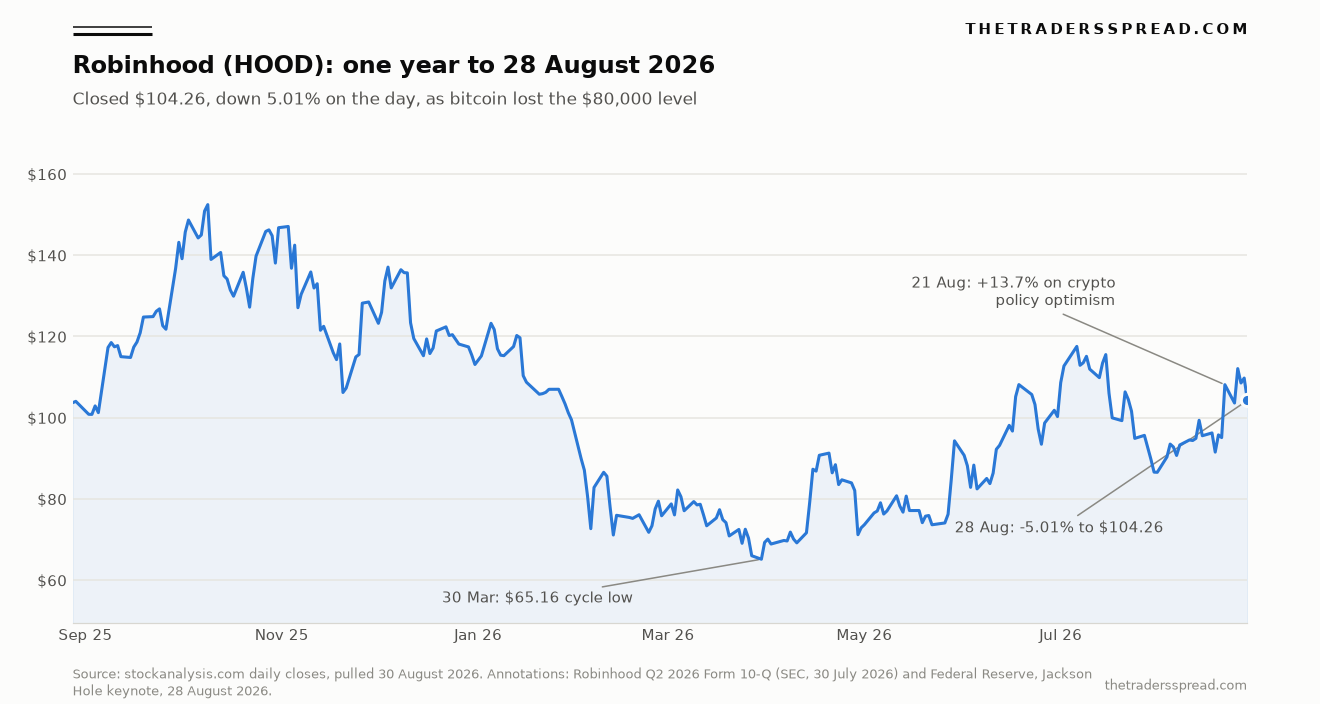
Robinhood (HOOD) is not a bitcoin stock, and its own accounts say so in plain numbers. Yet on Friday 28 August 2026 the shares closed at $104.26, down 5.01% or $5.50 on the session, on 16.3 million shares — a fall that erased roughly $5.0 billion of market value on a day when the S&P 500 barely moved. Nothing came out of Menlo Park. No filing, no guidance change, no downgrade. What happened was that bitcoin lost the $80,000 handle after a hawkish Jackson Hole keynote, and every ticker the market files under "crypto" was sold together. Robinhood was filed under crypto.
Here is the part that is not in the coverage. We ran a two-factor regression of Robinhood's daily returns on the iShares Bitcoin Trust (IBIT) and the S&P 500 (SPY) across the 250 sessions to 28 August, using session-aligned closes rather than the 00:00 UTC crypto prints that quietly break this calculation. The fit is HOOD = 0.71 × bitcoin + 1.88 × S&P, R² = 0.45. Given IBIT's −3.07% and SPY's −0.23%, that model called for a 2.57% decline. The stock fell 5.01%. Meanwhile Robinhood's own Q2 2026 Form 10-Q puts cryptocurrency trading at $100 million, or 7.6%, of $1,308 million in net revenue — and shrinking 38% year on year. The market is applying a bitcoin beta roughly twice the one the revenue line can justify, to a business where crypto is now the fifth-largest earner.
Key facts
- Robinhood (HOOD) closed at $104.26 on 28 August 2026, −5.01% (−$5.50), on 16.3m shares — stockanalysis.com daily data, pulled 30 August 2026.
- Bitcoin exposure fell 3.07% in the same session, measured by IBIT's 4pm close, taking spot back below $80,000 — stockanalysis.com and CoinGecko, 28–30 August 2026.
- Cryptocurrency trading produced $100m of Robinhood's $1,308m Q2 2026 net revenue (7.6%), down 38% year on year — Robinhood Q2 2026 Form 10-Q, SEC, 30 July 2026.
- Event contracts produced $156m, up from $10m, and now out-earn crypto by 1.56 times — same filing.
- Crypto is $26.3bn of $368.7bn Total Platform Assets (7.1%), down from 14.8% a year earlier; equities are 72% — same filing.
- Charles Schwab (SCHW) rose 1.95% in the same session; Interactive Brokers (IBKR) fell 0.74%; the S&P 500 ETF fell 0.23% — stockanalysis.com, 28 August 2026.
- Robinhood's one-year daily correlation is 0.76 with Coinbase but 0.60 with bitcoin; annualised volatility is 72.1% against the S&P's 12.8% — our calculation on stockanalysis.com closes.
What actually moved the price on Friday
The catalyst was macro, not corporate. Federal Reserve Chair Kevin Warsh delivered his first Jackson Hole keynote on Friday 28 August and used it to flag inflation still running above the 2% target. "While this summer's inflation readings were better than expected, they do not tell me that underlying trends have meaningfully improved," Warsh said in his keynote remarks at the 2026 Jackson Hole Economic Policy Symposium, adding that "markets are showing few signs of policy restraint". He declined, as he has since taking the chair, to offer forward guidance. Treasury yields rose sharply.
Prediction markets repriced immediately. As we set out in our note on how Fed September hike odds jumped 16 points on Warsh, the September meeting went from a formality to a coin toss. On a live pull of Polymarket's Fed Decision in September market on 30 August, "no change" traded at 51.5 cents and a 25 basis point increase at 47.5 cents, against roughly 1 cent for any cut, on $66.4 million of volume.
Long-duration risk sold off. Bitcoin, which had climbed 27.7% between 17 and 28 August, gave back the $80,000 level, and the equity complex attached to it went with it — amplified, as it always is. MARA Holdings fell 10.11%, Galaxy Digital 8.22%, Circle 7.53%, Coinbase 6.33%. MicroStrategy fell 7.34% to $127.31, leaving its bitcoin stack just 3.1% above cost, a situation we examined in our piece on MicroStrategy's mNAV maths.
Robinhood sat inside that basket at −5.01%. The tell is what did not fall. Charles Schwab, a retail broker with no crypto trading business to speak of, rose 1.95% on the same tape, because a hawkish Fed is a straightforward positive for a broker's interest income. Interactive Brokers slipped 0.74%. The financials sector ETF gained 0.38%. Robinhood was not sold as a broker on Friday. It was sold as a crypto ticker.
Who was responding, and to what
That distinction matters because the sell-side has spent 2026 arguing about precisely which company Robinhood is. On 20 July, a Bernstein team led by analyst Gautam Chhugani raised its price target to $160 from $130 with an Outperform rating, on a thesis that has nothing to do with the bitcoin price: that "broker-dealers, exchanges, prediction platforms, and crypto-native venues will spend the next two years competing for a fee pool worth more than $70 billion" across prediction markets, perpetual futures and tokenised equities. Days later Goldman Sachs cut its target to $118 from $137 while keeping a Buy, citing slower upside momentum against gathering headwinds.
Both houses are underwriting the same company and both are looking past crypto trading. Neither target was changed on Friday. No broker published on Robinhood that day at all — the move carried no analyst fingerprint.
The buy-side behaviour is more revealing. Look at 21 August, one week earlier. Bitcoin exposure rose 6.02% on IBIT after a White House cryptocurrency summit that included CFTC Chairman Michael Selig and SEC Chairman Paul Atkins alongside executives from Coinbase, Robinhood, Ripple and Kalshi. Coinbase rose 8.2%. Robinhood rose 13.7% on 50.0 million shares, more than double the bitcoin move and its heaviest turnover since June.
So the beta is not merely high, it is asymmetric and sentiment-driven: 2.3 times the bitcoin move on the way up, 1.6 times on the way down. That is the signature of a stock being traded as an expression of a policy view rather than as a claim on a revenue stream. Having tracked this name through the March low at $65.16 and the recovery since, we would note that the pattern has held through three separate crypto impulses this year, and it has been wrong about the underlying business each time.
What the accounts actually say
Robinhood's Q2 2026 Form 10-Q, filed with the SEC on 30 July 2026, is the document the tape ignored. Total net revenues rose 32% to $1,308 million. Net income attributable to Robinhood rose 45% to $561 million, diluted EPS 48% to $0.62. Funded Customers reached 28.4 million, up 7%. Annualised ARPU rose 24% to $187, and Gold subscribers rose 39% to 4.84 million. This was a record quarter, delivered while crypto trading revenue was falling by more than a third.
| Q2 revenue line | Q2 2025 | Q2 2026 | Change | % of net revenue |
|---|---|---|---|---|
| Options | $265m | $342m | +29% | 26.1% |
| Net interest revenues | $357m | $389m | +9% | 29.7% |
| Event contracts | $10m | $156m | +1,460% | 11.9% |
| Equities | $66m | $129m | +95% | 9.9% |
| Cryptocurrencies | $160m | $100m | −38% | 7.6% |
| Total net revenues | $989m | $1,308m | +32% | 100% |
Source: Robinhood Markets Q2 2026 Form 10-Q, SEC, 30 July 2026.
Two things fall out of that table when it is read against Friday's move. First, event contracts overtook crypto as a revenue line during the quarter and now out-earn it by 1.56 times. Prediction-market volumes are driven by elections, sport and macro releases — a Fed meeting being priced at 48% is, if anything, useful to that business, and Robinhood books the same fee whichever way the contract settles.
Second, and less obviously, higher rates are a tailwind to the largest growing line in the accounts. Margin interest revenue nearly doubled, from $114 million to $215 million, an 89% increase driven by customer margin balances that rose 132% to $21.6 billion. Net interest revenues of $389 million are now 29.7% of the total — nearly four times the crypto line. On the revenue arithmetic, a hawkish Warsh is closer to neutral-positive for Robinhood than it is for almost any other name that fell hard on Friday.
The balance-sheet picture matches. Total Platform Assets rose 32% to $368.7 billion, but the composition moved decisively: equities up 66% to $265.5 billion, or 72% of the total, while cryptocurrency holdings fell 36% to $26.3 billion. Crypto has gone from 14.8% of platform assets to 7.1% in twelve months. The 10-Q attributes the crypto revenue decline to structural causes, not price: lower rebate rates from crypto market makers, a 16% fall in the number of users placing crypto trades, and a 20% fall in average notional volume per trader.
That is the synthesis the market missed. Robinhood's crypto revenue fell 38% over a year in which bitcoin was broadly higher. The business line and the coin price have already decoupled in the accounts. Only the share price has not noticed.
The regulatory tension underneath
The reason this mispricing is durable rather than a one-day error is that Robinhood's fastest-growing business is also its least settled one, and the market has not decided how to value a legal question.
Event contracts are offered by Robinhood Derivatives, LLC through KalshiEX LLC, ForecastEX, LLC or Rothera Exchange and Clearing LLC — the former LedgerX, acquired via the MIAXdx transaction in January 2026. That structure sits under Commodity Futures Trading Commission oversight, and it is being contested state by state. The 10-Q discloses that in April 2026 the Third Circuit ruled in favour of KalshiEx LLC, extending a preliminary injunction against New Jersey; that Connecticut litigation remains pending; and that in Nevada the court denied Robinhood Derivatives' motion for a preliminary injunction, with the company agreeing to cease offering new sports-related event contracts in that state from 1 December 2025.
The crypto side carries its own perimeter. Bitstamp Europe S.A. and Robinhood Europe are licensed crypto-asset service providers under the EU's Markets in Crypto-Assets Regulation, in force since 30 December 2024. Bitstamp UK Limited answers to the Financial Conduct Authority, Bitstamp Asia to the Monetary Authority of Singapore, and the Canadian dealer subsidiary to CIRO — a lattice assembled through the Bitstamp, TradePMR and WonderFi acquisitions. Compliance across four regimes is a fixed cost against a revenue line that shrank 38%.
There is also an execution signal that the tape has not priced either way. On 16 June 2026 Robinhood announced a reduction in force of approximately 10% of full-time employees. Managements do not usually cut a tenth of headcount in the quarter before posting a record; the two facts together describe a company deliberately re-pointing its cost base at options, margin lending and event contracts. Traders comparing venues on cost will recognise the pattern from our broker comparison hub: fee compression forces the operator to find a different revenue engine, and the transition is rarely priced while it is happening.
What this changes
The second-order consequence of Friday is that Robinhood now offers a cleanly measurable gap between a factor exposure and a revenue exposure. The stock behaves as though roughly 30% of the enterprise is crypto. The filings say 7.6% of revenue and 7.1% of platform assets. Friday's $5.0 billion of lost market value is equivalent to 12.5 times the entire annualised run-rate of the crypto trading line. Both of those cannot stay true indefinitely; either the market re-rates the mix, or the mix reverts.
RelatedCrown Castle (CCI) Rises 15.6% on SpaceX's $8bn Spectrum Buy
What to watch, in order. First, the Q3 print in late October: if event contracts extend their lead over crypto for a second consecutive quarter, the "crypto stock" label becomes progressively harder to defend, and the sell-side models will have to move the revenue weightings whether the tape does or not. Second, the September FOMC on 16 September — the outcome matters less than the reaction function. If Robinhood falls on a hike while Schwab rises, the market is still mispricing a business that earns 29.7% of revenue from net interest.
Third, the state-by-state event-contract litigation. A Supreme Court petition out of the New Jersey matter, or an adverse Connecticut ruling, would hit the line that is actually growing — and that is the risk the current price is not paying attention to, because it is busy watching bitcoin. Fourth, the 0.71 bitcoin beta itself: it is a measured number, and a narrowing of it on the next crypto drawdown would be the first hard evidence that the equity is being re-underwritten as a brokerage.
What would change our reading: a return of crypto trading to double-digit revenue growth, which would legitimise the factor loading rather than contradict it; or event contract revenue stalling below $150 million in a quarter, which would remove the strongest argument that the mix has genuinely changed. Neither is visible in the current filings, but both are one quarter away from being testable.
FAQ
Why did Robinhood (HOOD) stock fall on 28 August 2026?
It fell 5.01% to $104.26 as part of a sector-wide crypto-equity selloff, not on any company news. Fed Chair Kevin Warsh's hawkish Jackson Hole keynote pushed Treasury yields higher and bitcoin below $80,000. Coinbase fell 6.33%, MicroStrategy 7.34% and MARA Holdings 10.11% the same day, while the S&P 500 ETF fell only 0.23%.
Was the Robinhood move company-specific or sector-wide?
Sector-wide. No filing, guidance change or analyst action was published on Robinhood that session. The cross-section settles it: every crypto-linked equity fell between 2% and 10%, while Charles Schwab, a retail broker without crypto, rose 1.95% and Interactive Brokers fell just 0.74%.
How much of Robinhood's revenue actually comes from crypto?
$100 million of $1,308 million in Q2 2026, or 7.6%, down 38% year on year, according to the Form 10-Q filed on 30 July 2026. Cryptocurrency holdings are $26.3 billion of $368.7 billion in Total Platform Assets, or 7.1%, against 14.8% a year earlier.
What is Robinhood's beta to bitcoin?
On our regression of 250 daily sessions to 28 August 2026, Robinhood carries a 0.71 loading on bitcoin and a 1.88 loading on the S&P 500, with an R² of 0.45. Its one-year daily correlation is 0.76 with Coinbase and 0.60 with bitcoin, and its annualised volatility is 72.1%.
Are Robinhood's event contracts bigger than its crypto business?
On revenue, yes. Event contracts generated $156 million in Q2 2026 against crypto's $100 million, having grown from $10 million a year earlier. They are offered by Robinhood Derivatives through KalshiEX, ForecastEX or Rothera Exchange and Clearing, under CFTC oversight and ongoing state litigation.
Does a hawkish Fed hurt Robinhood?
Not straightforwardly. Net interest revenues were $389 million, or 29.7% of Q2 net revenue, with margin interest nearly doubling to $215 million on margin balances up 132% to $21.6 billion. Higher policy rates generally support that line, which is why rate-sensitive brokers rose on the same session Robinhood fell.
Analysis, not advice. Nothing here is a recommendation to buy or sell any security. Prices and filings cited were verified on 30 August 2026; markets move and figures date quickly. Trading carries risk and your capital is at risk.