

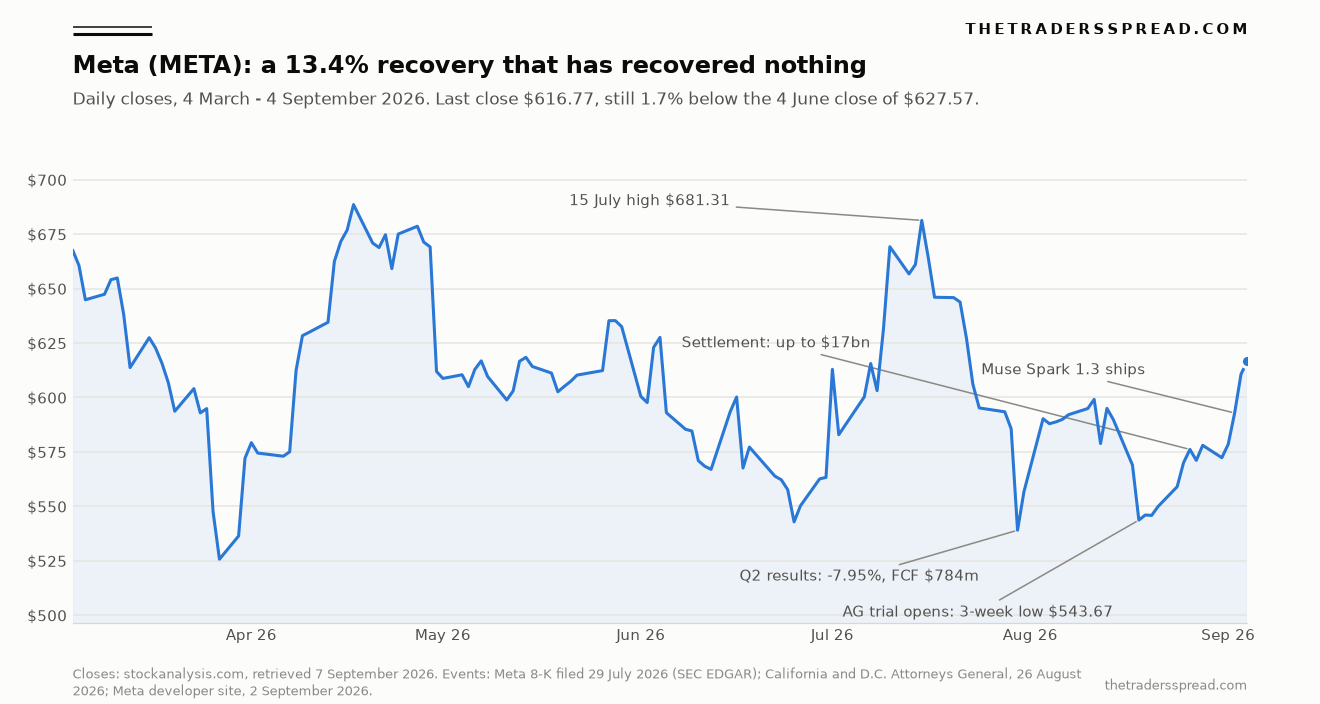
Meta Platforms (NASDAQ: META) closed at $616.77 on Friday 4 September 2026, up 13.45% from the $543.67 close of 18 August. Over the same three weeks the company filed nothing with the SEC and changed no guidance. Both of those statements are true at once, and so is a third: at $616.77 the stock is still 1.72% below its 4 June close of $627.57, and 9.5% below the $681.31 it printed on 15 July. A stock that has recovered this hard has recovered nothing. The rally took price back to where it sat before the second-quarter results, and stopped there. Everything the market was punishing in late July, a full-year capital expenditure floor of $130 billion and quarterly free cash flow of $784 million, is still exactly what Meta has guided to. Nothing about the spending has been withdrawn, softened or re-cut. Only the price changed.
The detail that gets lost in the coverage is what Meta did not file. Between the results 8-K of 29 July 2026 and 4 September, Meta's EDGAR index carries no Form 8-K at all: only Forms 4, Rule 144 notices, a Schedule 13G/A and the 10-Q. A settlement the California Attorney General's office valued at up to $17 billion arrived on 26 August without an accompanying current report, because Meta had already taken $2.40 billion of legal charges into second-quarter general and administrative expense and, at the guaranteed floor of roughly $1.21 billion a year, the obligation is smaller than a fortnight of the company's capital spending. The second thing nobody is pricing sits three lines down the cash flow statement: Meta repurchased zero shares in the first half of 2026, against $22.92 billion in the first half of 2025. The buyback did not shrink. It stopped.
Key facts
- META closed at $616.77 on 4 September 2026, +13.45% from the 18 August close of $543.67, and +6.70% over the last five sessions — stockanalysis.com daily closes, retrieved 7 September 2026.
- Over three months the stock is down 1.72% from the 4 June close of $627.57, and 9.5% below the 15 July close of $681.31 — same series.
- Q2 2026 free cash flow was $784 million, against $8.55 billion a year earlier, on operating cash flow of $31.86 billion and $30.12 billion of property and equipment purchases — Meta Q2 2026 results, Form 8-K Exhibit 99.1, 29 July 2026.
- Full-year 2026 capital expenditure guidance is $130–145 billion, narrowed from $125–145 billion. The low end went up, not down — same filing.
- Operating margin was 31% in Q2 2026 against 43% a year earlier; total costs and expenses rose 55% year on year to $42.03 billion — same filing.
- The multistate child-safety settlement guarantees at least $12.1 billion over ten years, rising toward $17.1 billion only if rival platforms adopt comparable measures — Office of the Attorney General for the District of Columbia, 26 August 2026.
- Share repurchases in H1 2026: $0, against $22.92 billion in H1 2025 — Q2 2026 condensed consolidated statements of cash flows.
A ledger of the three weeks, by date
The run was not one move. It was three, and only two of them have a named cause.
The hole came first. On 17 and 18 August META fell 3.54% and then 4.45%, the second of those on 27.1 million shares against a 17.7 million average over the prior 85 sessions, as a bipartisan coalition of state attorneys general opened its child-safety case against the company before Judge Yvonne Gonzalez Rogers in the Northern District of California. That put the stock at $543.67, its lowest close since the earnings crash of 30 July.
From 19 to 25 August the stock added 4.85% across five sessions on unremarkable volume, with no company disclosure and no filing to hang it on. It is drift off a washed-out low, and it should be described that way rather than reverse-engineered into a narrative.
Then 26 August, and the settlement. META closed up 1.07% at $576.14 on 31.4 million shares, the second-heaviest session since the results. And then the last leg: 2.47% on 2 September, 3.01% on 3 September and 1.00% on 4 September, coinciding with the release of Muse Spark 1.3 to paying developers through Muse Code and the Meta Model API on Wednesday 2 September, as first reported by Bloomberg the same day.
What $17 billion actually costs Meta
The reported settlement figure ranges from $16.68 billion to $18 billion depending on which outlet you read, and the spread is not sloppiness. It is structure. The District of Columbia's Attorney General describes a guaranteed component of at least $12.1 billion payable over ten years, with a further $5 billion contingent on other major platforms adopting comparable safety features, which is how the headline reaches $17.1 billion. California's release, from the coalition's co-lead, headlines "up to $17 billion over ten years" and puts the state's own share at $1.5 billion to $2.1 billion. Fifty-one attorneys general signed.
Run the guaranteed number against the company's own arithmetic. Meta's second-quarter capital expenditure including principal payments on finance leases was $31.08 billion, roughly $342 million a day. The $12.1 billion floor is therefore about 35 days of capital spending, spread across a decade. Against full-year expense guidance of $165–169 billion, the annual instalment of roughly $1.21 billion is 0.72% of costs. Against a diluted market capitalisation near $1.58 trillion at Friday's close, the whole ten-year floor is 0.76%.
That is why the stock rose on it.
The non-monetary terms are the part that carries real operating consequence, and they are not priced at all. Under the proposed consent judgment Meta must default under-18 accounts to a two-hour daily limit, block overnight access, suppress notifications during school hours, remove visible like counts and cosmetic-procedure filters for minors, offer a non-personalised feed, deploy age assurance, and submit to an independent auditor. Ad impressions across the Family of Apps rose 14% year on year in Q2 and average price per ad rose 12%. Impression supply from the most engaged cohort on the platform is now contractually capped.
"Meta has agreed to make massive transformations that will reduce the risk of harm from its platforms — and will do it within months." — Rob Bonta, Attorney General of California, 26 August 2026
"Meta intentionally exploited kids for profit and then lied about it, claiming its products were safe when its own internal research confirmed the platforms were addictive and harmful." — Brian L. Schwalb, Attorney General for the District of Columbia, 26 August 2026
Meta denied wrongdoing. "Within months" is the phrase to hold on to: the product changes land inside the fourth-quarter and first-quarter monetisation windows, not in some distant compliance horizon.
Best over three weeks, second-worst over three months
Rebase the megacap complex on the same two windows and the contradiction stops being rhetorical. All figures below are close-to-close from stockanalysis.com daily data retrieved on 7 September 2026; the three-month anchor is the 4 June 2026 close.
| Ticker | Close, 4 Sep | 18 Aug to 4 Sep | 3 months (4 Jun to 4 Sep) |
|---|---|---|---|
| META | $616.77 | +13.45% | −1.72% |
| NVDA | $230.36 | +4.83% | +5.35% |
| MSFT | $499.70 | +3.75% | +16.74% |
| AAPL | $319.97 | +3.21% | +2.81% |
| AMZN | $258.51 | −0.36% | +1.86% |
| GOOGL | $338.46 | −1.67% | −9.06% |
Meta is the best of the six over three weeks and the second-worst over three months. It is the only name in the group whose three-week gain exceeds its three-month gain by more than fifteen percentage points. Nvidia's own quarter, covered in our note on Nvidia's $108 billion Q3 guide, landed on 26 August and lifted the AI complex generally, but Meta outran it by more than eight points over the window. Alphabet, the closest structural comparison in digital advertising, went the other way in both columns.
The read is not that Meta got good news the others missed. The read is that Meta had further to bounce, because it had been sold harder.
The cash statement is the story the tape ignored
Second-quarter revenue was $60.80 billion, up 28% year on year, with advertising revenue at $59.36 billion. Family of Apps operating income was $23.39 billion, down 6% on a year earlier despite that revenue growth, because research and development rose from $12.94 billion to $21.66 billion and general and administrative from $2.66 billion to $5.61 billion. Reality Labs lost $4.62 billion on $431 million of revenue.
Below the operating line, the balance sheet moved further than the income statement. Property and equipment net of depreciation went from $176.40 billion at 31 December 2025 to $225.72 billion at 30 June 2026, an increase of $49.32 billion in six months. Long-term debt went from $58.74 billion to $83.66 billion, with $24.91 billion of net proceeds raised in the second quarter alone. Cash and cash equivalents fell from $35.87 billion to $15.46 billion.
And the buyback went to zero. Meta repurchased no Class A shares in the six months to 30 June 2026, against $22.92 billion in the equivalent 2025 period. For a company that spent the last three years using repurchases as the shock absorber under its share count, that is a structural change in the flow of demand for its own stock, disclosed in a table rather than a headline. Dividends continued at $1.35 billion for the quarter, which is roughly one twentieth of what the buyback used to be.
None of that reversed in the three weeks the stock rose 13.45%. The next time any of it is updated is the third-quarter report, on guidance of $61–64 billion of revenue and a tax rate of 15–17%.
"AI is accelerating our core business today, powering our next generation of products, and opening the door to entirely new enterprise opportunities. The results are already showing, and I'm optimistic about the potential ahead." — Mark Zuckerberg, founder and CEO, Meta Platforms, in the company's Q2 2026 results release filed with the SEC, 29 July 2026
How big a win was Muse Spark 1.3, measured on Meta's own scoreboard
Meta's published benchmark table does not say what the tape assumed it said. On DeepSWE v1.1, the long-horizon agentic coding test, Muse Spark 1.3 scores 75.4 against 74.0 for Anthropic's Opus 5 and 73.0 for OpenAI's GPT-5.6 Sol. That is a lead of 1.4 points over the nearest rival, and a jump of 20.4 points over Meta's own Muse Spark 1.2 at 55.0. On MRCR long-context retrieval between 256K and 512K tokens it posts 98.5 against 91.5 for GPT-5.6 Sol. On Terminal-Bench 2.1 it ties GPT-5.6 Sol at 88.8.
On GDPVal-AA v2, the knowledge-work benchmark at the top of the same table, Muse Spark 1.3 scores 1754 against 1824 for Opus 5. It loses that one by 70 points. Every figure above is Meta's own, for the "max" reasoning setting, published on its developer site and retrieved on 7 September 2026. Pricing is $1.25 per million input tokens and $4.25 per million output, with a 1M-token context window.
A 1.4-point lead on one self-published eval is a real engineering result. It is not, on its own, a $95 billion change in enterprise value, which is roughly the $98 billion of market capitalisation the three sessions from 1 to 4 September added.
The buying is lighter than the selling was
Volume tells the cleanest version of this. Against a 17.7 million share average over the 85 sessions to 29 July, every session that carried a hard news event traded heavy: 42.3 million shares on 30 July (2.39x), 27.1 million on 18 August (1.53x), 31.4 million on 26 August (1.78x). The three sessions that completed the recovery did not: 16.5 million on 2 September (0.93x), 18.9 million on 3 September (1.07x), 15.7 million on 4 September (0.89x).
The single best day of the entire recovery, 3 September at +3.01%, printed on 1.07 times average volume. Distribution came on conviction. The repair has come on ordinary flow, which is the signature of short covering and index-level buying rather than fresh institutional accumulation. That does not make the move fake. It makes it thinner than the chart implies.
RelatedTSMC (TSM) Falls 3.4% Ahead of the Q3 Earnings Print
Sell-side positioning has not caught up either way. Sixty-two analysts polled by S&P Global carry a consensus of Strong Buy with an average target of $754.77, a median of $750, a high of $1,000 and a low of $580, retrieved 7 September 2026. The lowest target on the street sits 5.96% below Friday's close, which is a rare configuration and a reminder that the bear case here is held by almost nobody in the ratings distribution.
What this changes
The settlement removes a defined tail risk and replaces it with an undefined operating constraint. Before 26 August, an adverse finding in Oakland was an open-ended number that no model could size. After it, the cash cost is a known 0.72% of annual expenses and the real cost has moved into product: default time limits, night blocks, school-hours notification suppression and age assurance across the under-18 base, delivered "within months" on the California Attorney General's own description. Impression growth of 14% year on year in Q2 was the engine of the quarter. The first quarter in which that engine runs with the new limits in place is the one to watch, and it is Q4 2026, reported in late January.
Second, the capital question is untouched and now sits alone. With the legal overhang settled and a competitive model shipped, there is no longer anything standing between the share price and the spending line. Full-year capital expenditure of $130–145 billion against second-quarter free cash flow of $784 million is the whole debate, and the next data point is the third-quarter report. Watch three things in it: whether the capex range narrows again and in which direction, whether free cash flow turns negative on a quarterly basis, and whether the buyback restarts. A resumed repurchase would say management believes it can fund both. Continued suspension says the build is consuming everything.
Third, the peer dispersion is now doing work. Meta at −1.72% over three months against Microsoft at +16.74% is not a sector call, it is a company-specific discount that survived a 13.45% rally. The same capital-intensity question is being asked of every AI builder, and the market is answering differently for each, as the divergence between our Amazon outlook, our Apple outlook and the margin-guidance repricing at AMD shows. Meta is the purest expression of the trade because it has the least diversified revenue base to fund it: 97.6% of second-quarter revenue was advertising.
The stock has recovered its price. It has not recovered its multiple, its free cash flow, its buyback or its margin. Those are four separate questions with one shared answer date.
FAQ
How much did Meta stock actually rise, and over exactly what window?
META closed at $543.67 on 18 August 2026 and $616.77 on 4 September 2026, a gain of 13.45% across twelve trading sessions. Over the last five sessions of that run the gain was 6.70%. The 4 September close is the most recent completed session, since 7 September is a Monday before the US open. All closes are from stockanalysis.com daily data retrieved on 7 September 2026.
If the stock rose 13.45%, why does the article say it has recovered nothing?
Because the starting point was a hole, not a base. At $616.77 the stock is 1.72% below its 4 June close of $627.57 and 9.5% below its 15 July close of $681.31. The rally carried price back to roughly where it traded before the second-quarter results and stopped. Meanwhile every figure that caused the July selling, capex guidance of $130–145 billion, free cash flow of $784 million and a 31% operating margin, is unchanged.
Is the child-safety settlement $16.68 billion, $17 billion or $18 billion?
All three appear in coverage because the deal has a floor and a ceiling. The District of Columbia Attorney General's release describes at least $12.1 billion guaranteed over ten years, with a further $5 billion contingent on other major platforms adopting comparable safety measures, reaching $17.1 billion. California's release headlines "up to $17 billion". The guaranteed component is the one that belongs in a model.
Did Meta file an 8-K about the settlement?
No. Meta's EDGAR filing index shows no Form 8-K between the results 8-K of 29 July 2026 and 4 September 2026. The company had already recognised $2.40 billion of charges related to legal proceedings in second-quarter general and administrative expense, and raised the low end of its full-year expense outlook to $165–169 billion to incorporate them.
What is the significance of Meta halting its buyback?
Meta repurchased $0 of Class A stock in the six months to 30 June 2026, against $22.92 billion in the same period of 2025, while raising $24.91 billion of net long-term debt in the second quarter. Repurchases had been a standing source of demand for the shares and a brake on dilution. Their absence means the share count is no longer being managed down while capital spending runs at roughly $342 million a day.
What is the next scheduled catalyst?
The third-quarter 2026 results, guided at $61–64 billion of revenue with a 15–17% tax rate for the remaining quarters. That report is the first opportunity for management to revise the $130–145 billion capital expenditure range, update free cash flow, and address whether repurchases resume. Meta's own release also flags continued youth-related regulatory scrutiny in several markets as a live risk to results.
Disclaimer
This article is analysis and information, not investment advice, and no part of it is a recommendation to buy, sell or hold any security. Prices, filings and benchmark figures were retrieved on 7 September 2026 and change without notice. Trading and investing carry risk, including the total loss of capital. Readers should conduct their own research and consider their own circumstances, or consult a licensed adviser, before acting on anything published here.