

"Will the US add between 0 and 25k jobs in October?" is the US nonfarm payrolls line at a Yes price of 0.2175. The best bid on that leg was 0.198 and the best ask was 0.237, so the displayed price is the midpoint of the quote, while the last trade on the same leg printed at 0.122.
The line sits on the Polymarket nonfarm payrolls ladder, the monthly jobs-added event whose rules pay the change in total nonfarm payroll employment. Links to Polymarket are affiliate links, from which The Traders Spread may earn a commission at no cost to you. We pulled the book from gamma-api at 09:02 UTC on 25 October 2026, event slug how-many-jobs-added-in-october-2026. Seven Yes mids added to 1.041. Event volume was $24,358.48, event liquidity was $16,748.84, and $469.77 traded in the prior 24 hours. Every leg was still open, and a resolved leg sitting at 1.00 on an empty book is a different screen.
Each rung is 25,000 jobs wide. The Employment Situation technical note, last modified 2 October 2026, puts the 90 percent confidence interval on the monthly change in total nonfarm employment on the order of plus or minus 122,000. September's printed change was a gain of 29,000. Apply that interval and the range runs from about a loss of 93,000 to about a gain of 151,000, which reaches both ends of this ladder. The contract will still pay exactly one rung, on the point estimate the release prints.
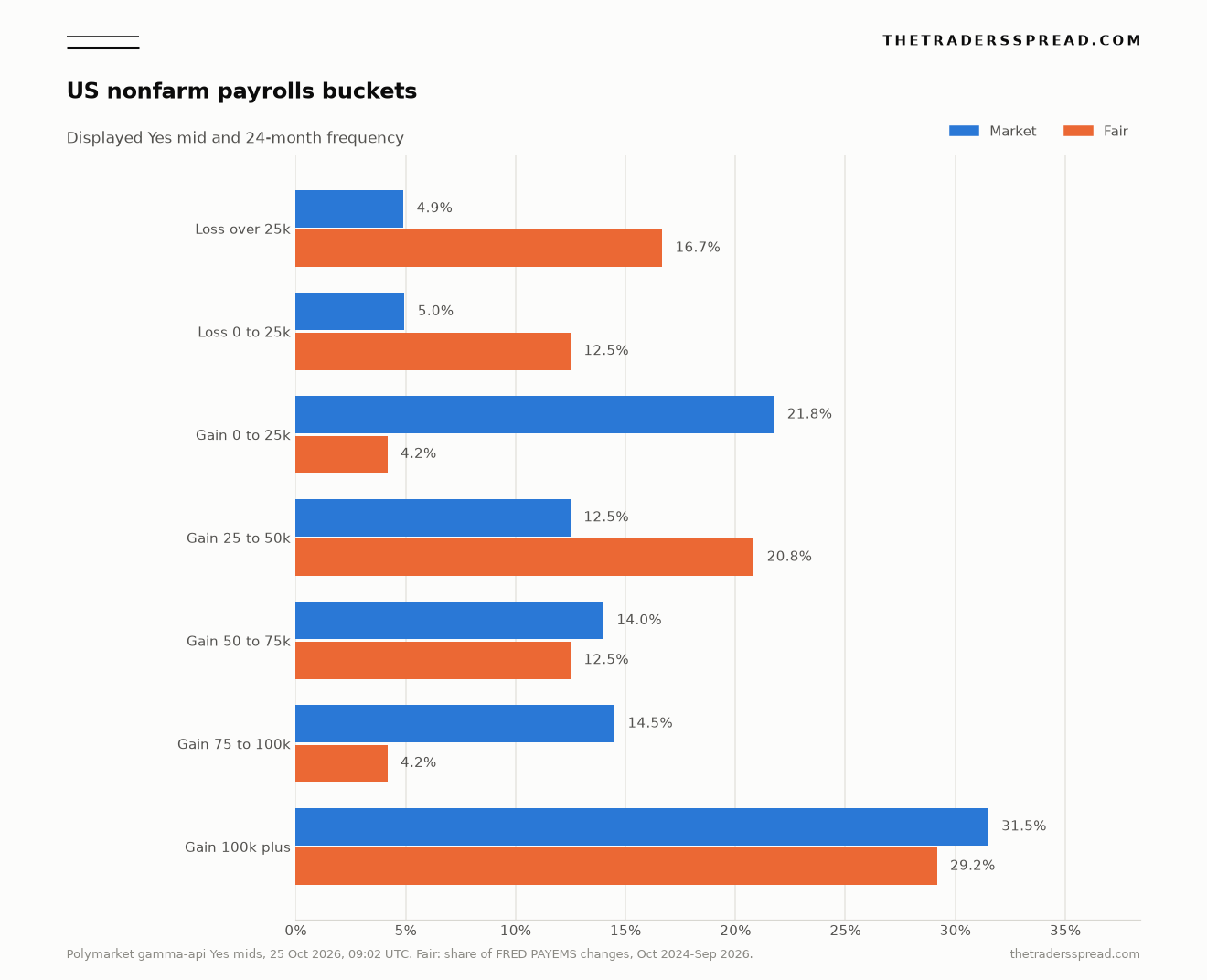
A second cut uses revised history. On FRED series PAYEMS, retrieved 25 October 2026, one of the 24 seasonally adjusted monthly changes from October 2024 through September 2026 landed from zero through 24,000, a 4.2 percent share. The displayed mid is 21.75 percent, above the reference frequency used as the fair value on the chart. The frequency counts revised changes with equal weight, and the contract pays a first print, so the shared bracket label covers two different questions.
Updated 25 October 2026 against the September Employment Situation, the PAYEMS vintage retrieved the same day, and the gamma-api book named above.
Key facts
- The Yes price on a gain of 0 to 25,000 jobs was 0.2175, with a best bid of 0.198, a best ask of 0.237, and a last trade at 0.122. Source: Polymarket gamma-api, 25 October 2026.
- Seven Yes mids on the October jobs-added event summed to 1.041, with $24,358.48 of volume, $16,748.84 of liquidity, and $469.77 traded over the prior 24 hours. Source: Polymarket gamma-api, 25 October 2026.
- Total nonfarm payroll employment rose by 29,000 in September 2026, after a prior-12-month average gain of 45,000, and the unemployment rate was 4.2 percent. Source: Bureau of Labor Statistics Employment Situation, 2 October 2026.
- July's payroll change was revised from a gain of 21,000 to a loss of 10,000, and August's from a gain of 162,000 to a gain of 133,000, a combined 60,000 lower. Source: Bureau of Labor Statistics, 2 October 2026.
- The October 2026 Employment Situation is scheduled for 6 November 2026 at 8:30 a.m., and the November release for 4 December 2026 at 8:30 a.m. Source: Bureau of Labor Statistics release calendar, retrieved 25 October 2026.
- One of 24 revised monthly changes from October 2024 through September 2026 fell between 0 and 25,000, a 4.2 percent share. Source: FRED series PAYEMS, retrieved 25 October 2026.
1. The printed change against the recent pace
We opened the Employment Situation for September 2026, embargoed until 8:30 a.m. Eastern time on Friday, 2 October 2026, under USDL-26-1549. Total nonfarm payroll employment changed little, at a gain of 29,000, after an average monthly gain of 45,000 over the prior 12 months. The unemployment rate was 4.2 percent. The bracket named in the contract takes that employment change and leaves the wage line and the hours line aside.
A surveyed consensus is what usually reprices the ladder before that embargo. The comparison the release itself prints is a gain of 29,000 against a prior-12-month average of 45,000. Both sit in the rung for a gain of at least 25,000 and below 50,000, so a 16,000-job gap stayed inside one rung.
The table sets the October book beside that history, with the Yes mid in the market column and the share of the 24 revised changes in the fair column. Their mean is about 47,000 and their standard deviation about 98,000. Four months show a loss of more than 25,000 and seven show a gain of 100,000 or more. May 2025, at a revised 13,000, is the only month in the gain of 0 to 25,000.
| Bracket | Yes mid | Bid / ask | Volume | Reference frequency |
|---|---|---|---|---|
| Loss of more than 25,000 | 0.049 | 0.022 / 0.076 | $1,506.48 | 16.7 percent, 4 of 24 |
| Loss of 0 to 25,000 | 0.0495 | 0.010 / 0.089 | $2,142.11 | 12.5 percent, 3 of 24 |
| Gain of 0 to 25,000 | 0.2175 | 0.198 / 0.237 | $2,376.45 | 4.2 percent, 1 of 24 |
| Gain of 25,000 to 50,000 | 0.125 | 0.12 / 0.13 | $1,655.33 | 20.8 percent, 5 of 24 |
| Gain of 50,000 to 75,000 | 0.14 | 0.13 / 0.15 | $1,875.52 | 12.5 percent, 3 of 24 |
| Gain of 75,000 to 100,000 | 0.145 | 0.129 / 0.161 | $1,761.99 | 4.2 percent, 1 of 24 |
| Gain of at least 100,000 | 0.315 | 0.30 / 0.33 | $13,040.60 | 29.2 percent, 7 of 24 |
The seven mids sum to 1.041, so the chart leaves that overround unscaled while the fair column, all 24 months, sums to one.
The gain of 0 to 25,000 had $2,376.45 of volume and $2,058.44 of liquidity. Marking it to the last trade produces 0.122, while outcomePrices is 0.2175, the mid of bid and ask on every leg in this fetch, against an offer of 0.237. The fair value on the leg is the 4.2 percent frequency, one month in 24, and the mid sits above that coarse base rate.
The Bureau's account on X posted the September characterization on 9 October 2026, and the post points at the official nonfarm total.
Nonfarm employment little changed in September 2026 https://t.co/sjh6as1I3K #BLSdata pic.twitter.com/nopcUo69Gp
— BLS-Labor Statistics (@BLS_gov) October 9, 2026
2. Where a round number goes
The event text pays the change in total nonfarm payroll employment in the Employment Situation Summary, and a value that falls exactly between two brackets goes to the higher range. On this ascending ladder that means exactly zero pays a gain of 0 to 25,000, exactly 25,000 pays 25,000 to 50,000, and exactly 50,000, 75,000, and 100,000 each step one rung toward the larger gain. A loss of exactly 25,000 pays the smaller-loss rung. A print of 24,000 pays the opening line, and a print of 25,000 pays the next rung, which is where September's 29,000 sits.
PAYEMS publishes levels in thousands, and September 2026 is 159,044 against August at 159,015, a difference of 29, the same integer the release states. The sensitive prints are 0, 25, 50, 75, and 100. How a proposer and a disputer argue that sentence is the procedure in the resolution explainer. The ladder's own words already pick the higher rung on those five integers.
3. Revisions, and the month a delay substitutes
The September release revised July from a gain of 21,000 to a loss of 10,000, down 31,000, and August from a gain of 162,000 to a gain of 133,000, down 29,000. Combined, employment in those two months is 60,000 lower than previously reported. Additional reports and new seasonal factors, calculated with the current month included, revise the three most recent establishment estimates. The newest month stays preliminary until two successive revisions are in.
July's first published change, a gain of 21,000, would have sat in the gain of 0 to 25,000. The revised loss of 10,000 sits in the loss of 0 to 25,000, so the revision crossed a boundary. August's revision stayed at or above 100,000, and the rung label survived the haircut. October's contract pays the change in the summary scheduled for 6 November 2026, and a later rewrite of that change is a later document.
If data for the specified month are still unpublished on the date the next month's data are scheduled, the market resolves on data from the last available month. The BLS calendar, read on 25 October 2026, puts the October reference month out on 6 November 2026 at 8:30 a.m. and the November reference month out on 4 December 2026 at 8:30 a.m. The delay clock is that December morning. The last monthly change on the Employment Situation we opened is September's gain of 29,000, which maps to the gain of 25,000 to 50,000.
The first print also carries a birth-death adjustment: an offset for firms the survey misses, plus an ARIMA residual fit to unemployment-insurance microdata. The annual benchmark then aligns the sample to March universe counts. Its absolute average revision over the prior 10 years is 0.2 percent, about 318,000 jobs on the September level of 159,044,000, beside a 25,000-wide monthly flow.
4. The source the contract names
The description on gamma-api names the Bureau's Employment Situation Summary and points to the news-release index. The operative measure is the change in total nonfarm payroll employment from the establishment survey. The technical note says the program surveys about 119,000 businesses and government agencies, representing about 622,000 worksites, about 26 percent of all nonfarm payroll jobs. People count if they worked or received pay for any part of the pay period that includes the 12th of the month, and the length of that period differs by firm.
A private payroll estimate published a day or two earlier can reprice the rung for a gain of at least 100,000. On this fetch that rung carried $13,040.60 of volume, 53.5 percent of the event, at a Yes mid of 0.315, bid 0.30 and ask 0.33. Its reference frequency is 29.2 percent, seven of the 24 months, and the mid sits close to that share. The private estimate is a different sample, and the summary named in the contract is the document that selects the rung.
The same habit of mixing lines shows up on other Bureau releases. The US CPI settlement note is about which inflation line a contract names. Payroll brackets have one published employment change to point at, and the jobs-added settlement is that payroll change.
5. 8:30 a.m. is the print, and the book ends later
The September release states its embargo as 8:30 a.m. Eastern time, and the October contract names the same hour on 6 November 2026. Prices before that stamp are a forecast of an unpublished integer. After the release, the bracket is a price on a number already public, while the book waits for a resolution proposal and the end timestamp is still hours away.
Gamma-api records the event end as 2026-11-07T04:59:00Z. The 2 October 2026 release date fell on a Friday, so 1 November 2026 falls on a Sunday, the first Sunday of that month, which is when US clocks go back. On 6 November, Eastern time is five hours behind UTC, and the end stamp is 11:59 p.m. Eastern on the release date, about fifteen and a half hours after the embargo. A summary that arrives later the same day is still inside the event end. A summary that arrives only with the next reference month hits the delay clause, and that clock is 4 December 2026 at 8:30 a.m.
The House-control note separated a high displayed price from a finished payout. The same separation applies on a payroll morning. A Yes mid of 0.315 on a gain of at least 100,000, quoted 0.30 to 0.33, is an open book with $2,458.36 of liquidity on that leg. A resolved leg at a price of 1, with liquidity gone, would be a payout record. On this fetch the event was active and the legs were open.
RelatedWill the Bank of Russia hold the key rate on 23 October?
6. Strikes, weather, and the pay period that includes the 12th
John P. Mullins, an economist in the Bureau's Office of Employment and Unemployment Statistics, set out the strike rule in the Monthly Labor Review in 2015. Anyone who worked or received pay during the pay period that includes the 12th stays on the establishment count. People on strike for that entire period are off it, while a stoppage that covers only part of a longer period leaves them in. Mullins's example is a stoppage from the 7th to the 17th: a one-week pay period across the 12th drops the strikers, and a two-week period that outlasts the return keeps them.
The CES strike report covers stoppages of 1,000 or more through the whole reference period and is compiled from public sources before the estimates. Sample coverage varies, and replacements can offset the idle. The September summary led with the payroll gain and the 4.2 percent rate, with a strike footnote and a weather footnote absent from that opening. The technical note counts people temporarily absent for bad weather as employed in the household survey, while the establishment count requires work or pay, so a storm through the reference period can cut the payroll change the bracket pays.
7. The household survey on the same morning
The household survey is a sample of about 60,000 eligible households, and its reference period is the calendar week that contains the 12th. September's release put the unemployment rate at 4.2 percent and the number of unemployed people at 7.1 million, both little changed, with the rate inside a range of 4.1 percent to 4.3 percent since March. The labor force participation rate was 61.8 percent and the employment-population ratio was 59.2 percent.
Traders read those lines in the same hour the establishment number prints, and an open ladder can reprice on that reading. The household survey includes agricultural workers, the unincorporated self-employed, and unpaid family workers, counts each person once, and still counts someone temporarily absent for a dispute as employed. The establishment survey leaves those groups out, counts each payroll, and drops a worker who is off the payroll for the whole reference period. A wire can lead with the rate while the rung pays the payroll change.
FAQ
Which line in the Employment Situation settles a payroll bucket?
The jobs-added contract pays the change in total nonfarm payroll employment in the Employment Situation Summary for the named month. The open October book points at the release scheduled for 6 November 2026 at 8:30 a.m. Eastern time. The establishment survey produces that change, while the unemployment rate, hourly earnings, and the workweek sit in other columns of the same release. A private payroll estimate from earlier in the week is a different sample.
Can a later revision move a bracket after the release?
Further sample reports and new seasonal factors revise the prior two months. July 2026 moved from a gain of 21,000 to a loss of 10,000, crossing neighboring rungs, while August stayed at or above 100,000. A contract that names one summary pays the change in that summary. The delay clause substitutes the last available month if the named month is still unpublished on the next release date.
Why does the household survey move the price on payroll morning?
The two surveys cover different people. September put unemployment at 4.2 percent, with 7.1 million people unemployed, while payrolls rose by 29,000. Traders can reprice an open ladder off the rate in that same hour. The resolution sentence names the payroll change, so a wire lead built on the household rate can be the loudest sentence and still leave the rung to the other survey.
What happens if the printed change lands on a round boundary?
The event text sends a reported value that falls exactly between two brackets to the higher range bracket. On this ladder a printed change of exactly 0, 25,000, 50,000, 75,000, or 100,000 steps toward the larger gain, and a loss of exactly 25,000 goes to the smaller-loss rung. September's gain of 29,000 sits between 25,000 and 50,000. September minus August on PAYEMS equals 29, matching the release.
What if the October Employment Situation misses its morning?
If the named month is still unpublished when the next release is due, resolution uses the last available month. The calendar sets that date at 4 December 2026, 8:30 a.m. September's gain of 29,000 maps to the 25,000-to-50,000 rung, and a later revision of that integer would move the mapping with it. A same-day slip past 8:30 a.m. is a different case, since the event ends at 11:59 p.m. Eastern on 6 November.
Which rung is the release actually about?
The September print of a 29,000 gain, and the October book read at 09:02 UTC on 25 October 2026, will go stale while the mapping stays. Which rung pays when the headline change, the higher-range sentence on an exact thousand, and a still-unpublished month disagree?
This is analysis of public contract rules and a government data release, for information only. Prediction-market positions can be lost in full, including when a resolution follows a reading of the rules that a trader did not expect.