

Polymarket resolution can still be open after a contract prints 97.2 cents, and a proposal that looks finished is not finished while a challenge window can still take a counter-bond. The price is a trade. The settlement is a bonded claim that can be ignored, replaced, or sent to a vote.
How Polymarket resolution works is that fork, not the last print. One path lets a proposal sit through a challenge period and settle. The other throws the first proposal out of the settlement and opens a second request. Only a further dispute sends the question to UMA's Data Verification Mechanism. Links to Polymarket are affiliate links, from which The Traders Spread may earn a commission at no cost to you. The Bank of Israel Decision in October event was still unresolved when its page and the gamma-api record were read on 21 October 2026, hours after the market's own end timestamp.
In records updated at 07:28 UTC that day, No Change showed a Yes outcome price of 0.972, a best bid of 0.966, a best ask of 0.978, and a last trade at 0.978. Decrease was 0.025. Increase was 0.004. Event volume was $116,124.33 and liquidity was $15,068.92. Each bracket had an empty umaResolutionStatuses list, closed was false, and umaBond and umaReward were 500 and 5. Polymarket's Resolution page calls a typical bond $750 pUSD and describes a 2-hour challenge. UMA's page on how UMA resolves prediction markets says a flagged proposal can have that window extended by a length that is not fixed, and that requests carry a proposer whitelist. No proposal had been posted, so none of those clocks had started.
Updated 21 October 2026
What does a price promise before anything is proposed?
Almost nothing about the payout.
The Resolution page says the market title describes the question, but the rules define how it resolves. A title can sound settled while the rules still name a source, a comparison, and a fallback that fires on a later date. The token price does not edit that paragraph.
When a market does resolve, winning tokens redeem for $1 each and losing tokens become worthless. Trading stops. The help-center article How Are Prediction Markets Resolved?, schema-dated 11 January 2026, says the same payout and still calls the bond USDC.e. Neither page treats a 97-cent token as a dollar already owed. A proposal is what starts the report: an outcome, a bond, a submission. Until that transaction exists there is nothing to dispute. The empty status list is that absence. The same split is why a book like the Nobel Peace Prize market can show a leader and still be only a trade.
How does an undisputed proposal settle?
The Resolution page lists three moves. Select the outcome. Post a bond, typically $750 pUSD. Submit it to the UMA Oracle. If the proposal is correct and undisputed, the proposer gets the bond back plus a reward. After the proposal there is a 2-hour challenge period. If nobody disputes, the proposal is accepted and the market resolves. The page calls that the fastest flow: propose, then resolve, in about 2 hours.
"Anyone" on that page is not the last word on who may propose. UMA's integration page says these requests use a proposer whitelist on ManagedOptimisticOracleV2. This piece did not open the list, so it names no addresses. The product sentence and the oracle sentence are not the same gate. A dispute, once a proposal exists, is a separate act.
Propose incorrectly or too early, the Resolution page says, and you lose the entire bond. The January help article puts that at $750. The dispute article, schema date 5 April 2026, says the counter-bond matches it, "usually $750." Gamma-api recorded umaBond of 500 and umaReward of 5 on the Bank of Israel brackets, on Argentina's World Cup leg, and on the suit market. The usual figure in the docs is not the field on these contracts.
UMA's oracle overview describes the happy path without that dollar figure. Each request can be proposed once, and each proposal disputed once. If no dispute arrives, the proposal settles as correct and the proposer receives the reward and the refunded bond. A sloppy first claim is not edited in place. A dispute drops it from the settlement.
What does the first dispute change?
It does not, by itself, start the token-holder vote.
The Resolution page says a dispute begins a new proposal round. If the second proposal is also disputed, resolution escalates to the DVM. The three flows are no dispute; one dispute followed by a second proposal that is accepted; and two disputes, ending in a vote. UMA's integration page adds the consequence. A second request uses the same rules. Settlement ignores the first request and resolves only on the second. If that second request is disputed, the market resolves as per the second request. The point of the extra round is to stop a one-time error forcing a full vote.
The help-center dispute article, modified 5 April 2026, compresses this. Using the 2-hour window, it says, begins a debate of 24-48 hours and then a vote of about 48 hours. The Resolution page, read on 21 October 2026, still has those debate and vote lengths, but it places them on the path that reaches voters. Evidence in the debate goes to UMA's #evidence-rationale and #voting-discussion channels. The dispute itself is posted on the UMA oracle app. Neither channel rewrites the market's rules.
Two hours is a default, not a promise that every proposal lives or dies at minute 120. UMA says requests set a minimum challenge period. Risk Labs can extend a flagged proposal by a length that is not fixed, and that review team ends the extension. An unflagged sports proposal can use a short minimum, the page's example is 15 minutes, while a complex geopolitics proposal can run past two hours. Polymarket's timeline still prints 2 hours. One number is the product doc. The other is the valve on the oracle.
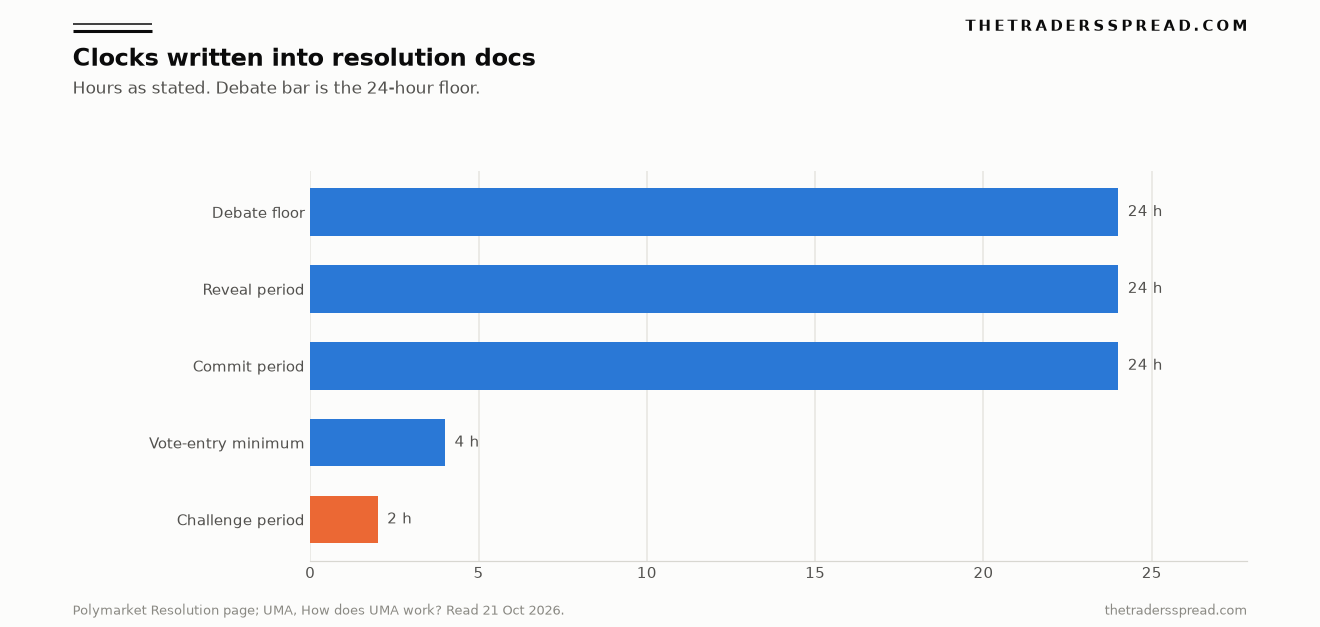
The bars are hours written on the pages, not a forecast. Orange is the 2-hour challenge. Four hours is the minimum age before a dispute can enter a voting round. Commit and reveal are 24 hours each. The debate bar is only the floor of the 24-48 hour range. Polymarket's "about 48 hours" matches commit plus reveal, and it leaves out both the wait for 24:00 UTC and any extension. A flagged proposal can outlast the orange bar.
When does a UMA vote happen, and what can it return?
Rarely, on UMA's own telling. The page How does UMA work? says the optimistic oracle resolves the vast majority of requests, "currently 99.8%," and escalates the rest. That is an oracle-wide figure as the page stood on 21 October 2026, not a Polymarket hit rate. Most requests are meant to die in the challenge window.
When a dispute does reach the DVM, stakers commit secret votes for 24 hours and reveal them for 24 hours. Rounds turn at 24:00 UTC. A dispute under 4 hours old waits. Passage needs at least 65% of staked UMA on one outcome. Abstainers and the minority are slashed, and that stake goes to the majority. Unstaking waits a week, so a corrupt majority would still be holding the token. That is UMA's account of the cost.
Polymarket lists four results. If the proposer wins, the proposal stands and the proposer gets the bond back plus half the disputer's bond. If the disputer wins, the proposal is rejected and a new one is required, with the same style of bounty. Too Early means the event has not concluded, and the proposer loses the bond. On a second or later request, UMA opens another request and leaves the market up. Too Early is not a backdoor No. Unknown, or 50-50, is rare: each token redeems for $0.50. The vote replaces the price. It does not average it.
UMA's page on bond and liveness parameters keeps the bounty at half the losing bond, so a caught proposer cannot front-run an honest disputer. Its OOV3 illustration is a 10,000 USDC bond: 15,000 to the winner, 5,000 to the Store. That is not the bond of 500 on the markets here. Polymarket's table is the same half-bond idea. Neither page sizes the bond to volume, which is how a book with hundreds of millions in historical volume can still show a bond field of 500. The chip makes a wrong proposal cost something. It is not a share of open interest.
Polymarket's timeline puts a disputed resolution at 4 to 6 days, against about 2 hours if nobody objects. The dispute article is blunt about the end of the path. "Polymarket is non-custodial and cannot alter or reverse market resolutions. Once finalized by UMA, outcomes are immutable."
Which resolved markets took the quiet path and the long one?
Two closed markets, pages opened on 21 October 2026, show the fork as status strings rather than as a theory.
Argentina's leg of World Cup Winner is the quiet path. Gamma-api recorded "Will Argentina win the 2026 FIFA World Cup?" with statuses proposed, then resolved. Outcome prices were 0 and 1, so No is the paying side. Volume was $174,315,688.26. Bond 500, reward 5. The end timestamp was 2026-07-20T00:00:00Z. Closed time was 2026-07-20 01:24:43 UTC, 1 hour, 24 minutes and 43 seconds later. The event page showed Spain marked Yes and Argentina marked No, with an Argentina volume line of $174,315,688.
The rules follow the team that wins. A knockout elimination can make the market eligible for No before the final. Cancellation, or no champion by 13 October 2026 at 11:59 PM, resolves it to Other. FIFA's own information is the primary source, and credible reporting can be used as well. Eligible is not the same as settled. The status list still shows a proposal, then a resolution, and no dispute.
That 84-minute gap is not a measured challenge period. The pull did not include the proposal's block time, and customLiveness of 0 is not converted here into seconds. The negative fact is the one the field supports. Recorded path: proposal, then resolution. Polymarket's first flow, after the fact, on a sports market that could also settle early.
The long path is Will Zelenskyy wear a suit before July? The page showed it resolved, with volume displayed at $242,231,180 and the chance under 1%. Gamma-api volumeNum was $242,231,180.27. Outcome prices were 0 and 1. Bond 500, reward 5. End timestamp 2025-06-30T12:00:00Z. Closed time 2025-07-09 00:30:39 UTC, which is 8 days, 12 hours, 30 minutes and 39 seconds later. The status array was not proposed, then resolved. It was proposed, disputed, five times, and it never used the word resolved, even though the page and the prices say the market settled.
Yes, on that gamma text, needed a photograph or video of Volodymyr Zelenskyy in a suit between 22 May and 30 June 2025, Eastern Time, released inside the window and not generated or edited. Otherwise No. The source is a consensus of credible reporting. The page listed 21,295 comments. Those are not the five dispute pairs in the status array.
Five pairs is longer than the two-dispute sketch. UMA allows the extra length without naming this market: Too Early on a second or later request opens another request. These strings do not say Too Early, and they do not name a majority. Inventing the vote would be a guess. The contrast does not need it. Argentina stored one proposal and a resolution near its end timestamp. The suit market stored five pairs and was still open, on these clocks, more than eight days after its end. A high price in that window was a trade about a text a later proposal, or a vote, still had to read.
Where do the Bank of Israel rules sit against a 97.2-cent print?
The event is still open, which is why it sits beside the closed paths. It is evidence about Polymarket resolution, not a view on Israeli rates. Three brackets share one rules text, and each is its own Yes/No market.
Related2028 Presidential Winner: Vance 20.5 Cents, Fair Lower
Resolution follows the change in the Bank of Israel rate at the October decision, versus the rate before it. The source is the bank's release after the 21 October 2026 decision. The market may resolve as soon as that release, with the data, is out. If no rate decision is issued by the end of the next scheduled meeting, the market resolves to No Change.
The fallback does not say the end timestamp passed, so pay No Change. It waits on the next meeting. Gamma's endDate was 2026-10-21T00:00:00Z. At 07:28 UTC, more than seven hours later, closed was false and the status lists were empty. The event page said the scheduled end had passed and the market was not officially resolved. A 0.972 Yes was traders marking a bracket, not the fallback firing, and not a proposal anyone could dispute.
The Yes prices 0.972, 0.025 and 0.004 sum to 1.001 because they are separate markets. Volumes were $65,576.13, $34,609.77 and $15,938.43. No Change's last trade, 0.978, sat next to a 0.966 bid and a 0.978 ask. Decrease last traded at 0.022 against an outcome price of 0.025. "The price" is already a choice of field. Each bracket carried the bond of 500 and the reward of 5, and the resolver 0x69c47De9D4D3Dad79590d61b9e05918E03775f24, which the event page also showed. An empty status list means that address had not been handed a bonded outcome in this record.
An experimental AI summary on the page, updated 20 October 2026, is labeled as playing no role in resolution. Its figures are left out here. The schedule URL in the rules did not return decision text, so the bank's announcement is not a fact in this account. Price, bond, empty list, and fallback still leave open whether a proposal will be Too Early, a clean No Change, or a dispute about the release. The largest-company market is a different question with that same gap. The card is not the measurement the rules will use.
Can a clarification rewrite the question after trading starts?
Clarifications are rare. The Resolution page limits them to circumstances the market did not foresee. The tool is an "Additional context" update. It cannot change the fundamental intent of the question. It is published onchain through the bulletin-board contract. Proposers and voters are told to consider it. Requests go to Polymarket's #market-review channel.
That is not a rewrite. Context can tell voters how to apply the rules to a fact the authors missed. It cannot flip an outcome because the price went the wrong way. The suit rules already contained the fight: what a suit is, what counts as authentic footage, and whether the image landed inside the window. No clarification text turned up on the pages opened for that market, and none is invented here.
The order that matches the docs is original rules, then any published context, then the proposal. A Discord argument is not a clarification unless it was published as one. The bond is kept or lost on the published text. The TIME Person of the Year book draws the same kind of argument about a title. The resolution text, plus later context, is what a proposal has to match.
Why do some markets skip this fork?
The Resolution page names two sources. UMA handles prediction markets. Chainlink TWAP handles up-down markets, with no proposal, no bond, and no vote.
An up-down contract names a pair, a start, and a duration. The starting TWAP is the price to beat. The ending TWAP, from the same stream, is the final price. Up means final is equal to or above that beat. Down means it is lower. The chart here does not apply, because there is no optimistic claim to challenge. A rate decision, a photograph, or a tournament leg stays on the UMA fork until a proposal clears or a vote returns.
What changes in the way you read a price that has not resolved?
You stop treating the cents as a verdict.
On an open market the price is what someone paid for a token that might later redeem at $1, at $0, or, in a rare 50-50 vote, at $0.50. It is not a proposal, so it does not start a challenge and it cannot be disputed. The Bank of Israel book made that concrete at 07:28 UTC on 21 October 2026: a 0.972 Yes on No Change, an empty status list, and a fallback that still pointed at a later meeting.
Once a proposal exists, the status list is the field that tells the paths apart. Argentina's World Cup leg stored proposed, then resolved. The suit market stored five propose-and-dispute pairs and, on the timestamps, was still unsettled more than eight days after its end. One price during either stretch would not have named the list. The list would have.
The reading order does not pick a side. Read the rules, fallback included, and skip a blurb the page says does not govern resolution. See whether a proposal exists. If it does, the product doc's two hours can still be extended by a length UMA does not fix. A first dispute is not the vote. Settlement ignores that request and follows the second. A further dispute brings the debate, the commit, the reveal, and the four results. Too Early can keep the market open. Unknown can pay both tokens $0.50. Added context cannot change the question's intent. Once UMA finalizes, the help article says the outcome is immutable.
A 97.2-cent token can be a sensible trade or a poor one. This page does not decide which. The print is what traders paid while the question was open. Polymarket resolution is the proposal, the dispute, or the vote that comes after, under rules the price does not get to edit.