

I have sat through enough Bitcoin above ladders to stop treating the title as the instrument. The family asks whether a strike is cleared, and the page that pays is the rules block on a fresh weekly event: one Binance BTC/USDT one-minute close, taken at noon in the ET timezone, and compared with the strike by the word "higher."
That sentence is the whole settlement. A daily candle, the high of the hour, a last trade that happens to print as a watch shows 12:00, and a price from a second exchange are different objects. The rules I opened name one of them. The comparator is strict, so a close that merely equals the strike fails it. Precision follows the source, and on BTCUSDT that source steps in hundredths of a USDT.
A search for bitcoin above polymarket lands on this weekly family. The specimen for the open book is Bitcoin above on 12 November, slug bitcoin-above-on-november-12-2026, still active on the Gamma payload whose updatedAt is 2026-11-11T06:50:25Z. Links to Polymarket are affiliate links, from which The Traders Spread may earn a commission at no cost to you. That payload carries eleven markets, an endDate of 2026-11-12T17:00:00Z, event volume of $142,343.10, liquidity of $537,322.31 and an openInterest field of $108,266.29. The event sits in the series BTC Multi Strikes Weekly, recurrence weekly. The negRisk flag on it is false, so the strikes are separate questions grouped on one page.
Updated 11 November 2026 against that Gamma payload, the Binance kline response retrieved at 06:51:39 UTC the same morning, the settled ladder of 10 November, and the resolution pages named below.
Key facts
- The open event bitcoin-above-on-november-12-2026 lists 11 markets and an endDate of 2026-11-12T17:00:00Z, with event volume of $142,343.10 and liquidity of $537,322.31. Polymarket Gamma, payload updated 11 November 2026 at 06:50:25 UTC.
- Its rules resolve to Yes when the Binance BTC/USDT one-minute candle closing at 12:00 in the ET timezone has a final Close higher than the strike in the title. Same Gamma description, read 11 November 2026.
- BTCUSDT is trading with a PRICE_FILTER tickSize of 0.01 USDT. Binance exchangeInfo, server time 11 November 2026 at 06:51:39 UTC.
- On 10 November 2026 the one-minute bar opening at 16:59:00 UTC closed at 72,880.64, and the bar opening at 17:00:00 UTC closed at 72,974.83, a gap of 94.19 USDT. Binance GET /api/v3/klines, retrieved 11 November 2026 at 06:51:39 UTC.
- The settled 10 November ladder of the same family shows outcome prices of 1 and 0, UMA status resolved, with Yes on 68,000, 70,000 and 72,000 and No from 74,000 through 88,000. Polymarket Gamma, payload updated 11 November 2026 at 06:38:33 UTC.
- Prediction-market resolution on Polymarket uses a proposal bond described as typically $750, then a challenge period of 2 hours, and winning tokens redeem for $1.00. Polymarket resolution documentation, opened 11 November 2026.
- Asking the same kline request with timeZone=-5 returned the same three bars and the same closes around 17:00 UTC. Binance GET /api/v3/klines, 11 November 2026 at 06:51 UTC.
The close, and the other numbers in the same minute
People say "the noon print" as if a minute contained one price. The spot REST document says klines are uniquely identified by their open time. In the published example the open time is the first field, the close is the fifth, and the close time is the seventh, the last millisecond of the interval. High, low, volume and trade count fill the other slots. The contract picks one cell of that array.
On 10 November 2026 the bar opening at 16:59:00 UTC closes its time field at 16:59:59.999 and prints a close of 72,880.64, against an open of 72,885.83, a high of 72,949.93 and a low of 72,875.71. The next bar opens at 17:00:00 UTC and closes at 72,974.83, with a high of 72,984.37 and a low of 72,856.16. Retrieved from api.binance.com at 06:51:39 UTC on 11 November 2026, the closes differ by 94.19 USDT.
The open 12 November rules resolve to Yes if the Binance one-minute candle for BTC/USDT closing at 12:00 in the ET timezone has a final Close higher than the price in the title, and otherwise resolve to No. They name the source as the BTC/USDT Close prices on the Binance trade page, with 1m and Candles selected. An open-time timestamp in UTC is absent from the text I read.
Binance identifies the bar by its open time. A reader who takes "closing at 12:00" to mean the bar whose interval ends as noon begins will copy the 16:59 UTC close on a date when noon Eastern is 17:00 UTC. A reader who takes the candle stamped with open time 12:00 will copy the bar that opens at 17:00 UTC. On 10 November those neighbouring closes disagreed by 94.19 USDT.
The rules send a reader to Close prices with one-minute candles selected on that Binance page. A last-price tile on the same site updates whenever the latest trade lands, while the Close is the last trade inside a finished minute, the fifth field of that bar.
| Reading people bring to the title | What the opened rules specify |
|---|---|
| The high of the noon minute, because price "traded through" the strike | The final Close of the one-minute candle the rules call the candle closing at noon |
| The open of whatever bar the chart labels 12:00 | The Close, after that candle is the one the sentence names |
| The daily candle, or the 4pm stock-market habit | A one-minute candle on the named date |
| The last trade a watch happened to catch at 12:00:00 | The Close the source stores for the finished minute, at the source's own decimal places |
I sent the same kline request with timeZone=-5. The REST notes say that argument reinterprets intervals in the named zone, while startTime and endTime stay in UTC. The three bars around 17:00 UTC came back identical, same open times and the same closes. A whole-hour offset already shares minute boundaries with UTC, so the parameter earns its keep on a daily candle, whose open is a local midnight. The mix-up that moves a Bitcoin above payout is calling the wrong minute noon.
Noon on which clock
The rules say 12:00 in the ET timezone, and they keep that phrase as the family rolls forward, because the Eastern civil clock moves and a UTC constant stored in a spreadsheet goes stale with the season.
The Cornell copy of 15 U.S.C. § 260a, opened 11 November 2026, advances standard time by one hour from 2:00 a.m. on the second Sunday of March until 2:00 a.m. on the first Sunday of November. In 2026 that Sunday is 1 November, so by 10 and 12 November the advancement has ended and noon Eastern is 17:00 UTC. The settled ladder ends at 2026-11-10T17:00:00Z and the open ladder ends at 2026-11-12T17:00:00Z. On these two dates the endDate and the word "noon" agree.
During the March-to-November advancement the same words sit one hour earlier on the UTC clock, because the statute moves the civil hour forward by one. A desk that stores 17:00 UTC as a permanent fact will be an hour late all summer. The family text says ET, and each event's endDate is the UTC instant that matches noon on that date. The two November events matched. A July event has to be read against its own endDate.
The kline timestamps I pulled are UTC milliseconds, while the rules speak in Eastern Time and point at a website chart. Naming the minute is the hard step, and the statute is what makes that name shift by an hour with the season.
What a price of 100 cents is doing there
Polymarket's prices and order book page, opened 11 November 2026, prices every share between $0.00 and $1.00 and treats that price as a probability. Its worked example turns a 34-cent bid and a 40-cent ask into a displayed 37 cents, the midpoint, and switches to the last traded price when the spread is wider than $0.10. A Yes bid and a No bid that add to $1.00 become a complete set. The resolution page, opened the same morning, describes a later moment: winning tokens redeem for $1.00 each, losing tokens become worthless, and trading stops.
One of those one-dollar figures is a quote, and the prices page says a displayed midpoint can be a price you will be unable to trade. The other is a redemption after the oracle reports a payout.
A quote of 100 cents is not a resolved payout. On the open 12 November ladder the 66,000 Yes figure in the Gamma payload is 0.9945, which is 99.45 cents, beside a No figure of 0.0055. The two add to one dollar. The leg is closed false, and umaResolutionStatus is empty. A screen that rounds 99.45 cents to a clean 100 is rounding a quote on a market that has yet to reach its noon.
The leg that shows the book still split is the 74,000 market, Yes 0.415 and No 0.585 on the same payload, volume $14,408.95, closed false. The 74,000 market on that ladder is the rung where the open event's Yes price sits nearest the middle of the cent scale. I am quoting the outcomePrices field. The order book stayed unopened, so 41.50 cents stays a payload figure rather than the midpoint the prices page defines. The chart below uses those payload figures and labels them as market prices.
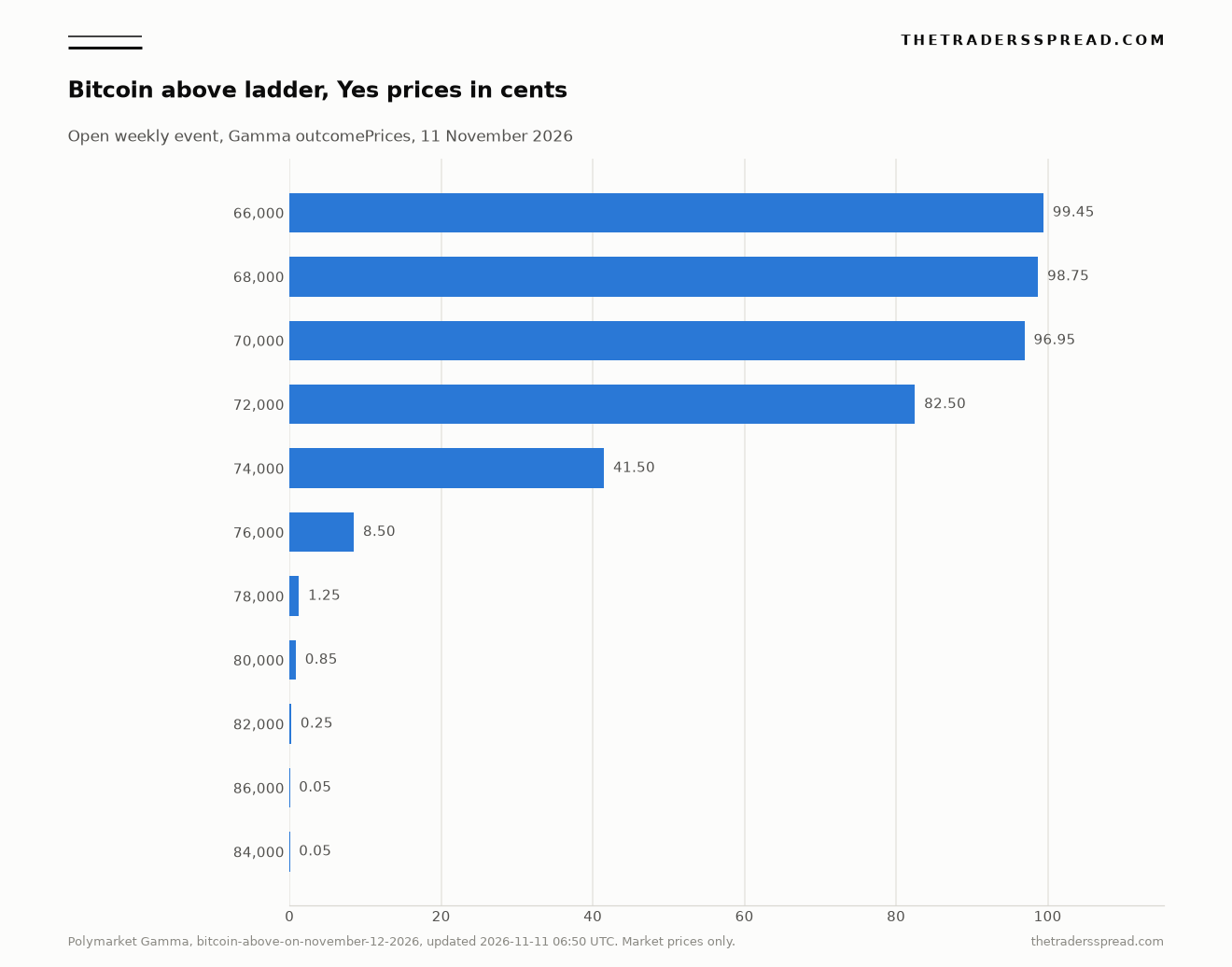 The bars record Yes outcome prices from the 11 November 2026 Gamma payload on the open weekly event, strike by strike, as market prices.
| Strike on the open 12 November ladder | Yes outcome price, cents | Leg volume, dollars |
|---|---|---|
| 66,000 | 99.45 | 19,674.90 |
| 68,000 | 98.75 | 22,705.37 |
| 70,000 | 96.95 | 12,894.69 |
| 72,000 | 82.50 | 13,521.21 |
| 74,000 | 41.50 | 14,408.95 |
| 76,000 | 8.50 | 7,121.53 |
| 78,000 | 1.25 | 8,646.74 |
| 80,000 | 0.85 | 25,905.89 |
| 82,000 | 0.25 | 9,418.20 |
| 84,000 | 0.05 | 6,190.67 |
| 86,000 | 0.05 | 1,854.94 |
The 72,000 leg's outcomePrices were the strings 0.825 and 0.175, so the Yes figure is 82.50 cents and the pair still sums to a dollar. The 84,000 and 86,000 legs both print 0.0005. Those cent-rounded leg volumes are the pieces of the $142,343.10 event total.
The settled ladder is where the one-dollar figure means redemption. Bitcoin above on 10 November is closed on Gamma, with endDate 2026-11-10T17:00:00Z and updatedAt 2026-11-11T06:38:33Z. The 68,000, 70,000 and 72,000 markets carry outcome prices 1 and 0, and umaResolutionStatus resolved. From 74,000 through 88,000 the prices are 0 and 1, also resolved. That ladder's strikes ran from 68,000 to 88,000. The open 12 November ladder runs from 66,000 to 86,000. Same rules text, a different board. The family keeps its sentence and replaces its rungs, which is why a page about the sentence outlasts any single noon.
I keep the open 99.45 cent row and the resolved 1-and-0 row in different columns, even though both use the cent scale, because only the second carries a closed flag and a UMA status of resolved. Screenshots that mix them invent a history of "100" prints that were still live quotes.
When the other tape disagrees
The rules confine the price to Binance BTC/USDT and place other exchanges and other trading pairs outside the settlement. The resolutionSource field on the open event is the Binance BTC/USDT trade URL. Price precision, the rules add, is determined by the number of decimal places in the source.
A Coinbase print, a bitcoin index, and a BTC/USD quote are not the source the rules name. A second venue can sit well away from Binance at 12:00 and still feel like the bitcoin price because a headline used it. The contract I opened is about a named feed. Averaging the tapes, or preferring whichever one crossed the strike, would be a different contract.
exchangeInfo for BTCUSDT, pulled in the same 06:51 UTC pass, sets the PRICE_FILTER tickSize at 0.01000000, with the symbol status TRADING. The source prints hundredths, so a close of 72,000.00 and a close of 72,000.01 are different prints, and the comparator in the rules is "higher than" the price specified in the title. On a 72,000 market, 72,000.00 fails that word and 72,000.01 clears it. That is a reading of the wording plus the tick I retrieved, and a clarification that treated equality as a Yes, or that rounded the Close to the nearest dollar, would replace it.
RelatedWho Leads the Taipei Mayor Contract on Polymarket?
The 10 November settlement agrees with a print inside that gap, and it is too coarse to pick the minute. Both closes sit above 72,000 and below 74,000, and so do the high and the low of each bar. The settled book paid Yes on 72,000 and No on 74,000. Every one of those six prints would have produced the same split on strikes spaced $2,000 apart. The resolved ladder confirms the gap. It leaves the choice of minute untested, because the day was quiet at the boundary.
The text gives Yes on a higher Close and No in every other case. A postponed noon, a halted pair or a missing candle is absent from the paragraphs I read, so I will leave the fallback uninvented. If that Close is missing, the next step is a clarification or a dispute under the oracle, rather than a quiet swap to a second exchange the same paragraph has set aside.
Eleven questions, then a wait
Because negRisk is false, the eleven markets are separate Yes/No questions that happen to share an event page. A single Close can clear several strikes together. Read with the comparator in the rules, a Close of 73,000 USDT would clear 66,000, 68,000, 70,000 and 72,000, and it would miss 74,000 and every strike above it on the open board. That is four Yes redemptions and seven No redemptions from one number, ordinary for this family and strange if you arrived from a winner-take-all book expecting a single rung to collect the whole payout.
The five-year Treasury ladders are a different instrument with a different print. Rows stacked by threshold look like a race on both pages. On Bitcoin above the rows are thresholds on one number, and several of them can pay.
Noon is when the print exists, and redemption comes later. Polymarket's resolution page separates the UMA Optimistic Oracle, used for prediction markets, from Chainlink TWAP on up-down markets. Bitcoin above sits in the first group. Anyone may propose an outcome and post a bond the page describes as typically $750, and the page says an early or wrong proposal loses that bond. A challenge period of 2 hours follows. Left undisputed, resolution lands about 2 hours after the proposal. A second dispute goes to a debate of 24 to 48 hours and then a UMA token-holder vote of about 48 hours, which the page totals at 4 to 6 days.
How a disputer posts a counter-bond, and how a second round starts, is the subject of the proposal and dispute explainer. I am using that page here for the clock alone. Treating 12:00 Eastern as the moment a balance changes leaves out the challenge window, and it leaves out days more if someone disputes which Close was copied. The open event's endDate, 2026-11-12T17:00:00Z, is when the market becomes eligible for the proposal. It matches noon Eastern on that date, and it is earlier than the redemption.
Kalshi's fees, rules and settlement belong to another venue's document. A habit as specific as "noon means the Binance close" is a poor substitute for the next venue's text. A different house can name a different clock, a different feed and a different equality rule, while the cent scale on the screen still looks familiar.
| Step | What the opened page says | Clock |
|---|---|---|
| The candle | Binance BTC/USDT one-minute Close, the candle closing at noon Eastern | The date in the title, noon on the Eastern civil clock |
| Eligibility | The event endDate on the open ladder | 2026-11-12T17:00:00Z |
| Proposal | A bond, described as typically $750, naming the outcome | After the print exists, and after the market is eligible |
| Undisputed path | A challenge period of 2 hours, then acceptance | About 2 hours from the proposal |
| Disputed path | A debate of 24 to 48 hours, then a vote of about 48 hours | 4 to 6 days in the page's total |
| Redemption | Winning tokens redeem for $1.00, and trading stops | After the oracle reports the payout |
The edit that would change this reading
I would change the reading on this page if the rules named the kline open time in UTC, or if they named the bar whose open time equals noon Eastern. Either sentence would pick one of the two neighbouring minutes. The 10 November pair, 72,880.64 against 72,974.83, shows why a $2,000 rung can conceal the choice.
I would change the reading again if the comparator became "greater than or equal." A close that lands on the strike would then pay, and the 0.01 tick would matter on the other side of the line: 72,000.00 would clear a 72,000 market, where the word "higher," as written, leaves it short. I would change it if the resolution source left Binance BTC/USDT for another exchange, another pair, or an index. The whole point of the sentence I read is that a disagreement between tapes is settled by ignoring one of them. Replace the feed and the ignoring flips.
I would also change it if a posted clarification told proposers to round the Close to the nearest dollar, or to take the high of the minute, before asking whether the number is higher than the strike. The resolution page treats that kind of note as context for proposers and voters, with the fundamental intent left in place. Until one of those edits is in the rules block, the family still settles on a single Close, from a single pair, at a noon that follows the Eastern civil clock. A quote near 100 cents stays a quote until the resolved prices sit at 1 and 0.
The reading above records contract text and reference prints for information only. It is not a recommendation to transact.