

US CPI markets on Polymarket settle on a line in a Bureau of Labor Statistics news release, and the habit of treating that line as whatever inflation did, cleaned up later, is the habit that mis-sets the book. The annual contract names the 12-month percent change before seasonal adjustment, printed to one decimal, taken from the official monthly release at the moment it is published.
The October annual book is where that habit shows. Question 16 of the BLS shutdown FAQ, last modified 16 September 2026, says October 2026 12-month percent changes stay unpublished where the October 2025 index is missing. All-items CPI-U for October 2025 is a dash in the public API, footnoted "Data unavailable due to the 2025 lapse in appropriations." On 24 October 2026 the 3.7 percent Yes leg of the October annual US CPI market on Polymarket traded at 89 cents, in a ladder whose Yes prices add to about 104.7 cents and whose shape looks like a repeat of September. The core book's 2.6 percent leg was at 90.5 cents. Links to Polymarket are affiliate links, from which The Traders Spread may earn a commission at no cost to you.
Updated 24 October 2026 against the Bureau of Labor Statistics release, the public API, and the Polymarket book named in each section below.
Key facts
- CPI-U all items rose 3.7 percent over the 12 months ending September 2026, before seasonal adjustment, to an index of 336.940 — Bureau of Labor Statistics news release USDL-26-1574, 14 October 2026.
- All items less food and energy rose 2.6 percent over those 12 months, CPI-W rose 3.9 percent to 330.654, and the chained CPI-U rose 3.5 percent — same release, 14 October 2026.
- October 2025 all-items CPI-U (series CUUR0000SA0) is a dash in the public API, footnote "Data unavailable due to the 2025 lapse in appropriations"; September 2025 is 324.800 and November 2025 is 324.122 — BLS Public Data API, retrieved 24 October 2026.
- Twelve-month percent changes for October 2026 stay unpublished where October 2025 data are unavailable — BLS shutdown FAQ, question 16, last modified 16 September 2026.
- The October annual 3.7 percent Yes leg traded at 89 cents, with $8,771.57 of volume and $9,180.05 of liquidity, inside an event of $19,718.56 volume and $52,238.13 liquidity — Polymarket gamma-api, 24 October 2026.
- The September annual 3.7 percent leg resolved Yes, outcome prices at 1 and 0, after $37,089.34 of volume on that leg and $274,681.47 on the event — Polymarket gamma-api, closed market, retrieved 24 October 2026.
The line the annual contract names
Every month Polymarket lists a fresh annual ladder and a fresh monthly ladder for US CPI. The annual description covers inflation over the 12 months ending in the reference month, before seasonal adjustment, as the Bureau reports it, and it resolves to that percentage change in the monthly BLS report. The October version adds a clock: the October 2026 report, set for 10 November 2026 at 8:30am Eastern time, with resolution upon release.
The contract resolves on the one decimal the release prints. The 14 October 2026 release put the CPI-U all-items index at 336.940, and the September 2025 index on the public API is 324.800. Dividing the later by the earlier produces a change of about 3.738 percent. The September news release printed 3.7 percent, and the September annual market resolved on that leg.
A delay clause sits under that path. If BLS misses the relevant figures on the scheduled date, the market may stay open until the next CPI report. If the information is still absent then, resolution uses the figures of the most recent previous month with available data. The BLS release calendar, read on 24 October 2026, puts October's CPI on 10 November at 8:30am and November's CPI on 10 December at 8:30am.
Where a revision actually lives
People carry the payrolls habit into US CPI and treat the first print as a draft. CPI-U and CPI-W are final when released. The chained CPI-U is the series issued in preliminary form and then revised, and that release put the chained index at 3.5 percent over 12 months. The annual contract names CPI-U, the series the technical note treats as final.
Seasonal adjustment is where a revision does live, on a schedule. BLS builds factors with X-13ARIMA-SEATS, updates them each February, and uses the new factors to revise five years of seasonally adjusted data. The annual contract specifies the change before seasonal adjustment, so a February factor update rewrites adjusted levels and leaves the unadjusted 12-month change where the release put it.
The monthly contract is the one that touches the adjustable series, and the settlement moment is still the release. October's monthly rules take the one-month percent change in seasonally adjusted CPI-U, to one decimal, upon release of the October 2026 report. September's monthly book resolved on 0.6 percent, the seasonally adjusted all-items change in the 14 October release. How a proposer and a disputer argue over a number that did print is a separate procedure, set out in the resolution explainer.
Question 12 sounds like a published October 2025 index. For seasonal adjustment only, BLS filled the missing October observation with the geometric mean of September and November. The published all-items CPI-U for October 2025 remains a dash. The annual contract asks for the published index, which is the dash.
Four rates leave one release
Another myth treats "the CPI number" as one figure every ladder must share. The September release, embargoed until 8:30am Eastern time on Wednesday 14 October 2026 under USDL-26-1574, printed several. All-items CPI-U rose 3.7 percent over 12 months before seasonal adjustment, up from 3.4 percent for the 12 months ending in August. All items less food and energy rose 2.6 percent over the year. CPI-W rose 3.9 percent, to 330.654. The chained CPI-U rose 3.5 percent. Energy rose 5.2 percent on the month, and gasoline rose 9.1 percent seasonally adjusted.
On the morning of that release, the Bureau's own account on X stated the all-items monthly increase and linked the archived news release, which is the document a prior-month fallback would be copying.
CPI for all items increases 0.6% in September; gasoline rises #BLSData https://t.co/cEp3k5mcdM
— BLS-Labor Statistics (@BLS_gov) October 14, 2026
September's annual resolution picked among those rates without a speech and paid the 3.7 percent leg. CPI-W at 3.9 percent and the chained index at 3.5 percent were in the same PDF and lost. The specimen says this template means the CPI-U all-items 12-month change, unadjusted, to one decimal. October's core year-over-year rules resolve on all items excluding food and energy, and they place the headline figure outside that settlement. September's core book resolved on 2.6 percent.
The October core year-over-year market makes the hole obvious a second time. Core CPI-U for October 2025 is also a dash, on series CUUR0000SA0L1E, and question 16 covers any index in that position. On 24 October 2026 the 2.6 percent core leg, a repeat of September's resolved core print, traded at 90.5 cents with $4,227.05 of volume, inside an event of $8,626.59.
| Claim that keeps circulating | What the release and the rules specify |
|---|---|
| A later revision rewrites the annual payout | CPI-U and CPI-W are final when released. The annual contract takes the unadjusted 12-month change in that release. |
| Headline and core share a settlement | September printed all-items CPI-U at 3.7 percent and all items less food and energy at 2.6 percent. Core rules name the exclusion. |
| Any rate in the PDF will do | The September annual book resolved at 3.7 percent. CPI-W printed 3.9 percent and the chained CPI-U printed 3.5 percent in the same release. |
| The book ends at 8:30am sharp | Resolution is upon release, scheduled for 10 November 2026 at 8:30am Eastern time. Late figures can keep the market open until 10 December 2026 at 8:30am Eastern time. |
| A price of 100 cents is still a forecast | The September 3.7 percent leg shows outcome prices of 1 and 0, UMA status resolved, and empty liquidity. That is a closed payout record. |
Release time, end time, and a blank cell
The timestamp myth is smaller, and it still moves money around the print. The October annual rules resolve upon release and name 8:30am Eastern time on 10 November 2026 as the scheduled time. Gamma-api's end timestamp is 2026-11-11T04:59:00Z, which is 11:59pm Eastern time on 10 November after the clocks have gone back. A slip past midnight belongs to the delay clause, which keeps the market open until the next report.
The source agency is the quieter mix-up. A consensus survey, a Cleveland Fed nowcast, the BEA personal-consumption price index, and a CPI-W print can all inform a forecast. The annual rules name the BLS CPI news release, and September resolved on the CPI-U line inside that release.
If the October report arrives on time and leaves the 12-month all-items cell blank, the argument is what "relevant figures" means. The primary sentence asks for the 12-month change, and question 16 says that change stays unpublished for this index. A proposer can treat the figure as absent and keep the delay clause alive until 10 December. A disputer can say the release arrived with an October index and a one-month change, and that the clause was written for a cancelled morning. September never had to choose, because the September 2025 index existed and the cell was filled.
What a resolved leg at one dollar is worth
A last myth sits on markets that have already finished. The September annual 3.7 percent leg is the specimen: outcome prices of 1 and 0, umaResolutionStatus resolved, closed true, volumeNum of 37,089.34, liquidity empty, inside an event that did $274,681.47 of volume before it shut. A Yes share held into that resolution is a one-dollar claim on redemption, not a live probability you can still buy. The displayed 1.00 is a payout state on an empty book.
Every other September annual bucket resolved the other way, at prices of 0 and 1, closed, and without liquidity. Losing shares redeem at zero and winning shares redeem at one dollar. An earlier note on this desk, September CPI Odds, took the view that the 3.7 percent bucket was rich before the print. The print happened, the leg resolved, and a closed 100-cent price is a finished payout.
An open price near one dollar is a different object from a resolved leg with empty liquidity and a resolved flag. A long-shot No at 99 cents still has a book and an end date ahead. The fields that separate the screens are closed, umaResolutionStatus, and liquidityNum, and on 24 October 2026 the October legs were still open while September's were finished.
The October book prices a print the FAQ withholds
Gamma-api reported this ladder on 24 October 2026. Yes prices across the twelve buckets summed to 1.047. The cents below are prices, and the small overround is why they add to a bit more than one.
| Bucket | Yes price | Volume | Liquidity |
|---|---|---|---|
| 3.2 percent or less | 0.6 cents | $791.81 | $4,272.19 |
| 3.3 percent | 0.5 cents | $662.29 | $3,807.21 |
| 3.4 percent | 0.9 cents | $747.70 | $3,643.61 |
| 3.5 percent | 0.55 cents | $676.19 | $3,881.87 |
| 3.6 percent | 0.35 cents | $641.86 | $3,181.79 |
| 3.7 percent | 89 cents | $8,771.57 | $9,180.05 |
| 3.8 percent | 6.75 cents | $1,149.86 | $4,945.58 |
| 3.9 percent | 1.95 cents | $2,253.56 | $4,095.29 |
| 4.0 percent | 2.5 cents | $1,460.93 | $3,876.03 |
| 4.1 percent | 0.75 cents | $1,007.27 | $3,969.99 |
| 4.2 percent | 0.2 cents | $722.53 | $3,352.14 |
| 4.3 percent or more | 0.65 cents | $832.99 | $3,829.96 |
Mass on 3.7 percent, with a cheap wing and a tail through 3.8 to 4.0, is what an anchor on last month's CPI-U print looks like. That shape is odd beside a 12-month cell the Bureau has said it will leave unpublished. Read as a fallback to the most recent previous month with available data, the rules point at September's published 3.7 percent. Read as a demand for the October 12-month figure, they point at a number the FAQ says the release will omit.
RelatedProposal vs Dispute: How Polymarket Resolution Works
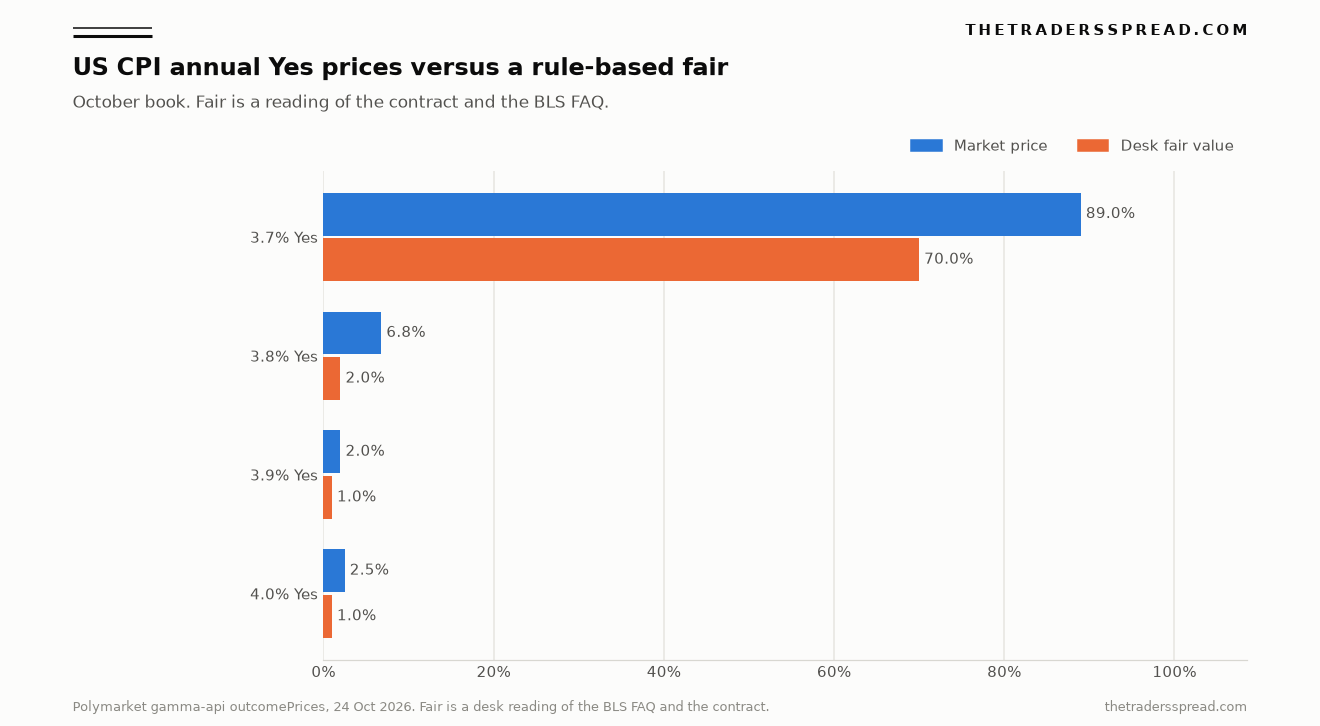
The desk's fair value on the 3.7 percent leg is 70 percent. September's published 3.7 percent CPI-U change is the number the fallback already has, and the haircut to 70 percent is the dispute: the rules still ask for an October 12-month figure, question 16 says that figure stays unpublished, and September is a weak precedent because its cell was filled. The other 30 points sit mostly on a dispute or a path the ladder labels poorly. The smaller fairs drawn beside that leg are desk judgments. The market's 89 cents sits above that 70 percent. The date on the reading is 10 December 2026, when the delay clause runs out.
The House-control note separated a high price from a finished payout on another contract, and the same gap applies at 89 cents with weeks left and a blank cell in the source. The 3.7 percent leg showed $9,180.05 of liquidity inside an event at $52,238.13, with $19,718.56 of volume beside September's $274,681.47.
The monthly contract still has a figure to print
October's monthly market is the control case. It takes the one-month percent change in seasonally adjusted CPI-U, October 2026 against September 2026, and September's index is already published at 336.940. Question 16 leaves that neighbouring-month comparison alone. The October monthly contract can take an ordinary first print on 10 November. Its modal leg on 24 October was 0.3 percent at 38 cents, in an event with $25,853.25 of volume, and September's monthly book resolved at 0.6 percent. One ladder is a print market, and the October annual ladder, this once, is a missing-cell market in the same branding.
November restores a base month for the annual family. The November 2025 all-items index is on the API at 324.122, so a 12-month change ending November 2026 has a published denominator, and the calendar puts that release on 10 December 2026, the morning the October delay clause runs out.The check that survives is to open the public API, confirm the base month exists, and only then read the ladder.
The question that outlives this book
Six months on, the open question is what the October annual contract did with a blank cell, and whether question 16 still stood where the Bureau left it on 16 September 2026. A reader would still need the October 2026 release, to see whether the 12-month all-items line was absent, filled, or replaced by a footnote, and the UMA record on the 3.7 percent leg: a fallback proposal copying September's 3.7 percent, a dispute that the release arrived without that figure, or a clarification that voided the ladder. The 10 December 2026 release matters as the delay clause's outer clock and as the first annual comparison with a published base again.
FAQ
Which release line settles an annual US CPI contract?
The annual family resolves to the 12-month CPI-U percent change before seasonal adjustment, as the Bureau prints it in the monthly news release, to one decimal. October's contract names the release set for 10 November 2026 at 8:30am Eastern time and the BLS CPI page. A consensus survey, a nowcast, and the PCE price index sit outside that settlement. September's book, on the same template, resolved on the all-items figure of 3.7 percent.
Can a revision after publication move the annual payout?
The September technical note says CPI-U and CPI-W are final when released. Seasonal factors update each February and can revise five years of seasonally adjusted indexes. The annual contract takes the unadjusted 12-month change in the release, at the moment that release comes out. A February factor update rewrites the adjusted history. The unadjusted percent change printed on release morning is the figure the annual wording names.
Why do headline and core markets settle on different numbers?
The September 2026 release reported all-items CPI-U up 3.7 percent over 12 months and all items less food and energy up 2.6 percent. CPI-W rose 3.9 percent and the chained CPI-U rose 3.5 percent in the same document. Core rules name the index that excludes food and energy and place the headline figure outside that settlement. September's core year-over-year book resolved on 2.6 percent, a different ladder from the 3.7 percent headline result.
What is a resolved leg at 100 cents actually worth?
Once UMA marks a leg resolved, outcome prices sit at 1 and 0 and liquidity is empty. September's annual 3.7 percent leg is in that state, with $37,089.34 of volume recorded while it was open. A Yes share held through resolution is a one-dollar redemption, and the displayed 100 cents is the payout record of a finished contract. An open leg trading near 100 cents is a different screen, because it still has a book and a future end date.
What happens if BLS leaves the 12-month cell blank?
October's rules say that if the Bureau misses the relevant figures on the scheduled morning, the market can stay open until the next CPI release. That release is the November report, on the calendar for 10 December 2026 at 8:30am Eastern time. If that 12-month figure is still absent, the rules point to the most recent previous month with data, which for all-items CPI-U is September's 3.7 percent. A dispute over that reading is the live risk.
This is analysis of public contract rules and a government data release, for information only. Prediction-market positions can be lost in full, including when a resolution follows a reading of the rules that a trader did not expect.