

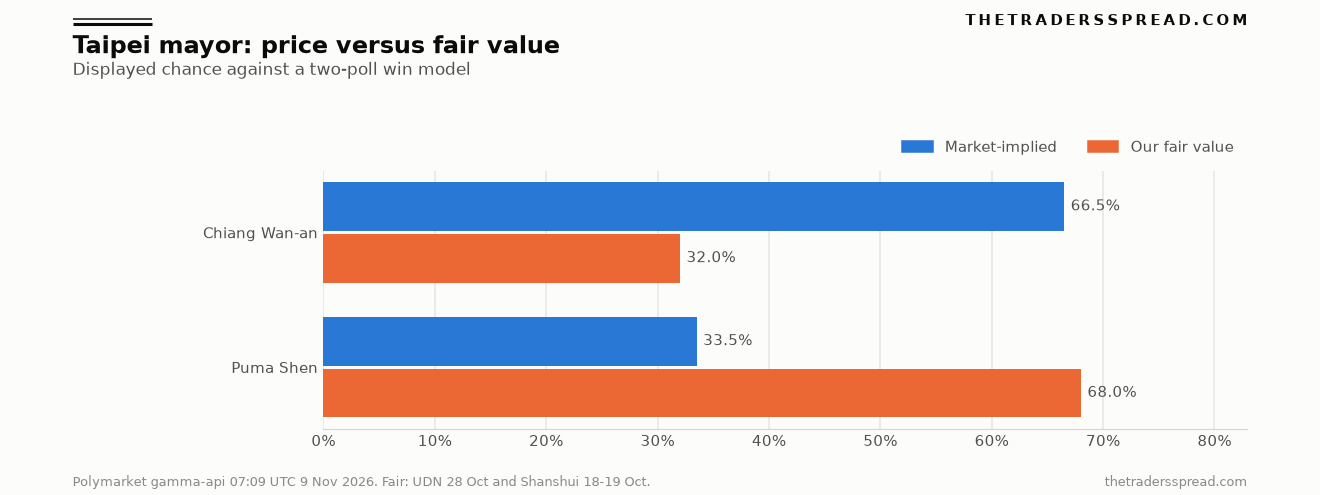
We pulled the Taipei mayor contract on 9 November 2026 and set it against telephone polls, because a 66.5 cent favorite only means something once a count outside the order book can disagree with it. At 07:09 UTC the Chiang Wan-an leg was 66.5 cents, bid 66 and offered at 67, last trade 67. Puma Shen sat at 33.5 cents. The event page is the Taipei Mayor Election Winner market. Links to Polymarket are affiliate links, from which The Traders Spread may earn a commission at no cost to you.
That handle lines up with a poll already months behind the vote. On 22 October, Z.media restated its June Shanshui survey: Chiang Wan-an at 55.2 percent, Shen Po-yang at 27.5 percent. Divide 55.2 by the sum of those two figures and the two-candidate share is 66.7 percent, a tenth of a point from the contract we just read. The October horse race, in the two polls we opened from the second half of that month, puts the same share near 47.7 percent.
United Daily News fieldwork that ended on 25 October had Shen ahead if the vote were tomorrow, 45 percent to 41, with 13 percent undecided, while 48 percent expected Chiang to win and 35 percent expected Shen. The contract pays on who becomes mayor, and readers looking up Taipei mayor election odds are staring at a book that still behaves like June. Our fair value on the Chiang Wan-an leg is 32 percent. The traded price sits above that mark.
Key facts
- Chiang Wan-an at 66.5 cents, bid 66, ask 67, last trade 67, at 07:09 UTC on 9 November 2026 (Polymarket gamma-api).
- Puma Shen at 33.5 cents, bid 33.1, ask 33.9, last trade 33.1, on the same pull (Polymarket gamma-api, 9 November 2026).
- Event volume $4,210,651 and liquidity $1,119,358. Chiang volume $2,019,631 and liquidity $389,334. Shen volume $2,052,260 and liquidity $329,358 (Polymarket gamma-api, 9 November 2026).
- United Daily News poll, 20-22 and 25 October 2026, 1,115 interviews: Chiang 41 percent, Shen 45 percent, others under 1 percent, undecided 13 percent, error within 3.0 points (United Daily News, 28 October 2026).
- Shanshui poll for Z.media, 18-19 October 2026, 1,074 completed interviews: Shen 42.8 percent, Chiang 39.0 percent, sampling error about 2.99 points (Z.media, 22 October 2026).
- TVBS poll, evenings of 3 and 5-7 October 2026, 1,120 valid interviews: Chiang 49 percent, Shen 41 percent, undecided 11 percent, sampling error 2.9 points (TVBS, 8 October 2026).
- Desk fair value on the Chiang Wan-an leg: 32 percent, from a 47.7 percent two-candidate share and a normal error of 5 points (The Traders Spread calculation, 9 November 2026).
The book we pulled
Gamma returned one open event, ending 29 November 2026 at 04:59 UTC. The payload says local elections are scheduled for 28 November 2026 and that the market resolves to whoever becomes the next mayor of Taipei because of that election. A TVBS story on 8 October 2026 states the same voting day, so we treat 28 November as the vote and 29 November as the market's scheduled end.
Chiang Wan-an, the Kuomintang incumbent, was at 0.665, with a one-cent book from 0.66 to 0.67 and the last trade at 0.67. Using the bid or the last trade instead of the outcome price moves the mark by half a cent, which leaves the gap to a low-30s fair value intact. Puma Shen printed 0.335, bid 0.331, ask 0.339, last trade 0.331, on the Puma Shen Taipei mayor contract. His volume was $2,052,260 against Chiang's $2,019,631.
Kuo Hsi, the third named leg, was at 0.05 cents, with the ask and the last trade at 0.1 cent and $139,041 of volume. We report that leg because the volume is real, and we leave it outside the model because the polls put the minor field under 1 percent combined. Placeholder rows, Candidate A onward plus an Other shell, each showed 50 cents, zero volume, and an inactive flag. Those empty slots stay out of the chart.
Who is on the ballot
Chiang Wan-an has held the office since the last local election. The Taipei Times, in a report by Lee I-chia published on 26 December 2022, wrote that he took office as Taipei mayor the day before, at a City Hall ceremony where Ko Wen-je handed over the seal, and that he was the youngest person elected to the job. The United Daily News poll story of 28 October 2026, retrieved again on 9 November, still describes him as the incumbent and as the Kuomintang candidate seeking another term.
That story names a six-person field: Chiang, Shen Po-yang, Kuo Hsi, Hsiao Wen-chien, Tang Hsin-min, and Lin Chi-cheng. It identifies Shen as the Democratic Progressive Party candidate, and the other four names share a combined support figure under 1 percent. Shen Po-yang is the Puma Shen on the contract, and the wire copy we opened uses 沈伯洋 for the same person.
Two late polls, and one earlier dissent
The fair value starts from polls opened in this session. United Daily News published at 06:00 on 28 October 2026, from fieldwork on 20-22 and 25 October, and the paper paid for it. Interviewers completed 1,115 interviews with registered Taipei adults and logged 264 refusals. Sampling error sits within 3.0 points at 95 percent confidence. The frame mixes landlines and mobiles, weighted to sex, age, and district.
On the horse race, 41 percent supported Chiang and 45 percent supported Shen, the other four candidates together were under 1 percent, and 13 percent were undecided. The paper says the gap sits inside the sampling error. A 4-point lead against a 3-point band is a close race, and it is a race with Shen ahead on the item the contract cares about.
Among women Shen led by 9 points, at 47 percent, and under 40 he led by 25 points, at 58 percent. From 40 upward, Chiang held narrow leads. Green supporters backed Shen at 91 percent and blue supporters backed Chiang at 86 percent, while neutrals split 40 percent Shen and 33 percent Chiang.
Prior votes cut the same way. Of people who had backed Chiang last time, 75 percent stayed and 18 percent had moved to Shen. Chen Shih-chung's former voters were 95 percent with Shen, and Huang Shan-shan's were 55 percent with Shen against 38 percent with Chiang. Asked who would win, 48 percent named Chiang and 35 percent named Shen, while 16 percent withheld a judgment. Satisfaction with his work as mayor was 50 percent, against 41 percent ready to vote for him.
Shanshui Public Opinion Research, paid by Z.media, interviewed registered Taipei adults on 18 and 19 October, and the outlet published on 22 October. Weights follow Interior Ministry population statistics, completed interviews were 1,074, and the sampling error is about 2.99 points. Shen led 42.8 percent to 39.0. Among people who said they would definitely vote, the gap widened to 51.2 against 38.6. The same article restates June, when Chiang led 55.2 to 27.5, and says his support had since fallen 16.2 points while Shen's had risen 15.3.
Shanshui's party picture disagrees about the middle and agrees about the headline. Green identifiers backed Shen at 92.8 percent, Kuomintang identifiers backed Chiang at 91.2 percent, and people the release classes as unaligned gave Chiang 29.1 percent against Shen at 21.0, the reverse of the United Daily News neutral split. Both houses, on the full sample, still had Shen ahead.
TVBS is the dissent, and it is older. Reporter Huang Wei-chuan's story went up on 8 October 2026 from fieldwork on the evenings of 3 October and of 5 through 7 October: 1,284 people reached, 164 refusals, 1,120 valid interviews, sampling error 2.9 points. Chiang led 49 percent to 41, with 11 percent undecided, and TVBS said the gap had narrowed from 28 points in its late-May survey to 8. On expectations, 55 percent thought Chiang would win and 20 percent thought Shen would.
From a horse race to a win chance
A support number is a share of respondents. The contract is a probability that one person becomes mayor. We take the two polls whose fieldwork falls after 15 October and give them equal weight. Each is a telephone sample of Taipei adults, each prints a sampling error near 3 points, and each has Shen ahead by about 4 points. TVBS, which ended on 7 October, stays in the file as the prior. Letting a three-week-old lead outvote two later surveys that agree would throw away the fresher evidence.
Inside each late poll, Chiang's share of the people who named either him or Shen is the input, and undecided respondents stay out of that denominator. United Daily News is 41 divided by 86, or 47.67 percent. Shanshui is 39.0 divided by 81.8, or 47.68 percent. The mean we carry forward is 47.7 percent. An even split of the undecided block lands near the same place, so the month matters more than the parking rule.
We treat 47.7 percent as the mean of a normal distribution for his two-candidate share, with a 5-point standard deviation, and we read the chance the share finishes above 50. Five points is wider than either sampling error because the raw Chiang figures run from 39.0 to 49.
The distance from 47.7 to 50 is 2.3 points, a z-score near 0.46, and the upper tail is 32.1 percent, which we round to 32 percent on the Chiang Wan-an leg. That leg's own page is the Chiang Wan-an contract the figure belongs to.
On the chart, Puma Shen's fair-value bar is 68 percent, 100 minus 32. The residual is his because the minor field is thin. Change the error width and the mark barely moves relative to the market: 28 percent at 4 points, 35 percent at 6. Fold TVBS back in, equal-weighted with the two later polls, and the two-candidate share rises to 49.9 percent, which produces a win chance near 49 percent at any of those widths. Forty-nine is still under 66.5 cents.
Deleting the later polls is what flips the relationship. TVBS alone, at a 54.4 percent two-candidate share and the same 5-point error, produces a win chance near 81 percent, which would put the contract below fair value. We keep both late surveys because they are closer to the vote and they agree. Shanshui's certain-voter slice, a 43 percent share for Chiang, would push the model near 8 percent, and it stays out of the stored figure because that slice is a selected subset whose own error the release leaves unstated.
Expectation is a different question
United Daily News asked both whom people would support and whom they expected to win: support had Shen ahead, 45 to 41, while expectation had Chiang ahead, 48 to 35. Among people who named a likely winner, his share is 58 percent. TVBS expectation in early October was 55 to 20, or 73 percent of the named answers. A vote contract should track support. An expectation contract would land in the high 50s, or the low 70s on the TVBS version.
The live price of 66.5 cents sits on the June two-candidate share of 66.7 percent, while late-October support, run through our model, is 32 percent. With a bit over $2 million through each main leg, that June reading is a traded opinion with a crowd behind it.
A confident price still has to survive the count, which is why the note on how a Polymarket proposal and a dispute settle belongs beside these rules.
Prices on a multi-name slate can move together, and Taipei is that kind of book, so a revision in the Chiang fair value is mostly a revision in the Shen fair value.
How this contract reaches a result
The rules on the gamma payload resolve the market to the candidate who becomes the next mayor of Taipei because of this election. A temporary or placeholder mayor appointed before the election falls outside that test. If the result is still unknown, or the seat is still empty, at 11:59 pm Eastern Time on 30 June 2027, the market resolves to Other. The ordinary path is a consensus of credible reporting. If the reporting is ambiguous, the rules point at official results and name the Central Election Commission.
RelatedHouse Turnout 120 Million Falls 8 Points vs 125 Million
We store 29 November 2026 because that is the endDate gamma returned, while voting day on the rules and the TVBS story is 28 November. The June 2027 line is the backstop if the count is still unfinished. Our earlier note on a Bank of Japan contract that traded above the desk's fair value turned on the same distinction: the price and the fair value meet only after the settling document is named.
From 9 November to voting day is 19 days, while United Daily News finished 34 days before the vote, Shanshui 40 days before it, and TVBS 52. A month is a long time in a 4-point race, which is why the error term is 5 points and why one fresh poll can move fair value by more than a single house's sampling error.
What would move the 32 percent
Fair value climbs through the market price if new fieldwork restores a Chiang two-candidate share in the mid-50s, the TVBS world of early October and the June Shanshui world. One such poll, with a printed sample size and error, would rebuild the average. Fair value falls if the certain-voter gap reappears with its own error, or if another United Daily News survey keeps a Shen lead.
Job approval at 50 percent is the figure an incumbent campaign will keep citing, while the same survey's support item is 41 percent. Until a later poll shows those two figures closing, approval stays context and the horse race stays the input. Another round of who-will-win answers can flatter the incumbent while support stays level, and the contract still pays on the ballots.
FAQ
Who leads the Taipei mayor contract on Polymarket?
Chiang Wan-an leads the displayed book. At 07:09 UTC on 9 November 2026 his outcome price was 66.5 cents, bid 66 and offered at 67, with the last trade at 67. Puma Shen was at 33.5 cents, bid 33.1 and offered at 33.9. Kuo Hsi, the only other named leg with volume, was at 0.05 cents, and event volume on that pull was $4,210,651.
Which polls set the fair value on the Taipei mayor election odds?
Two surveys, equal-weighted, both opened in this session. United Daily News published on 28 October a poll taken on 20-22 and 25 October, with 1,115 completes: Chiang 41 percent, Shen 45, undecided 13. Shanshui, for Z.media, completed 1,074 interviews on 18-19 October: Chiang 39.0, Shen 42.8. Each house's two-candidate Chiang share is 47.7 percent. A normal model with a 5-point error turns that share into a 32 percent win chance for the incumbent.
Why does 66.5 cents sit above that fair value?
The contract pays on who becomes mayor, and the late-October support items have Shen slightly ahead. The 66.5 cent price matches the June Shanshui two-candidate share instead, 66.7 percent, which Z.media restated on 22 October. It also sits nearer the "who do you expect to win" answers than the "whom would you support" answers. We price the vote, after a stated error, and that calculation is 32 percent against a market price of 66.5 cents.
When does the Taipei mayor market resolve?
Gamma stamps the event end at 29 November 2026, 04:59 UTC, and that is the resolution date we store on the contract. The market rules, and a TVBS report on 8 October 2026, put voting day on 28 November 2026. If the winner is still unknown at 11:59 pm Eastern Time on 30 June 2027, the rules send the market to Other. An ambiguous count falls to official results, and the rules name the Central Election Commission as that source.
What would lift the fair value up to the traded price?
A new telephone poll with Chiang's share of Chiang-plus-Shen support in the mid-50s, near the early-October TVBS two-candidate share of 54.4 percent, would lift the model through the traded price. Using that TVBS poll alone, with the same 5-point error, already prints a win chance near 81 percent. We keep TVBS as the dissent because the two later polls agree on a Shen lead. Fresh fieldwork that restored the earlier lead would change the mark we publish.
Verdict
We mark the Chiang Wan-an leg above fair value. The price at 07:09 UTC on 9 November 2026 was 66.5 cents, inside a one-cent market, on about $2.02 million of volume. Fair value is 32 percent: the chance, under a normal model with a 5-point error, that a 47.7 percent two-candidate share finishes above half. That share is the average of the United Daily News poll published on 28 October and the Shanshui poll of 18-19 October.
Puma Shen's bar is the 68 percent left over. Widen the error from 4 points to 6 and fair value only travels from 28 percent to 35. Fold the older TVBS poll back in and the win chance rises to about 49 percent, still under the contract. The path above 66.5 cents runs through deleting both late-October polls, or through new interviews that look like June. Until then, the support question in the two later houses has the challenger slightly ahead, and that is the question the ballots will resemble.
This is analysis for traders, and it is not a recommendation to transact on any contract or to take a side in the Taipei mayor election. Prediction-market prices and polls can both be wrong, and capital put at risk can be lost. Earlier survey results do not decide how the vote or the contract resolves.