

27.7 cents is the price of a first-day close at $1.5 trillion or more for OpenAI, and that leg is the dearest print on the closing market-cap ladder. At 07:37 UTC on 15 November 2026 the Polymarket gamma API showed a displayed yes price of 0.277 on the leg, a best bid of 0.276 and a best ask of 0.278, on about $193,478 of volume and about $18,385 of liquidity. The same snapshot priced a close with no IPO by 31 December 2027 at 24.6 cents, and a close from $1.25 trillion to $1.5 trillion at 19.0 cents. The OpenAI IPO closing market-cap ladder is one mutually exclusive book. Links to Polymarket are affiliate links, from which The Traders Spread may earn a commission at no cost to you.
A private round reported nine days earlier measures a different object. The Verge, citing Bloomberg, on 6 November 2026, wrote that OpenAI was valued at $1.25 trillion in a round that had raised $11 billion, after raising $122 billion in March at an $852 billion valuation. The same account said further money could still take the round toward $20 billion, below an earlier hope of as much as $30 billion at a $1.4 trillion valuation. An exact first-day close of $1.25 trillion would, under the ladder's boundary rule, land in the higher bracket, the leg priced at 19.0 cents.
Across the seven displayed yes prices, the sum was 96.75 cents. Event volume on that gamma pull was about $782,672, event liquidity about $173,866, and volume over the prior day about $15,071. The parent totals are context for the book. Each number below is a leg.
The dearest price is a close at $1.5 trillion or more
What the ladder price says, read as a single favorite, is that a first-day closing market cap of $1.5 trillion or more is the outcome with the highest displayed yes price. At 27.7 cents it sits ahead of the no-listing leg at 24.6 cents and ahead of $1.25 trillion to $1.5 trillion at 19.0 cents. The three legs under $1 trillion together were 8.1 cents.
The $1.5 trillion-or-more leg is also one of the tightest books on the ladder. Two-tenths of a cent separated the bid at 27.6 cents from the ask at 27.8 cents, and the last trade printed at 27.8 cents. A displayed price of 27.7 cents in a market that narrow is a live quote, rather than a stale midpoint floating between distant orders. Volume on the leg, about $193,478, was the largest of the seven.
A private round counts a negotiated mark
What readers often treat as the OpenAI IPO valuation is the private figure in that 6 November account: $1.25 trillion, on a round that had taken in $11 billion and might still take more. The Verge attributed the figure to Bloomberg and also recorded the March mark of $852 billion on a $122 billion raise. OpenAI had declined to put the newer terms out as a company release in the reporting The Verge was summarizing, so the number enters as a reported round.
The ladder pays on a first-day closing market cap, not on the last private round. Gamma's event text, read with the prices on 15 November 2026, defines market capitalization as shares outstanding multiplied by the closing share price on the first trading day, in the pricing currency. Resolution looks first to the primary exchange's official listing page. If that page omits the figure, the rules name another reliable source. Nothing in the opened Verge account states the share count that formula would use, and nothing there labels the $1.25 trillion figure as the eventual listed close.
The round was also described as unfinished in size. Further money toward $20 billion would change the cash in the company, while the headline The Verge reported was already $1.25 trillion. The under-$1 trillion legs, together 8.1 cents, are the price of a first-day close back in that older neighbourhood.
An exact boundary steps up one bracket
The rules add a tie-break the private headline omits. If the closing market cap falls exactly between two brackets, the market resolves to the higher range bracket. The questions on the book are written as less than $500 billion, between $500 billion and $750 billion, between $750 billion and $1 trillion, between $1 trillion and $1.25 trillion, between $1.25 trillion and $1.5 trillion, and $1.5 trillion or greater, plus the no-listing outcome. The tie-break is what decides a print that lands on a shared edge.
Read as a label for where a print would settle, an exact close of $1.25 trillion, the November reported mark, would resolve in the $1.25 trillion to $1.5 trillion bracket. An exact close of $1.5 trillion would resolve in the dearest leg, $1.5 trillion or more. An exact close of $852 billion, the March mark from the same Verge account, would sit inside $750 billion to $1 trillion, the leg priced at 3.55 cents. The rule assigns a bracket to a number. A probability comes from the order book, which is a separate column.
On the 15 November print, the bracket that would catch an exact $1.25 trillion close was priced at 19.0 cents. The $1.25 trillion to $1.5 trillion contract showed a bid of 18 cents, an ask of 20 cents, and a last trade at 20 cents, on about $93,830 of volume and about $19,369 of liquidity. The bracket just below, $1 trillion to $1.25 trillion, was 17.35 cents. The private mark sits on the edge between those two legs.
The no-listing outcome carries its own price
If no IPO occurs by 31 December 2027 at 11:59 PM Eastern, the rules say the market resolves to the outcome titled No IPO by December 31, 2027. The gamma end stamp on the legs is 1 January 2028 at 04:59 UTC, the same instant expressed in UTC while the rule text names Eastern time. A listing on the deadline day still produces a closing market cap and uses one of the cap brackets. A calendar that runs out with no first-day close pays the no-listing leg and pays none of the cap legs.
That leg was 24.6 cents at the same 07:37 UTC print, the second-highest displayed yes price on the ladder. The no-listing contract had a best bid of 22.7 cents and a best ask of 26.5 cents, a 3.8 cent spread, with the last trade at 22.7 cents. Volume was about $116,453 and liquidity about $15,491, the thinnest liquidity of the seven legs. The displayed 24.6 cents sits inside that spread, a much wider market than the two-tenths-of-a-cent book on $1.5 trillion or more.
Sam Altman, chief executive of OpenAI, has talked about timing in public without turning that talk into a dated listing. The Verge on 30 September 2026 reported a question-and-answer session after his DevDay keynote. Hayden Field's account quotes him saying the company had "got to be able to make confident safety claims," and quotes him saying, "I think it's also kind of bad for the world if OpenAI waits too long to go public." He described a rush to list as something that "seems ill-advised." The Verge said he gave no firm timeline, and the remarks state no share count, price range, or resolution source.
Volume and liquidity pick different legs
Price, volume, and liquidity crown different legs. The highest yes price and the most volume sit together on $1.5 trillion or more. The most liquidity sits on $750 billion to $1 trillion, a leg priced at only 3.55 cents, with about $60,668 of liquidity and about $151,917 of volume, the second-largest pool. The dearest leg held about $18,385 of liquidity, and the no-listing leg about $15,491.
Adding the seven volume figures gives the event total, about $782,672. Adding the seven yes prices gives 96.75 cents. Volume stacks because each leg has its own trades. The yes prices stop short of a dollar because each quote comes from its own book. The missing 3.25 cents is smaller than the 3.8 cent spread on the no-listing leg alone.
| Leg | Yes price | Bid / ask | Last | Volume | Liquidity |
|---|---|---|---|---|---|
| Under $500 billion | 1.9 cents | 1.3 / 2.5 | 2.3 | $47,166 | $20,371 |
| $500 billion to $750 billion | 2.65 cents | 1.8 / 3.5 | 3.5 | $37,192 | $18,300 |
| $750 billion to $1 trillion | 3.55 cents | 3.3 / 3.8 | 3.8 | $151,917 | $60,668 |
| $1 trillion to $1.25 trillion | 17.35 cents | 16.8 / 17.9 | 17.9 | $142,635 | $23,495 |
| $1.25 trillion to $1.5 trillion | 19.0 cents | 18 / 20 | 20 | $93,830 | $19,369 |
| $1.5 trillion or more | 27.7 cents | 27.6 / 27.8 | 27.8 | $193,478 | $18,385 |
| No IPO by the deadline | 24.6 cents | 22.7 / 26.5 | 22.7 | $116,453 | $15,491 |
Dollar amounts in that table are gamma volumeNum and liquidityNum rounded to the nearest dollar. Bids, asks, and last trades are the gamma fields at 07:37 UTC on 15 November 2026, expressed in cents. The yes column is outcomePrices for the yes outcome, also in cents. The $1.5 trillion-or-more contract is the row with the highest yes price and the most volume.
What the price says, and what the rules measure
Pair the claim a casual reading makes with the object the documents actually grade. The left column is the story the cents are often asked to tell. The right column is the rule text, or the valuation page that was opened, applied to that story.
| What the ladder price is often asked to mean | What the rules, or the opened round, measure |
|---|---|
| 27.7 cents means OpenAI is a $1.5 trillion company | 27.7 cents is the yes price of a first-day close at $1.5 trillion or more, one leg among seven |
| The $1.25 trillion round belongs in the $1 trillion to $1.25 trillion band | An exact $1.25 trillion close resolves to the higher bracket, $1.25 trillion to $1.5 trillion, priced at 19.0 cents |
| 24.6 cents is a comment on what the company is worth today | 24.6 cents is the yes price of no IPO by 31 December 2027, 11:59 PM Eastern |
| The deepest book marks the likely close | The deepest liquidity, about $60,668, sits on the $750 billion to $1 trillion leg at 3.55 cents |
| A March mark of $852 billion is the floor for a later close | That mark is a reported private valuation from The Verge's account of the March round, and the leg containing $852 billion was priced at 3.55 cents |
Other ladders on this desk separate two prints that sound alike and settle apart. The five-year Treasury ladders sit apart from the ten-year book because the fixing is specific. A resolution still runs through a proposal and a dispute window, the sequence in how a Polymarket resolution moves from proposal to dispute. Grabbing the first public number is a familiar miss, including on US CPI markets that miss the print the contract uses. Here the repeated number is a private valuation, and the contract grades a closing market cap.
A circuit breaker or a half-day uses the official close of that shortened session. If none is published, the next session with an official close is treated as the first day. An opening-auction headline sits outside that sentence.
The leading leg sits in line
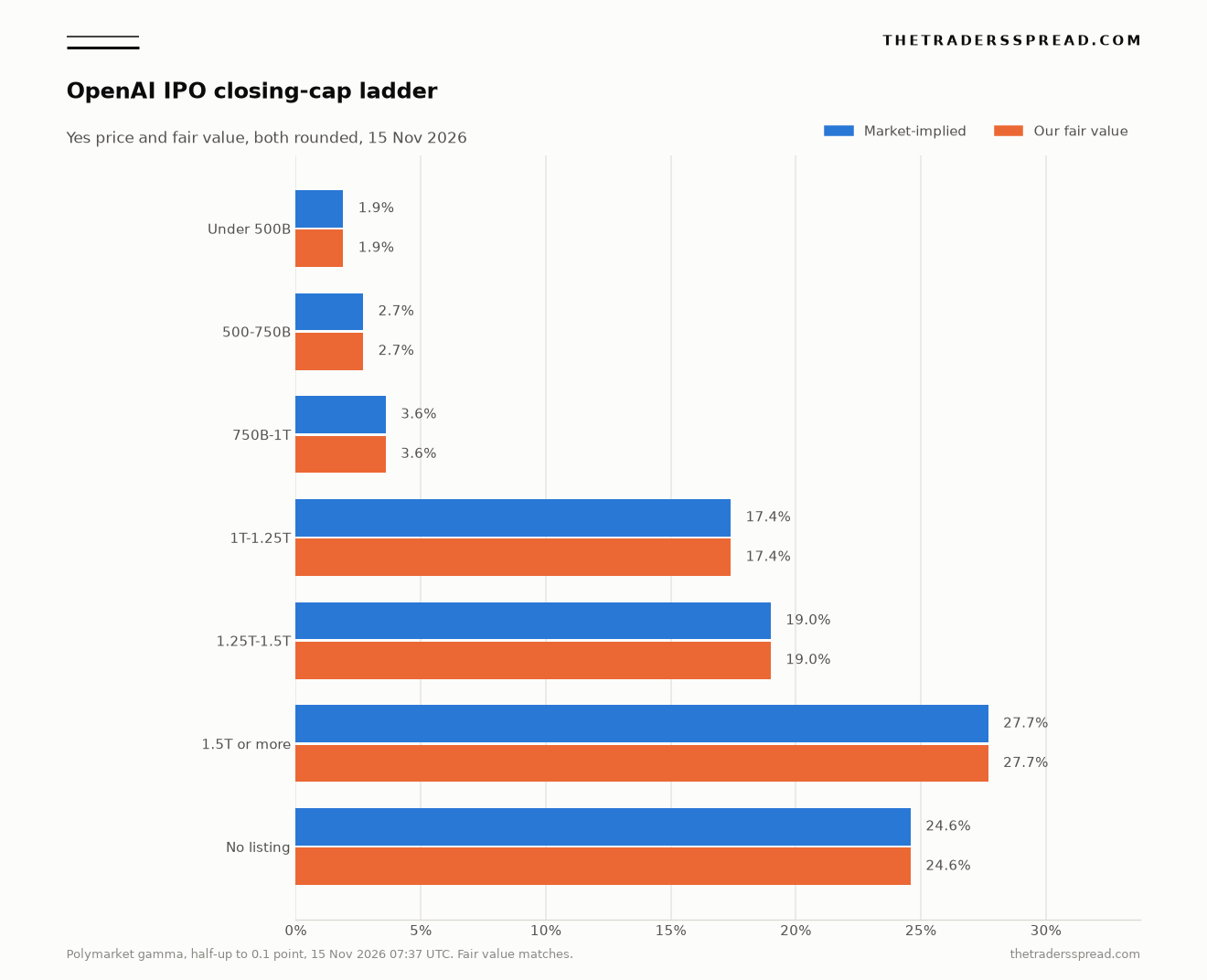
Fair value on the leading leg is 27.7 cents, the same displayed yes price gamma printed for a first-day close of $1.5 trillion or more. The label for a match between that fair value and the market is In line. The $1.25 trillion round, the March mark of $852 billion, and Altman's September remarks each name an object, and the boundary rule would drop an exact $1.25 trillion close into the 19.0 cent bracket. A different probability would need a share count, a stated IPO range, or a finished round published as the listed value. The opened pages stop short of that, so the probability stays with the book.
RelatedHow Jensen Huang's Exit Contract Splits News From Rules
Each fair-value bar on the chart equals the rounded yes price, so the two bars on a row are the same length. The stored fair value is the leader's unrounded price, 0.277. The caption marks the three rows the chart rounds, and the table keeps the gamma print.
A listing page with shares outstanding and an official close would settle the contract. Until that page exists, 27.7 cents on the rich close, 24.6 cents on no listing, and 19.0 cents on the bracket that would catch an exact $1.25 trillion close remain three separate statements, each in line with the book.
Questions on the closing-cap ladder
What does this ladder settle on?
The rules settle the ladder on market capitalization at the first day's closing price, shares outstanding times that close. The source is the primary exchange's listing page, or another reliable source if the page omits the figure. A shortened session uses its official close, or the next session that publishes one, treated as day one. The gamma event text carrying those sentences was read on 15 November 2026.
Where would an exact close of $1.25 trillion land?
A value exactly on a shared edge resolves to the higher bracket. $1.25 trillion is that edge between the $1 trillion to $1.25 trillion leg and the $1.25 trillion to $1.5 trillion leg, so an exact print would use the higher leg. On 15 November that leg was 19.0 cents, bid 18 cents and ask 20 cents. The mapping labels a bracket for that hypothetical close, while the private round stays a private round.
Which outcome pays if the deadline passes with no listing?
With no IPO by 31 December 2027 at 11:59 PM Eastern, the rules pay the outcome titled No IPO by December 31, 2027. The gamma end stamp is 1 January 2028 at 04:59 UTC, the same moment. On 15 November the yes price was 24.6 cents, between a 22.7 cent bid and a 26.5 cent ask. A listing that prints a close uses a cap bracket instead.
Why do the yes prices add to 96.75 cents?
The seven yes prices at 07:37 UTC on 15 November 2026 sum to 0.9675. Each comes from its own book, and the gap of 3.25 cents is smaller than the 3.8 cent spread on the no-listing leg. Scaling them to a dollar would describe a different book from the gamma print used here.
Why is fair value on the leading leg equal to the market price?
The leading leg was 27.7 cents on a first-day close of $1.5 trillion or more. The Verge's 6 November account, citing Bloomberg, puts a private mark at $1.25 trillion, and an exact close at that mark would use the 19.0 cent bracket. September remarks from Sam Altman, in The Verge's report, discuss safety claims and waiting, with no firm date. Fair value on the leading leg stays at 27.7 cents, in line with the quote.
Set against that fair value, the ladder is In line. The dearest leg, a first-day close of $1.5 trillion or more, was 27.7 cents at the gamma print, and 27.7 cents is the fair value held here. The reported $1.25 trillion mark tells a reader which bracket an exact close of that size would use, and the 24.6 cent leg prices the chance that no first-day close arrives before the deadline. Those are the measurements the opened pages support. The cents on the book remain the probabilities.
Capital committed to a prediction market can be lost, prices on the ladder can move after the 15 November gamma print, and nothing here is a solicitation to trade any contract.