

Satoshi's yes on a labeled-wallet move traded at 2.2 cents at 08:43 UTC on 14 November 2026, down from an 11.85 cent print on 6 February and up from a 1.95 cent low at midnight UTC the same day. The gamma-api record updated at 08:47:55 UTC still showed a last trade of 0.022, a best bid of 0.021 and a best ask of 0.023, on $5,798,031.56 of lifetime volume, while a separate 2011 address had just spent 75 bitcoin and this contract stayed open. Our fair value on the yes, built from Arkham's statement that the labeled stack has been held for 17 years, is 0.76%, so the live price sits above that fair.
| Measure | Reading |
|---|---|
| Yes outcome price | 0.022 |
| Quiet-leg outcome price | 0.978 |
| Best bid / best ask | 0.021 / 0.023 |
| Last trade | 0.022 |
| Spread | 0.002 |
| Lifetime volume | $5,798,031.56 |
| Volume, latest 24 hours | $29,153.70 |
| Volume, 7 days | $204,350.41 |
| Volume, 30 days | $547,051.49 |
| Liquidity | $98,390.27 |
| Open interest | $1,494,977.24 |
| One-hour price change | +0.0005 |
| One-day price change | +0.0025 |
| One-week price change | −0.0015 |
| One-month price change | −0.0075 |
Every row in that board comes from the market object on Polymarket's gamma-api for Will Satoshi move any Bitcoin in 2026, event slug will-satoshi-move-any-bitcoin-in-2026, pulled again at 08:47:55 UTC on 14 November 2026. Open interest and the 85-comment count sit on the parent event, updated at 08:50:08 UTC the same morning. The bid, ask and last trade line up with the yes token. Links to Polymarket are affiliate links, from which The Traders Spread may earn a commission at no cost to you.
The spread is 0.002 on a 0.001 tick, so the yes is two ticks wide, and open interest of $1,494,977.24 dwarfs the $29,153.70 that traded in the latest day. The one-day change of +0.0025 is the bounce from the midnight low of 0.0195 to the 08:43 print of 0.022.
Key facts
- Yes last traded at 0.022, with a best bid of 0.021 and a best ask of 0.023, on the gamma-api market record updated 08:47 UTC on 14 November 2026.
- Lifetime volume on that record was $5,798,031.56, against $29,153.70 in the latest 24 hours, $204,350.41 over seven days and $98,390.27 of liquidity, per Polymarket gamma-api on 14 November 2026.
- The CLOB history for the yes token peaked at 0.1185 at 00:00:29 UTC on 6 February 2026 and printed 0.0195 at 00:00:25 UTC on 14 November 2026, per the Polymarket CLOB prices-history pull on 14 November 2026.
- Arkham's post on 16 September 2026 put the labeled stack at 1,096,361 BTC, worth $82.99 billion on that date, and put the holding period at 17 years, per Arkham on 16 September 2026.
- Rohan Khanna's Arkham holder guide, timestamped 10:16 am EST on 12 November 2026, lists the cluster at 1.096 million BTC, with the same page also printing dollar marks of about $90 billion and about $78 billion, per Arkham on 12 November 2026.
- Shaurya Malwa reported that a wallet dormant since 2011, listed as defendant 3,419, moved 75 BTC on Thursday evening, inside a case aimed at roughly 3.8 million BTC across 39,069 addresses, per CoinDesk at 11:30 pm EST on 13 November 2026.
What the yes leg actually pays
The contract text is narrower than the headline traders repeat, and wider than a picture of one man pressing send on a fortune. Polymarket's own resolution language, carried on the gamma record, is the document that settles the argument:
This market will resolve to “Yes” if any wallet labeled as belonging to Satoshi Nakamoto on Arkham’s Intel Explorer shows an “Outflow” or “Swaps” transaction at any time between January 9, 2026, 1:00 PM ET and December 31, 2026, 11:59 PM ET. Otherwise, this market will resolve to “No.”
The resolution source named in that text is Arkham's Intel Explorer entity for Satoshi Nakamoto. If Arkham becomes permanently unavailable, the rules fall back to a consensus of credible sources. The gamma endDate is 2027-01-01T05:00:00Z, matching 11:59 pm Eastern on 31 December, and the window opened at 1:00 pm Eastern on 9 January 2026. From that start to the end is 356.46 days. At the 08:47 UTC pull, 308.6 days had passed and 47.84 remained, so 13.4% of the clock is still ahead.
Two words inside the rule do more work than the rest of the sentence. The transfer has to be an Outflow or a Swap on a wallet Arkham has labeled as Satoshi's. An inflow of dust to a famous address, the sort of payment strangers send to the genesis output as a postcard, is a different field on the explorer. A coin moving between two addresses that Arkham has left unlabeled is a different market, even when the press calls the coins Satoshi-era. The market page for the same contract is the order book attached to that wording, and the wording is what a proposer would have to match.
A second live contract asks a cousin of the same question. Nothing Ever Happens: Satoshi Nakamoto resolves to Something if the same Arkham test hits, or if definitive public evidence identifies Jeffrey Epstein as Satoshi, by 31 December 2026. On the gamma pull updated at 08:35:56 UTC on 14 November, Nothing was 0.9765 and Something was 0.0235, with a last trade of 0.984, a bid of 0.967, an ask of 0.986 and a spread of 0.019. Lifetime volume was $17,988.76 and liquidity was $14,780.18. The record left the 24-hour volume field empty. Something at 2.35 cents sits 0.15 points above the move contract, on a book roughly 300 times smaller.
A 2011 wallet moved and this contract stayed open
The news sitting next to this book on 14 November is easy to misread as the event the contract pays on. Shaurya Malwa, senior ecosystems analyst at CoinDesk and the ecosystems lead for markets, data and tokens on his author page, filed the story at 11:30 pm EST on 13 November 2026. He reported that a bitcoin wallet created in the earliest years of the network moved its coins for the first time since 2011, and that on Thursday evening someone with the keys moved the balance, roughly $5 million, to a new address.
Malwa's account is specific about the legal wrapper. The lawsuit, filed in New York by a plaintiff identified as Noah Doe and two Wyoming companies, asks a court to declare them the owners of bitcoin held in 39,069 addresses, on the theory that a wallet left dormant for at least five years contains lost property that can be claimed under New York law. He wrote that the case "targets roughly 3.8 million BTC, including coins attributed to Bitcoin creator Satoshi Nakamoto." The court had allowed notice by tiny bitcoin payments carrying a link to the papers. On 22 May the address in question received 546 satoshis, a sum he put at less than 40 cents, in a transaction whose message read "COURT-ORDERED LEGAL NOTICE."
Thursday's transfer, in his telling, spent that notice together with the original 75 BTC and three other tiny deposits, one of them a July 2025 owner notice from Salomon Brothers Strategic Advisors. The spending wallet was listed as defendant 3,419 in the amended complaint. "Thursday's coins remained at their new address as of Friday evening," Malwa wrote. A direct pull of the transaction he linked timed out this session, so the 75 BTC, the 546 satoshis and the Thursday timing are his figures from that story.
What the story establishes is a spend from an early address the lawyers had already named, with the holder left unnamed. A qualifying Arkham outflow would already have taken this contract into settlement, and the book was still posting a 0.022 yes after the story. Across the UTC prints that bracket the report, the yes went from 0.0215 at 00:00 UTC on 12 November to 0.0205 on 13 November and 0.0195 on 14 November, then back to 0.022 at 08:43 UTC. That two-and-a-half-tick round trip is a book watching an early coin move while its own question stayed open.
Where the price has been
The yes is a slow deflation with one hot month near the start. These are recorded points from the CLOB prices-history pull for the yes token, one-day fidelity, checked against the raw file before they were set down.
| UTC timestamp | Yes price |
|---|---|
| 10 January 2026, 00:00:17 | 0.045 |
| 6 February 2026, 00:00:29 | 0.1185 |
| 4 May 2026, 00:00:05 | 0.0905 |
| 3 August 2026, 00:00:11 | 0.0545 |
| 17 September 2026, 00:00:18 | 0.0435 |
| 2 October 2026, 00:00:21 | 0.0285 |
| 17 October 2026, 00:00:44 | 0.0295 |
| 12 November 2026, 00:00:24 | 0.0215 |
| 13 November 2026, 00:00:24 | 0.0205 |
| 14 November 2026, 00:00:25 | 0.0195 |
| 14 November 2026, 08:43:11 | 0.022 |
The one-month gamma change of −0.0075 lines up with the drift from 0.0295 on 17 October, and the series low arrived with 47.8 days left. A constant hazard fitted to the 6 February price of 0.1185, when 329.2 days remained, decays to 1.82% by this morning, using 1 minus 0.8815 raised to 47.84/329.2. The live yes at 2.2% sits 0.38 points above that decayed path. The 10 January open of 0.045 decays to about 0.62% on the same method, after the yes more than doubled into the February high and then walked back. Fair value below uses Arkham's holding period, which sits outside the book.
What Arkham counts as the stack
The label the contract uses is a research object with a paper trail, and the coin count has been stable even where the dollar translation has moved. On 10 September 2026 Arkham posted that its cluster, built with the Patoshi pattern, covered 22,000 addresses holding 1.096 million BTC, over 5% of circulating supply, and that the wallets remained unmoved. Six days later the same account put a finer coin count on the same claim. Arkham put the holding period in public on 16 September 2026, with the dollar mark attached to that month's rally:
SATOSHI IS UP $12 BILLION THIS MONTH
— Arkham (@arkham) September 16, 2026
Satoshi Nakamoto's 1,096,361 BTC is now worth $82.99B, up $12.37B over the past 30 days as Bitcoin gained 17.5%.
The stack has never moved. He has been holding for 17 years. pic.twitter.com/y1W82kgrHU
Rohan Khanna, bylined author of Arkham's holder guide dated 12 November 2026 at 10:16 am EST, carried the cluster forward. He wrote that Satoshi Nakamoto is the largest holder once wallets are grouped into an entity, "in possession of 1.096 million BTC (around $90 billion)." The guide says the tags come from the Patoshi pattern and "include the only (known) addresses from which Satoshi spent BTC from," and treats the sum as the reward for mining 22,000 blocks. The same page's summary then says nearly 1.1 million bitcoin worth about $78 billion, and the category table prints 1.096 million BTC, $78 billion and 5.5% of supply, with Coinbase beneath at 961,000 BTC.
The coin count repeats: 1.096 million on 10 September, 1,096,361 on 16 September, 1.096 million again on 12 November, while Khanna's dollar marks swing from about $90 billion to about $78 billion on one page. A spend large enough to dent the rounded total would have printed a different integer. A smaller spend could still be an Outflow, so the round number is evidence of a quiet stack and stops short of the explorer field the rules name. The live entity page returned a bot check rather than a transfer list, and the recent-flow question rests on the guide, the posts, and an open contract.
A fair value from seventeen quiet years
The fair value used here is a Laplace rate on the holding period Arkham stated, aged to the morning of the pull, and applied only to the days the contract has left. Arkham's 16 September post says the stack has been held for 17 years. Seventeen years at 365.25 days is 6,209.25 days, measured as of that post. From 16 September to 14 November is 59 further days on which this contract, whose yes would have left the board after a qualifying outflow, was still trading. The silent sample used in the model is 6,268.25 days. The window still open is 47.84 days, measured from 08:47:55 UTC on 14 November to the gamma end at 05:00 UTC on 1 January 2027.
RelatedHow Jensen Huang's Exit Contract Splits News From Rules
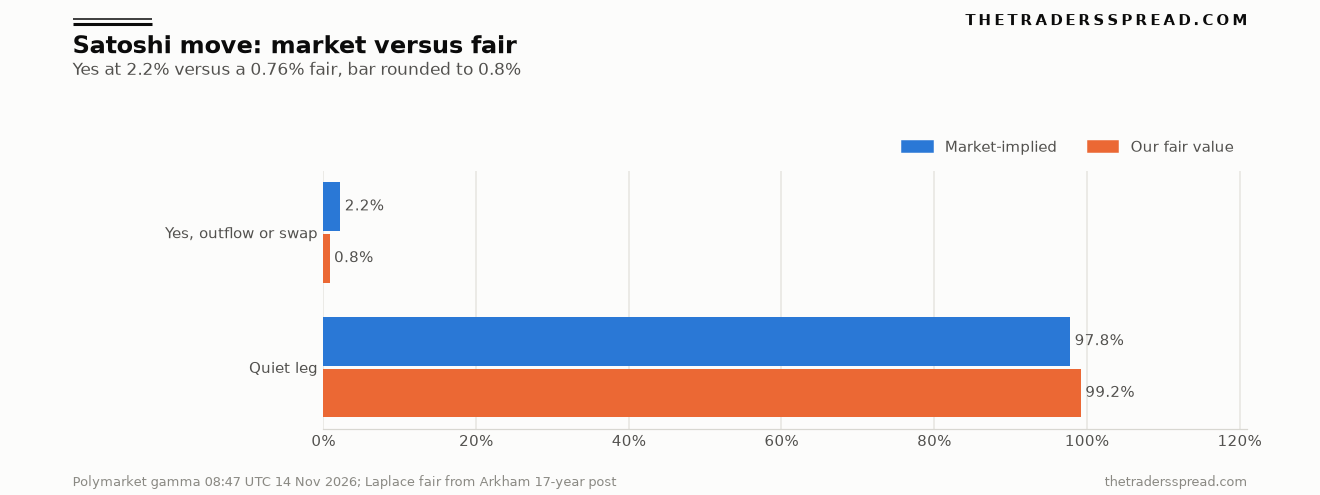
Laplace's rule of succession puts the chance of at least one event over d remaining days at 1 minus ((n+1)/(n+2)) raised to d. With n at 6,268.25 and d at 47.84, that equals 0.760%, the 0.76% fair in the table. A maximum-likelihood rate of zero events would mark the remaining window impossible, so Laplace keeps one hypothetical event in the history and leaves the tail open. The chart draws that fair bar at 0.8% because the labels print a single decimal, and the quiet leg is the complement, 99.2% against a market price of 97.8%.
| Reading | Probability of a qualifying move |
|---|---|
| Live yes, gamma outcome price | 2.20% |
| February hazard, decayed to 14 November | 1.82% |
| 17-year Laplace fair, our figure | 0.76% |
| Rule-of-three upper bound, 3d/n | 2.29% |
| 10 January price, decayed to 14 November | 0.62% |
| Sister contract, Something | 2.35% |
| Laplace using only the open window, set aside | 14.3% |
The rule of three is the other standard bound on a sample with zero events: an approximate 95% ceiling on the daily rate is 3 divided by n, and 3 times 47.84 divided by 6,268.25 equals 2.29%. The traded yes at 2.2% sits almost on that ceiling. The call uses the central Laplace figure of 0.76%, and on that figure the market is above fair by 1.44 points. The 0.09 point distance to the upper bound is the caveat beside the call. A Laplace rate that uses only the 308.6 days of this window, and ignores the 17-year holding statement, comes out at 14.3% and would put the market far under fair. That reading treats 9 January as the first day anyone looked. It stays in the table so the choice is visible, and it is the reading rejected here.
What the extra cent is paying for
The gap between 0.76% and 2.2% has a few contents the long holding period leaves out. The rule pays on any labeled wallet's Outflow or Swap, including a transfer too small to move the rounded 1.096 million total. Khanna's guide says the tags include the known addresses from which Satoshi spent coins in the early years, so a fresh spend from one of those addresses would qualify even while the mining cluster stayed put. The September posts speak about the stack. The contract speaks about the label.
The lawsuit is the other content of the premium. Malwa's 3.8 million BTC target includes coins attributed to Satoshi, and the notice method is a payment into dormant addresses. A sweep answering a notice from inside the Arkham entity would be an Outflow during the window. The 75 BTC spend was identified as defendant 3,419, and the dedicated contract's price barely moved, which reads as the book treating that spend as outside the label. Pricing a later notice, or a labeled key answering the case, at 1.44 points on top of a 0.76 point base rate is a large multiple for a risk this book has already watched in miniature.
Label drift is the third piece of the premium. The contract follows Arkham's labels as they stand when a transfer prints, and the rules keep a fallback if the explorer disappears. An entity edit that adds an active address can produce a yes while the 1,096,361 coins stay where the September post left them. The 0.15 point gap between Something at 2.35% and the move-only yes, on a sister book with a 0.019 spread, is a small allowance for an identity reveal. The deep book is the move book, and the rich price relative to the 17-year rate is a price on the move rule itself.
How a yes would have to be proven
Settlement here is a proposal against the written rule, then a dispute window, which is why the field names matter more than a dormant-coin headline. The mechanism is set out in how a proposal turns into a resolution: someone posts an outcome, bonds it, and a challenger can send the oracle back to the source. This contract's gamma record shows umaBond at 500 and umaReward at 5, and a taker-only fee schedule named crypto_fees_v2 with rate 0.07 and rebate rate 0.2. Those are field values, and the dollar cost of a fill is a schedule reading rather than a percentage invented from 0.07. How the two venues structure fees and settlement is in the Kalshi and Polymarket fee note.
Reading the named source, rather than the nearest famous number, is what separates a clean settlement from a noisy one. CPI contracts miss their own first print when traders watch the wrong release, which is the point of the note on why those markets miss the first print. Here the wrong release is any early-coin transaction the press tags as Satoshi-era. The right release is an Outflow or a Swap on the Arkham entity during the window that started on 9 January. The 85 comments on the event show the argument is already public, and they leave the oracle untouched until a proposal matches that field.
Verdict
The yes on Satoshi moving any labeled bitcoin sits above our fair value. The market price is 2.2% and the central fair is 0.76%, close to a 2.29% rule-of-three ceiling that the call sets aside in favor of the center. A February hazard decayed to 1.82% also sits under the live print. The 75 BTC spend in Malwa's 13 November story showed up as a two-tick round trip, and the contract was still open at 08:47 UTC the next morning.
The fair-value comparison is market analysis for information only, and the contract can move or settle against that reading before the 1 January 2027 end.