

Is a Polymarket weather market pricing the city's high, or the highest routine reading at one airport station named in the rules?
The second question is the one the contract answers. On the event titled "Highest temperature in NYC on November 11?", the rules pulled from the gamma API on the morning of 10 November 2026 name LaGuardia Airport, code KLGA, and the highest hourly temperature remark in any routine METAR for that station on the named date, in tenths of a degree Celsius. The city in the title is a label, not the thermometer. Links to Polymarket are affiliate links, from which The Traders Spread may earn a commission at no cost to you. The worked example is the New York highest-temperature event, still open at 07:02 UTC, with gamma's end timestamp at 2026-11-11T12:00:00Z, event volume of 2,830.97 and liquidity of 41,537.56.
That end timestamp is 07:00 when Eastern Standard Time sits five hours behind UTC, early on the morning the title names. The rules wait for the first METAR of the following local day, or for 11:59 pm Eastern on that following day, whichever comes first. The National Weather Service New York observations page, opened the same morning, lists Central Park (NYC) and Laguardia Airport (LGA) on separate rows, and it publishes a distinct product titled Hourly Central Park Observation. Adding the eleven Yes figures in outcomePrices at 07:02 UTC gives 1.060, or 106.0 cents of Yes, on a ladder that can pay a single range. A sibling New York event for the following date, created at 06:55 UTC that morning, showed volume of zero, a null outcomePrices field, and a bid of 0 against an ask of 1 on every leg.
Updated 10 November 2026, from the gamma event, the contract text, and the Aviation Weather Center feed opened that morning.
Which station does the contract actually read?
The opening sentence of the rules says the market resolves to the temperature range that contains the highest temperature reported at LaGuardia Airport (KLGA) on 11 Nov '26. A Central Park climate report, a Manhattan phone app, or the hourly product NYCOSOOKX is a different instrument. The NWS page groups Central Park with the city's climate products and places Laguardia under local airport observations, next to Kennedy.
The station is a per-contract choice. The Chicago event for the same date, fetched the same morning, begins by naming Chicago O'Hare International Airport, code KORD, and its resolution source is an Aviation Weather Center METAR request for that station. That Chicago event was still open. Same sentence shape, different ICAO identifier.
Four readings do the work, and the table sets each one beside the nearby figure a trader can confuse with it.
| Reading | What the New York rules name | A nearby figure the rules leave aside |
|---|---|---|
| Station | LaGuardia Airport, ICAO KLGA | Central Park (NYC) and Kennedy, listed separately by NWS New York |
| Unit | The T group in the remark, tenths of a degree Celsius, then whole degrees Fahrenheit | The body temperature, whole degrees Celsius, and only when the T group is missing |
| Hour | A routine report whose stamp, in station local time, falls on the named date | Gamma's end timestamp of 2026-11-11T12:00:00Z, and any line that begins SPECI |
| Winner | The bucket that contains the rounded whole-degree Fahrenheit value | The lowest bracket, used only if neither named source has a temperature by the deadline |
The Aviation Weather Center JSON opened that morning named the station "New York/La Guardia Arpt, NY, US," near 40.78 north and 73.88 west, elevation 9. The sensor sits on the airport, and the contract's pick is that site.
Which characters in the METAR are the temperature?
The qualifying value is the highest temperature in the hourly temperature remark of any routine observation. The rules describe that remark as the group beginning with the letter T and then exactly eight digits. The first digit is the sign, 0 for positive and 1 for negative. The next three digits are tenths of a degree Celsius. The last four are the dew point, and the rules set them aside. Their examples are T01390133 for 13.9°C and T10171022 for −1.7°C.
A live line shows the same grammar. At about 07:00 UTC on 10 November 2026, a six-hour raw request for KLGA returned this routine observation. The JSON copy listed receipt time 2026-11-10T06:54:15Z, temperature 11.1 and dew point 1.7:
METAR KLGA 100651Z 31009KT 10SM SCT046 BKN200 11/02 A2998 RMK AO2 SLP152 T01110017 $
T01110017 is a positive sign, 111 tenths and dew point 017, so 11.1°C, matching the parsed field. The body group 11/02 is 11°C. The rules assign that slash group only when the hourly remark is missing, so on this line the T group qualifies. The 0551Z routine an hour earlier carried the same T01110017 plus 10128 and 20111, and the contract still scores only the T group.
A line that begins with SPECI is a special observation, and the text leaves it out. Every other report is routine, including one issued off the nominal hour and one that carries no METAR or SPECI label. The specimen ends in a dollar sign the rules never mention. An observation with no temperature in the T group and none in the body is disregarded.
Which print counts is the same argument in other bucket markets. US CPI markets on Polymarket turn on which release the rules name, and a weather ladder hides the same trap inside one line: two temperatures, one of them qualifying.
How does a Celsius tenth become the Fahrenheit bucket?
Each leg states its range in whole degrees Fahrenheit. The qualifying Celsius value converts by the formula the rules print, °F = °C × 9/5 + 32, and the result rounds to the nearest whole degree. A value ending in exactly half rounds up to the next higher whole degree, toward positive infinity rather than away from zero.
The contract's worked cases are where ladders get expensive. 18.3 × 9/5 is 32.94, plus 32 is 64.94, and the rules count that as 65°F. 17.8°C becomes 64.04°F and counts as 64°F. 19°C becomes 66.2°F and counts as 66°F. Minus 22.5°C is exactly −8.5°F, and the next higher whole degree is −8°F. Rounding half away from zero, or half to even, mis-labels a boundary the text has already defined.
The 10 November line is a format drill, separate from the high that settles 11 November. 11.1 × 9/5 + 32 is 51.98, which rounds to 52°F, and a body reading of 11°C converts to 51.8°F and also rounds to 52. The split shows up in the rules' own 18°C case: a missing T group with a body reading of 18 becomes 64.4°F and rounds to 64, while 18.3°C in the remark counts as 65.
The open New York buckets run 51°F or below, then pairs from 52-53 through 68-69, then 70°F or higher. Under half-up, 63.50°F becomes 64°F and leaves 62-63, while 64.50°F becomes 65°F and stays inside 64-65, so the half-degree decides the payout.
Which hour is allowed to settle the day?
An observation counts when its time stamp, converted to the station's local time, including whatever daylight-saving shift is in effect, falls on the observation date. A routine report at 00:51 local time counts, and a routine report at 23:51 local time counts. A special that catches a spike between those hours stays out when the line begins SPECI.
The market resolves at the first METAR on the day after the observation date, or by 11:59 pm Eastern that following day, whichever comes first, using the observations the source shows for the observation date. If that next-day report is already out, the read is the one taken after it. If it is still unpublished at the deadline, the read is the one taken then. Once the first datapoint of the following date is published, later alterations stay outside.
Gamma's endDate of 2026-11-11T12:00:00Z is the clock a screen is most likely to show. The resolution paragraph is what makes the remark final. How a Fed decision market resolves is the same split in another family: a named document, and a clock easy to confuse with a headline. Here the mistake is treating 12:00 UTC on the title date as the moment the high is known.
How does one reading pick a winner among the buckets?
Once the rounded whole degree exists, exactly one range contains it, and that leg is the winner. The other ten legs are the complement. At 07:02:32 UTC on 10 November 2026 every leg was still open, and none printed a Yes figure of 0 or of 1. The two tails, 51°F or below and 70°F or higher, printed 0.0005. A screen that rounds those to zero would be rounding the feed, while the feed itself still showed an open leg.
| Bucket | Bid | Ask | Yes mid | Last | Volume | Liquidity |
|---|---|---|---|---|---|---|
| 51°F or below | blank | 0.001 | 0.0005 | blank | 95 | 1,522.66 |
| 52-53°F | 0.001 | 0.004 | 0.0025 | blank | 280 | 1,619.54 |
| 54-55°F | 0.002 | 0.025 | 0.0135 | blank | blank | 630.31 |
| 56-57°F | 0.003 | 0.025 | 0.014 | blank | blank | 751.57 |
| 58-59°F | 0.027 | 0.046 | 0.0365 | 0.04 | 238.98 | 673.15 |
| 60-61°F | 0.23 | 0.26 | 0.245 | 0.26 | 1,049.30 | 1,296.68 |
| 62-63°F | 0.50 | 0.55 | 0.525 | 0.55 | 275.96 | 26,358.08 |
| 64-65°F | 0.172 | 0.208 | 0.19 | 0.198 | 656.73 | 805.68 |
| 66-67°F | 0.014 | 0.029 | 0.0215 | blank | 10 | 616.26 |
| 68-69°F | 0.003 | 0.019 | 0.011 | blank | 80 | 963.26 |
| 70°F or higher | blank | 0.001 | 0.0005 | blank | 145 | 2,683.53 |
Where a bid and an ask were both present, the Yes figure was the midpoint. Where the bid was blank the mid sat halfway from zero to the ask, which is how an ask of 0.001 is stored as 0.0005, and those mids sum to 1.060. A column at 106.0 cents is the shape of the quotes, wide spreads included. On 54-55 and 56-57 the ask is 0.025 against a bid of a few tenths of a cent, and that midpoint still enters the sum.
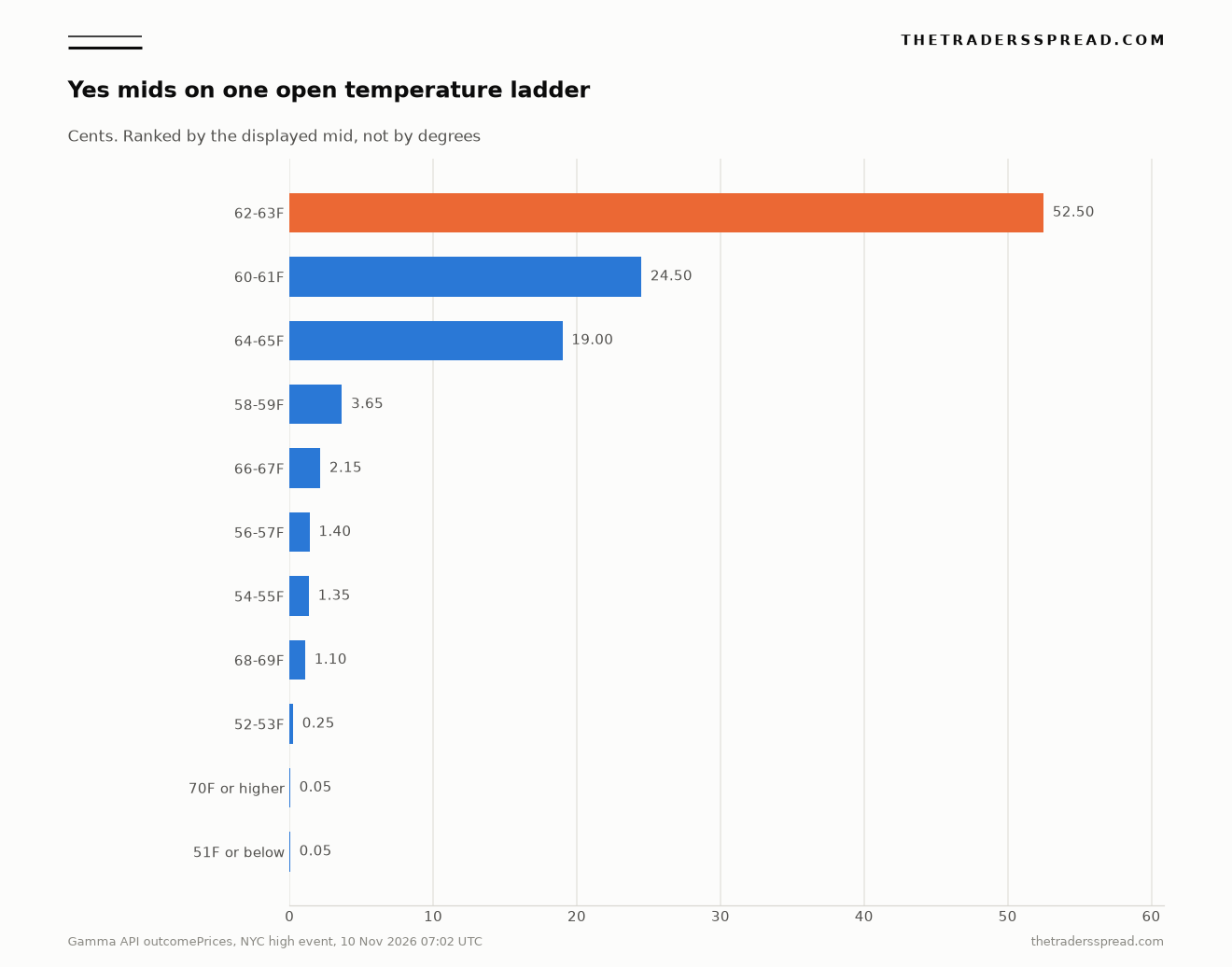
Liquidity and volume refuse to agree. Of the 41,537.56 in event liquidity, 26,358.08 sat on the 62-63°F leg, about 63.5 percent, with a Yes mid of 52.5 cents and the last trade at the 55 cent ask. The largest reported volume was 1,049.30 on 60-61°F. The 54-55 and 56-57 legs returned a null volume field even though both showed a bid, an ask, and liquidity. A 50 cent bid against a 55 cent offer is the spread on the crowded leg.
RelatedHouse Turnout 120 Million Falls 8 Points vs 125 Million
The 62-63°F leg is that crowded quote, taken the day before the observation date, while the ladder was still open. The following day's New York event, created at 06:55 UTC on 10 November, showed no volume, no outcomePrices, and a 0 bid against a 1 ask on each range, and those legs were still active rather than settled.
Public wording drifts from that machinery. On 9 November 2026 the Polymarket account posted a Miami temperature link and called the post a weather forecast.
Miami weather forecast:https://t.co/6lozieciEV
— Polymarket (@Polymarket) November 9, 2026
The post is one line and a link, and the words in it are "Miami weather forecast." The New York contract answers with KLGA and a METAR remark. The polymarket weather market, as written, is a claim about one instrument, one hour, and one integer.
What if the source is empty, late, or plainly wrong?
The rules name the source in a URL: routine KLGA observations from the Aviation Weather Center, ids=KLGA, format=raw, date=2026-11-12T08:00:00Z, hours=30. That date is the morning after the observation date, so the window can cover the local civil day once the next date has begun. Opened on 10 November 2026, while the date parameter was still ahead, the URL returned HTTP 204 and an empty body. A hours=6 request for the same station returned six routine lines, including the 0651Z report, so the feed was up and the URL in the rules was empty because its window had yet to open.
If the Aviation Weather Center has published no routine observation with a temperature by 11:59 pm Eastern on the following day, the Weather Underground Daily Observations table becomes the source. This contract names the table and leaves the URL unstated, so a familiar history link is a guess.
If neither source has a usable temperature by that deadline, the market resolves to the lowest bracket, 51°F or below on this ladder. That is why a tail priced at 0.0005 is still a live leg. The report on screen counts, with or without a COR mark, until the first datapoint of the following date. After that point, further edits stay out.
A clearly erroneous print, from a technical or operational fault or from interference with the source, can leave the market open for up to seven calendar days, Eastern time. If no correction appears, Polymarket issues a clarification on whether the original value can still settle the market. How a proposal and a dispute work is the venue-wide version of that step. The weather text already sets a shorter path, from the named feed to the table and then to the lowest bracket, and a separate path that stays open only when the print is clearly bad.
What is still open once the rules are clear?
The four readings are knowable before the day happens: KLGA, the T group in tenths, the local civil hour, and the bucket around the rounded Fahrenheit integer. What stays open is where that integer lands. On the morning of 10 November the Yes column put the resting size on 62-63°F and the reported volume on 60-61°F, with the whole column at 106.0 cents. A tenth in the remark, or a half that rounds up, can move the bucket, and the next day's ladder showed that a 0 and a 1 can be an unopened book.
Will the highest routine remark at the named station round into the bucket the resting size has crowded, into the neighbour that has traded more, or into a tail the rules reserve for a missing feed?
This is analysis, not a recommendation to trade. Prices on a polymarket weather market can move before the METAR exists, and you can lose money.